

'SHAPING INDUSTRIES WITH THE FINEST STEEL'
'SHAPING INDUSTRIES WITH THE FINEST STEEL'
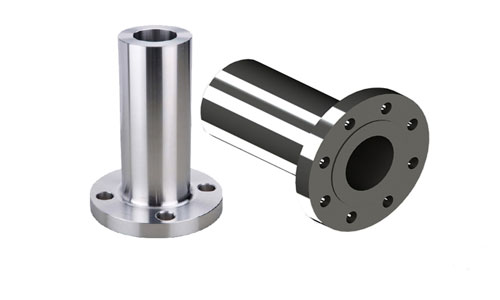
Tesco Steel & Engineering manufactures ASME B16.5 Class 300 long weld neck flanges — the nozzle in one forging: a B16.5 flange ring with an extended straight neck that welds directly into a vessel, column, drum or exchanger shell. Sizes NPS ½–24 (DN 15–600), raised face 2 mm standard with FF or RTJ on request, in standard, heavy barrel and equal barrel neck styles, any length (standard 229 / 305 / 406 mm), bore to nominal size or pipe schedule. This page is the complete reference: the full dimension chart in mm with neck OD, bore, bolt circles, standard lengths and weights, the pressure–temperature table in bar, specifying guidance and every material grade we produce — from A105 and A350 LF2 to SS 316, alloy steel and duplex. ISO 9001:2015 certified, made in Mumbai, India — exported worldwide.
The long weld neck flange is the vessel engineer’s answer to the nozzle question. Instead of fabricating a nozzle from a pipe stub and a weld neck flange — a forging, a pipe piece and two welds — the LWN delivers it as one forging with one shell weld: stronger, more fatigue-resistant, fully traceable, and with fewer welds to examine. Its home is pressure-vessel, column and drum nozzles, heat-exchanger shell and channel connections, boiler and HRSG drums, instrument, level-gauge and thermowell nozzles, reactor and separator inlets — refinery, petrochemical, fertiliser, power and offshore equipment.
Specifying one takes three decisions beyond the B16.5 ring. Neck style: standard (bore = nominal size), heavy barrel (thicker neck giving integral reinforcement per ASME VIII UG-37, no repad) or equal barrel (pipe-schedule bore for butt-welding to pipe). Length H: from the raised face to the neck end — standard 229, 305 or 406 mm, any length to order. End preparation: plain for shell welds, bevelled for butt welds. The chart below carries the B16.5 ring dimensions with the industry-standard neck values, against the lettered figure, with weights.


“Class 300” (also written 300 lb or #300, roughly PN 50) is a pressure–temperature rating class. The LWN is rated as an ASME B16.5 Class 300 flange per Table 2 — while the neck is checked separately as a nozzle under the vessel code:
| Temperature °C | Group 1.1 — A105 / A350 LF2 | Group 2.1 — A182 F304 | Group 2.2 — A182 F316 |
|---|---|---|---|
| −29 to 38 | 51.1 | 49.6 | 49.6 |
| 100 | 46.6 | 42.2 | 43.2 |
| 150 | 45.1 | 38.5 | 39.5 |
| 200 | 43.8 | 35.7 | 36.8 |
| 250 | 41.9 | 33.4 | 34.4 |
| 300 | 39.8 | 31.6 | 32.6 |
| 350 | 37.6 | 30.3 | 31.3 |
| 400 | 34.7 | 29.4 | 30.4 |
| 450 | 28.8 | 28.8 | 29.4 |
Working pressure in bar (gauge) per ASME B16.5-2020 Table 2. Both checks must pass: the flange rating at design temperature, and the neck as a nozzle per ASME VIII UG-37 / UG-45 (or the governing vessel code).
All dimensions in mm; the flange ring per ASME B16.5-2020 Tables 10 and 11, the neck per industry standard. Letters follow the figure: A = flange OD, B = flange thickness (including the 2 mm raised face F), C = neck OD, D = bore (standard = nominal size), E = raised face diameter, G = bolt circle (PCD), H = overall length from raised face to neck end. Prefer it on paper? Download the full Class 300 LWN dimensions datasheet (PDF) — the same chart with the drawing, ratings, neck styles and ordering notes, ready for the workshop.
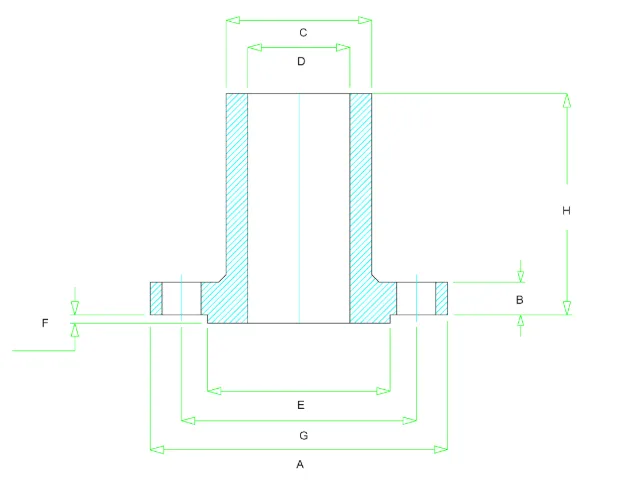
Long Weld Neck Flange Dimension Reference — ANSI / ASME B16.5
| Size in Inch | Size in mm | Flange OD | Thickness | Neck OD | Bore | RF Diameter | PCD | Length (std.) | No. of Studs | Hole Ø | Stud Size | Approx Weight (kg) |
|---|---|---|---|---|---|---|---|---|---|---|---|---|
| A | B | C | D | E | G | H | — | — | — | |||
| 1/2 | 15 | 95 | 14.3 | 38.1 | 12.7 | 35 | 66.7 | 229 | 4 | 15.9 | 1/2 | 2 |
| 3/4 | 20 | 115 | 15.9 | 47.8 | 19.0 | 43 | 82.6 | 229 | 4 | 19.1 | 5/8 | 4 |
| 1 | 25 | 125 | 17.5 | 53.8 | 25.4 | 51 | 88.9 | 229 | 4 | 19.1 | 5/8 | 4 |
| 1 1/4 | 32 | 135 | 19.1 | 63.5 | 31.8 | 64 | 98.4 | 229 | 4 | 19.1 | 5/8 | 6 |
| 1 1/2 | 40 | 155 | 20.7 | 69.8 | 38.1 | 73 | 114.3 | 229 | 4 | 22.2 | 3/4 | 7 |
| 2 | 50 | 165 | 22.4 | 84.1 | 50.8 | 92 | 127.0 | 229 | 8 | 19.1 | 5/8 | 9 |
| 2 1/2 | 65 | 190 | 25.4 | 100.1 | 63.5 | 105 | 149.2 | 229 | 8 | 22.2 | 3/4 | 11 |
| 3 | 80 | 210 | 28.6 | 117.3 | 76.2 | 127 | 168.3 | 229 | 8 | 22.2 | 3/4 | 16 |
| 3 1/2 | 90 | 230 | 30.2 | 133.3 | 88.9 | 140 | 184.2 | 229 | 8 | 22.2 | 3/4 | 19 |
| 4 | 100 | 255 | 31.8 | 146.0 | 101.6 | 157 | 200.0 | 305 | 8 | 22.2 | 3/4 | 28 |
| 5 | 125 | 280 | 35.0 | 177.8 | 127.0 | 186 | 235.0 | 305 | 8 | 22.2 | 3/4 | 38 |
| 6 | 150 | 320 | 36.6 | 206.2 | 152.4 | 216 | 269.9 | 305 | 12 | 22.2 | 3/4 | 48 |
| 8 | 200 | 380 | 41.3 | 260.3 | 203.2 | 270 | 330.2 | 305 | 12 | 25.4 | 7/8 | 67 |
| 10 | 250 | 445 | 47.7 | 320.5 | 254.0 | 324 | 387.4 | 305 | 16 | 28.6 | 1 | 95 |
| 12 | 300 | 520 | 50.8 | 374.6 | 304.8 | 381 | 450.8 | 305 | 16 | 31.8 | 1 1/8 | 125 |
| 14 | 350 | 585 | 54.0 | 425.4 | 355.6 | 413 | 514.4 | 305 | 20 | 31.8 | 1 1/8 | 147 |
| 16 | 400 | 650 | 57.2 | 482.6 | 406.4 | 470 | 571.5 | 305 | 20 | 35.0 | 1 1/4 | 183 |
| 18 | 450 | 710 | 60.4 | 533.4 | 457.2 | 533 | 628.6 | 305 | 24 | 35.0 | 1 1/4 | 211 |
| 20 | 500 | 775 | 63.5 | 587.2 | 508.0 | 584 | 685.8 | 305 | 24 | 35.0 | 1 1/4 | 249 |
| 24 | 600 | 915 | 69.9 | 701.5 | 609.6 | 692 | 812.8 | 305 | 24 | 41.3 | 1 1/2 | 353 |
| Style | Neck & Bore | Use It For |
|---|---|---|
| Standard LWN | Neck OD per chart, bore = nominal size | General vessel & instrument nozzles |
| Heavy Barrel (HB) | Thicker neck, same bore | Integral opening reinforcement per ASME VIII UG-37 — no repad |
| Equal Barrel (E) | Neck bored to pipe schedule | Butt-welding the neck to pipe of the same size & schedule |
Compared with a fabricated nozzle (pipe stub + weld neck flange): one forging and one weld instead of two welds — better fatigue life, fewer examinations, cleaner traceability.
Class 300 LWN flanges are produced in the material families below — each supplied with EN 10204 3.1 mill certificates, heat-number traceability and PMI on request:
| Material Family | Typical Flange Grades | Best suited to |
|---|---|---|
| Carbon Steel | ASTM A105 / A105N (SA-105 for ASME VIII vessels) | General vessel & process nozzles |
| LTCS | ASTM A350 LF2 Cl.1 / Cl.2, LF3; A266 Cl.2 for large necks | Low-temperature service, impact tested |
| Stainless Steel | A182 F304/L, F316/L, F321, F347 | Corrosive process & hygienic service |
| Alloy Steel | A182 F5, F9, F11, F12, F22, F91 | High-temperature boiler & refinery nozzles |
| Duplex / Super Duplex | A182 F51 (2205), F53 (2507), F55 | High strength + chloride resistance, offshore |
| Monel / Inconel / Hastelloy | 400, 600/625, C276 — on request | Severe corrosion & high temperature |
| Copper Nickel | 90/10 (C70600) — on request | Seawater & marine equipment |
| EN / DIN Equivalents | P250GH (1.0460), 1.4301, 1.4401, 1.4404, 1.4571 | European specifications — on request |
LWN flanges are manufactured to order — use the Ask for Quote button or the inquiry form for today’s price and delivery position.
| Pressure Class | Dimension Chart | Approx. A105 Rating @ 38 °C |
|---|---|---|
| Class 150 | Class #150 Long Weld Neck Flange | ≈285 psig |
| Class 300 | Class #300 Long Weld Neck Flange (this page) | ≈740 psig |
| Class 400 | Class #400 Long Weld Neck Flange | ≈990 psig |
| Class 600 | Class #600 Long Weld Neck Flange | ≈1480 psig |
| Class 900 | Class #900 Long Weld Neck Flange | ≈2220 psig |
| Class 1500 | Class #1500 Long Weld Neck Flange | ≈3705 psig |
| Class 2500 | Class #2500 Long Weld Neck Flange | ≈6170 psig |
Related references: Long Weld Neck Flanges overview · LWNRF Flanges · Class 300 Weld Neck Dimensions · All Flange Dimension Charts · Flange Weight Chart.
One forging and one shell weld replace a pipe stub, a weld neck flange and two welds — better fatigue life, fewer examinations, cleaner traceability.
The heavy-barrel neck provides opening reinforcement per ASME VIII UG-37 without a repad — one forging does the nozzle and the compensation.
Any length, any bore, three barrel styles, plain or bevelled ends, nut stops and reliefs — the neck is machined to your nozzle design.
Pressure-vessel, column and drum nozzles, heat-exchanger shell and channel connections, boiler and HRSG drums, instrument, level-gauge and thermowell nozzles, reactor and separator inlets — refinery, petrochemical, fertiliser, power and offshore.
What is a Class 300 long weld neck flange?
A weld neck flange with an extended straight neck that serves as the nozzle itself: the flange ring bolts to the piping and the neck end is welded directly into a vessel, column, drum or exchanger shell. One forging and one weld replace a pipe stub plus a weld neck flange — a stronger, more fatigue-resistant nozzle with full material traceability. The ring is a standard ASME B16.5 Class 300 flange; the neck is made to order.
What are the dimensions of a Class 300 long weld neck flange?
The flange ring — OD, thickness, facing, drilling — is per ASME B16.5-2020 Tables 10 and 11 and is reproduced in the chart above, together with the industry-standard neck OD, bore and length for the standard LWN. A 6 in Class 300 LWN flange, for example, has a 320 mm OD ring, 36.6 mm thick, a 206.2 mm neck OD, a 152.4 mm bore and a standard length of 305 mm, at about 48 kg. Neck dimensions are not part of B16.5 and are made to order.
What pressure can a Class 300 LWN flange handle?
The flange is rated as an ASME B16.5 Class 300 flange: 51.1 bar (roughly 740 psig) at 38 °C for Group 1.1 materials such as A105, derating with temperature — the full bar table is on this page. The neck is designed separately as a nozzle under the vessel code (ASME VIII UG-37 / UG-45), so both checks must pass.
Does ASME B16.5 cover long weld neck flanges?
Only the flange portion — OD, thickness, facing, drilling and pressure rating. Neck OD, bore and length are not standardised; they follow industry convention (the values in our chart) or the vessel drawing, and the neck is designed as a nozzle under the vessel code. That is why every LWN order states the length and bore explicitly.
Standard, heavy barrel or equal barrel — which neck style?
Standard for general nozzles, with the bore equal to the nominal size. Heavy barrel (HB) carries a thicker neck that provides integral opening reinforcement per ASME VIII UG-37, eliminating the repad. Equal barrel (E) has a pipe-schedule bore so the neck can be butt-welded to pipe of the same size and schedule. State the style with the order.
What length should I order?
Standard lengths are 229, 305 and 406 mm (9, 12 and 16 in), and any length can be supplied. Specify the overall length H from the raised face to the neck end — long enough to clear the vessel insulation and give the welder access, which is usually what sets it.
What bore does a standard LWN flange have?
The standard LWN bore equals the nominal size — a 6 in flange has a 152.4 mm bore — which is larger than any pipe-schedule bore. Where the neck must butt-weld to pipe, order the equal-barrel style with the bore matched to the pipe schedule instead.
Long weld neck flange or pipe stub plus weld neck flange?
The LWN wins on integrity: one forging and one shell weld instead of a forging, a pipe piece and two welds. Fewer welds means fewer examinations, better fatigue life and cleaner traceability — which is why vessel codes and critical-service nozzle specifications prefer it, and why the premium over a stub-plus-flange fabrication usually pays for itself in NDE alone.
How is the neck end prepared?
Plain (square cut) as standard, for set-in or set-on nozzle welds to the shell; a 37.5 degree bevel for butt welds on request, and nut stops or reliefs where the nozzle design calls for them. State the end preparation with the order.
Does the thickness in the chart include the raised face?
Yes — for Class 300 the tabulated flange thickness B includes the 2 mm raised face, and the overall length H is measured from the raised face to the neck end. Our charts follow the ASME B16.5 convention on every page.
How much does a Class 300 LWN flange weigh?
From the weight column in our chart: a 2 in weighs about 9 kg, a 6 in about 48 kg and a 24 in about 353 kg at the standard lengths shown. The neck dominates the weight, so a longer or heavy-barrel neck weighs proportionally more; exact weights are confirmed on order.
What materials are available for LWN flanges?
Carbon steel ASTM A105/A105N — supplied as SA-105 for ASME VIII vessels — with A350 LF2/LF3 for low temperature and A266 Cl.2 for large necks. Stainless A182 F304/L, F316/L, F321 and F347, alloy F5-F91, duplex F51 and super duplex F53/F55 — plus Monel, Inconel, Hastelloy and copper-nickel on request. EN equivalents available — all with EN 10204 3.1 mill certificates.
What facing do these flanges come with?
A 2 mm raised face as standard, serrated to 125-250 microinch Ra (3.2-6.3 micrometre); flat face and RTJ are available on request. State the facing with the enquiry.
Which gasket and bolts are used?
Spiral wound gaskets to ASME B16.20 or non-metallic gaskets to B16.21, with stud bolts and heavy hex nuts — A193 B7 / A194 2H for carbon steel, B8M Class 2 for stainless flanges. Counts, hole sizes and stud sizes per flange size are in the chart; each hole is drilled 3 mm larger than its stud.
How are your LWN flanges tested and certified?
Forged from certified bars and billets, normalised, quenched-and-tempered or solution annealed per the material specification. The flange is inspected to ASME B16.5 tolerances and the neck to the drawing; face finish per MSS SP-6, marking per MSS SP-25, UT per ASTM A388 on request. Every batch ships with EN 10204 3.1 certificates; MPI/DPT, PMI, Charpy, HIC/NACE MR0175, IBR, PED and ASME VIII U-stamp vessel documentation on request.
What other names does this flange go by?
ANSI B16.5 300 lb LWN flange, 300# long welding neck, nozzle flange and LWNRF Class 300 all describe the same product, at roughly PN 50 in metric terms. ANSI B16.5 and ASME B16.5 are also the same standard — custodianship moved from ANSI to ASME decades ago but the old name persists on drawings.
Class 300 and Class 600 LWN flange rings look identical in small bore — what differs?
At NPS 1/2 to 3-1/2 the two classes share the same ring OD and bolt circle at every size, so side by side they are hard to tell apart. The differences are the ring thickness, the raised face (2 mm at Class 300, 7 mm at Class 600) and of course the rating — 102.1 against 51.1 bar at 38 °C for A105. Check the marking, not the silhouette.