
Tesco Steel & Engineering manufactures ASTM A182 F22 alloy steel flanges — the 2.25% chromium, 1% molybdenum (2.25Cr-1Mo) chrome-moly forging grade and the most widely used chrome-moly of the family. It combines strong creep strength, elevated-temperature strength and excellent resistance to high-temperature hydrogen attack (per the API 941 Nelson curves), making it the standard for refinery hydroprocessing reactors, boilers and hot hydrogen piping. As a hardenable alloy steel it requires preheat and post-weld heat treatment. Supplied in Class 1 or 3. Available in weld neck, slip-on, blind, socket-weld, threaded, lap-joint, spectacle and orifice types to ASTM A182 / ASME B16.5. Class 150 to 2500, NPS 1/2″ to 24″, PN6 to PN400. ISO 9001:2015 certified. Made in India.
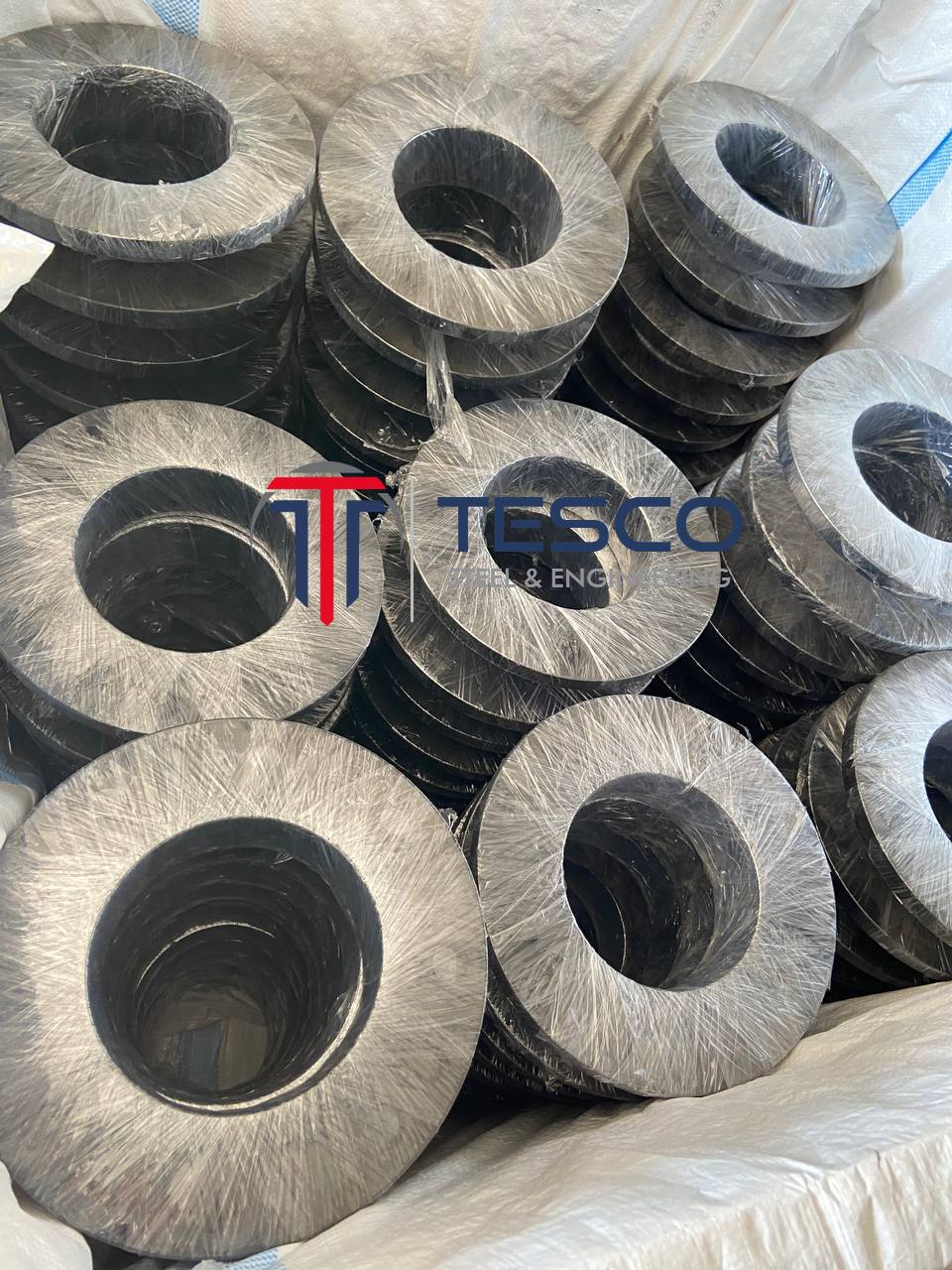
ASTM A182 F22 (2.25Cr-1Mo) Alloy Steel Flanges
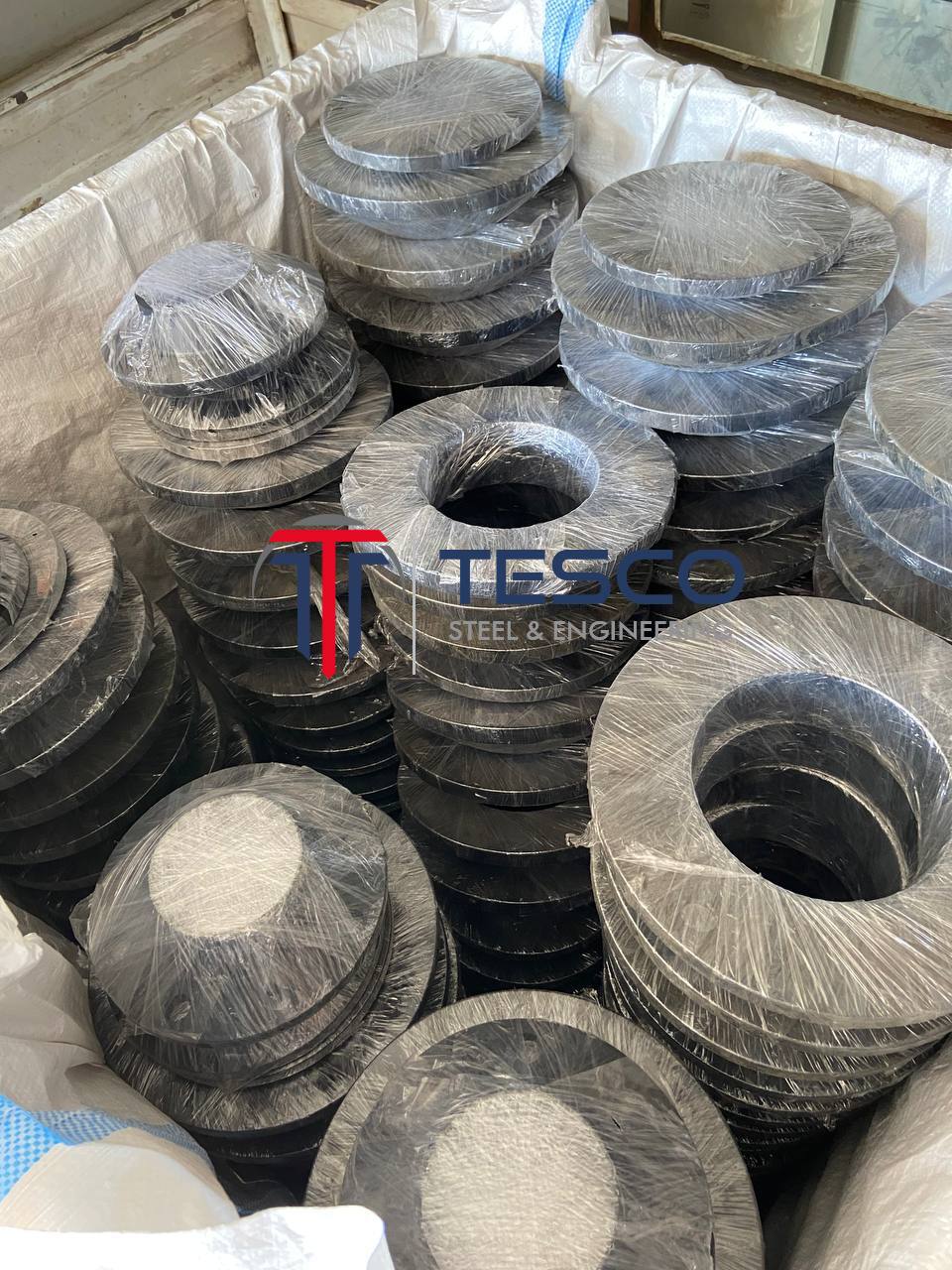
A182 F22 Weld Neck & Blind Flanges
Tesco Steel & Engineering manufactures A182 F22 flanges in all types from weld neck to orifice, Class 150 to 2500 — supplied normalized-and-tempered with EN 10204 3.1 / 3.2 certification, hardness results and third-party inspection on request. Explore the wider alloy steel flange range, the lower-chrome A182 F11 flanges, the neighbouring A182 F21 flanges and higher-chrome A182 F5 flanges, and the flange dimension charts.
| ASTM A182 F22 flanges are available in the following specifications: | |
|---|---|
| Material Grade | ASTM A182 / A182M Grade F22, Class 1 / 3 (2.25Cr-1Mo chromium-molybdenum alloy steel) |
| Alloy Type | Chromium-molybdenum (chrome-moly) hardenable alloy steel |
| Heat Condition | Annealed or normalized and tempered |
| Size | 1/2″ NB to 24″ NB (DN 15 to DN 600); larger to ASME B16.47 |
| Class / Rating | 150#, 300#, 600#, 900#, 1500#, 2500# · 3000#, 6000#, 9000# (socket-weld / threaded) |
| Pressure Ratings | PN 6 – PN 400 (PN6, 10, 16, 25, 40, 64, 100, 160, 250, 320, 400) |
| Related Specs | Pipe ASTM A335 P22; casting ASTM A217 WC9; fittings ASTM A234 WP22; plate A387 Gr22 |
| Dimensional Standards | ASME B16.5, ASME B16.47 (Series A & B), MSS SP-44, DIN EN 1092-1 |
| Flange Types | Weld Neck (WNRF), Slip-On (SORF), Blind, Socket Weld (SWRF), Lap Joint, Threaded / Screwed, Spectacle Blind, Long Weld Neck, Orifice, Plate |
| Flange Faces | Raised Face (RF), Flat Face (FF), Ring Type Joint (RTJ), Tongue & Groove (T&G) |
| Weld Filler | E9018-B3 / ER90S-B3 (matching 2.25Cr-1Mo), with preheat & PWHT |
| Testing | Hardness, hydrostatic, UT, MT/PT per spec; EN 10204 3.1 / 3.2 |
F22 is the 2.25Cr-1Mo member of the A182 chrome-moly family — the most widely used grade. The chromium and molybdenum give the balance of creep strength and high-temperature hydrogen-attack resistance that makes it the hydroprocessing workhorse.
| Element | ASTM A182 F22 |
|---|---|
| Carbon (C) | 0.05 – 0.15% |
| Manganese (Mn) | 0.30 – 0.60% |
| Silicon (Si) | 0.50% max |
| Chromium (Cr) | 2.00 – 2.50% |
| Molybdenum (Mo) | 0.87 – 1.13% |
| Phosphorus (P) | 0.030% max |
| Sulphur (S) | 0.030% max |
| Mechanical Property (Class 3) | ASTM A182 F22 |
|---|---|
| Tensile Strength (min) | 75 ksi (515 MPa) |
| Yield Strength (min) | 45 ksi (310 MPa) |
| Elongation (min) | ~20% |
| Hardness | ≤ 207 HBW (typical) |
| Classes | Class 1 (~60 ksi) · Class 3 (~75 ksi) |
| Service Temperature | Sustained high temperature, ~600–650°C |
| Product Form | 2.25Cr-1Mo Designation |
|---|---|
| Forgings / Flanges | ASTM A182 F22 |
| Seamless Pipe | ASTM A335 P22 |
| Castings | ASTM A217 WC9 |
| Fittings | ASTM A234 WP22 |
| Plate | ASTM A387 Gr 22 |
| Common name | 2.25Cr-1Mo Chrome-Moly Alloy Steel |
F22 Weld Neck Flange (WNRF)
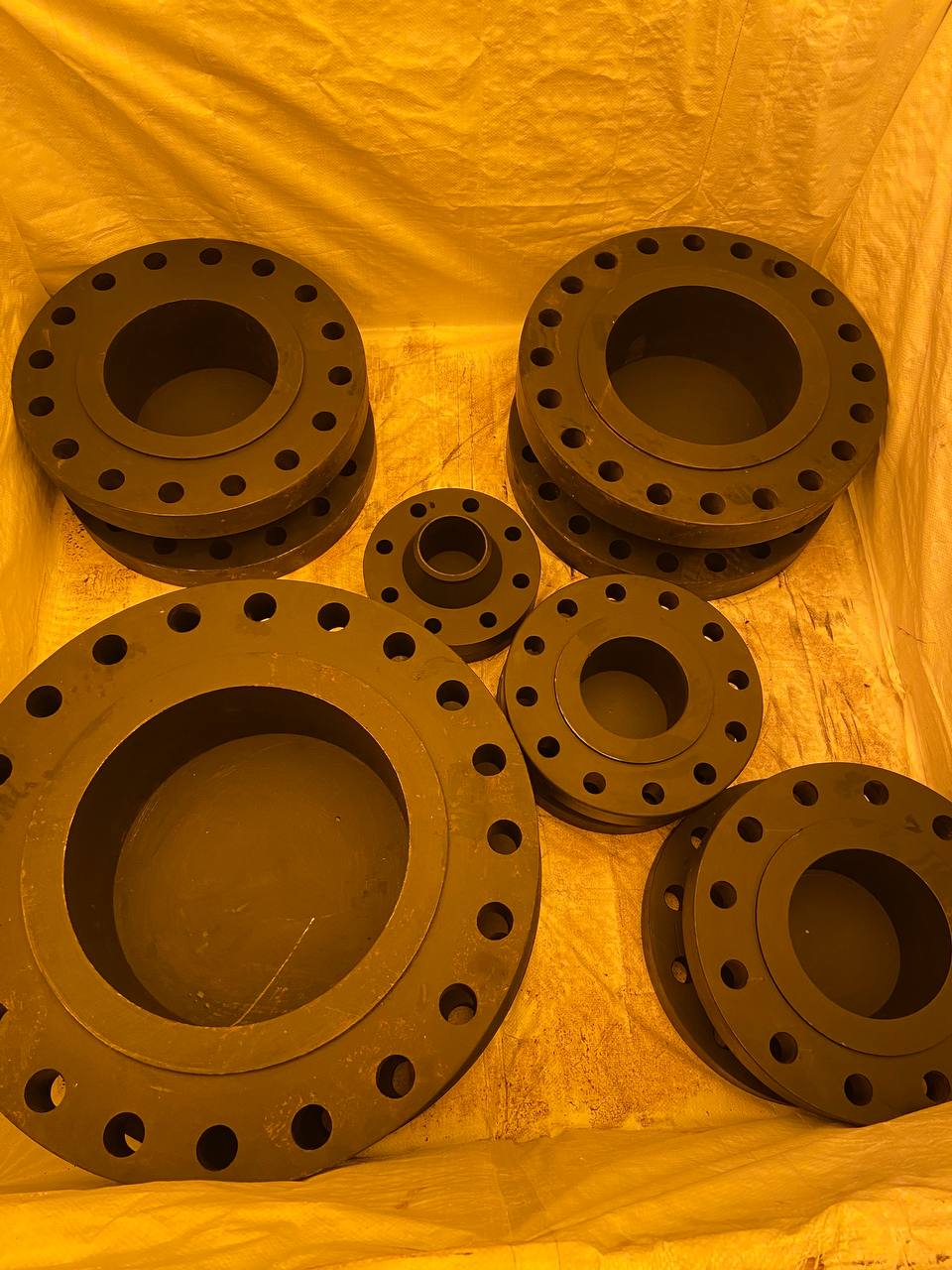
F22 Slip-On Flange (SORF)
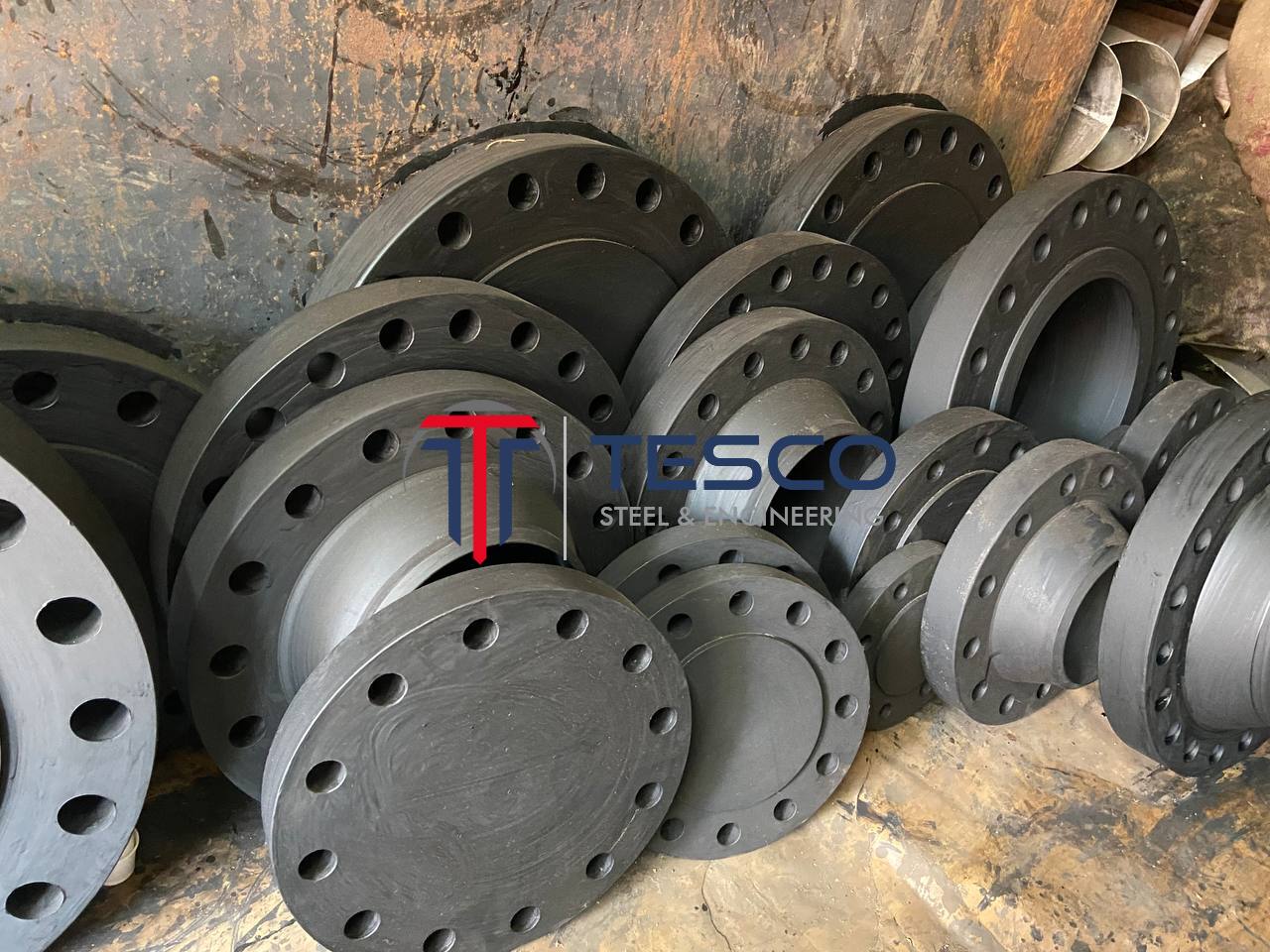
F22 Blind Flange
| Flange Type | Description & F22-Specific Use |
|---|---|
| Weld Neck (WNRF) | Tapered hub butt-welded to pipe for high-integrity, high-pressure hydroprocessing piping; weld with E9018-B3 filler, preheat & PWHT. |
| Slip-On (SORF) | Fillet-welded over the pipe; used in chrome-moly piping at moderate pressure. |
| Blind | Seals pipe ends and vessel nozzles in high-temperature hydrogen and hydrocarbon systems. |
| Socket Weld (SWRF) | Small-bore (1/2″–2″) instrument and branch connections in hot service. |
| Lap Joint (LJRF) | Used with an F22 stub end where frequent dismantling is required. |
| Threaded (TRFF) | Internal NPT/BSP threads for non-welded connections. |
| Spectacle Blind / Long Weld Neck | Isolation spades and nozzle/long-neck flanges in A182 F22 for high-temperature duty. |
| Property | F22 | F11 | F21 | F5 |
|---|---|---|---|---|
| Nominal type | 2.25Cr-1Mo | 1.25Cr-0.5Mo | 3Cr-1Mo | 5Cr-0.5Mo |
| Chromium | ~2.25% | ~1.25% | ~3% | ~5% |
| Hydrogen-attack resistance | Excellent (industry standard) | Moderate | Good | High |
| Availability / popularity | Most common chrome-moly | Common | Specialised | Common |
| Typical role | Hydroprocessing reactors & hot H2 piping | Boiler / moderate temp | Higher-temp hydrogen | Hot refinery sulphur |
The industry-standard chrome-moly for high-temperature hydrogen attack resistance per the API 941 Nelson curves.
Molybdenum gives strong creep resistance for sustained hot service to ~600–650°C.
The most common chrome-moly grade — readily stocked in all types, classes and ratings with matching pipe and fittings.
Backed by matching pipe (A335 P22), castings (A217 WC9), fittings (A234 WP22) and plate (A387 Gr22).
| Industry | Typical Application |
|---|---|
| Oil Refining | Hydrocracker and hydrotreater reactor, exchanger and hot-piping flanges |
| Hydrogen / Hydroprocessing | High-temperature, high-pressure hydrogen-service flanges per API 941 |
| Power Generation | High-temperature boiler, superheater and steam-line flanges |
| Petrochemical | Elevated-temperature hydrocarbon process flanged connections |
| Heaters & Furnaces | Fired-heater and transfer-line flanged connections |
| Process Plant | General high-temperature chrome-moly piping flanges |
Made from certified 2.25Cr-1Mo with PMI verification of chromium and molybdenum — chemistry, class and heat-treatment on the MTC.
Supplied in the specified class, annealed or normalized-and-tempered, with hardness within spec for weldability and hydrogen service.
WNRF, SORF, blind, socket-weld, threaded, lap-joint, spectacle, LWN, orifice and plate — in RF, FF, RTJ and T&G.
EN 10204 3.1 / 3.2 MTC with hardness results, heat/lot traceability, hydrostatic and third-party inspection on request.
A182 F22 flange prices reflect the chrome-moly alloy content plus forging and heat treatment — it is the most widely stocked chrome-moly grade for high-temperature hydrogen and hydroprocessing service. Tesco Steel & Engineering offers competitive ex-works pricing from Mumbai with full export documentation and material traceability. Click Ask for Quote or message us on WhatsApp at +91 92233 66922 with flange type, size (NB), pressure class, quantity and documentation requirements.
Q1. What is an ASTM A182 F22 flange?
An ASTM A182 F22 flange is a forged chromium-molybdenum (chrome-moly) alloy steel flange with about 2.25% chromium and 1% molybdenum (2.25Cr-1Mo). It is the most widely used chrome-moly grade, combining strong creep strength, elevated-temperature strength and resistance to high-temperature hydrogen attack, which makes it the standard material for refinery hydroprocessing reactors, boilers and high-temperature hydrogen piping. Flanges are made to ASTM A182 and machined to ASME B16.5 / B16.47 dimensions.
Q2. What is the chemical composition of ASTM A182 F22?
ASTM A182 F22 nominal composition: carbon 0.05–0.15%, manganese 0.30–0.60%, silicon 0.50% max, chromium 2.00–2.50%, molybdenum 0.87–1.13%, phosphorus 0.030% max, sulphur 0.030% max. The ~2.25% chromium with ~1% molybdenum is the defining 2.25Cr-1Mo chrome-moly composition.
Q3. What are the classes of A182 F22?
ASTM A182 F22 is supplied mainly in Class 1 and Class 3, which share the same chemistry but differ in tempering and strength. Class 1 is the lower-strength condition (tensile ~60 ksi min), and Class 3 is the common higher-strength condition (tensile ~75 ksi min, yield ~45 ksi min). The project specification states which class is required; Class 3 is the most widely used.
Q4. Why is A182 F22 used for hydrogen service?
F22 (2.25Cr-1Mo) has excellent resistance to high-temperature hydrogen attack, with operating limits defined by the API 941 Nelson curves, plus strong creep strength. This makes it the default material for refinery hydroprocessing (hydrocracker and hydrotreater) reactors, exchangers and hot hydrogen piping, where atomic hydrogen would damage lower-alloy steels.
Q5. What is the difference between A182 F22, F11, F21 and F5?
These are chrome-moly alloy steels with increasing chromium: F11 is 1.25Cr-0.5Mo, F22 is 2.25Cr-1Mo, F21 is 3Cr-1Mo, and F5 is 5Cr-0.5Mo. F22 is the most widely used, giving an excellent balance of creep strength and hydrogen-attack resistance for hydroprocessing; F11 is for milder/boiler service, and F21, F5 and F9 step up in chromium for hotter or more sulphidic streams.
Q6. Do A182 F22 flanges need post-weld heat treatment?
Yes. As a hardenable chrome-moly alloy steel, F22 requires preheat (typically around 200–300 degrees C) before welding and post-weld heat treatment (PWHT, a temper around 690–740 degrees C) to relieve stress, temper the heat-affected zone and restore toughness. Matching low-hydrogen consumables (e.g. E9018-B3 / ER90S-B3) and controlled interpass temperature are used.
Q7. What standards apply to A182 F22 flanges?
A182 F22 flanges are forged to ASTM A182/A182M (Grade F22, Class 1/3) and machined to ASME B16.5 (1/2 inch to 24 inch) or ASME B16.47 / MSS SP-44 for larger sizes, with EN 1092-1 for PN-rated flanges. Material is supplied annealed or normalized-and-tempered with EN 10204 3.1 / 3.2 certification. Matching pipe is ASTM A335 P22, casting ASTM A217 WC9, fittings ASTM A234 WP22.
Q8. What are the mechanical properties of A182 F22 Class 3?
Typical ASTM A182 F22 Class 3 properties: tensile strength 75 ksi (515 MPa) minimum, yield strength 45 ksi (310 MPa) minimum, elongation about 20% minimum, hardness generally below 207 HBW. It is supplied in the normalized-and-tempered (or annealed) condition with strong elevated-temperature and creep properties.
Q9. What temperature can A182 F22 flanges handle?
A182 F22 is used for sustained high-temperature service, commonly up to about 600–650 degrees C, with good creep strength and resistance to high-temperature hydrogen attack at elevated hydrogen partial pressures. The exact allowable temperature and pressure follow the applicable code (e.g. ASME B16.5 / B31.3) and API 941 guidance.
Q10. Are A182 F22 flanges supplied with material test certificates?
Yes. Every A182 F22 flange is supplied with EN 10204 3.1 (or 3.2) mill test certificates confirming chemistry, mechanical properties, class, heat-treatment condition and heat/lot traceability, with hardness, hydrostatic testing and third-party inspection on request. Tesco Steel & Engineering is an ISO 9001:2015 certified manufacturer and exporter from Mumbai, India.