
Tesco Steel & Engineering manufactures Hastelloy B2 flanges (UNS N10665 / W.Nr. 2.4617) — the nickel-molybdenum alloy with ~68% Ni and ~28% molybdenum, with very low chromium and iron. B2 is purpose-built for strongly reducing environments and is the benchmark alloy for hydrochloric acid at all concentrations and temperatures, plus hot sulphuric, phosphoric and acetic acids. Available in weld neck, slip-on, blind, socket-weld, threaded, lap-joint, spectacle and orifice types to ASTM B564 / ASME B16.5. Class 150 to 2500, NPS 1/2″ to 24″, PN6 to PN400. ISO 9001:2015 certified. Made in India.
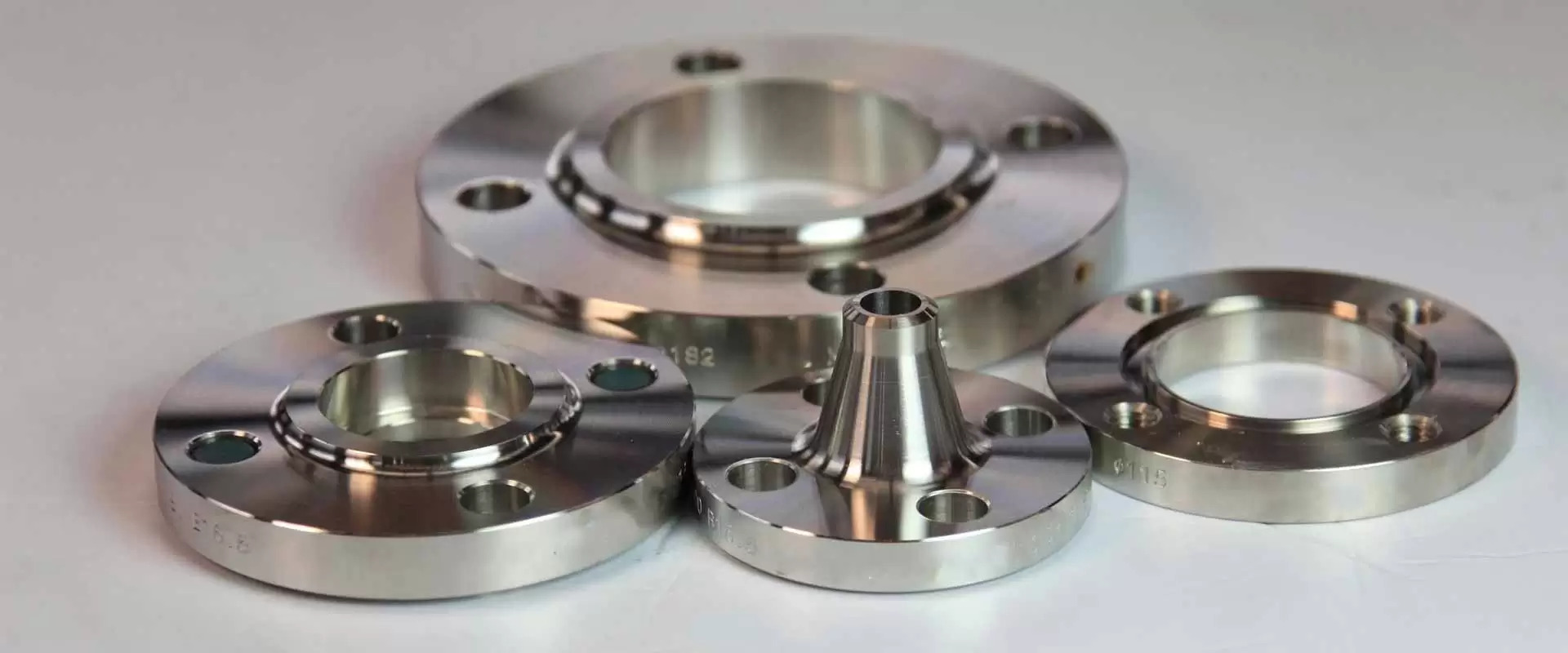
Hastelloy B2 (UNS N10665) Flanges
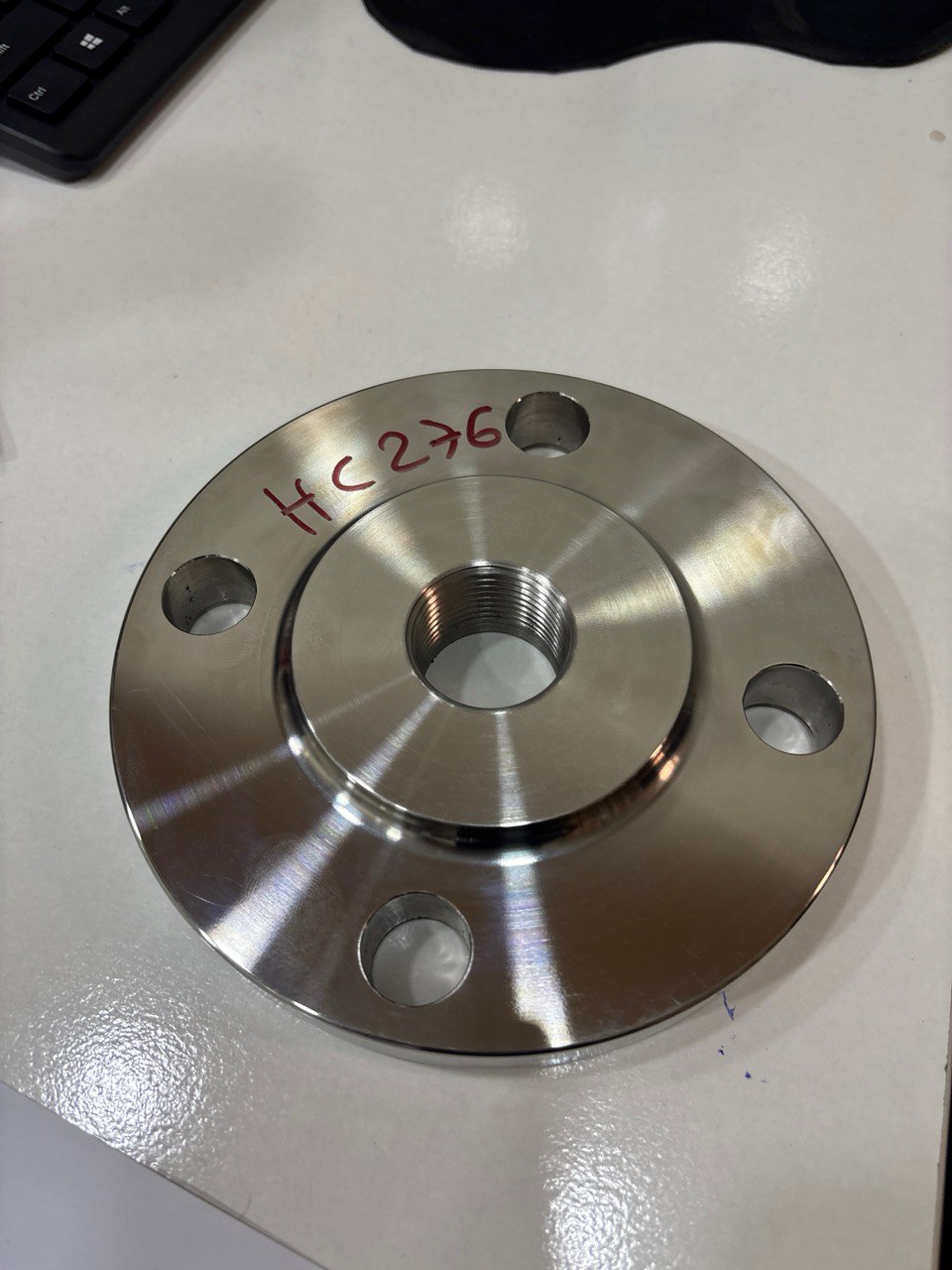
Hastelloy B2 Threaded Flange (Polished)
Tesco Steel & Engineering manufactures B2 flanges in all types from weld neck to orifice, Class 150 to 2500 — supplied with EN 10204 3.1 / 3.2 certification, PMI and third-party inspection on request. Explore the wider Hastelloy flange range, the improved successor Hastelloy B3 flanges, the oxidizing-service Hastelloy C276 flanges, and the flange dimension charts.
| Hastelloy B2 flanges are available in the following specifications: | |
|---|---|
| Material Grade | Hastelloy B2 / UNS N10665 / W.Nr. 2.4617 (NiMo28) |
| Alloy Type | Nickel-molybdenum alloy (Ni-Mo), reducing-acid grade |
| Size | 1/2″ NB to 24″ NB (DN 15 to DN 600); larger to ASME B16.47 |
| Class / Rating | 150#, 300#, 600#, 900#, 1500#, 2500# · 3000#, 6000#, 9000# (socket-weld / threaded) |
| Pressure Ratings | PN 6 – PN 400 (PN6, 10, 16, 25, 40, 64, 100, 160, 250, 320, 400) |
| Material Standards | ASTM B564, ASME SB564; EN designation 2.4617 |
| Dimensional Standards | ASME B16.5, ASME B16.47 (Series A & B), MSS SP-44, DIN EN 1092-1 |
| Flange Types | Weld Neck (WNRF), Slip-On (SORF), Blind, Socket Weld (SWRF), Lap Joint, Threaded / Screwed, Spectacle Blind, Long Weld Neck, Orifice, Plate |
| Flange Faces | Raised Face (RF), Flat Face (FF), Ring Type Joint (RTJ), Tongue & Groove (T&G) |
| Weld Filler | ERNiMo-7 / ENiMo-7 (AWS A5.14 / A5.11) |
| Testing | PMI, hydrostatic, UT, MT/PT per spec; EN 10204 3.1 / 3.2 |
B2's defining feature is its very high molybdenum (~28%) with minimal chromium and iron. The molybdenum delivers unmatched resistance in reducing acids; the absence of chromium is why B2 cannot be used in oxidizing media. Low carbon (0.02% max) helps limit grain-boundary precipitation.
| Element | Hastelloy B2 (UNS N10665) |
|---|---|
| Nickel (Ni) | Balance (~68%) |
| Molybdenum (Mo) | 26.0 – 30.0% |
| Iron (Fe) | 2.0% max |
| Chromium (Cr) | 1.0% max |
| Cobalt (Co) | 1.0% max |
| Manganese (Mn) | 1.0% max |
| Carbon (C) | 0.02% max |
| Silicon (Si) | 0.10% max |
| Mechanical Property (solution annealed, typical) | Hastelloy B2 |
|---|---|
| Tensile Strength | 760 – 840 MPa (110–122 ksi) |
| Yield Strength 0.2% | 350 – 415 MPa (51–60 ksi) |
| Elongation | 40 – 55% |
| Hardness | ≤ 100 HRB |
| Density | 9.22 g/cm³ |
| Melting Range | 1330 – 1380 °C |
| Standard | Hastelloy B2 Designation |
|---|---|
| UNS (USA) | N10665 |
| Werkstoff (Germany) | 2.4617 |
| EN designation | NiMo28 |
| ASTM / ASME | B564 / SB564 (forgings); B333, B335, B619, B622 (other forms) |
| Common names | Hastelloy B-2, Alloy B2, Alloy B-2 |
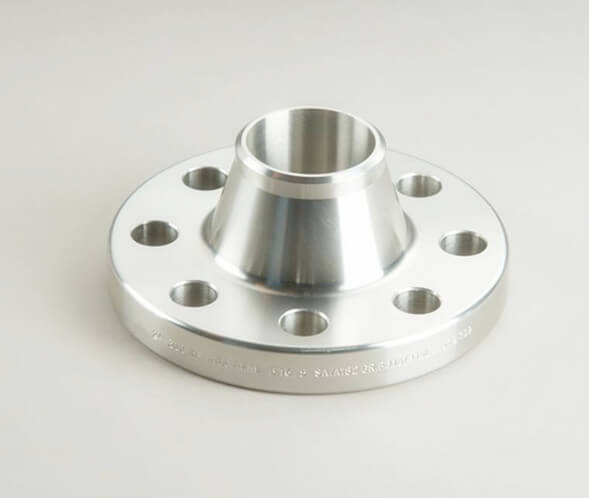
B2 Weld Neck Flange (WNRF)
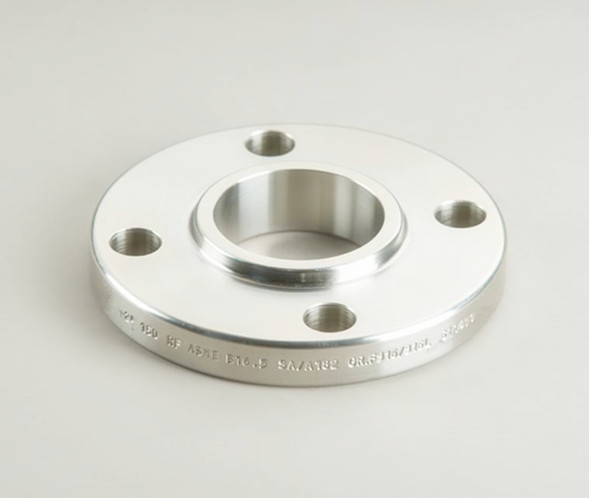
B2 Slip-On Flange (SORF)
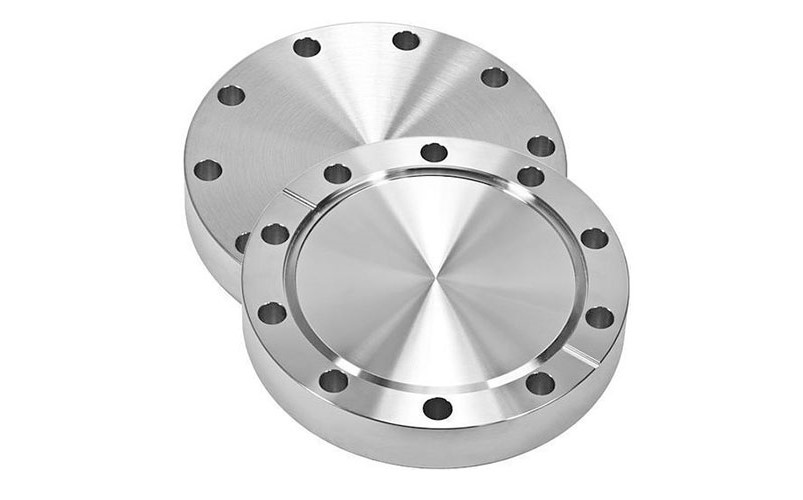
B2 Blind Flange
| Flange Type | Description & B2-Specific Use |
|---|---|
| Weld Neck (WNRF) | Tapered hub butt-welded to pipe for high-integrity HCl and reducing-acid service; weld with ERNiMo-7 filler under controlled heat input. |
| Slip-On (SORF) | Fillet-welded over the pipe; used in hydrochloric and reducing-acid piping at moderate pressure. |
| Blind | Seals pipe ends and vessel nozzles in HCl reactors and acid systems. |
| Socket Weld (SWRF) | Small-bore (1/2″–2″) instrument and branch connections in reducing-acid service. |
| Lap Joint (LJRF) | Used with a B2 stub end where frequent dismantling is required; economizes on alloy in the backing ring. |
| Threaded (TRFF) | Internal NPT/BSP threads for non-welded low-pressure connections. |
| Spectacle Blind / Long Weld Neck / Orifice | Isolation spades, nozzle/long-neck and flow-metering flanges in B2 for HCl and reducing-acid duty. |
| Property | B2 (N10665) | B3 (N10675) | C276 (N10276) |
|---|---|---|---|
| Molybdenum | ~28% | ~28.5% | ~16% |
| Chromium | ~1% (none) | ~1.5% | ~16% |
| Hydrochloric-acid resistance | Excellent | Excellent | Good |
| Oxidizing-media use | Not suitable | Not suitable | Suitable |
| Thermal stability / weldability | Limited | Improved | Excellent |
| Typical role | HCl / reducing acids | HCl, improved fabricability | Reducing & oxidizing workhorse |
~28% Mo with no chromium gives the best HCl resistance of any alloy across all concentrations up to boiling.
Excellent in hot sulphuric, phosphoric, hydrofluoric and organic acids under reducing conditions.
High tensile and yield strength among the corrosion-resistant nickel alloys for robust flanged joints.
Resists chloride-induced stress-corrosion cracking in reducing chloride environments.
| Industry | Typical Application |
|---|---|
| Hydrochloric Acid Plants | HCl production, handling and storage line and equipment flanges |
| Chemical & Petrochemical | Reducing-acid reactor, column and piping flanges |
| Pharmaceutical & Agrochemical | Corrosion-critical reducing-acid process flanged joints |
| Acetic / Organic Acid Plants | Acetic, formic and other organic acid line flanges |
| Sulphuric & Phosphoric Acid | Hot mineral-acid line and equipment flanges in reducing conditions |
| Pickling & Acid Recovery | Hydrochloric pickling and acid-recovery plant flanges |
Made from certified B2 with PMI verification of the ~28% Mo and low Cr/Fe — full chemistry confirmed on the MTC.
Manufactured to ASTM B564 / ASME B16.5 in the solution-annealed condition for full corrosion resistance.
WNRF, SORF, blind, socket-weld, threaded, lap-joint, spectacle, LWN, orifice and plate — in RF, FF, RTJ and T&G.
EN 10204 3.1 / 3.2 MTC, heat/lot traceability, hydrostatic and third-party inspection on request.
B2 flange prices reflect the high nickel and very high molybdenum content plus forging and machining — it is a premium alloy for the most demanding hydrochloric and reducing-acid service. Tesco Steel & Engineering offers competitive ex-works pricing from Mumbai with full export documentation and material traceability. Click Ask for Quote or message us on WhatsApp at +91 92233 66922 with flange type, size (NB), pressure class, quantity and documentation requirements.
Q1. What is a Hastelloy B2 flange?
A Hastelloy B2 flange is a pipe flange made from the nickel-molybdenum alloy UNS N10665 (W.Nr. 2.4617) — about 68% nickel with ~28% molybdenum and very low chromium and iron. B2 is purpose-built for strongly reducing environments and is the benchmark material for hydrochloric acid at all concentrations and temperatures, plus hot sulphuric, phosphoric and acetic acids. Flanges are forged to ASTM B564 and machined to ASME B16.5 / B16.47 dimensions.
Q2. What is the chemical composition of Hastelloy B2?
Hastelloy B2 (UNS N10665) nominal composition: nickel balance (~68%), molybdenum 26–30%, iron 2% max, chromium 1% max, cobalt 1% max, with very low carbon (0.02% max) and silicon (0.10% max). The very high molybdenum with minimal chromium is what makes B2 outstanding in reducing acids — but also why it is not suitable for oxidizing media.
Q3. Why is Hastelloy B2 used for hydrochloric acid?
The ~28% molybdenum content of Hastelloy B2, with almost no chromium, gives it outstanding resistance to hydrochloric acid across all concentrations and up to boiling temperatures — performance no chromium-bearing alloy can match. It also resists hot sulphuric, phosphoric and many organic acids. This makes B2 the default choice for HCl service and other strongly reducing, chloride-free acid environments.
Q4. Can Hastelloy B2 be used in oxidizing media?
No. Hastelloy B2 has very little chromium, so it is not suitable for oxidizing media such as nitric acid, ferric or cupric salts, or aerated/oxidizing chloride solutions, which rapidly attack it. B2 must be reserved for reducing environments. Where oxidizing or mixed oxidizing/reducing conditions occur, a Hastelloy C grade (C276, C22 or C2000) should be used instead.
Q5. What is the difference between Hastelloy B2 and B3?
Both are Ni-Mo alloys (~28% Mo) for reducing acids and HCl. B3 (UNS N10675) is the improved successor: it has much better thermal stability and resistance to the embrittling intermetallic precipitation that can affect B2 during welding or intermediate-temperature exposure, and it has better fabricability. B2 remains widely specified, but B3 is preferred where weldability and thermal stability are critical.
Q6. What standards apply to Hastelloy B2 flanges?
Hastelloy B2 flanges are forged to ASTM B564 (UNS N10665) and machined to ASME B16.5 (1/2 inch to 24 inch) or ASME B16.47 / MSS SP-44 for larger sizes, with EN 1092-1 for PN-rated flanges. The European designation is W.Nr. 2.4617 / NiMo28. Material is supplied with EN 10204 3.1 / 3.2 certification.
Q7. Can Hastelloy B2 flanges be welded?
Yes, B2 can be welded by GTAW (TIG), GMAW and SMAW using matching ERNiMo-7 / ENiMo-7 filler, but care is needed: B2 is prone to intermediate-temperature embrittlement, so heat input and interpass temperature must be tightly controlled, and a solution anneal after welding may be specified for critical service. For easier fabrication, the successor alloy B3 is often preferred.
Q8. What are the mechanical properties of Hastelloy B2?
Typical Hastelloy B2 properties in the solution-annealed condition: tensile strength about 760–840 MPa (110–122 ksi), yield strength about 350–415 MPa (51–60 ksi), elongation about 40–55%, density 9.22 g/cm³. It combines high strength with good ductility in the annealed state.
Q9. What industries use Hastelloy B2 flanges?
Hastelloy B2 flanges are used in hydrochloric acid production and handling, chemical and petrochemical processing involving reducing acids, pharmaceutical and agrochemical plants, acetic and other organic acid plants, and equipment handling hot sulphuric and phosphoric acids — wherever strongly reducing, chloride-free acid service demands the highest molybdenum content.
Q10. Are Hastelloy B2 flanges supplied with material test certificates?
Yes. Every Hastelloy B2 flange is supplied with EN 10204 3.1 (or 3.2) mill test certificates confirming chemistry, mechanical properties and heat/lot traceability, with PMI, hydrostatic testing and third-party inspection on request. Tesco Steel & Engineering is an ISO 9001:2015 certified manufacturer and exporter from Mumbai, India.