Tesco Steel & Engineering manufactures Alloy 20 long weld neck flanges — the acid ladder's dedicated specialist: ASTM B462, UNS N08020, W.Nr. 2.4660, the 20Cb-3 of the trade — with ASME B16.5 flange ends in Classes 150–2500 and the barrel made to order. This is the alloy designed for one acid: against 904L it turns three dials — copper doubled to 3–4%, nickel raised to 32–38%, niobium in at 8×C — and gives back the molybdenum, because sulphuric's aggressive middle concentrations are the mission and chlorides are not. The stabilisation completes the design: supplied stabilize-annealed, so every joint faces the acid as-welded — the 347 lock's logic on the bench where it earns most — at the acid bench's strongest certificate, 551/241 MPa. The ladder stays honest: 904L below for breadth, the Hastelloy bench above for the acids beyond iron, duplex across when the enemy is brine. One forging, one closing weld with ER320LR filler. Facings: RF / FF / RTJ; small bore on the Alloy 20 socketweld. Every lot with EN 10204 3.1/3.2 MTC. ISO 9001:2015, made in Mumbai, India — exported to 50+ countries.
ASTM B462 · UNS N08020 · W.Nr. 2.466020Cb-3 — The Alloy Built for One AcidCu 3–4% Doubled · Ni 32–38%Niobium-Stabilised — As-Welded Safe551 / 241 MPa Stabilize-AnnealedER320LR — The Low-Residual FillerB16.5 Flange Ends · Class 150–2500EN 10204 3.1 / 3.2 · ISO 9001:2015
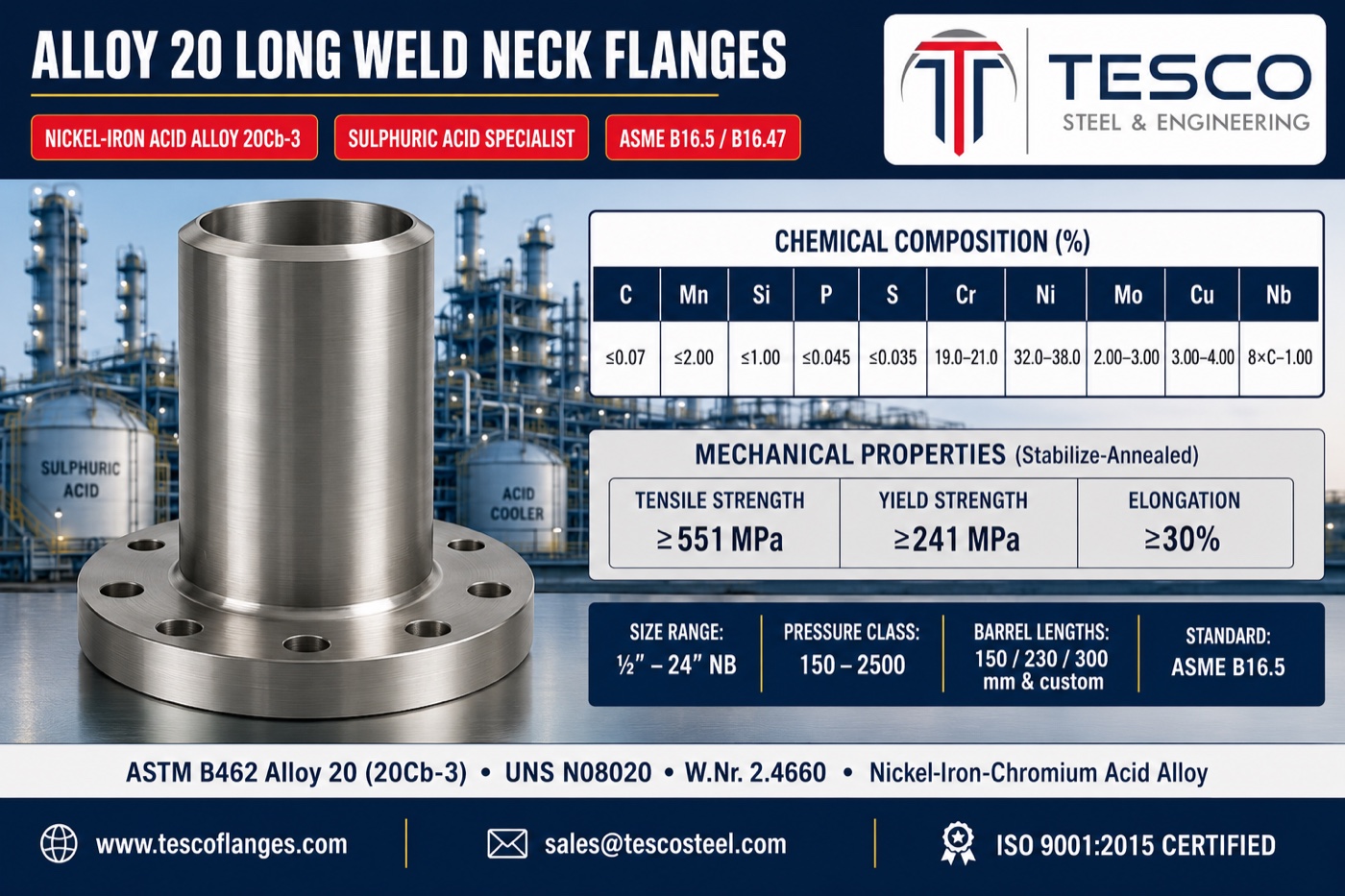
Alloy 20 Long Weld Neck Flanges — Specifications at a Glance
What is an Alloy 20 Long Weld Neck Flange?
The dedicated sulphuric specialist, in the nozzle pattern. An Alloy 20 flange (20Cb-3, UNS N08020, ASTM B462) whose neck continues as a long, heavy-walled straight barrel — the nozzle itself — bevelled for one closing butt weld at the acid-plant column, cooler or shell. Copper 3–4% and nickel 32–38% designed around sulphuric's aggressive middle; niobium at 8×C locking every joint as-welded safe. Supplied stabilize-annealed — 551/241/30, the acid bench's strongest certificate. The acid ladder: 316L → 904L → Alloy 20 → C-276; chlorides go elsewhere — honestly. Flange ends per ASME B16.5, Classes 150–2500; barrel length and bore stated by you. EN 10204 3.1 on every lot.
Also searched as: Alloy 20 LWN flange, 20Cb-3 long weld neck flange, N08020 nozzle flange, Carpenter 20 flange, B462 LWN, sulphuric acid nozzle flange — all the same product. Related pages: the facings — LWNRF / LWNFF / LWNRTJ — the long weld neck hub, the Alloy 20 socketweld on small bore, the acid ladder — F317L / F904L below / Hastelloy bench above — the stabilised cousins — F347 — and the Alloy 20 blind / weld neck siblings.
The rule of the specialist's rung: for named sulphuric service, Alloy 20 is usually the one-line answer — for breadth, 904L; for the acids beyond iron, the nickel bench; and for brine, none of the above: the chloride ladder is a different mountain.
What the 20Cb-3 Recipe Buys
Sulphuric's Middle, Answered by Design
Copper doubled to 3–4% on 32–38% nickel — the electrochemistry built specifically for the hot, reducing middle concentrations that dissolve ordinary stainless by the millimetre.
As-Welded Safe, By Stabilisation
Niobium at 8×C locks the carbon, and the stabilize-anneal ships the carbides already precipitated — fabricate, repair and modify with no post-weld treatment and no intergranular anxiety.
The Acid Bench's Strongest Certificate
551/241 MPa — outrunning 904L and the stainless families, with the stabilisation contributing strength as well as safety.
SCC Beyond Question
At 32–38% nickel the cracking mechanism has no grip at all — the third route of the 904L page, taken further than any chloride service will ever test.
Specification Notes — Getting Alloy 20 Long Weld Necks Right
Three honest notes.The franchise is acid, not brine: molybdenum is the dial Alloy 20 turned down — chloride pitting questions go to the duplex and super duplex rungs, and buying N08020 for seawater is nickel money spent on the wrong mountain. The standard is B462, not A182: Alloy 20 is formally a nickel alloy — write ASTM B462 on the order line and expect the alloy market's lead times behind it. And name the acid fully: type, concentration, temperature and impurities decide between 904L's breadth, this page's depth and the Hastelloy bench above.
How Our Alloy 20 LWN Flanges Are Manufactured
1
Forging — each piece individually forged from certified N08020 heats kept segregated on the alloy shelf, with the barrel integral — no welded build-ups.
2
Stabilize-annealing — the grade's own condition: the cycle that deliberately precipitates the niobium carbides in their finished, harmless form before the alloy ships; records retained against the heat number.
3
Verification — chemistry per heat with the 8×C stabilisation arithmetic and the copper addition certified; mechanicals per heat at the 551/241 line.
4
Machining — flange end to ASME B16.5; barrel turned to pattern (standard / HB / equal) and bored to the ordered schedule or drawing; RF serrations, flat face or RTJ groove per B16.20; weld end bevelled 37.5°.
5
Testing & marking — PMI reads the nickel, copper and niobium lines on every piece — Alloy 20 can mix with neither the stainless shelf nor its acid-bench neighbours; marked with grade, size, schedule and heat number.
6
Certification & packing — EN 10204 3.1 MTC with stabilize-anneal records (3.2 witnessed on request); WPS guidance naming the ER320LR low-residual filler; faces and bevels protected, packed sea-worthy.
Where Alloy 20 LWN Flanges Are Used
Where the acid is named: sulphuric acid plants end to end — absorption towers, acid coolers, dilution trains, storage and loading circuits — steel-mill and metal-finishing pickling systems, phosphoric and mixed-acid chemical process where the sulphuric component governs, pharmaceutical and fine-chemical acid duty, and the column nozzles, cooler connections and instrument standpipes that ride on all of them. Large connections, modest pressures, the acid as the load — and every nozzle one forging with one closing weld. Production and supply below:
Long Weld Necks — Machined at Our WorksLong Weld Neck — Heavy Barrel, Bevelled Weld EndDN600 RF Long Weld Neck — Large Diameter, B16.5 Drilling
Alloy 20 LWN Flange Dimensions
Flange-end dimensions are class-governed per ASME B16.5 (ratings per the N08020 material group); barrel length and bore per order. Full class-by-class charts:
Seven elements — the acid's four numbers confirm the specialist's rung:
1
Size & standard — e.g. 8″ NB ASME B16.5.
2
Pressure class & facing — 150#–2500#; RF, FF or RTJ with ring number.
3
Barrel length — overall, face to weld end: 150 / 230 / 300 mm stock or any stated length.
4
Barrel bore & pattern — pipe schedule to match or finished bore in mm; standard, heavy barrel or equal barrel; weld-end prep if non-standard.
5
Grade line & service — ASTM B462 Alloy 20 (UNS N08020) — the B-series standard, not A182; the acid stated fully: type, concentration, temperature, impurities — they confirm the rung against 904L below and the Hastelloy bench above.
6
Certification — EN 10204 3.1 with stabilize-anneal records (our standard) / 3.2 witnessed.
Example: “LWN Flange RF, 6″ NB, ASME B16.5 Class 150, barrel 230 mm, Sch 40S bore, standard pattern, ASTM B462 Alloy 20, sulphuric dilution train nozzles — 60% H2SO4 at 70 °C, EN 10204 3.1 — 8 pcs.” Quotations normally within 24 hours with price, unit weight and delivery.
Alloy 20 LWN Flanges — Frequently Asked Questions
What is an Alloy 20 long weld neck flange?
An Alloy 20 long weld neck flange is a forged nickel-iron-chromium acid alloy flange — UNS N08020, W.Nr. 2.4660, the 20Cb-3 of the trade, supplied to ASTM B462 — whose neck continues as a long, heavy-walled straight barrel that is itself the nozzle, bevelled at its far end for one closing butt weld made out at the acid-plant column, cooler or vessel shell. Alloy 20 is the acid ladder's dedicated specialist: 3.00-4.00% copper and 32.0-38.0% nickel designed specifically around sulphuric acid's aggressive middle concentrations, with niobium stabilisation at eight times carbon making every joint as-welded safe. Flange ends follow ASME B16.5 in Classes 150 to 2500; the barrel is machined to the ordered length and bore. Supplied stabilize-annealed with records at the acid bench's strongest certificate, 551/241 MPa.
How does a long weld neck differ from a standard weld neck flange?
Geometry and mission. A standard weld neck's hub tapers quickly down to the pipe's outside diameter and wall, ending in a weld bevel a few centimetres from the flange face — it is built to butt-weld to pipe and continue as a piping run. A long weld neck keeps a full-section straight barrel for its entire length: no taper to pipe dimensions, wall far heavier than the matching schedule, length made to order. The mission follows the shape — the LWN is not a fitting on a pipe run but a nozzle in its own right, projecting through insulation, vessel walls or exchanger channels, with the butt weld relocated to the shell side where the fabricator wants it. In one certified forging it replaces the weld neck flange, the pipe nipple and one whole circumferential weld.
Why was Alloy 20 designed — the alloy built for one acid?
Because sulphuric acid's middle concentrations were once metallurgy's most expensive unsolved problem. Dilute sulphuric can be lived with, and concentrated sulphuric passivates plain steel — but the broad middle band, hot, is reducing chemistry at its most destructive, dissolving ordinary stainless at rates measured in millimetres per year. Alloy 20 was designed in the 1940s as the direct answer: copper doubled beyond 904L's later addition, nickel raised to 32-38% to carry the copper's electrochemistry and put stress corrosion cracking beyond reach, chromium held near 20% for the oxidising side of mixed duties. The result became the acid industry's house alloy — so identified with its purpose that 'Alloy 20 service' means sulphuric acid service in plant shorthand. Everything about the grade, from its chemistry to its stabilisation, reads as a design brief for one acid answered completely.
Alloy 20 or 904L — the acid-bench decision?
The specialist against the generalist, one rung apart. Against 904L, Alloy 20 turns three dials: copper up from 1-2% to 3-4% — deeper sulphuric capability across wider concentration and temperature windows; nickel up from 23-28% to 32-38% — SCC immunity beyond question and the electrochemistry to support the copper; and niobium in — the stabilising lock that makes heavy fabrication and repair welding carefree. What it gives back is molybdenum, down from 4-5% to 2-3%: chlorides are not this alloy's franchise. The practical split: where sulphuric is the named service — acid plants, dilution trains, pickling circuits — Alloy 20 is the grade the industry writes; where the duty mixes acids with chlorides, or spreads across broader chemistry, 904L's balance serves wider. Both benches are stocked at our works, and the acid's four numbers — type, concentration, temperature, impurities — decide in one line.
What does the niobium do — the stabilised acid alloy?
The same lock the site's 347 page describes, applied where it matters doubly. Niobium at a minimum of eight times the carbon content claims the carbon as harmless niobium carbide, so welding and hot work can never sensitise the grain boundaries — and on an acid alloy that protection is existential, because the acids Alloy 20 lives in are precisely the chemistry that finds sensitised boundaries fastest. The supply condition completes the design: stabilize-annealing (rather than a plain solution anneal) deliberately precipitates the niobium carbides in their finished, harmless form before the alloy ever ships, so nothing remains in solution for a fabricator's torch to mobilise. The consequence for purchasers is simple: Alloy 20 welds, repairs and modifies as-welded, with no post-weld treatment and no intergranular anxiety — a stabilised grade in the fullest sense, on the bench where it earns the most.
What is the chemical composition of Alloy 20 (UNS N08020)?
Carbon ≤0.07%, manganese ≤2.00%, silicon ≤1.00%, phosphorus ≤0.045%, sulphur ≤0.035%, chromium 19.0-21.0%, nickel 32.0-38.0%, molybdenum 2.00-3.00%, copper 3.00-4.00%, and niobium (columbium in the American tradition — the Cb of 20Cb-3) at a minimum of eight times carbon, up to 1.00%. Every column serves the design brief: the big nickel carries the structure and the copper's electrochemistry, the doubled copper buys the sulphuric franchise, chromium holds the oxidising side, the modest molybdenum assists without pretending to a chloride mission, and the niobium locks the carbon for as-welded safety. Chemistry is verified per heat, PMI-confirmed with the nickel, copper and niobium lines read, and travels on the EN 10204 3.1 MTC.
What are the mechanical properties of Alloy 20 long weld neck flanges?
Stabilize-annealed: tensile strength 551 MPa (80 ksi) minimum, yield strength 241 MPa (35 ksi) minimum, elongation 30% minimum — the strongest certificate on the austenitic corrosion bench, outrunning both 904L's 490/215 and the stainless families' standard numbers. The condition word matters: stabilize-annealed is not solution annealed — the cycle finishes with the niobium carbides deliberately precipitated, which both completes the intergranular protection and contributes the certificate's extra strength. In nozzle practice the numbers work as everywhere on the bench: class-governed flange geometry, ratings per the alloy's B16.5 group, generous elongation for forging and field welding, hardness low with nothing to manage. The two-ceilings honesty stands: what the alloy sells is the acid franchise, and the gasket system retires before the metal does.
What is the ASTM B462 specification family?
The first grade on this site's LWN bench to leave A182 behind — because A182 is a steel forging specification, and Alloy 20 is formally a nickel alloy. Its product standards run in the B-series family: ASTM B462 (and ASME SB-462) for forged flanges, fittings and parts — the specification our LWN forgings certify to — with B463 covering plate, B464 welded pipe, B473 bar and B475 wire, all sharing the N08020 chemistry. Nothing changes at the flange end: dimensions, drilling and facings still follow ASME B16.5, and pressure-temperature ratings come from B16.5's own material group for N08020. For purchasers the practical note is simply to write the right standard on the order — 'ASTM B462 Alloy 20' — and to expect the alloy world's supply chain behind it, as the quotation FAQ explains.
What is Alloy 20 NOT for — the chloride honesty?
Brine. The molybdenum that buys chloride pitting resistance is exactly the dial Alloy 20 turned down: at 2-3% its PREN sits in the modest twenties, below 317L, far below the duplex rungs — so seawater, hot brines and chloride-concentrating duties are not this alloy's mission, and specifying it there buys an expensive nickel alloy to do a job a cheaper grade does better. The distinction that saves confusion: against chloride stress corrosion cracking Alloy 20 is effectively immune — the 32-38% nickel sees to that, exactly as on the 904L page — but pitting and crevice attack in chloride media follow the molybdenum, and the molybdenum is modest. Chloride questions go to the chloride ladder: duplex and the super duplex twins for brine and strength, 254 SMO for the austenitic route. Alloy 20's franchise is acid — and inside it, the franchise is nearly absolute.
How is the closing weld on an Alloy 20 LWN made?
With stainless-like ease and the acid bench's care points. No preheat beyond dryness, no PWHT — the stabilisation makes post-weld treatment unnecessary by design. The consumable of record is ER320LR — the low-residual Alloy 20 filler developed precisely because the alloy's fully austenitic weld metal runs the family's hot-cracking sensitivity: the LR grade's tightened phosphorus, sulphur and silicon exist to close that window, and procedures support it with low heat input, controlled bead shapes and modest interpass temperatures. The base metal's heat-affected zone is the stabilised design's showcase — niobium holds the carbon through the weld cycle, so the joint faces the acid as-welded with clean boundaries. The closing weld at the column or shell inherits the plant's own qualified procedure, and WPS guidance travels with every supply, filler class stated.
How are the barrel length and bore of a LWN specified?
Two numbers that belong on every enquiry. Length: measured overall from the flange face to the weld end — 150 mm (6"), 230 mm (9") and 300 mm (12") are the common stock lengths, and any length machines to order; state it explicitly, because 'long' is not a dimension. Bore: the barrel is drilled and bored to order — most commonly to match the inside diameter of the connecting pipe schedule, sometimes cylindrical special bores for level bridles, instrument standpipes or restriction work; state the schedule or the finished bore in millimetres. Add the weld-end preparation (standard 37.5° bevel unless told otherwise) and the nozzle is fully defined.
When does Alloy 20 hand off — along the acid ladder or across?
Down by breadth: where the acid duty is real but general — mixed chemistry, moderate concentrations, chloride-contaminated streams — 904L's balanced recipe serves wider at a friendlier price, and below it the 316L/317L rungs carry the wet-chemistry floor. Up by severity: when sulphuric runs hotter and stronger than even Alloy 20's window, or hydrochloric and the reducing acids beyond iron's reach enter, the nickel bench takes over — C-276 and its Hastelloy siblings, with their own pages on this site. Across by enemy: brine and seawater go to the duplex family and the super duplex twins, as the chloride-honesty FAQ explains. The rule stays the acid ladder's: state the acid, concentration, temperature and impurities — for named sulphuric service Alloy 20 is usually the one-line answer, and the quotation confirms the rung either way.
What sizes and pressure classes do Alloy 20 LWN flanges come in?
Flange ends follow ASME B16.5 from ½" to 24" NB in Classes 150, 300, 400, 600, 900, 1500 and 2500 — with the full class-by-class LWN dimension charts on this site — and larger diameters forge to order against B16.47 or drawing dimensions, with EN 1092-1 drilling machined on the same barrels. The order book mirrors the habitat: sulphuric plant columns, coolers, dilution and loading systems concentrate in Classes 150 and 300 — large connections, modest pressures, the acid as the load — with pickling circuits and pressure-bearing chemical process reaching higher. State size, class, barrel length and bore together — the four numbers define the forging — and our quotation returns price, unit weight and delivery per class, with the nickel-alloy supply-chain honesty stated up front.
What details are needed to get an accurate Alloy 20 LWN flange quotation?
Seven elements plus commercial terms: (1) size and dimensional standard — e.g. 8" NB ASME B16.5; (2) pressure class — 150 to 2500; (3) facing — RF (the default), FF or RTJ with ring number; (4) barrel length overall, face to weld end — 150/230/300 mm stock or any stated length; (5) barrel bore — pipe schedule to be matched or finished bore in millimetres, with pattern (standard, heavy barrel, equal barrel) and weld-end prep if non-standard; (6) the grade line — ASTM B462 Alloy 20, UNS N08020 — with the acid stated fully (type, concentration, temperature, impurities) so the specialist's rung is confirmed against 904L below and the Hastelloy bench above; (7) certification — EN 10204 3.1 with stabilize-anneal records (our standard) or 3.2 witnessed. Add quantity and destination; quotations normally within 24 hours, with the alloy-market lead time quoted honestly.
Who manufactures Alloy 20 long weld neck flanges in India?
Tesco Steel & Engineering is an ISO 9001:2015 certified flange manufacturer based in Mumbai, India, producing Alloy 20 (20Cb-3) long weld neck flanges to ASTM B462 with B16.5 flange ends from ½" to 24" NB (larger to order) in Classes 150-2500, in standard, heavy-barrel and equal-barrel patterns — each forged individually from certified N08020 heats kept segregated on the alloy shelf, stabilize-annealed with records retained, machined with the barrel bored to the ordered schedule or drawing, bevelled for the closing weld, PMI-checked with the nickel, copper and niobium lines read on every piece, and marked with grade, size, schedule and heat number. Supplied with EN 10204 3.1/3.2 certification and WPS guidance naming the ER320LR filler — alongside the 904L rung below, the Hastelloy bench above, and the complete long weld neck range. Exported to more than 50 countries.