

'SHAPING INDUSTRIES WITH THE FINEST STEEL'
'SHAPING INDUSTRIES WITH THE FINEST STEEL'
Tesco Steel & Engineering manufactures ASME B16.5 Class 400 blind flanges — the solid, removable closure that bolts to any flange of the same class and size: line ends, vessel and exchanger nozzles, hydrotest and isolation. Sizes NPS ½–24 (DN 15–600), raised face 7 mm standard with FF or RTJ on request, plain or with threaded / socket-weld tapping. This page is the complete reference: the full dimension chart in mm with bolt circles, bolting and weights, the pressure–temperature table in bar, installation practice and every material grade we produce — from A105 and A350 LF2 to SS 316, alloy steel and duplex. ISO 9001:2015 certified, made in Mumbai, India — exported worldwide.
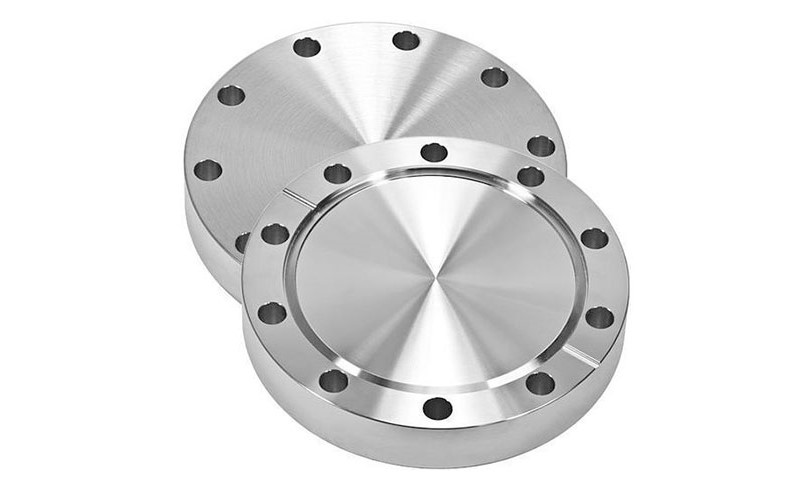
The blind flange is the piping system’s full stop — and its question mark. A solid disc with the standard drilling, it bolts to any B16.5 flange of the same class and size, closes the line at full rating, and comes off again when the line is extended, inspected, cleaned or tested. That removability is the whole point: line ends and future tie-ins, vessel, exchanger and manway nozzles, spare pump and compressor nozzles, hydrotest and isolation blinds, and tapped blinds carrying a vent, drain or gauge connection. No welding is involved — the blind is the one flange type installed entirely with a spanner.
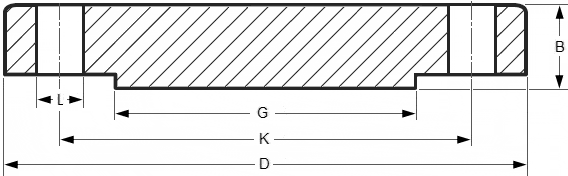
Mechanically it works harder than any other flange: the unsupported centre carries full line pressure as a flat plate, which is why ASME B16.5 blinds are generous forgings — and why the weights in our chart climb so quickly with size. Installation is simple but disciplined: match class, size and facing to the mating flange, use a new gasket, tighten in a cross pattern in at least three steps, and on large blinds specify jack-screw holes for break-out and a tapped vent for safe depressurising. NPS 1/2 to 3-1/2 Class 400 flanges are furnished to the Class 600 dimensions per ASME B16.5. The chart below carries every dimension against the lettered figure, with weights.

“Class 400” (also written 400 lb or #400, roughly PN 64) is a pressure–temperature rating class, not a working pressure. ASME B16.5 Table 2 gives the maximum allowable working pressure at each temperature for each material group — here in bar for the groups we ship most:
| Temperature °C | Group 1.1 — A105 / A350 LF2 | Group 2.1 — A182 F304 | Group 2.2 — A182 F316 |
|---|---|---|---|
| −29 to 38 | 68.1 | 66.2 | 66.2 |
| 100 | 62.1 | 56.3 | 57.6 |
| 150 | 60.1 | 51.3 | 52.7 |
| 200 | 58.4 | 47.6 | 49.0 |
| 250 | 55.9 | 44.5 | 45.9 |
| 300 | 53.1 | 42.2 | 43.5 |
| 350 | 50.1 | 40.4 | 41.7 |
| 400 | 46.3 | 39.2 | 40.6 |
| 450 | 38.4 | 38.4 | 39.2 |
Working pressure in bar (gauge) per ASME B16.5-2020 Table 2. The solid centre is rated for full class pressure; confirm bolting and gasket for the same duty, and always check the rating at your design temperature — including hydrotest pressure where the blind serves as the test closure.
All dimensions in mm per ASME B16.5-2020 Tables 12 and 13. Letters follow the figure: D = flange outside diameter, B = flange thickness (excluding the 7 mm raised face), G = raised face diameter, K = bolt circle (PCD), L = bolt hole diameter. Prefer it on paper? Download the full Class 400 blind flange dimensions datasheet (PDF) — the same chart with the drawing, ratings, installation practice and ordering notes, ready for the workshop.
Blind Flange Dimension Reference — ANSI / ASME B16.5
| Size in Inch | Size in mm | Flange OD | Thickness | RF Diameter | PCD | No. of Studs | Hole Ø | Stud Size | Approx Weight (kg) |
|---|---|---|---|---|---|---|---|---|---|
| D | B | G | K | — | L | — | |||
| 1/2 | 15 | 95 | 14.3 | 35 | 66.7 | 4 | 15.9 | 1/2 | 1.5 |
| 3/4 | 20 | 115 | 15.9 | 43 | 82.6 | 4 | 19.0 | 5/8 | 1.5 |
| 1 | 25 | 125 | 17.5 | 51 | 88.9 | 4 | 19.0 | 5/8 | 1.8 |
| 1 1/4 | 32 | 135 | 20.7 | 64 | 98.4 | 4 | 19.0 | 5/8 | 2.3 |
| 1 1/2 | 40 | 155 | 22.3 | 73 | 114.3 | 4 | 22.2 | 3/4 | 3.7 |
| 2 | 50 | 165 | 25.4 | 92 | 127.0 | 8 | 19.0 | 5/8 | 4.6 |
| 2 1/2 | 65 | 190 | 28.6 | 105 | 149.2 | 8 | 22.2 | 3/4 | 6.8 |
| 3 | 80 | 210 | 31.8 | 127 | 168.3 | 8 | 22.2 | 3/4 | 9.1 |
| 3 1/2 | 90 | 230 | 35.0 | 140 | 184.2 | 8 | 25.4 | 7/8 | 13.2 |
| 4 | 100 | 255 | 35.0 | 157 | 200.0 | 8 | 25.4 | 7/8 | 15 |
| 5 | 125 | 280 | 38.1 | 186 | 235.0 | 8 | 25.4 | 7/8 | 20 |
| 6 | 150 | 320 | 41.3 | 216 | 269.9 | 12 | 25.4 | 7/8 | 28 |
| 8 | 200 | 380 | 47.7 | 270 | 330.0 | 12 | 28.6 | 1 | 46 |
| 10 | 250 | 445 | 54.0 | 324 | 387.4 | 16 | 31.8 | 1 1/8 | 71 |
| 12 | 300 | 520 | 57.2 | 381 | 450.8 | 16 | 34.9 | 1 1/4 | 102 |
| 14 | 350 | 585 | 60.4 | 413 | 514.4 | 20 | 34.9 | 1 1/4 | 132 |
| 16 | 400 | 650 | 63.5 | 470 | 571.5 | 20 | 38.1 | 1 3/8 | 168 |
| 18 | 450 | 710 | 66.7 | 533 | 628.6 | 24 | 38.1 | 1 3/8 | 207 |
| 20 | 500 | 775 | 69.9 | 584 | 685.8 | 24 | 41.3 | 1 1/2 | 266 |
| 24 | 600 | 915 | 76.2 | 692 | 812.8 | 24 | 47.6 | 1 3/4 | 405 |
| Closure | How It Works | Character |
|---|---|---|
| Blind Flange (this page) | Bolts to the end flange | Removable, reusable, full class rating |
| Spectacle / Spade Blind | Inserted between two flanges (ASME B16.48) | Positive isolation of a live line without dismantling |
| Pipe Cap (B16.9) | Butt-welded to the pipe end | Permanent closure — no reopening without cutting |
Class 400 blind flanges are produced in the material families below — each supplied with EN 10204 3.1 mill certificates, heat-number traceability and PMI on request:
| Material Family | Typical Flange Grades | Best suited to |
|---|---|---|
| Carbon Steel | ASTM A105 / A105N | General process & utility closures |
| LTCS | ASTM A350 LF2 Cl.1 / Cl.2, LF3 | Low-temperature service, impact tested |
| Stainless Steel | A182 F304/L, F316/L, F321, F347 | Corrosive process service |
| Alloy Steel | A182 F5, F9, F11, F12, F22, F91 | High-temperature steam & refinery service |
| Duplex / Super Duplex | A182 F51 (2205), F53 (2507), F55 | High strength + chloride resistance, offshore |
| Monel / Inconel / Hastelloy | 400, 600/625, C276 — on request | Severe corrosion & high temperature |
| Copper Nickel | 90/10 (C70600) — on request | Seawater & marine piping |
| EN / DIN Equivalents | P250GH (1.0460), 1.4301, 1.4401, 1.4404, 1.4571 | European specifications — on request |
Use the Ask for Quote button or the inquiry form for today’s price and delivery position.
| Pressure Class | Dimension Chart | Approx. A105 Rating @ 38 °C |
|---|---|---|
| Class 150 | Class #150 Blind Flange | ≈285 psig |
| Class 300 | Class #300 Blind Flange | ≈740 psig |
| Class 400 | Class #400 Blind Flange (this page) | ≈990 psig |
| Class 600 | Class #600 Blind Flange | ≈1480 psig |
| Class 900 | Class #900 Blind Flange | ≈2220 psig |
| Class 1500 | Class #1500 Blind Flange | ≈3705 psig |
| Class 2500 | Class #2500 Blind Flange | ≈6170 psig |
Related references: Blind Flanges overview · Spectacle Blinds · Class 400 Blind Flange (product page) · All Flange Dimension Charts · Flange Weight Chart.
Bolts on and off with hand tools, seals at the full class rating, and goes back into stores when the line is extended — the closure that keeps options open.
OD, drilling and thickness match every other B16.5 flange of the class and size, so a blind in stores closes any joint in the plant of that rating.
Vent, drain, gauge or injection connections machined into the solid disc turn a closure into a working end-of-line fitting.
Line ends and future tie-ins, vessel, exchanger and manway nozzles, spare pump and compressor nozzles, hydrotest and isolation blinds, instrument and sample connections — refinery, petrochemical, power, water and offshore.
What is a Class 400 blind flange?
A solid forged disc with the standard Class 400 drilling and facing but no bore — also called a blank flange. It bolts to any B16.5 flange of the same class, size and facing to close the end of a pipe, valve or vessel nozzle, and comes off again for inspection, cleaning, extension or hydrotest. Because it carries full line pressure on its unsupported centre, it is the most highly stressed of the B16.5 flange types.
What are the dimensions of a Class 400 blind flange?
They are tabulated in ASME B16.5-2020 Tables 12 and 13 and reproduced in full in the chart above: for each of the twenty sizes, the flange OD, thickness, raised face diameter, bolt circle and bolting — all in millimetres — plus the approximate weight. A 6 in Class 400 blind flange, for example, is 320 mm OD and 41.3 mm thick (plus the 7 mm face) on a 269.9 mm bolt circle with twelve 7/8 in studs, at about 28 kg.
What pressure can a Class 400 blind flange handle?
The rating depends on material and temperature. For Group 1.1 materials such as A105 carbon steel, ASME B16.5 allows 68.1 bar (roughly 990 psig) at 38 °C, derating with temperature — the full bar table for carbon and stainless groups is on this page. The solid centre is rated for the full class pressure; always confirm the rating at your design temperature.
Is a blind flange the same thickness as a weld neck flange?
Yes — ASME B16.5 gives one thickness per class and size for all flange types, so the blind in this chart matches the weld neck, slip-on and socket weld of the same class and size. The OD, bolt circle and bolting match too: any B16.5 flange of one class and size bolts to any other.
Can a blind flange be drilled and tapped?
Yes — tapped blinds with an NPT or socket-weld connection are common for vents, drains, gauges and chemical injection; specify the connection size and type with the order. The tapping reduces the flange rating only if it exceeds the reinforcement limits of B16.5 and B31.3, which a single small-bore tap in a thick blind rarely does.
How should a blind flange be installed?
Match class, size and facing to the mating flange, fit a new gasket of the same type, and tighten the studs in a cross pattern in at least three steps. Large blinds benefit from jack-screw holes for break-out and a tapped vent so the line can be depressurised safely before the joint is opened — both available on request.
Blind flange or spectacle blind — which do I need?
A blind flange closes the end of a line; a spectacle or spade blind (ASME B16.48) slips between two existing flanges to positively isolate a live line without dismantling it. For a permanent closure, a welded pipe cap (B16.9) is the third option. End of line: blind flange. Isolation inside a run: spectacle blind.
Can a blind flange be used for hydrotest?
It is the standard hydrotest closure — bolted on, tested against, removed. Confirm the blind's class rating covers the test pressure (typically 1.5 times design), use fresh gaskets, and fit a tapped vent and drain so filling and depressurising are controlled. We supply test blinds tapped to order.
Does the thickness in the chart include the raised face?
No — at Class 400 and above the raised face is 7 mm, and the tabulated thickness B excludes it. That is the reverse of the Class 150 and 300 convention, where the 2 mm face is included in the thickness — worth checking whenever you compare charts from different sources.
How much does a Class 400 blind flange weigh?
From the weight column in our chart: a 2 in weighs about 4.6 kg, a 6 in about 28 kg, a 12 in about 102 kg and a 24 in about 405 kg. Blinds are the heaviest flange type per size — a solid disc, not a ring — and the weights are approximate for carbon steel, solid and untapped.
What materials are available for blind flanges?
Carbon steel ASTM A105/A105N is the usual choice, with A350 LF2/LF3 for low temperature. Stainless A182 F304/L, F316/L, F321 and F347, alloy steel F5/F9/F11/F12/F22/F91 for high-temperature service, duplex F51 and super duplex F53/F55 — plus Monel 400, Inconel 600/625, Hastelloy C276 and copper-nickel 90/10 on request. EN equivalents such as P250GH, 1.4301 and 1.4404 are available — all with EN 10204 3.1 mill certificates.
What facing do these flanges come with?
A 7 mm raised face as standard, serrated to 125-250 microinch Ra (3.2-6.3 micrometre); flat face and RTJ are available on request. The facing must match the mating flange — state it with the enquiry.
Which gasket and bolts are used?
Spiral wound gaskets to ASME B16.20 or non-metallic gaskets to B16.21 on RF and FF joints, ring gaskets on RTJ, with stud bolts and heavy hex nuts — A193 B7 / A194 2H for carbon steel, B8M Class 2 for stainless flanges. Counts, hole sizes and stud sizes per flange size are in the chart; each hole is drilled 3 mm larger than its stud.
How are your blind flanges tested and certified?
Forged from certified bars and billets, normalised, quenched-and-tempered or solution annealed per the material specification. Dimensional inspection follows ASME B16.5 tolerances, face finish per MSS SP-6 and marking per MSS SP-25; UT of forgings is available for NPS 12 and above. Every batch ships with EN 10204 3.1 mill test certificates traceable by heat number; MPI/DPT, PMI, NACE MR0175, IBR and PED compliance and 3.2 endorsement are available on request.
What other names does this flange go by?
ANSI B16.5 400 lb blind flange, 400# blank flange, BLRF Class 400 and blind raised face flange all describe the same product, at roughly PN 64 in metric terms. ANSI B16.5 and ASME B16.5 are also the same standard — custodianship moved from ANSI to ASME decades ago but the old name persists on drawings.
Why do the small Class 400 sizes share dimensions with Class 600?
ASME B16.5 does not tabulate separate Class 400 flanges below NPS 4 — demand is too small — so NPS 1/2 to 3-1/2 Class 400 blinds are furnished to the Class 600 dimensions. They carry the full Class 600 geometry and are marked accordingly; the chart above already shows those values.