ASTM A182 F316L Slip On Flanges — Low Carbon SS 316L Manufacturer
Tesco Steel & Engineering forges ASTM A182 F316L slip on flanges — the low-carbon (0.030% max) version of stainless steel 316 that pairs molybdenum-bearing chloride resistance with sensitization-proof weldability — to ASME B16.5 Class 150–2500 from ½″ to 24″ NB, larger patterns to order. A slip-on is a welded flange by definition, and 316L is the welded chloride-service default: the pharmaceutical reference grade of ASME BPE, the metal of coastal process lines and CIP-cycled hygienic systems, serviceable to cryogenic temperatures. Supplied solution annealed, commonly dual-certified 316/316L, with 316, 316H and 304L from the same forge. Ready stock in common sizes; every lot with EN 10204 3.1/3.2 MTC. ISO 9001:2015, made in Mumbai, India — exported to 50+ countries.
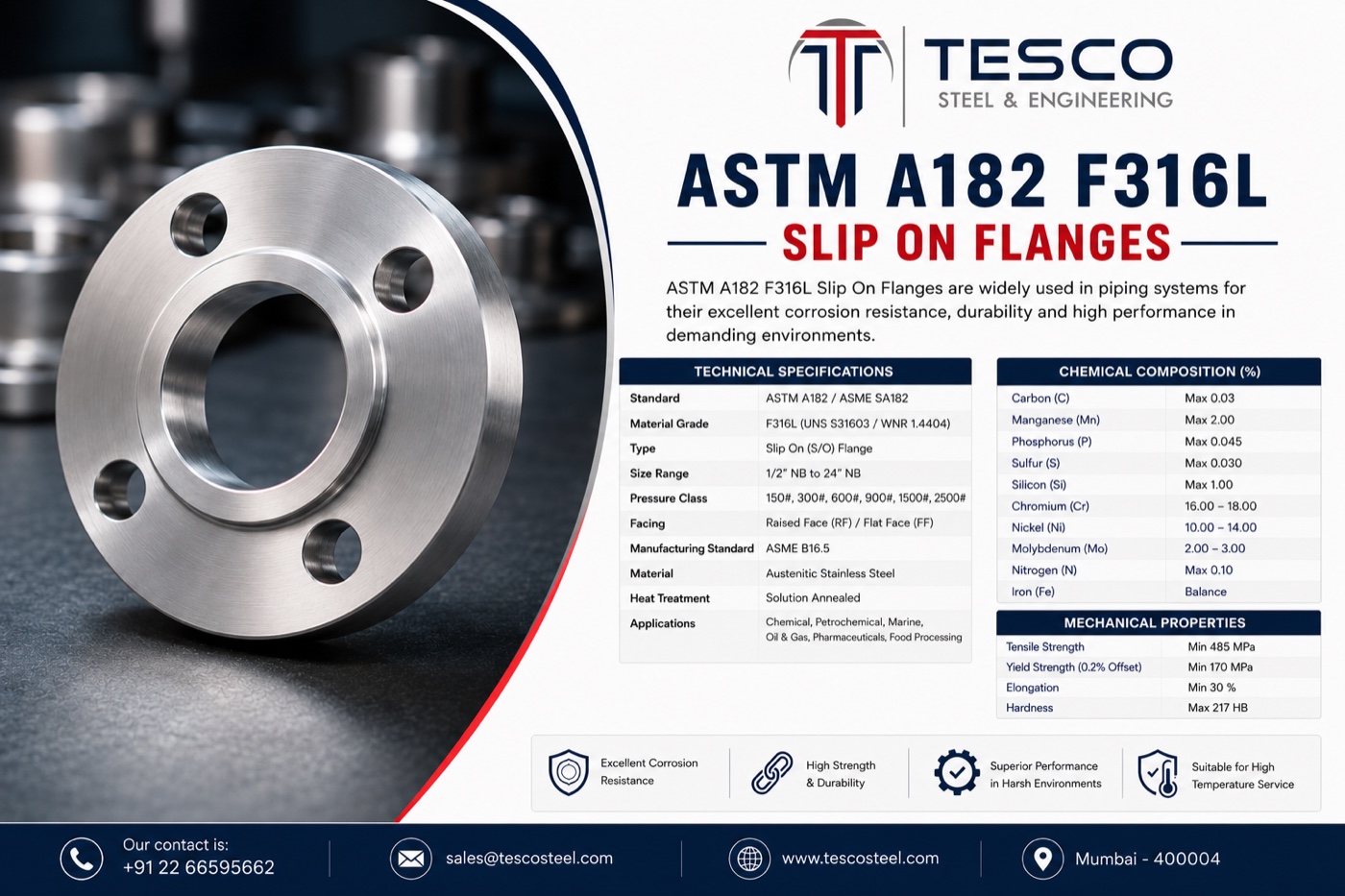
ASTM A182 F316L · SA182 · S31603C ≤ 0.030% + 2–3% Mo · 1.4404ASME B16.5 Class 150–2500½″ – 24″ NB · SORFPharma / ASME BPE Reference GradeReady Stock · Dual 316/316LEN 10204 3.1 / 3.2 · ISO 9001:2015
ASTM A182 F316L Slip On Flange — Specifications at a Glance
What is an ASTM A182 F316L Slip On Flange?
F316L = 316's corrosion resistance, built for welding.ASTM A182 F316L (UNS S31603) caps carbon at 0.030%, starving the sensitization reaction that can strip chromium from weld heat-affected zones — while keeping the 2–3% molybdenum that resists chloride pitting. Since a slip-on is secured by two fillet welds, 316L is its natural chloride-duty specification: weld with E316L and walk away. The reference grade of pharma (ASME BPE) and welded coastal process piping; cryogenic-capable, no preheat, no PWHT.
Also searched as: SS 316L slip on flange, 316L SORF flange, low carbon 316 slip on flange, SA182 F316L slip on flange, SUS 316L flange, 1.4404 slip on flange, S31603 slip on flange — all refer to the product on this page.
Rule of thumb: within the 316 family the selector is carbon — L for welded corrosive duty, standard for general service, H for creep-range heat. Across families the selector is chloride exposure, stepping up through duplex, 904L and 6-moly.
ASTM A182 F316L (UNS S31603) Chemical Composition
C
Mn
Si
P
S
Cr
Ni
Mo
N
Fe
0.030 max
2.00 max
1.00 max
0.045 max
0.030 max
16.0-18.0
10.0-14.0
2.00-3.00
0.10 max
Bal
Values in weight % for UNS S31603. It is 316's recipe with the carbon removed — the molybdenum that resists chloride pitting stays, the sensitization risk goes. The 0.030% carbon cap is the grade.
ASTM A182 F316L Mechanical Properties
Tensile Strength, MPa (ksi)
Yield Strength, Min, MPa (ksi)
Elongation % min (2")
Hardness, HB max
485 (70) min
170 (25) min
30
217
Slightly below standard 316's 515/205 MPa — carbon is a strengthener, and removing it costs a little. In Class 150/300 general service the difference is rarely felt, and dual-certified 316/316L heats meet the higher minimums anyway. Values demonstrated per heat on the EN 10204 certificate.
A182 F316L Slip On Flange Specifications
ASTM A182 F316L Slip On Flanges are available in the following specifications:
1/2"NB to 24"NB per ASME B16.5; larger patterns and EN 1092-1 stainless flanges to order
Class
150#, 300#, 400#, 600#, 900#, 1500#, 2500#
Facing
Raised Face (SORF) — default; Flat Face or RTJ where the piping class specifies
Heat Treatment
Solution annealed per ASTM A182, thermal record retained
Temperature Range
Cryogenic (no impact transition) to ~425 °C working practice; hotter: F316 / F316H
Installation
Two fillet welds (hub + bore), pipe set back 1/8"; E316L/ER316L consumables, no preheat, no PWHT
Ready Stock
Class 150 & 300 common sizes (dual 316/316L) — typically quick dispatch
Certification
EN 10204 3.1 (standard) / 3.2 witnessed; intergranular corrosion testing on request
Equivalent Grades of ASTM A182 F316L
Standard
Werkstoff Nr.
UNS
JIS
BS
EN
SS 316L
1.4404 / 1.4435
S31603
SUS 316L
316S11
X2CrNiMo17-12-2
ASME SA182 F316L is the boiler-code twin. System partners: ASTM A312 TP316L pipe and A403 WP316L fittings — the welded-316 trio. Certificates always state the actual grade forged, including dual 316/316L where the heat qualifies.
Why A182 F316L Slip Ons Are Specified
Weld It and Walk Away
No sensitization means no post-weld anneal and no intergranular corrosion risk along the fillet welds — on a flange type that is welded by definition.
The Molybdenum Margin, Weldable
316's chloride pitting resistance carried into every weld zone — coastal lines, brines and CIP chemistry with no weak seams.
The Pharma Reference Metal
ASME BPE clean systems are written around 316L — orbital-welded, electropolished, CIP/SIP-cycled — and our pickled, solution-annealed flanges fit straight in.
Cryogenic Without Paperwork
No ductile-brittle transition — the same flange serves −196 °C cryogenic duty and ambient process lines.
How Our A182 F316L Slip On Flanges Are Manufactured
1
Forging — cut billet of certified A182 F316L heat is hot-forged into the flange blank, keeping full heat traceability from raw material to despatch.
2
Solution annealing — heated and quenched per ASTM A182 to dissolve carbides and restore the fully austenitic, corrosion-ready condition; furnace record retained.
3
Machining — hub, faces and bolt holes to ASME B16.5; the bore machined slightly over pipe OD per the slip-on tolerance.
4
Facing & finish — SORF raised face with serrated stock finish, flat face or RTJ groove; pickled and passivated on request.
5
Testing & marking — mechanical and chemical verification against the heat, the qualifying ≤0.030% carbon on every certificate (intergranular corrosion testing where the order specifies), then permanent marking of grade, size, class and heat number.
6
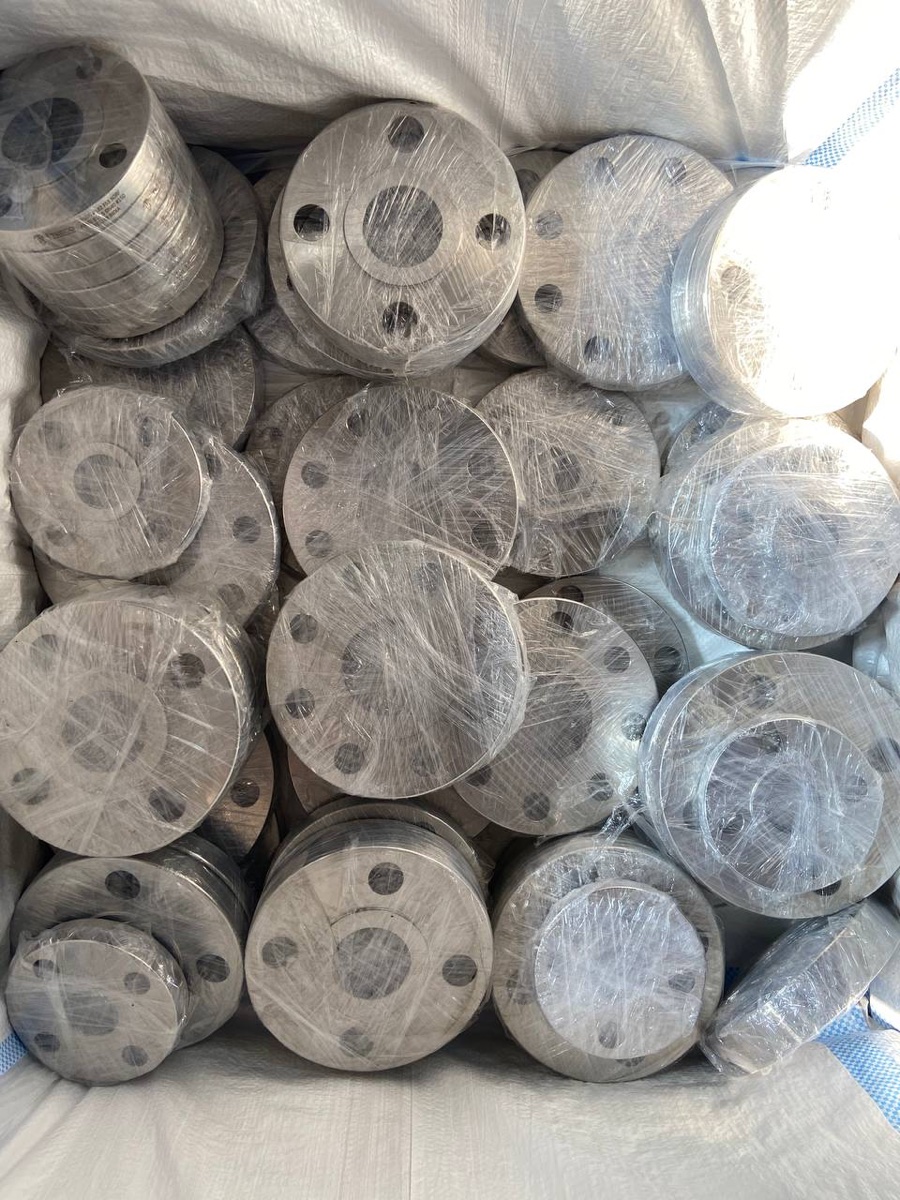
Certification & packing — EN 10204 3.1 MTC (3.2 witnessed on request), export-packed as pictured on this page.
Where A182 F316L Slip On Flanges Are Used
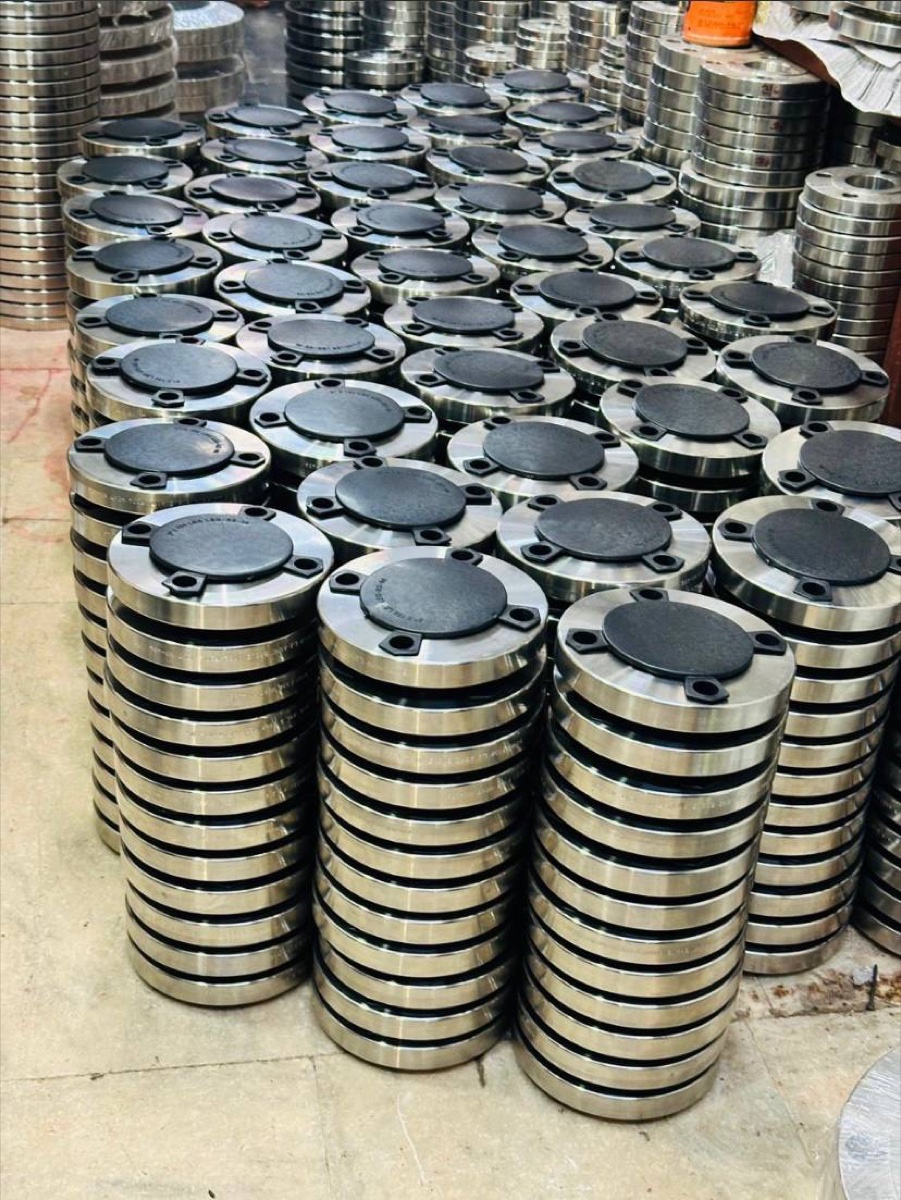
Wherever welded stainless meets chlorides or cleanliness: pharmaceutical and biotech clean systems per ASME BPE, food and beverage lines with brines and CIP chemistry, coastal and marine-adjacent process piping, chemical plants, desalination pretreatment, water treatment, and cryogenic systems. Our 316L production and packing below:
F316L Slip On Flanges — Wrapped & Bagged for ExportStainless Flanges — Face-Protected Stacks at Our Works
A182 F316L Slip On Flange Dimensions
F316L slip-on dimensions follow the ASME B16.5 slip-on tables — identical for every material. Full charts by class:
Example: “Slip On Flange, 4″ NB, ASME B16.5 Class 150, RF, ASTM A182 F316L (dual 316/316L), EN 10204 3.1 — 50 pcs.” Ready-stock sizes quote with immediate delivery; the rest normally within 24 hours.
ASTM A182 F316L Slip On Flanges — Frequently Asked Questions
What is an ASTM A182 F316L slip on flange?
It is a slip-on flange forged from ASTM A182 F316L — the low-carbon version of stainless steel 316 (UNS S31603), capped at 0.030% carbon so it welds without sensitization — dimensioned to ASME B16.5. The flange slides over the pipe end and is secured with two fillet welds, and the grade combines 316's molybdenum-bearing chloride resistance with the L-grade's weld-zone immunity: the default flange of welded chloride-bearing process piping and the pharmaceutical industry's reference metal.
What does the L in 316L mean — and why does it matter for a welded flange?
L is low carbon: 0.030% max against standard 316's 0.08%. Holding standard-carbon stainless at 425-815 °C — as every weld heat-affected zone briefly is — precipitates chromium carbides at grain boundaries and locally strips the passive film, inviting intergranular corrosion along the weld. Capping the carbon starves that reaction. A slip-on flange carries two fillet welds by definition, so the L grade is its natural stainless specification: weld with E316L and walk away.
What is the chemical composition of ASTM A182 F316L?
For UNS S31603: carbon 0.030% max, manganese 2.00% max, silicon 1.00% max, phosphorus 0.045% max, sulphur 0.030% max, chromium 16.0-18.0%, nickel 10.0-14.0%, molybdenum 2.00-3.00% and nitrogen 0.10% max. It is 316's recipe with the carbon removed — the molybdenum that resists chloride pitting stays, the sensitization risk goes. European practice knows it as 1.4404 (X2CrNiMo17-12-2).
What are the mechanical properties of A182 F316L slip on flanges?
Tensile strength 485 MPa (70 ksi) minimum, yield strength 170 MPa (25 ksi) minimum, elongation 30% minimum in 2", and hardness 217 HB maximum — supplied solution annealed. The slightly lower strength than standard 316 (515/205 MPa) is the price of removing carbon; in Class 150/300 general service the difference is rarely felt, and dual-certified 316/316L heats meet the higher minimums anyway. Values are demonstrated per heat on the EN 10204 certificate.
What is the difference between 316L and 316?
Only the carbon: 0.030% max against 0.08% max. That makes 316L immune to weld sensitization at the cost of slightly lower strength minimums. In modern practice most heats are melted low-carbon yet still meet 316's strength floor, and are dual-certified 316/316L — one certificate satisfying both specifications. Where a piping class or ASME BPE names 316L explicitly, the certificate shows the qualifying carbon; either way the material welds clean.
What is the difference between 316L and 304L?
Molybdenum — the same split as their standard-carbon parents. 316L adds 2-3% Mo for markedly better resistance to chloride pitting and crevice corrosion, taking the coastal, marine-adjacent, brine and CIP-chemistry duties, while 304L covers milder welded service for less money. Both share the low-carbon weldability and the full cryogenic capability. The choice is service chemistry: if the welded system sees salt or aggressive cleaning agents, it is 316L territory.
Why is 316L the pharmaceutical reference grade?
Because clean systems are welded systems. Pharmaceutical and biotech piping is orbital-welded, electropolished and CIP/SIP-cycled — exactly the conditions where sensitized weld zones would harbour corrosion and contamination. 316L's low carbon keeps every weld as corrosion-resistant as the parent metal, and its molybdenum stands up to chloride-bearing cleaning chemistry, which is why ASME BPE and pharma specifications worldwide are written around 316L. Our solution-annealed, pickled flanges fit straight into that world.
What temperature range can F316L slip on flanges handle?
Downward, effectively unlimited — austenitic stainless has no ductile-brittle transition, so 316L serves cryogenic systems at -196 °C and below without impact-test complications. Upward, working practice caps the L grade around 425 °C, because low carbon also means lower creep strength — sustained hot duty belongs to standard 316 or, above 538 °C, to 316H. Between those bounds, 316L simply works.
How is an A182 F316L slip on flange welded to pipe?
With two fillet welds — hub outside, bore inside, pipe set back 1/8" (3 mm) from the face — using E316L/ER316L consumables, no preheat, no PWHT, and no sensitization concern afterwards. It is the easiest possible combination: the most weldable flange type in the most weld-tolerant stainless chemistry. For hygienic systems, welds are typically finished and passivated to the project's surface specification.
What is the equivalent of ASTM A182 F316L in other standards?
ASME SA182 F316L is the boiler-code twin; UNS S31603 the designation; the European equivalents are X2CrNiMo17-12-2 (Werkstoff 1.4404) and the higher-alloyed 1.4435 variant; JIS SUS 316L the Japanese. System partners specified alongside it: ASTM A312 TP316L pipe and A403 WP316L fittings — the welded-316 trio. Certificates always state the actual grade forged, including dual 316/316L where the heat qualifies.
Can 316L slip on flanges be used in seawater?
The same honest answer as all 316: coastal atmosphere, splash and wash-down duty, yes — immersed or stagnant seawater, no. The low carbon changes weldability, not pitting resistance, so 316L carries the same PREN of roughly 24-26 as 316, short of what crevice-prone gasket faces and bolt holes demand in real seawater. Immersion and firewater duty belong to duplex 2205 and the super duplex grades F53/F55.
When is 316L not enough — and what replaces it?
When chlorides get serious or heat climbs. Immersed seawater, hot brines and high-chloride streams exceed its PREN of ~24-26 — the escalation runs duplex 2205, then super duplex F53/F55, with 904L and 6-moly 254 SMO covering acid-plus-chloride chemistry, and nickel alloys for reducing acids. For sustained service above about 425 °C the low carbon works against you — standard 316 or 316H takes over. Within its envelope, 316L is the welded chloride-service default.
What sizes and classes are A182 F316L slip on flanges available in?
From ½" to 24" NB per ASME B16.5 in Classes 150 through 2500, with larger patterns and DIN/EN 1092-1 stainless flanges forged to order. Because dual-certified 316/316L is the default stainless supply, common Class 150/300 sizes rotate through ready stock, typically available for quick dispatch — larger sizes and higher classes are forged against the order. Every quotation states the stock position alongside price and weight.
What details are needed to get an accurate A182 F316L slip on flange quotation?
Five elements plus commercial terms: (1) size and standard — e.g. 4" NB ASME B16.5; (2) pressure class — 150 through 2500; (3) facing — SORF (raised face) default, flat face or RTJ where specified; (4) grade — F316L or dual-certified 316/316L, with pickling/passivation or intergranular corrosion testing where the project specifies; (5) certification — EN 10204 3.1 or 3.2. No pipe schedule is needed for the slip-on bore. Add the quantity and destination and we return price, weight and delivery — often from ready stock.
Who manufactures ASTM A182 F316L slip on flanges in India?
Tesco Steel & Engineering is an ISO 9001:2015 certified flange manufacturer based in Mumbai, India, forging ASTM A182 F316L stainless steel slip on flanges from ½" to 24" NB per ASME B16.5 — alongside standard 316, 316H, 304L and the full 300-series family — in solution-annealed condition with ready stock in common sizes, full heat traceability and EN 10204 3.1/3.2 certification on every lot. Flanges are marked with grade, size, class and heat number and export to more than 50 countries.