ASTM A182 F316H Slip On Flanges — High Temperature SS 316H Manufacturer
Tesco Steel & Engineering forges ASTM A182 F316H slip on flanges — the high-temperature version of stainless steel 316, with carbon controlled to 0.04–0.10% so the creep strength the code demands above 538 °C is guaranteed — to ASME B16.5 Class 150–2500 from ½″ to 24″ NB, larger patterns to order. The carbon window plus 316's molybdenum make it the strongest creep performer of the standard austenitic flange grades, rated to 815 °C in the B16.5 tables — the stainless of refinery heaters, power piping and furnace-adjacent lines. With 316L, 304H and the stabilised 321/347 from the same forge. Every lot with EN 10204 3.1/3.2 MTC. ISO 9001:2015, made in Mumbai, India — exported to 50+ countries.
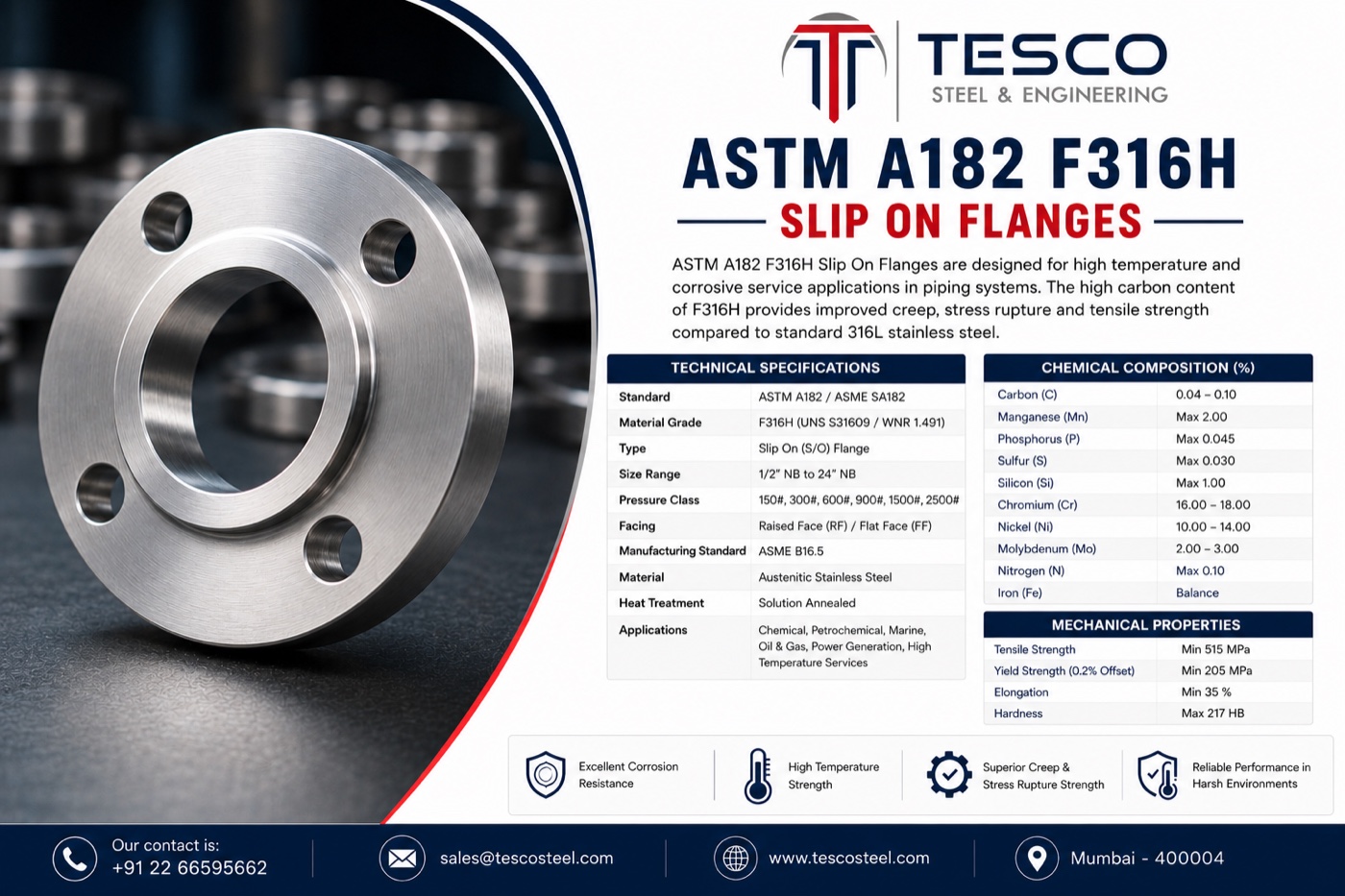
ASTM A182 F316H · SA182 · S31609C 0.04–0.10% + 2–3% Mo · 1.4919ASME B16.5 Class 150–2500½″ – 24″ NB · SORFCreep Duty >538 °C · Rated to 815 °CEN 10204 3.1 / 3.2 MTCISO 9001:2015 · Exported Worldwide
ASTM A182 F316H Slip On Flange — Specifications at a Glance
What is an ASTM A182 F316H Slip On Flange?
F316H = 316 with the carbon locked in.ASTM A182 F316H (UNS S31609) controls carbon to 0.04–0.10% — a range with a deliberate minimum, because carbon pins austenitic grain boundaries against creep, and the code allows 316's stresses above 538 °C only when C ≥ 0.04%. Add 316's molybdenum and it is the strongest creep performer of the standard austenitic flange grades. As a slip-on, it installs with two fillet welds, E316H consumables, no preheat, no PWHT — heaters, hot headers and flue duty to 815 °C.
Also searched as: SS 316H slip on flange, 316H SORF flange, high temperature stainless slip on flange, SA182 F316H slip on flange, S31609 slip on flange, 1.4919 slip on flange — all refer to the product on this page.
Rule of thumb: within the 316 family the selector is carbon — L for welded corrosive duty, standard for general service, H for creep-range heat. Hotter or dirtier still, the stabilised grades and 310 take over.
ASTM A182 F316H (UNS S31609) Chemical Composition
C
Mn
Si
P
S
Cr
Ni
Mo
N
Fe
0.04-0.10
2.00 max
1.00 max
0.045 max
0.030 max
16.0-18.0
10.0-14.0
2.00-3.00
0.10 max
Bal
Values in weight % for UNS S31609. The carbon range with its 0.04% minimum is the grade's defining feature — the creep-strengthening element the code's elevated-temperature stress tables are conditioned on — while the molybdenum adds hot strength on top. Otherwise the recipe is standard 316.
ASTM A182 F316H Mechanical Properties
Tensile Strength, MPa (ksi)
Yield Strength, Min, MPa (ksi)
Elongation % min (2")
Hardness, HB max
515 (75) min
205 (30) min
30
217
Identical to standard 316 at room temperature — the H grade's value is invisible at ambient. It lives in the creep-rupture strength above 538 °C, supported by the guaranteed carbon, the molybdenum, and a solution anneal run hot enough to develop the coarser grain creep resistance favours. Values demonstrated per heat on the EN 10204 certificate.
A182 F316H Slip On Flange Specifications
ASTM A182 F316H Slip On Flanges are available in the following specifications:
Material
ASTM A182 F316H / ASME SA182 F316H (UNS S31609)
Size
1/2"NB to 24"NB per ASME B16.5; larger patterns to order
Class
150#, 300#, 400#, 600#, 900#, 1500#, 2500#
Facing
Raised Face (SORF) — default; Flat Face or RTJ where the piping class specifies
Heat Treatment
High-temperature solution anneal per ASTM A182 — develops the creep-favouring grain; thermal record retained
Service
Creep-range duty above 538 °C — rated to 815 °C in the ASME B16.5 tables
Installation
Two fillet welds (hub + bore), pipe set back 1/8"; E316H/ER316H consumables, no preheat, no PWHT
Below 538 °C
The H grade buys nothing — standard F316 or F316L is the economical choice
Certification
EN 10204 3.1 (standard) / 3.2 witnessed, qualifying carbon on every certificate
Equivalent Grades of ASTM A182 F316H
Standard
Werkstoff Nr.
UNS
JIS
EN (working equivalent)
SS 316H
1.4919
S31609
SUS 316H
X3CrNiMo17-13-3
ASME SA182 F316H is the boiler-code twin. System partners: ASTM A312 TP316H pipe and A403 WP316H fittings — the hot-316 trio of creep-range piping. Certificates always state the actual grade forged with the qualifying 0.04-0.10% carbon.
Why A182 F316H Slip Ons Are Specified
The Strongest Standard Hot Austenitic
Guaranteed carbon plus 2–3% molybdenum — higher allowable and creep-rupture stresses than 304H through the shared 538–815 °C range.
The Code's Grade Above 538 °C
B16.5 and the boiler code condition 316's elevated-temperature stresses on C ≥ 0.04% — F316H is the supply that guarantees it on paper.
Rated to 815 °C
The B16.5 stainless tables run to 815 °C with oxidation resistance to ~870 °C continuous — genuine furnace-adjacent territory.
Austenitic Simplicity Retained
No preheat, no PWHT, standard E316H practice — creep-range metallurgy without the chrome-moly fabrication burden.
Know the Handoffs
Below 538 °C: 316/316L. Economy at heat: 304H. Hot duty with wet shutdowns: stabilised 321/347. Hotter still: 310. Critical RT-mandated lines: F316H weld necks.
How Our A182 F316H Slip On Flanges Are Manufactured
1
Forging — cut billet of certified A182 F316H heat — carbon verified 0.04-0.10% — is hot-forged into the flange blank, keeping full heat traceability from raw material to despatch.
2
Solution annealing — run at the high end of the range per ASTM A182 to dissolve carbides and develop the coarser grain that creep resistance favours; furnace record retained.
3
Machining — hub, faces and bolt holes to ASME B16.5; the bore machined slightly over pipe OD per the slip-on tolerance.
4
Facing & finish — SORF raised face with serrated stock finish, flat face or RTJ groove; pickled and passivated on request.
5
Testing & marking — mechanical and chemical verification against the heat, grain size where the order specifies, then permanent marking of grade, size, class and heat number.
6
Certification & packing — EN 10204 3.1 MTC with the qualifying carbon (3.2 witnessed on request), export-packed for sea freight.
Where A182 F316H Slip On Flanges Are Used
The creep range of stainless duty: refinery fired-heater and FCC circuits, steam superheater and reheater connections, power piping, HRSG hot sections, hot air and flue-gas systems, and furnace-adjacent process lines running 538-815 °C where 304H's stresses run out. Our stainless production and stock below:
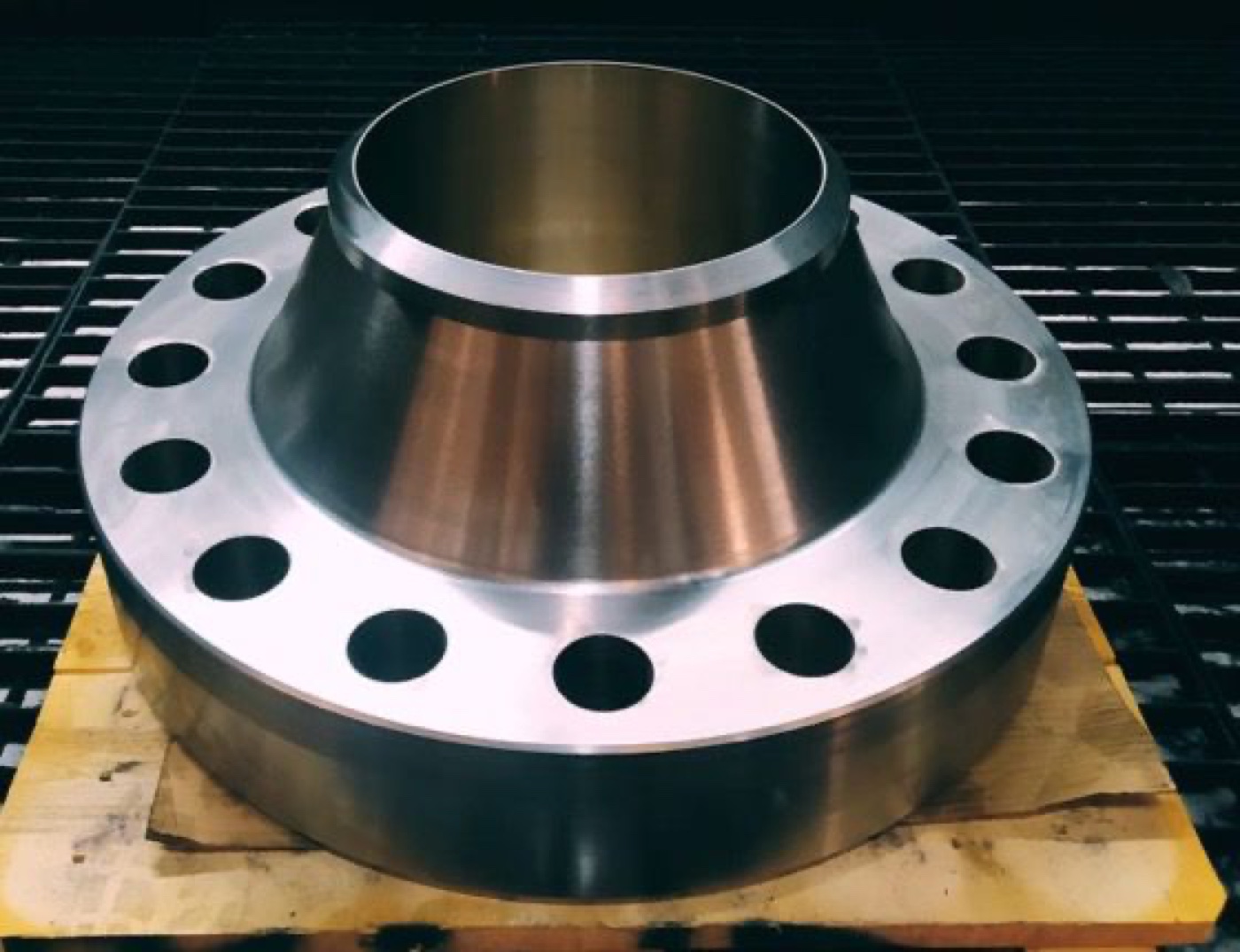
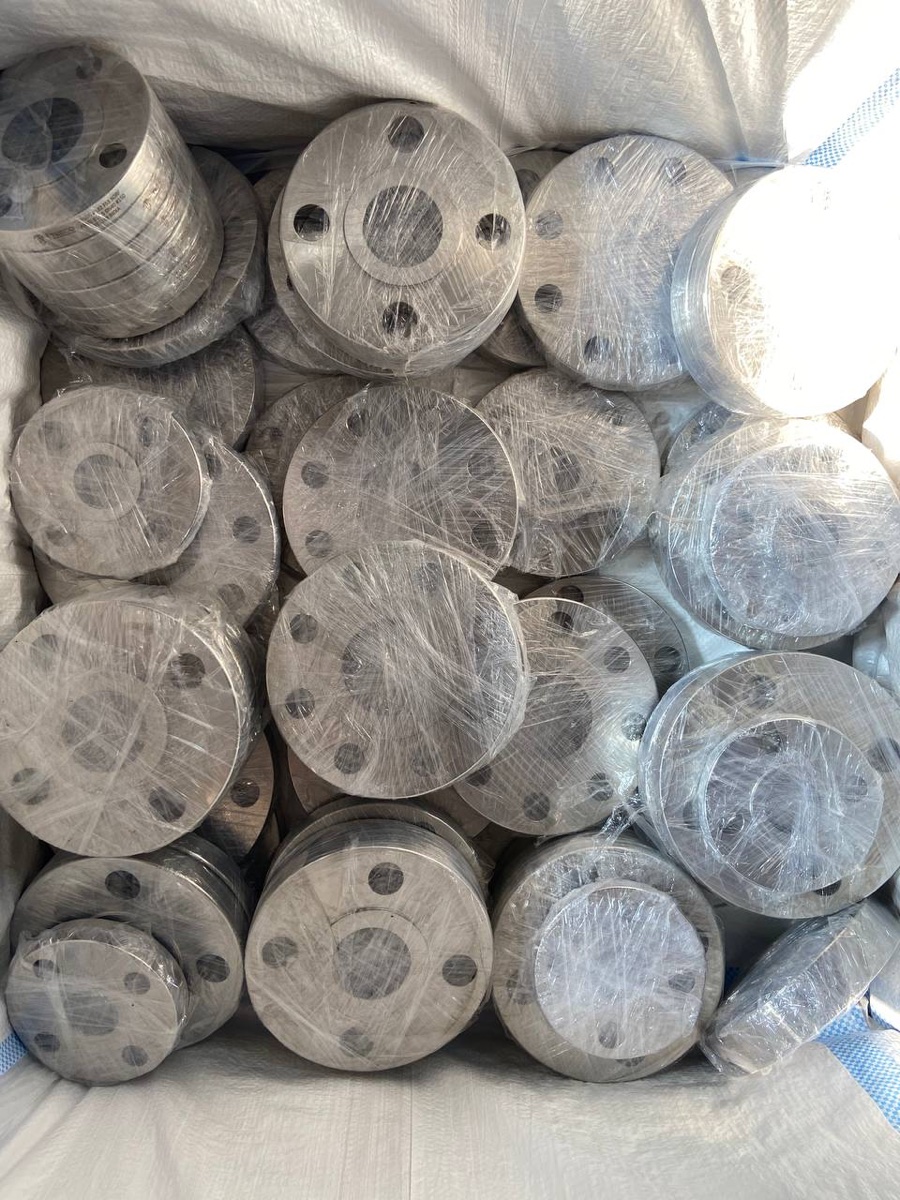
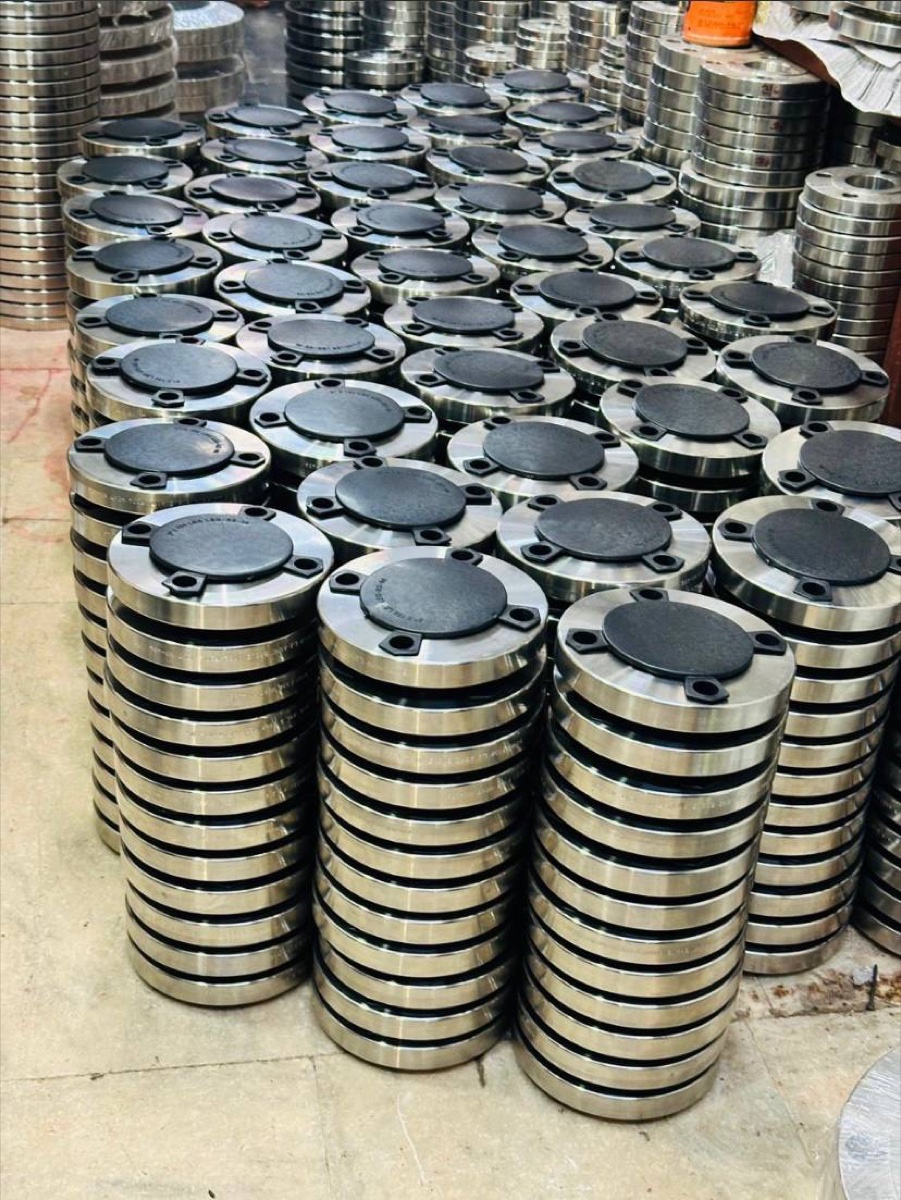
A182 F316H Heavy Flange — Machined & MarkedStainless Slip On Flanges — Wrapped & Bagged for ExportStainless Flanges — Face-Protected Stacks at Our Works
A182 F316H Slip On Flange Dimensions
F316H slip-on dimensions follow the ASME B16.5 slip-on tables — identical for every material. Full charts by class:
Example: “Slip On Flange, 4″ NB, ASME B16.5 Class 300, RF, ASTM A182 F316H, EN 10204 3.1 — 20 pcs.” Quotations normally within 24 hours with price, unit weight and delivery.
ASTM A182 F316H Slip On Flanges — Frequently Asked Questions
What is an ASTM A182 F316H slip on flange?
It is a slip-on flange forged from ASTM A182 F316H — the high-temperature version of stainless steel 316 (UNS S31609), with carbon controlled to 0.04-0.10% rather than merely capped — dimensioned to ASME B16.5. The flange slides over the pipe end and is secured with two fillet welds, and the guaranteed carbon minimum plus 316's molybdenum deliver the strongest creep performance of the standard austenitic flange grades above 538 °C — the stainless of refinery heaters, power piping and furnace-adjacent lines.
What does the H in 316H mean — and why a carbon minimum?
H is high temperature, and the mechanism is carbon. In the creep range, carbon is austenitic stainless steel's load-bearing element — it pins grain boundaries against slow deformation — so ASME B16.5 and the boiler code allow 316's higher elevated-temperature stresses only when carbon is at least 0.04%. Standard 316 merely caps carbon at 0.08% and might melt anywhere below it; 316H guarantees the 0.04-0.10% window, making the creep strength contractual rather than accidental.
What is the chemical composition of ASTM A182 F316H?
For UNS S31609: carbon 0.04-0.10% (a controlled range with a deliberate minimum — the grade's defining feature), manganese 2.00% max, silicon 1.00% max, phosphorus 0.045% max, sulphur 0.030% max, chromium 16.0-18.0%, nickel 10.0-14.0%, molybdenum 2.00-3.00% and nitrogen 0.10% max. Apart from the carbon window it is the same molybdenum-bearing 316 recipe.
What are the mechanical properties of A182 F316H slip on flanges?
Tensile strength 515 MPa (75 ksi) minimum, yield strength 205 MPa (30 ksi) minimum, elongation 30% minimum in 2" and hardness 217 HB maximum — the same room-temperature numbers as standard 316. The grade's value is invisible at ambient: it lives in the creep-rupture strength above 538 °C, supported by the carbon window, the molybdenum, and a solution anneal run hot enough to develop the coarser grain that creep resistance favours.
What is the difference between 316H and 316/316L?
Carbon direction. 316L removes carbon (0.030% max) for weld-zone corrosion immunity; 316H guarantees it (0.04% min) for creep strength — they are chemical opposites built from the same 16Cr-12Ni-2Mo base, and no heat can certify to both. Standard 316 sits between, capped at 0.08% with no floor. Choose by service temperature: L for welded corrosive duty below about 425 °C, standard for general service, H for sustained duty above 538 °C where the code demands the carbon.
What is the difference between 316H and 304H?
Molybdenum — and with it, creep strength. Both are controlled-carbon hot grades, but 316H's 2-3% molybdenum solid-solution-strengthens the austenite at temperature, giving it higher allowable and creep-rupture stresses than 304H through the shared 538-815 °C range, plus better corrosion resistance in condensing or chloride-touched excursions. 304H remains the economical choice where its stresses suffice; 316H is the stronger, more forgiving hot austenitic. We forge both.
What temperature range can F316H slip on flanges handle?
Its working territory is roughly 538-815 °C. ASME B16.5 rates the stainless groups to 815 °C, and 316H carries the code's full elevated-temperature stresses through that range — the highest of the standard austenitic flange grades — with oxidation resistance to about 870 °C in continuous service. Below 538 °C the H grade works but buys nothing; standard 316 or 316L is the economical choice there. Hotter or more demanding still, the 25Cr-20Ni grade 310 takes over.
Does 316H sensitize — and does it matter?
Yes, it sensitizes readily — with 0.04%+ carbon, chromium carbides will precipitate during welding and during service in the 425-815 °C band. In hot dry service this is accepted: intergranular corrosion is an aqueous mechanism, and there is no electrolyte inside a heater line at 600 °C. The caution belongs to shutdowns and cleaning — a sensitized system exposed to wet corrosive conditions can suffer weld-line attack. Where that risk governs, the stabilised grades 321H and 347H serve heat with sensitization resistance.
When are 321H or 347H specified instead of 316H?
When the service combines creep temperatures with corrosion or cyclic exposure that sensitization would compromise. 321H (titanium-stabilised) and 347H (niobium-stabilised) tie up carbon as harmless Ti/Nb carbides, keeping chromium in solution while retaining H-grade creep minimums — the classic choice for refinery heater outlets and cyclic hot lines that also see wet shutdowns. Where the hot service is clean and dry, 316H's molybdenum-boosted creep strength does the job. We forge all of them.
How is an A182 F316H slip on flange welded to pipe?
With two fillet welds — hub outside, bore inside, pipe set back 1/8" (3 mm) — using matching E316H/ER316H consumables, whose controlled carbon preserves the weld metal's creep strength. No preheat and no PWHT, as for all austenitics. The heat-affected zone will sensitize; in the hot dry services 316H is bought for, that is accepted practice. Weld procedures for creep-range lines are qualified accordingly under B31.3/B31.1.
What is the equivalent of ASTM A182 F316H in other standards?
ASME SA182 F316H is the boiler-code twin; UNS S31609 the designation; the European working equivalent is the hot-service 316 of EN pressure standards, X3CrNiMo17-13-3 (Werkstoff 1.4919); JIS practice uses SUS 316H. System partners specified alongside it: ASTM A312 TP316H pipe and A403 WP316H fittings — the hot-316 trio. Certificates always state the actual grade forged with the qualifying carbon.
Are slip on flanges allowed in creep-range service?
Within limits. Slip-on flanges are permitted by the piping codes and serve on lower-criticality hot lines — drains, vents, utility and auxiliary connections — but many piping classes restrict creep-range and cyclic main lines to weld neck flanges, whose full-penetration butt weld can be radiographed and handles thermal fatigue better than fillet welds. Follow the piping class: where it allows a slip-on, an F316H slip-on delivers the metallurgy at lower flange and fit-up cost.
What sizes and classes are A182 F316H slip on flanges available in?
From ½" to 24" NB per ASME B16.5 in Classes 150 through 2500, with larger patterns forged to order. The H grade is project material rather than shelf stock — forged against the order from certified 0.04-0.10% carbon heats with the high-temperature solution anneal — so standard sizes normally dispatch within a few weeks with EN 10204 3.1 certification. State the required delivery on the enquiry and we confirm the schedule with the quotation.
What details are needed to get an accurate A182 F316H slip on flange quotation?
Five elements plus commercial terms: (1) size and standard — e.g. 4" NB ASME B16.5; (2) pressure class — 150 through 2500; (3) facing — SORF (raised face) default, flat face or RTJ where specified; (4) grade — ASTM A182 F316H, with grain size or supplementary requirements where the project specifies; (5) certification — EN 10204 3.1 or 3.2. No pipe schedule is needed for the slip-on bore. Add the quantity and destination and we return price, weight and delivery.
Who manufactures ASTM A182 F316H slip on flanges in India?
Tesco Steel & Engineering is an ISO 9001:2015 certified flange manufacturer based in Mumbai, India, forging ASTM A182 F316H stainless steel slip on flanges from ½" to 24" NB per ASME B16.5 — alongside 316, 316L, 304H and the stabilised hot grades 321 and 347 — with the qualifying carbon on every certificate, full heat traceability and EN 10204 3.1/3.2 certification on every lot. Flanges are marked with grade, size, class and heat number and export to more than 50 countries.