ASTM A182 F347 Slip On Flanges — SS 347 / 1.4550 Manufacturer
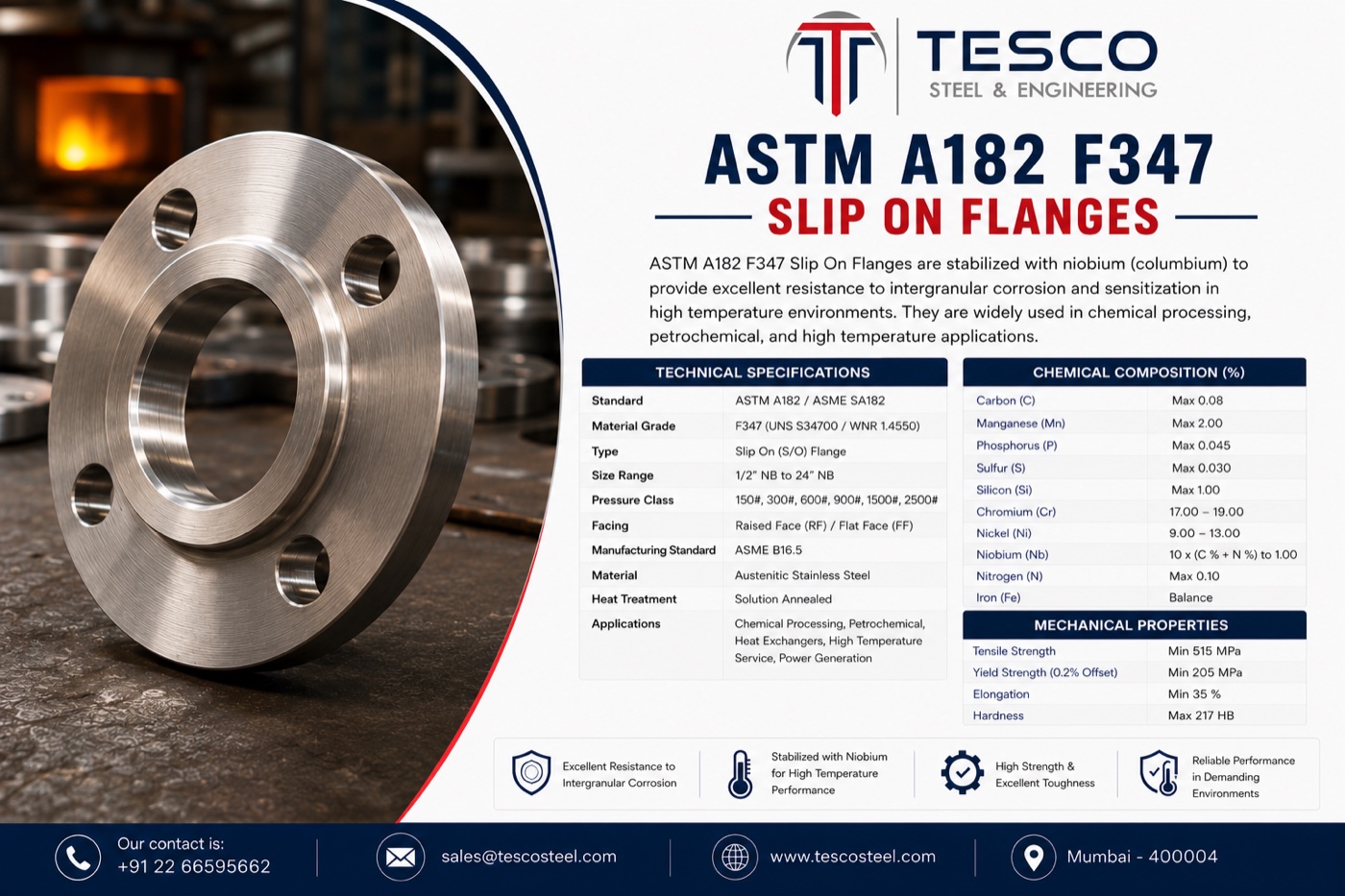
Tesco Steel & Engineering forges ASTM A182 F347 slip on flanges — niobium-stabilised stainless steel 347 (UNS S34700, Werkstoff 1.4550), the strongest of the stabilised grades — to ASME B16.5 Class 150–2500 from ½″ to 24″ NB, larger patterns to order. The niobium ties up carbon against sensitization with a stabilisation that survives arc welding and the severest cyclic hot service — the grade of refinery heater circuits, protected against polythionic acid attack at shutdowns. Supplied solution annealed, with 347H, the titanium-stabilised 321 and 316Ti from the same forge. Every lot with EN 10204 3.1/3.2 MTC. ISO 9001:2015, made in Mumbai, India — exported to 50+ countries.
ASTM A182 F347 Slip On Flange — Specifications at a Glance
What is an ASTM A182 F347 Slip On Flange?
F347 = the heavy-duty stabilised stainless.ASTM A182 F347 (UNS S34700) adds niobium at 10×(C+N) minimum to the 18-11 austenitic base: carbon precipitates as harmless niobium carbides, so the steel passes through the 425–815 °C sensitization band unharmed — and unlike titanium, niobium survives the welding arc, keeping even the weld metal stabilised. The grade of refinery heaters, immune to polythionic acid attack at shutdowns. As a slip-on: two fillet welds, E347 filler, no preheat, no PWHT.
Also searched as: SS 347 slip on flange, 347 SORF flange, 1.4550 slip on flange, X6CrNiNb18-10 flange, columbium stabilised flange (18-8 Cb), SA182 F347 slip on flange, S34700 slip on flange — all refer to the product on this page.
Rule of thumb: hot duty that cycles wants a stabilised grade — and the severest of it, with polythionic-acid shutdown risk, wants 347. Creep-governed designs add the H carbon (347H). Hotter than all of them, 310 takes over.
ASTM A182 F347 (UNS S34700) Chemical Composition
C
Mn
Si
P
S
Cr
Ni
Nb
N
Fe
0.08 max
2.00 max
1.00 max
0.045 max
0.030 max
17.0-19.0
9.0-13.0
10×(C+N) min – 1.00 max
0.10 max
Bal
Values in weight % for UNS S34700. The niobium formula is the grade: at ten times the carbon-plus-nitrogen content, every carbon atom finds a niobium partner before it can touch the chromium. No molybdenum — chloride duty belongs to the 316Ti/317 families.
ASTM A182 F347 Mechanical Properties
Tensile Strength, MPa (ksi)
Yield Strength, Min, MPa (ksi)
Elongation % min (2")
Hardness, HB max
515 (75) min
205 (30) min
30
217
Supplied solution annealed. The niobium carbides also strengthen the matrix at temperature, giving 347 the best hot-strength retention of the standard stabilised grades — one reason refinery heater specifications favour it. Values demonstrated per heat on the EN 10204 certificate.
A182 F347 Slip On Flange Specifications
ASTM A182 F347 Slip On Flanges are available in the following specifications:
1/2"NB to 24"NB per ASME B16.5; larger patterns to order
Class
150#, 300#, 400#, 600#, 900#, 1500#, 2500#
Facing
Raised Face (SORF) — default; Flat Face or RTJ where the piping class specifies
Heat Treatment
Solution annealed per ASTM A182, thermal record retained
Service
Severest cyclic hot duty — stabilised through 425-815 °C; polythionic-acid resistant; oxidation to ~870 °C; cryogenic capable
Installation
Two fillet welds (hub + bore), pipe set back 1/8"; E347/ER347 filler (weld metal stays stabilised), no preheat, no PWHT
Testing
Intergranular corrosion testing (e.g. ASTM A262) on request
Certification
EN 10204 3.1 (standard) / 3.2 witnessed
Equivalent Grades of ASTM A182 F347
Standard
Werkstoff Nr.
UNS
JIS
BS
EN
SS 347
1.4550
S34700
SUS 347
347S31
X6CrNiNb18-10
ASME SA182 F347 is the boiler-code twin; older US drawings may say “18-8 Cb” — the same grade under niobium's former name, columbium. System partners: ASTM A312 TP347 pipe and A403 WP347 fittings. Certificates always state the actual grade forged with the qualifying niobium ratio.
Why A182 F347 Slip Ons Are Specified
Stabilisation That Survives the Arc
Niobium transfers through welding where titanium burns away — parent metal, HAZ and weld metal all stay stabilised, with matching E347 filler.
Polythionic-Acid Proof
Refinery shutdowns turn sulfide scale into grain-boundary acid — 347's chromium never leaves solution, so there are no depleted boundaries to attack.
The Toughest Stabilisation Available
Niobium carbides resist dissolution and coarsening through the harshest cyclic exposure — the margin that makes heater circuits name 347 over 321.
Hot Strength Included
The same carbides strengthen the matrix at temperature — the best hot-strength retention of the standard stabilised grades, extended further by 347H.
Know the Handoffs
General cyclic duty: 321 for less. Hot + chlorides: 316Ti. Creep-governed design above 538 °C: 347H. Hotter still: 310. Critical RT-mandated lines: F347 weld necks.
How Our A182 F347 Slip On Flanges Are Manufactured
1
Forging — cut billet of certified A182 F347 / 1.4550 heat is hot-forged into the flange blank, keeping full heat traceability from raw material to despatch.
2
Solution annealing — heated and quenched per ASTM A182 to restore the fully austenitic, corrosion-ready condition; the niobium stabilisation then does its work in service; furnace record retained.
3
Machining — hub, faces and bolt holes to ASME B16.5; the bore machined slightly over pipe OD per the slip-on tolerance.
4
Facing & finish — SORF raised face with serrated stock finish, flat face or RTJ groove; pickled and passivated on request.
5
Testing & marking — mechanical and chemical verification against the heat, the qualifying niobium ratio on every certificate (ASTM A262 intergranular testing where the order specifies), then permanent marking of grade, size, class and heat number.
6
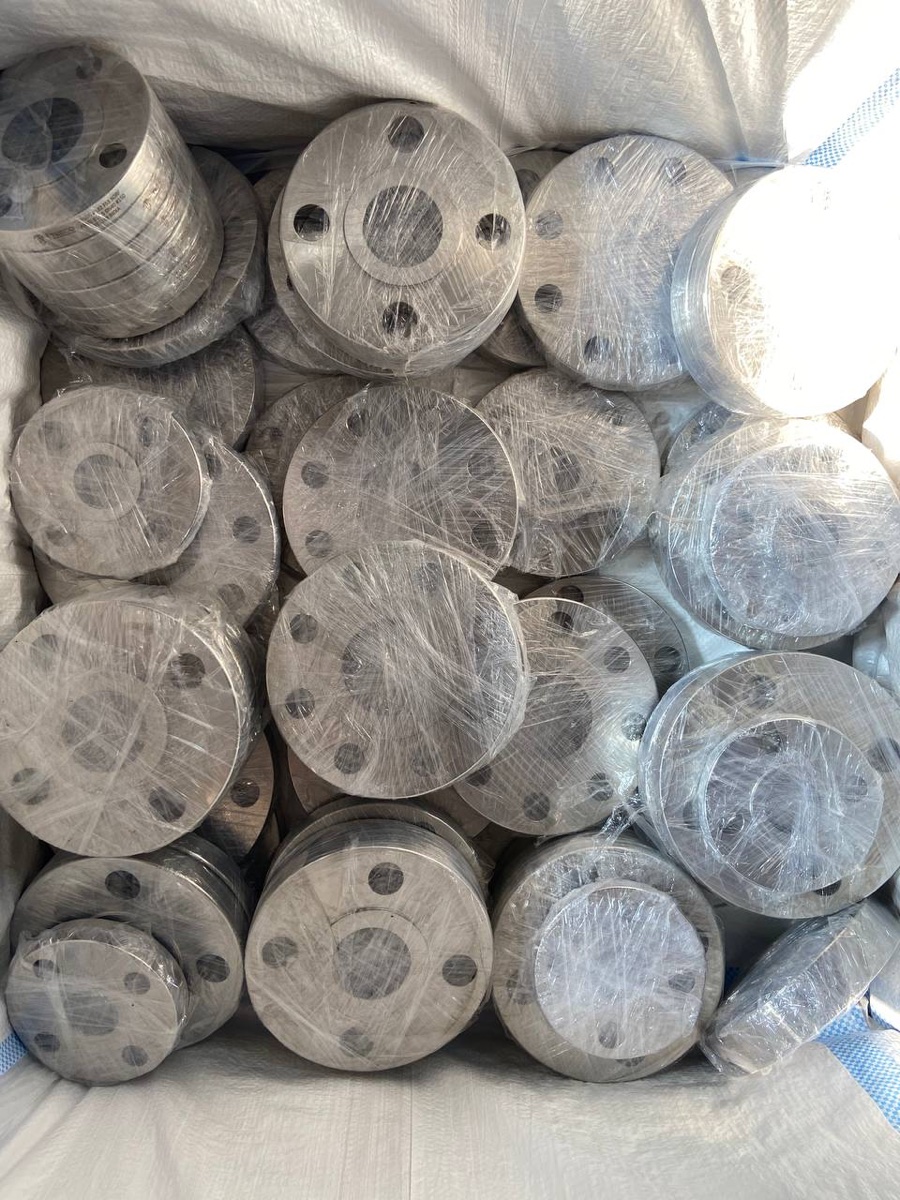
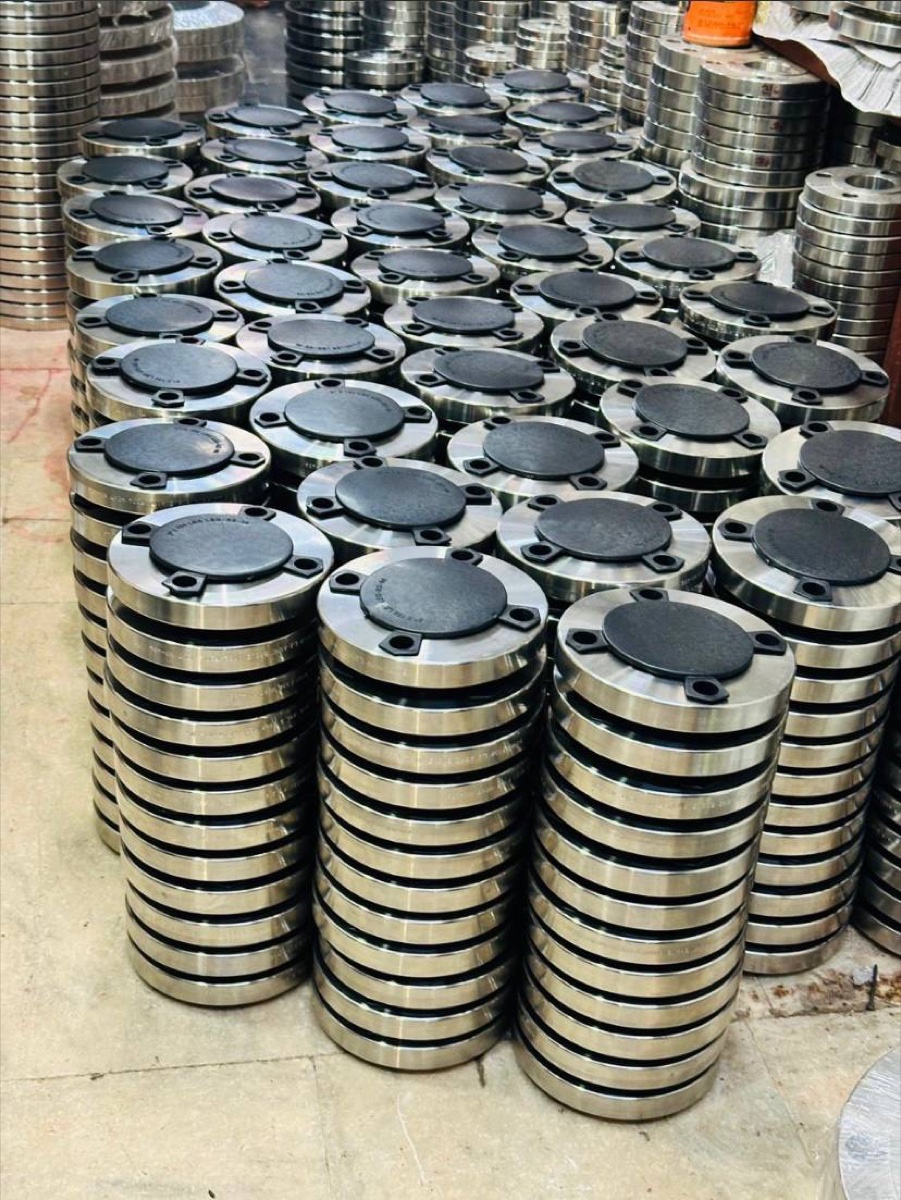
Certification & packing — EN 10204 3.1 MTC (3.2 witnessed on request), export-packed as pictured on this page.
Where A182 F347 Slip On Flanges Are Used
The severest cyclic hot services: refinery fired-heater circuits and outlet manifolds, FCC and reformer hot lines, hydrogen unit piping, hot cyclic process systems with shutdown exposure to polythionic acids, expansion bellows and furnace components — wherever 321 needs an extra margin. Our stainless production and packing below:
Stainless Slip On Flanges — Wrapped & Bagged for ExportStainless Flanges — Face-Protected Stacks at Our Works
A182 F347 Slip On Flange Dimensions
F347 slip-on dimensions follow the ASME B16.5 slip-on tables — identical for every material. Full charts by class:
Example: “Slip On Flange, 4″ NB, ASME B16.5 Class 300, RF, ASTM A182 F347 (1.4550), EN 10204 3.1 — 25 pcs.” Quotations normally within 24 hours with price, unit weight and delivery.
ASTM A182 F347 Slip On Flanges — Frequently Asked Questions
What is an ASTM A182 F347 slip on flange?
It is a slip-on flange forged from ASTM A182 F347 — niobium-stabilised stainless steel 347 (UNS S34700, Werkstoff 1.4550) — dimensioned to ASME B16.5. The flange slides over the pipe end and is secured with two fillet welds, and the niobium ties up carbon so the steel passes through the 425-815 °C sensitization band unharmed — with a stabilisation robust enough for the severest cyclic hot service. It is the classic grade of refinery heater circuits and hot cyclic process piping.
What does the niobium in 347 do?
It stabilises the steel. Niobium (historically called columbium in the US, hence 'Cb' on older documents) bonds with carbon far more eagerly than chromium does, so carbon precipitates as harmless niobium carbides instead of the chromium carbides that cause sensitization in weld zones and hot service. The chromium stays in solution, the passive film stays intact — through welding, sustained 425-815 °C exposure, and repeated thermal cycling.
What is the chemical composition of ASTM A182 F347?
For UNS S34700: carbon 0.08% max, manganese 2.00% max, silicon 1.00% max, phosphorus 0.045% max, sulphur 0.030% max, chromium 17.0-19.0%, nickel 9.0-13.0%, nitrogen 0.10% max, and the defining addition: niobium at a minimum of ten times the carbon-plus-nitrogen content, up to 1.00% max. It is the 18-11 austenitic base with the carbon chemically neutralised — no molybdenum; chloride duty belongs to the 316/317 families.
What are the mechanical properties of A182 F347 slip on flanges?
Tensile strength 515 MPa (75 ksi) minimum, yield strength 205 MPa (30 ksi) minimum, elongation 30% minimum in 2" and hardness 217 HB maximum — supplied solution annealed. The niobium carbides also strengthen the matrix at temperature, giving 347 the best hot-strength retention of the standard stabilised grades — one reason refinery heater specifications favour it. Values are demonstrated per heat on the EN 10204 certificate.
What is the difference between 347 and 321?
The stabilising element: niobium in 347, titanium in 321. Both neutralise carbon the same way; 347's advantages sit at the margins that matter in severe service. Niobium survives arc transfer, so 347 weld metal stays stabilised — indeed E347 is the filler 321 itself must borrow. Niobium carbides also resist dissolution and coarsening better through the harshest cyclic exposure, which is why refinery heater circuits name 347 while general hot duty runs 321 for less. We forge both.
Why is 347 the refinery heater grade?
Because heater circuits are the severest stabilised-grade duty: sustained temperatures deep in the sensitization band, relentless start-stop cycling, and shutdown exposure to polythionic acids — which attack sensitized stainless along grain boundaries. 347's niobium stabilisation is the most robust available in a standard grade, and decades of refinery practice (including NACE guidance on polythionic acid stress corrosion) wrote it into heater and hot-line specifications. 347H extends the same logic where creep stresses govern.
What is 347H — and when is it needed?
The controlled-carbon version (UNS S34709, carbon 0.04-0.10%) that combines niobium stabilisation with the H-grade carbon minimum the code demands for full creep stresses above 538 °C. Order plain 347 for hot cyclic duty where sensitization and polythionic acid are the enemies; order 347H where the design also leans on the code's elevated-temperature allowable stresses — heater outlet manifolds are the classic case. The certificate shows the qualifying carbon either way.
What temperature range can F347 slip on flanges handle?
Its home ground is the 425-815 °C band — hot enough to sensitize unstabilised grades, exactly where the niobium earns its keep — with oxidation resistance to about 870 °C in continuous service and unrestricted cryogenic capability below. For creep-governed design above 538 °C the controlled-carbon 347H carries the code's stresses. Across that whole span, 347 handles the thermal cycling and shutdown chemistry that retire plain 304.
What is polythionic acid attack — and how does 347 resist it?
A refinery shutdown phenomenon: sulfide scale on hot stainless reacts with air and moisture during cooldown to form polythionic acids, which crack sensitized material along its chromium-depleted grain boundaries. The defence is simple — never be sensitized. 347's niobium keeps chromium in solution through every heat-up and cool-down, so there are no depleted boundaries to attack. That resistance, codified in NACE SP0170 practice, is a core reason hot refinery circuits specify stabilised grades.
How is an A182 F347 slip on flange welded to pipe?
With two fillet welds — hub outside, bore inside, pipe set back 1/8" (3 mm) — using matching E347/ER347 consumables, no preheat, no PWHT. Unlike titanium, niobium survives the arc, so the weld metal is stabilised by the same element as the parent — the reason E347 is also the filler of choice for 321. Heavy restrained joints deserve modest heat input, standard practice for fully austenitic weld metal.
Can 347 slip on flanges be used in chloride or seawater service?
Treat it like 304 in this respect: with no molybdenum, 347's pitting resistance is that of the 18-8 family — fine for fresh water and mild atmospheres, unsuited to serious chlorides and out of the question for seawater immersion. Stabilisation protects against sensitization, not pitting. For chloride-bearing hot duty look to 316Ti; for brines and immersion, duplex 2205 and beyond. 347's territory is heat and its aftermath, not salt.
What is the equivalent of ASTM A182 F347 in other standards?
ASME SA182 F347 is the boiler-code twin; UNS S34700 the designation; the European equivalent is X6CrNiNb18-10, Werkstoff 1.4550; JIS practice uses SUS 347. Older US drawings may say '18-8 Cb' — the same grade under niobium's former name. System partners specified alongside it: ASTM A312 TP347 pipe and A403 WP347 fittings — the stabilised trio of hot refinery piping. Certificates always state the actual grade forged with the qualifying niobium ratio.
What sizes and classes are A182 F347 slip on flanges available in?
From ½" to 24" NB per ASME B16.5 in Classes 150 through 2500, with larger patterns forged to order. 347 is project material rather than shelf stock, forged against the order from certified heats with the qualifying niobium ratio, with standard sizes normally dispatching within a few weeks with EN 10204 3.1 certification. State the required delivery on the enquiry and we confirm the schedule with the quotation.
What details are needed to get an accurate A182 F347 slip on flange quotation?
Five elements plus commercial terms: (1) size and standard — e.g. 4" NB ASME B16.5; (2) pressure class — 150 through 2500; (3) facing — SORF (raised face) default, flat face or RTJ where specified; (4) grade — ASTM A182 F347, or 347H where the design requires the code's creep stresses, with intergranular corrosion testing where the project specifies; (5) certification — EN 10204 3.1 or 3.2. No pipe schedule is needed for the slip-on bore. Add the quantity and destination and we return price, weight and delivery.
Who manufactures ASTM A182 F347 slip on flanges in India?
Tesco Steel & Engineering is an ISO 9001:2015 certified flange manufacturer based in Mumbai, India, forging ASTM A182 F347 / 1.4550 slip on flanges from ½" to 24" NB per ASME B16.5 — alongside 347H, the titanium-stabilised 321, 316Ti and the full 300-series family — in solution-annealed condition with full heat traceability and EN 10204 3.1/3.2 certification on every lot. Flanges are marked with grade, size, class and heat number and export to more than 50 countries.