ASTM A182 F316Ti Slip On Flanges — SS 316Ti / 1.4571 Manufacturer
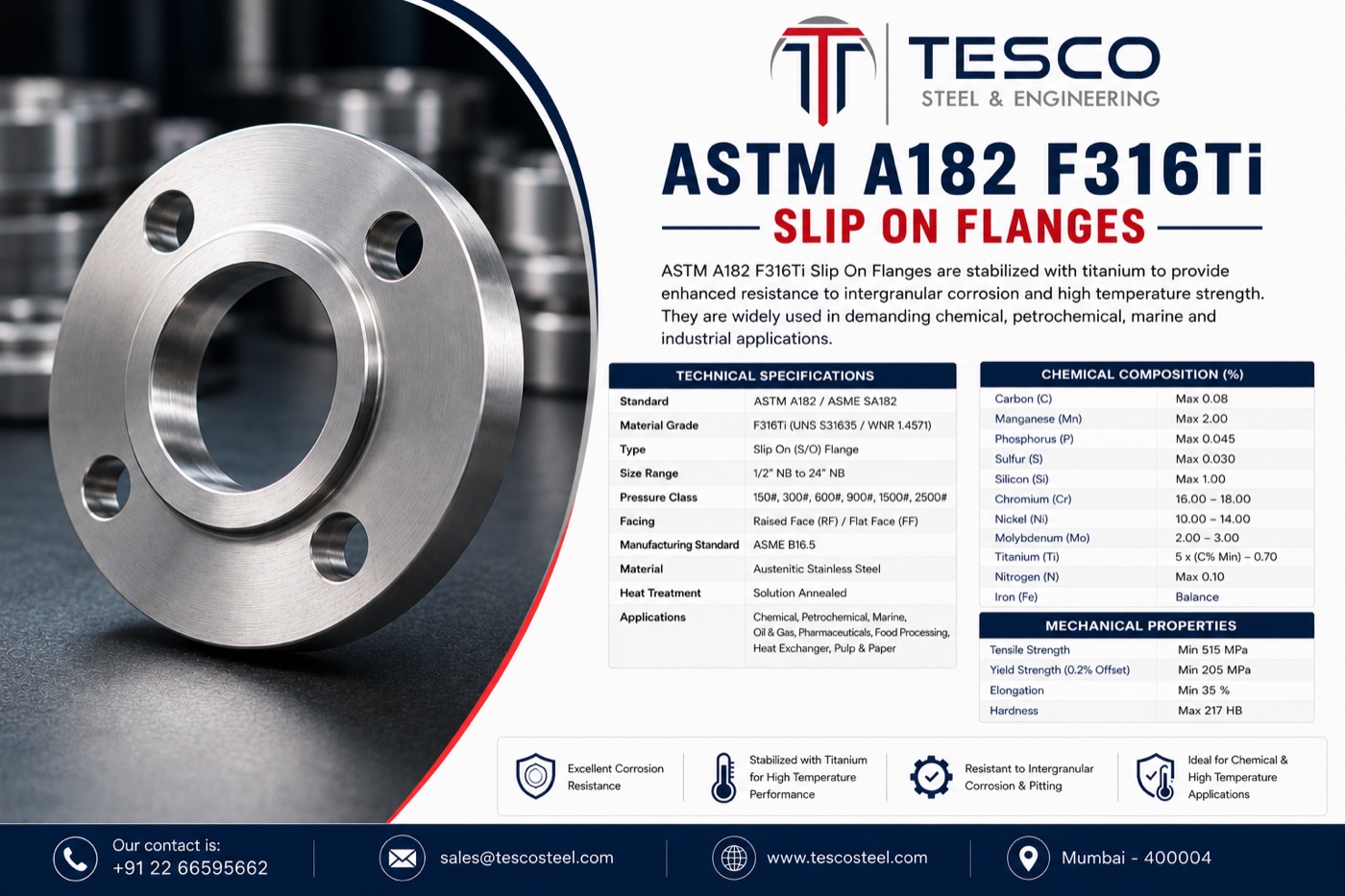
Tesco Steel & Engineering forges ASTM A182 F316Ti slip on flanges — titanium-stabilised 316 (UNS S31635), known across European engineering as Werkstoff 1.4571 — to ASME B16.5 Class 150–2500 from ½″ to 24″ NB, and EN 1092-1 patterns to order. The titanium ties up carbon against sensitization while adding hot strength: the continental workhorse of chemical plants running hot, corrosive duty, and the grade European piping classes still call by name. Supplied solution annealed, with 316L, 316H and the stabilised 321/347 from the same forge. Every lot with EN 10204 3.1/3.2 MTC. ISO 9001:2015, made in Mumbai, India — exported to 50+ countries.
ASTM A182 F316Ti Slip On Flange — Specifications at a Glance
What is an ASTM A182 F316Ti Slip On Flange?
F316Ti = 316 with the carbon neutralised.ASTM A182 F316Ti (UNS S31635) adds titanium at 5×(C+N) minimum to the 16Cr-12Ni-2Mo base: the carbon precipitates as harmless titanium carbides instead of the chromium carbides that sensitize weld zones and hot service — while the molybdenum keeps the chloride resistance. Europe knows it as 1.4571, the chemical industry's stabilised workhorse. As a slip-on, it installs with two fillet welds, no preheat, no PWHT.
Also searched as: 1.4571 slip on flange, SS 316Ti slip on flange, 316Ti SORF flange, X6CrNiMoTi17-12-2 flange, SA182 F316Ti slip on flange, S31635 slip on flange, titanium stabilised stainless flange — all refer to the product on this page.
Rule of thumb: sensitization has two cures — remove the carbon (L) or neutralise it (Ti/Nb). The stabilised route also holds strength in sustained 400–550 °C service, which is why hot corrosive chemical duty stays 1.4571 territory.
ASTM A182 F316Ti (UNS S31635) Chemical Composition
C
Mn
Si
P
S
Cr
Ni
Mo
Ti
N
Fe
0.08 max
2.00 max
1.00 max
0.045 max
0.030 max
16.0-18.0
10.0-14.0
2.00-3.00
5×(C+N) min – 0.70 max
0.10 max
Bal
Values in weight % for UNS S31635. The titanium formula is the grade: at five times the carbon-plus-nitrogen content, every carbon atom finds a titanium partner before it can touch the chromium. Otherwise it is the standard molybdenum-bearing 316 recipe.
ASTM A182 F316Ti Mechanical Properties
Tensile Strength, MPa (ksi)
Yield Strength, Min, MPa (ksi)
Elongation % min (2")
Hardness, HB max
515 (75) min
205 (30) min
30
217
The same room-temperature numbers as standard 316, supplied solution annealed. The titanium's contribution appears at temperature: stabilised carbides resist coarsening, giving 316Ti a strength and stability edge in the 400–550 °C band where plain 316 begins to sensitize. Values demonstrated per heat on the EN 10204 certificate.
A182 F316Ti Slip On Flange Specifications
ASTM A182 F316Ti Slip On Flanges are available in the following specifications:
1/2"NB to 24"NB per ASME B16.5; EN 1092-1 flanges in 1.4571 and larger patterns to order
Class
150#, 300#, 400#, 600#, 900#, 1500#, 2500#; PN ratings per EN 1092-1
Facing
Raised Face (SORF) — default; Flat Face or RTJ where the piping class specifies
Heat Treatment
Solution annealed per ASTM A182, thermal record retained
Service
Hot corrosive chemical duty — stabilised against sensitization through 425-815 °C exposure; cryogenic capable
Installation
Two fillet welds (hub + bore), pipe set back 1/8"; 318-type or ER316L filler, no preheat, no PWHT
Testing
Intergranular corrosion testing (e.g. ASTM A262) on request
Certification
EN 10204 3.1 (standard) / 3.2 witnessed
Equivalent Grades of ASTM A182 F316Ti
Standard
Werkstoff Nr.
UNS
JIS
EN
SS 316Ti
1.4571
S31635
SUS 316Ti
X6CrNiMoTi17-12-2
ASME SA182 F316Ti is the boiler-code twin — but the name most of the world actually specifies is 1.4571. System partners: ASTM A312 TP316Ti pipe and, on European projects, the EN 10216-5 / EN 1092-1 family in 1.4571. Certificates state every designation the heat satisfies.
Why A182 F316Ti Slip Ons Are Specified
Sensitization-Proof at Full Carbon
Titanium claims the carbon before chromium can — weld zones and 425–815 °C service exposure leave the passive film untouched.
Holds Strength Where 316 Softens
Stabilised carbides resist coarsening through sustained 400–550 °C duty — the hot-corrosive middle ground the L grade cannot serve.
The Name European Specs Call
Decades of German and continental chemical engineering standardised on 1.4571 — plants worldwide built to those classes still buy it by name.
Dual-Standard Supply
ASME B16.5 and EN 1092-1 patterns from the same certified heat — the capability this grade's mixed-heritage projects demand.
How Our A182 F316Ti Slip On Flanges Are Manufactured
1
Forging — cut billet of certified A182 F316Ti / 1.4571 heat is hot-forged into the flange blank, keeping full heat traceability from raw material to despatch.
2
Solution annealing — heated and quenched per ASTM A182; the titanium stabilisation does its work in service, but the anneal restores the fully austenitic, corrosion-ready condition; furnace record retained.
3
Machining — hub, faces and bolt holes to ASME B16.5 or EN 1092-1; the bore machined slightly over pipe OD per the slip-on tolerance.
4
Facing & finish — SORF raised face with serrated stock finish, flat face or RTJ groove; pickled and passivated on request.
5
Testing & marking — mechanical and chemical verification against the heat, the qualifying titanium ratio on every certificate (ASTM A262 intergranular testing where the order specifies), then permanent marking of grade, size, class and heat number.
6
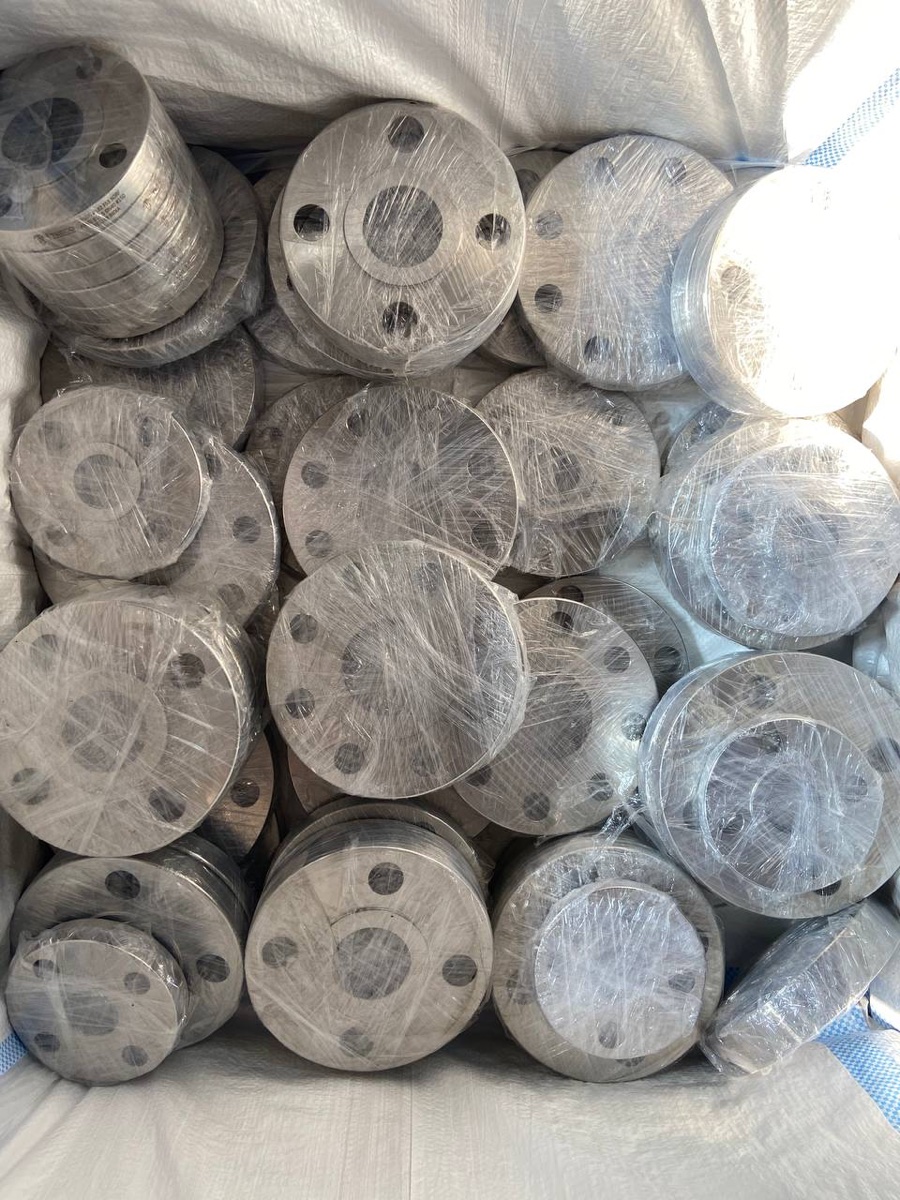
Certification & packing — EN 10204 3.1 MTC (3.2 witnessed on request), export-packed as pictured on this page.
Where A182 F316Ti Slip On Flanges Are Used
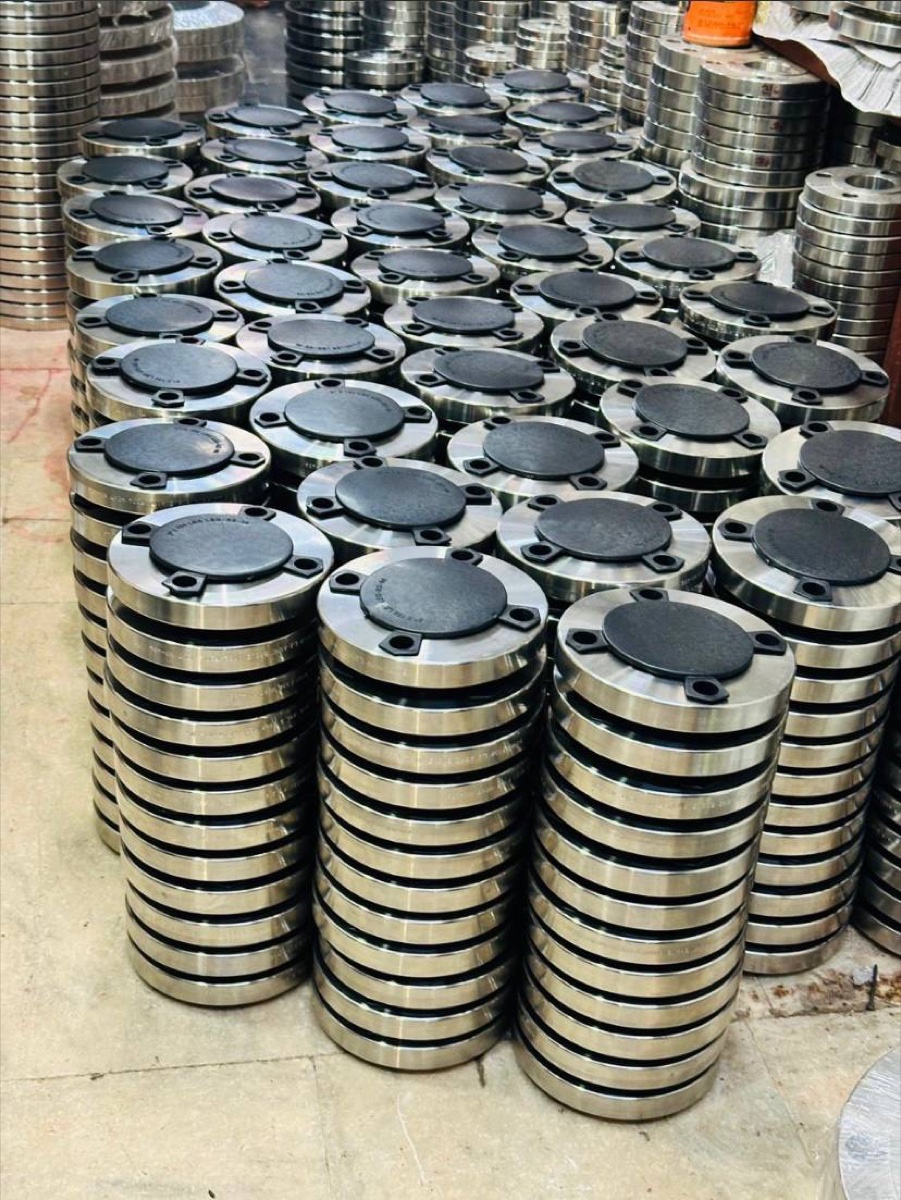
Hot corrosive chemical duty and European-engineered plants: chemical and petrochemical process lines running 400-550 °C, heat-exchanger and reactor connections, dye and fertiliser plants, pulp and paper, exhaust and hot-gas systems with corrosive condensates, and any project whose piping classes are written around 1.4571. Our stainless production and packing below:
Stainless Slip On Flanges — Wrapped & Bagged for ExportStainless Flanges — Face-Protected Stacks at Our Works
A182 F316Ti Slip On Flange Dimensions
F316Ti slip-on dimensions follow the ASME B16.5 slip-on tables — identical for every material — with EN 1092-1 dimensions applying to the European pattern. Full ASME charts by class:
Example: “Slip On Flange, 4″ NB, ASME B16.5 Class 150, RF, ASTM A182 F316Ti (1.4571), EN 10204 3.1 — 30 pcs.” Quotations normally within 24 hours with price, unit weight and delivery.
ASTM A182 F316Ti Slip On Flanges — Frequently Asked Questions
What is an ASTM A182 F316Ti slip on flange?
It is a slip-on flange forged from ASTM A182 F316Ti — titanium-stabilised stainless steel 316Ti (UNS S31635), known across European engineering as Werkstoff 1.4571 — dimensioned to ASME B16.5. The flange slides over the pipe end and is secured with two fillet welds, and the titanium addition ties up carbon against sensitization while adding hot strength: the continental workhorse of chemical plants running hot, corrosive duty.
What does the titanium in 316Ti do?
It stabilises the steel. Titanium bonds with carbon far more eagerly than chromium does, so the carbon precipitates as harmless titanium carbides instead of the chromium carbides that cause sensitization in weld zones and hot service. The chromium stays in solution, the passive film stays intact — through welding and through sustained 425-815 °C exposure. The same stabilising titanium also adds a measure of elevated-temperature strength over plain 316.
What is the chemical composition of ASTM A182 F316Ti?
For UNS S31635: carbon 0.08% max, manganese 2.00% max, silicon 1.00% max, phosphorus 0.045% max, sulphur 0.030% max, chromium 16.0-18.0%, nickel 10.0-14.0%, molybdenum 2.00-3.00%, nitrogen 0.10% max, and the defining addition: titanium at a minimum of five times the carbon-plus-nitrogen content, up to 0.70% max. It is 316's recipe with the carbon chemically neutralised rather than removed.
What are the mechanical properties of A182 F316Ti slip on flanges?
Tensile strength 515 MPa (75 ksi) minimum, yield strength 205 MPa (30 ksi) minimum, elongation 30% minimum in 2" and hardness 217 HB maximum — the same room-temperature numbers as standard 316, supplied solution annealed. The titanium's contribution appears at temperature: the stabilised carbides resist coarsening, giving 316Ti a modest strength and stability edge in the 400-550 °C band where plain 316 begins to sensitize.
What is the difference between 316Ti and 316L?
Two solutions to the same sensitization problem. 316L removes the carbon (0.030% max); 316Ti neutralises it with titanium. Historically Ti-stabilisation came first, and Europe standardised on 1.4571 while modern low-carbon melting made 316L the global default — for ambient and welded service the two perform equivalently. 316Ti keeps two advantages: better strength retention in sustained 400-550 °C service, and full immunity even at standard carbon levels. 316L counters with cleaner polishability, which is why pharma prefers it.
What is the difference between 316Ti and 321?
Molybdenum. Both are titanium-stabilised austenitics, but 321 is built on the 304 base (18Cr-9Ni, no Mo) while 316Ti is built on the 316 base with 2-3% molybdenum — adding chloride pitting resistance that 321 lacks. 321 is the aerospace and hot-air grade; 316Ti is the chemical-plant grade where heat and corrosive media meet. If the hot service also sees chlorides or acids, 316Ti is the stabilised grade to specify.
Why is 316Ti so common in European specifications?
Heritage and habit — earned honestly. German chemical engineering standardised on Werkstoff 1.4571 decades before low-carbon melting was routine, built an enormous installed base of plants around it, and DIN/EN piping classes still name it. When European-engineered plants are built or maintained anywhere in the world, their specifications call for 1.4571 — which is why we forge F316Ti to both ASME B16.5 and EN 1092-1 patterns, certified to the same heat.
What temperature range can F316Ti slip on flanges handle?
The full austenitic span, with a stabilised middle. Cryogenic service is unrestricted — no ductile-brittle transition — and ASME B16.5 rates the grade through the stainless tables. Its special value is the 400-550 °C band: hot enough to sensitize plain 316 in sustained service, where 316Ti's titanium keeps the chromium in solution and holds strength. For creep-governed duty above 538 °C the H grades carry the code stresses; 316Ti covers the hot-corrosive middle ground.
How is an A182 F316Ti slip on flange welded to pipe?
With two fillet welds — hub outside, bore inside, pipe set back 1/8" (3 mm) — no preheat, no PWHT. Filler practice: titanium transfers poorly across an arc, so 1.4571 is conventionally welded with the niobium-stabilised 318 type (1.4576) or simply with ER316L, both of which keep the joint stabilised or low-carbon respectively. The parent metal's stabilisation is unaffected either way — European fabricators have welded this combination for decades.
What is the equivalent of ASTM A182 F316Ti in other standards?
ASME SA182 F316Ti is the boiler-code twin; UNS S31635 the designation; and the name most of the world actually uses — EN X6CrNiMoTi17-12-2, Werkstoff 1.4571. JIS practice knows SUS 316Ti. System partners: ASTM A312 TP316Ti pipe, and in European projects the EN 10216-5 / EN 1092-1 family in 1.4571. Certificates always state the actual designations the heat satisfies.
Can 316Ti slip on flanges be used in seawater?
The same honest answer as all 316 variants: coastal atmosphere, splash and wash-down duty, yes — immersed or stagnant seawater, no. Titanium stabilisation changes sensitization behaviour, not pitting resistance, so 316Ti carries the same PREN of roughly 24-26 as 316/316L, short of what crevice-prone gasket faces demand in real seawater. Immersion and firewater duty belong to duplex 2205 and the super duplex grades.
When is 316Ti not enough — and what replaces it?
When chlorides get serious or the duty leaves its envelope. Immersed seawater, hot brines and high-chloride streams call for duplex 2205 and super duplex; acid-plus-chloride chemistry for 904L and 6-moly 254 SMO; reducing acids for nickel alloys. For creep-governed clean heat above 538 °C the controlled-carbon 316H carries higher code stresses, and for the hottest furnace duty 310 takes over. Within hot corrosive chemical service, 1.4571 remains the proven answer.
What sizes and classes are A182 F316Ti slip on flanges available in?
From ½" to 24" NB per ASME B16.5 in Classes 150 through 2500, plus EN 1092-1 flanges in 1.4571 for European specifications — the dual capability this grade particularly demands. 316Ti is project material rather than shelf stock, forged against the order from certified heats, with standard sizes normally dispatching within a few weeks with EN 10204 3.1 certification. State the required delivery on the enquiry and we confirm the schedule with the quotation.
What details are needed to get an accurate A182 F316Ti slip on flange quotation?
Five elements plus commercial terms: (1) size and standard — ASME B16.5 or EN 1092-1 with the PN rating; (2) pressure class — 150 through 2500 or the PN equivalent; (3) facing — SORF (raised face) default, flat face or RTJ where specified; (4) grade — ASTM A182 F316Ti / 1.4571, with intergranular corrosion testing where the project specifies; (5) certification — EN 10204 3.1 or 3.2. No pipe schedule is needed for the slip-on bore. Add the quantity and destination and we return price, weight and delivery.
Who manufactures ASTM A182 F316Ti slip on flanges in India?
Tesco Steel & Engineering is an ISO 9001:2015 certified flange manufacturer based in Mumbai, India, forging ASTM A182 F316Ti / 1.4571 slip on flanges from ½" to 24" NB per ASME B16.5 and to EN 1092-1 patterns — alongside 316, 316L, 316H and the stabilised grades 321 and 347 — in solution-annealed condition with full heat traceability and EN 10204 3.1/3.2 certification on every lot. Flanges are marked with grade, size, class and heat number and export to more than 50 countries.