ASTM A182 F317 / F317L Slip On Flanges — High Moly SS Manufacturer
Tesco Steel & Engineering forges ASTM A182 F317 / F317L slip on flanges — the high-molybdenum austenitic stainless (UNS S31700 / S31703) that raises 316's molybdenum to 3–4%, lifting pitting resistance a full step (PREN ~29–33) — to ASME B16.5 Class 150–2500 from ½″ to 24″ NB, larger patterns to order. The grade of FGD scrubbers, pulp & paper bleach plants and chloride-plus-acid process duty, commonly supplied as low-carbon 317L for welded service. Supplied solution annealed, with 316L, 904L and 254 SMO covering the rungs either side. Every lot with EN 10204 3.1/3.2 MTC. ISO 9001:2015, made in Mumbai, India — exported to 50+ countries.
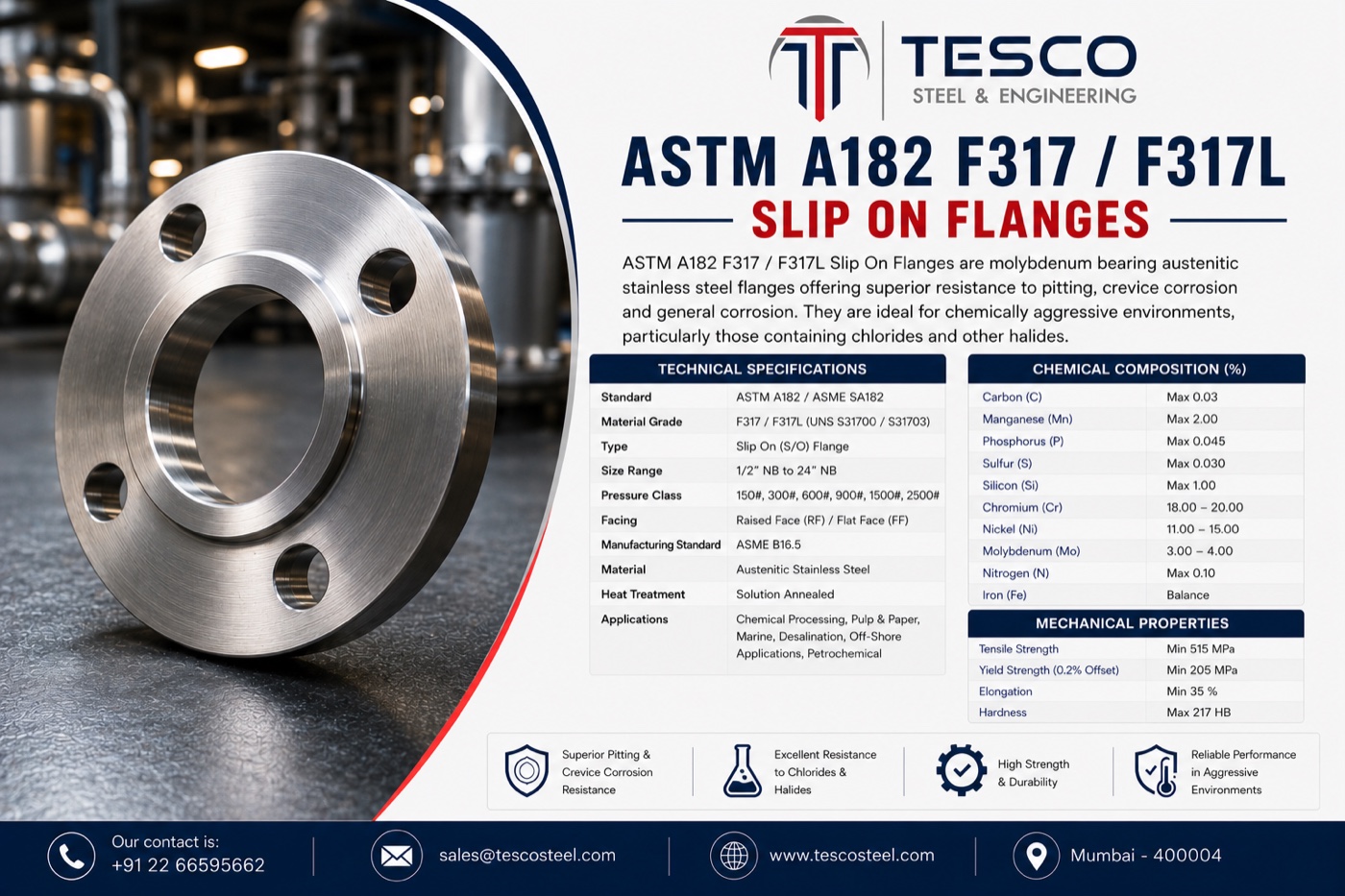
ASTM A182 F317 / F317L Slip On Flange — Specifications at a Glance
What is an ASTM A182 F317 Slip On Flange?
F317 = 316 with the molybdenum turned up.ASTM A182 F317 / F317L raises molybdenum to 3–4% (with nickel up to 11–15% to balance it), lifting the PREN to ~29–33 — a full step above 316 against pitting and crevice attack in hot, acidic, chloride-bearing service. The proven grade of FGD scrubbers and bleach plants, usually supplied as low-carbon 317L for welded fabrication. As a slip-on: two fillet welds, E317L filler, no preheat, no PWHT.
Also searched as: SS 317 slip on flange, 317L slip on flange, high moly stainless flange, SA182 F317 slip on flange, S31700 / S31703 slip on flange, 1.4438 flange, scrubber grade stainless flange — all refer to the product on this page. A dedicated F317L slip on flange page covers the low-carbon version in detail.
Rule of thumb: 317L is the bridge grade — the economical step when 316L keeps failing but 904L, 6-moly or duplex would be overkill.
ASTM A182 F317 / F317L Chemical Composition
C
Mn
Si
P
S
Cr
Ni
Mo
N
Fe
0.08 max (317) 0.030 max (317L)
2.00 max
1.00 max
0.045 max
0.030 max
18.0-20.0
11.0-15.0
3.00-4.00
0.10 max
Bal
Values in weight % for UNS S31700 / S31703. Against 316 the molybdenum rises a full point and the nickel follows to hold the austenite — lifting the PREN from ~24-26 to roughly 29-33. The 0.030% carbon cap defines the L version.
ASTM A182 F317 / F317L Mechanical Properties
Tensile Strength, MPa (ksi)
Yield Strength, Min, MPa (ksi)
Elongation % min (2")
Hardness, HB max
515 (75) min
205 (30) min
30
217
Supplied solution annealed — and notably the same minimums for both 317 and 317L: the higher molybdenum and nitrogen carry the strength that leaner L grades give up. Values demonstrated per heat on the EN 10204 certificate.
A182 F317 / F317L Slip On Flange Specifications
ASTM A182 F317 / F317L Slip On Flanges are available in the following specifications:
Material
ASTM A182 F317 / F317L / ASME SA182 (UNS S31700 / S31703); 317L is the common welded-service supply
Size
1/2"NB to 24"NB per ASME B16.5; larger patterns to order
Class
150#, 300#, 400#, 600#, 900#, 1500#, 2500#
Facing
Raised Face (SORF) — default; Flat Face or RTJ where the piping class specifies
Heat Treatment
Solution annealed per ASTM A182, thermal record retained
Two fillet welds (hub + bore), pipe set back 1/8"; E317L/ER317L consumables, no preheat, no PWHT
Testing
Intergranular corrosion testing (e.g. ASTM A262) on request
Certification
EN 10204 3.1 (standard) / 3.2 witnessed
Equivalent Grades of ASTM A182 F317 / F317L
Standard
Werkstoff Nr.
UNS
JIS
EN (317L)
SS 317 / 317L
1.4438
S31700 / S31703
SUS 317L
X2CrNiMo18-15-4
ASME SA182 is the boiler-code twin. System partners: ASTM A312 TP317L pipe and A403 WP317L fittings — the high-moly trio of scrubber and bleach-plant piping. Certificates always state every designation the heat satisfies.
Why A182 F317 / F317L Slip Ons Are Specified
A Full Point More Molybdenum
3–4% Mo lifts the PREN to ~29–33 — visibly longer life than 316L in hot, acidic, chloride-bearing streams.
The Scrubber-Proven Grade
FGD absorbers and bleach washers wrote 317L into their specifications after decades of retiring 316L early — service history, not theory.
L Without the Strength Penalty
Unlike 316L, the L version keeps the full 515/205 MPa minimums — the extra Mo and N carry what the carbon gave up.
Austenitic Simplicity
No duplex temperature ceiling, no special welding discipline — E317L fillet welds and full cryogenic capability with ordinary shop practice.
How Our A182 F317 / F317L Slip On Flanges Are Manufactured
1
Forging — cut billet of certified A182 F317 / F317L heat is hot-forged into the flange blank, keeping full heat traceability from raw material to despatch.
2
Solution annealing — heated and quenched per ASTM A182 to dissolve carbides and restore the fully austenitic, corrosion-ready condition; furnace record retained.
3
Machining — hub, faces and bolt holes to ASME B16.5; the bore machined slightly over pipe OD per the slip-on tolerance.
4
Facing & finish — SORF raised face with serrated stock finish, flat face or RTJ groove; pickled and passivated on request.
5
Testing & marking — mechanical and chemical verification against the heat, the qualifying carbon on every certificate (ASTM A262 intergranular testing where the order specifies), then permanent marking of grade, size, class and heat number.
6
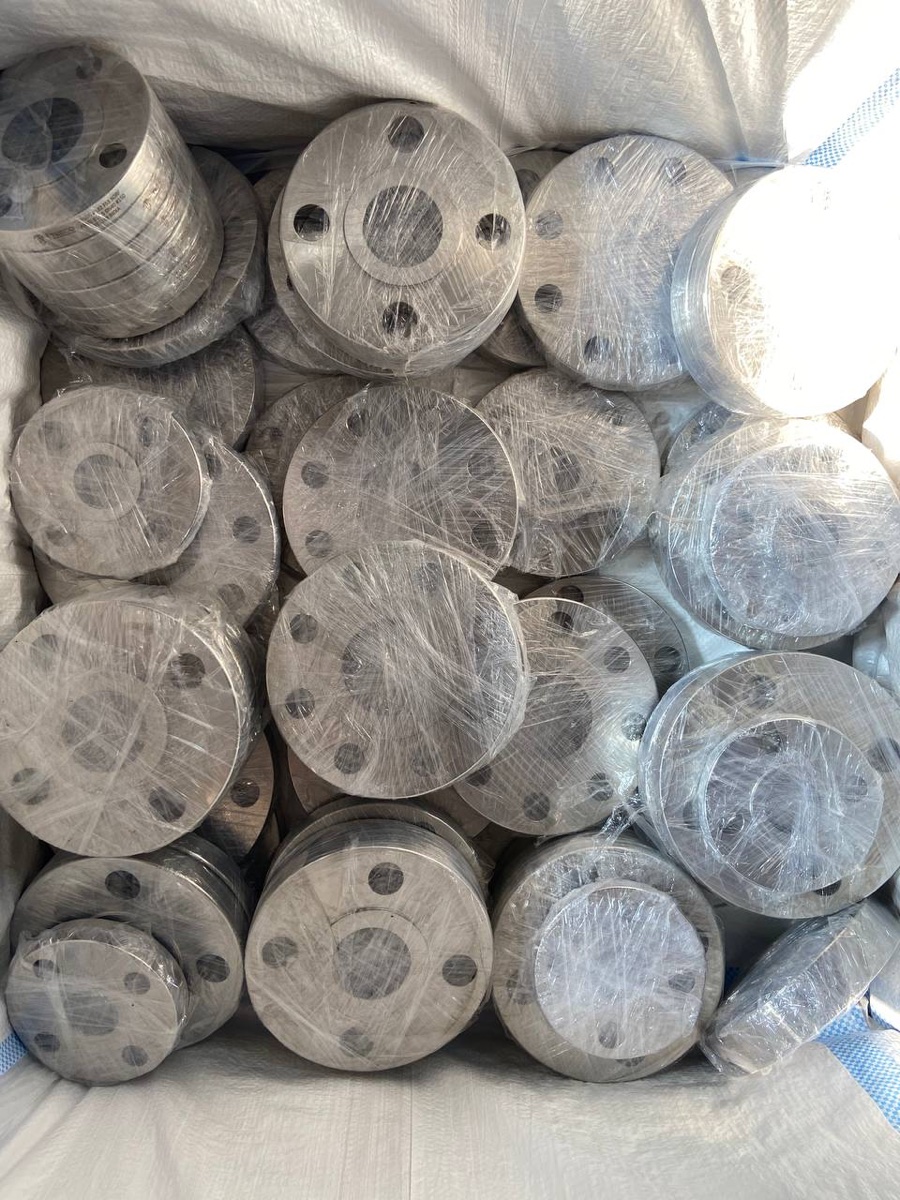
Certification & packing — EN 10204 3.1 MTC (3.2 witnessed on request), export-packed as pictured on this page.
Where A182 F317 / F317L Slip On Flanges Are Used
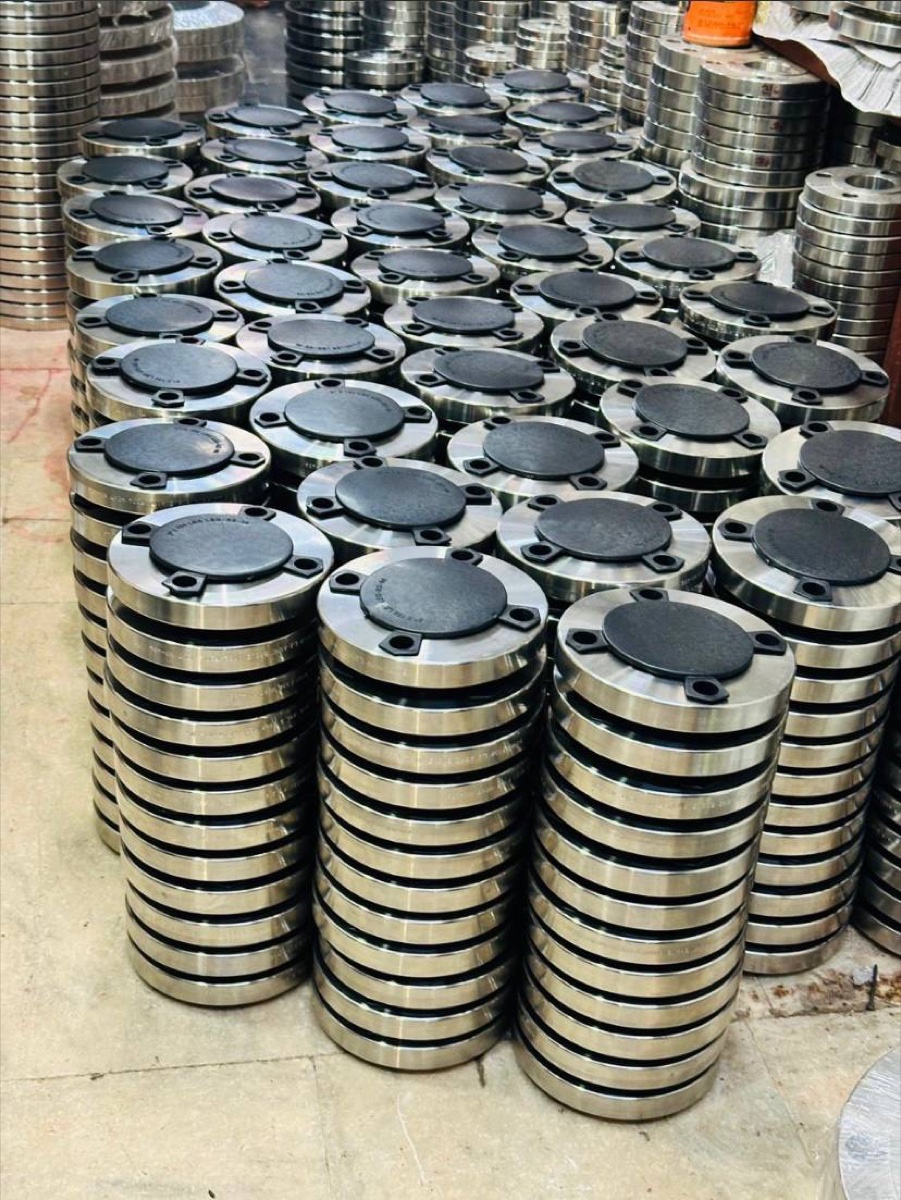
Chloride-plus-acid territory: flue-gas desulfurization absorbers and recycle loops, pulp-and-paper bleach washers and towers, chemical process lines with hot acidic chlorides, textile and dye chemistry, condensing SO2/SO3 environments, and desalination pretreatment where 316L keeps pitting. Our stainless production and packing below:
Stainless Slip On Flanges — Wrapped & Bagged for ExportStainless Flanges — Face-Protected Stacks at Our Works
A182 F317 Slip On Flange Dimensions
F317 slip-on dimensions follow the ASME B16.5 slip-on tables — identical for every material. Full charts by class:
Example: “Slip On Flange, 4″ NB, ASME B16.5 Class 150, RF, ASTM A182 F317L, EN 10204 3.1 — 20 pcs.” Quotations normally within 24 hours with price, unit weight and delivery.
ASTM A182 F317 Slip On Flanges — Frequently Asked Questions
What is an ASTM A182 F317 slip on flange?
It is a slip-on flange forged from ASTM A182 F317 / F317L — the high-molybdenum austenitic stainless (UNS S31700 / S31703) that raises 316's molybdenum to 3-4% — dimensioned to ASME B16.5. The flange slides over the pipe end and is secured with two fillet welds, and the extra molybdenum lifts pitting and crevice resistance a full step above 316: the grade of FGD scrubbers, pulp-and-paper bleach plants and chloride-plus-acid process duty.
What is the difference between 317 and 317L?
Carbon — the familiar L-grade logic. Straight 317 allows carbon to 0.08%; 317L caps it at 0.030%, welding without sensitization, and is what the grade's home industries actually specify: scrubber and bleach-plant duty is welded fabrication in corrosive service, exactly where the L version belongs. Usefully, 317L retains the full 515/205 MPa strength minimums rather than trading strength away as 316L does. Most supply is 317L or dual-certified; state the version your specification names.
What is the chemical composition of ASTM A182 F317 / F317L?
For UNS S31700 / S31703: chromium 18.0-20.0%, nickel 11.0-15.0%, molybdenum 3.00-4.00%, manganese 2.00% max, silicon 1.00% max, phosphorus 0.045% max, sulphur 0.030% max, nitrogen 0.10% max, with carbon 0.08% max for 317 and 0.030% max for 317L. Against 316 the molybdenum rises a full point and the nickel follows to hold the austenite — lifting the PREN from ~24-26 to roughly 29-33.
What are the mechanical properties of A182 F317 slip on flanges?
Tensile strength 515 MPa (75 ksi) minimum, yield strength 205 MPa (30 ksi) minimum, elongation 30% minimum in 2" and hardness 217 HB maximum — supplied solution annealed, and notably the same minimums for both 317 and 317L: the higher molybdenum and nitrogen carry the strength that leaner L grades give up. Values are demonstrated per heat on the EN 10204 certificate.
What is the difference between 317L and 316L?
One more point of molybdenum — 3-4% against 2-3% — and more nickel to balance it. That lifts the PREN from roughly 24-26 to 29-33, buying visibly better pitting and crevice resistance in hot, acidic, chloride-bearing service: the difference between a scrubber lining that lasts and one that pits through. 316L remains the economical choice for ordinary chloride duty; 317L is the step specifications take when 316L keeps failing but exotic alloys aren't yet justified.
Why is 317L the named grade for FGD scrubbers and bleach plants?
Because those services combine everything that attacks stainless at once: hot condensing acids, high chlorides, and crevice-prone welded construction. Flue-gas desulfurization absorbers and pulp bleach washers retired 316L early and repeatedly; 317L's extra molybdenum proved the economical fix, and decades of service wrote it into the industry specifications. Where scrubber chemistry runs harsher still — high chloride, low pH — the escalation continues to 904L and 6-moly.
When is 317L not enough — and what replaces it?
When the chloride-acid combination outruns PREN ~30. Hot brines, low-pH high-chloride scrubber loops and seawater-strength chlorides call for 904L (more nickel and copper for acids), 6-moly 254 SMO (PREN ~43), or duplex and super duplex where strength and SCC resistance matter too. For reducing acids outright, nickel alloys take over. 317L's economic sweet spot is the broad band where 316L fails and those premium alloys would be overkill.
How does 317L compare with duplex 2205?
Similar pitting resistance, different personalities. Duplex 2205 (PREN ~34) adds double the yield strength and superior chloride-SCC resistance, at the price of a 250 °C service ceiling and duplex welding discipline. 317L stays fully austenitic: no temperature ceiling games, effortless weldability, cryogenic capability, better tolerance of the hot acidic condensates scrubbers generate. Chloride-stress-driven duty favours duplex; hot acid-plus-chloride chemistry and simple fabrication favour 317L.
What temperature range can F317 slip on flanges handle?
The full austenitic span: no ductile-brittle transition downward, so cryogenic duty is unrestricted, and ASME B16.5 rates the grade through the stainless tables. In practice its services are wet and warm rather than hot — scrubber and bleach circuits run well below 200 °C — and for sustained duty above about 425 °C the low-carbon version's creep strength argues for other grades. Unlike duplex alternatives, there is no 250 °C ceiling to design around.
How is an A182 F317 slip on flange welded to pipe?
With two fillet welds — hub outside, bore inside, pipe set back 1/8" (3 mm) — using E317L/ER317L consumables, no preheat, no PWHT, and with the L grade no sensitization concern afterwards. It welds like any 300-series stainless, which is precisely its advantage over duplex alternatives in field fabrication: ordinary austenitic practice delivers the corrosion performance.
What is the equivalent of ASTM A182 F317 / F317L in other standards?
ASME SA182 is the boiler-code twin; UNS S31700 (317) and S31703 (317L) the designations; the European equivalent for 317L is X2CrNiMo18-15-4, Werkstoff 1.4438; JIS practice uses SUS 317L. System partners specified alongside it: ASTM A312 TP317L pipe and A403 WP317L fittings — the high-moly trio of scrubber and bleach-plant piping. Certificates always state every designation the heat satisfies.
Can 317L slip on flanges be used in seawater?
It buys real margin over 316L in brackish, splash and chloride-adjacent service, but PREN ~29-33 still falls short of what crevice-prone gasket faces demand in genuine seawater immersion — that territory starts at duplex 2205 and belongs decisively to super duplex and 6-moly. Treat 317L as the bridge grade: the honest upgrade for chloride-bearing process water, not a seawater immersion alloy.
What sizes and classes are A182 F317 slip on flanges available in?
From ½" to 24" NB per ASME B16.5 in Classes 150 through 2500, with larger patterns forged to order. 317/317L is project material rather than shelf stock — forged against the order from certified heats, usually as 317L or dual-certified — with standard sizes normally dispatching within a few weeks with EN 10204 3.1 certification. State the required delivery on the enquiry and we confirm the schedule with the quotation.
What details are needed to get an accurate A182 F317 slip on flange quotation?
Five elements plus commercial terms: (1) size and standard — e.g. 4" NB ASME B16.5; (2) pressure class — 150 through 2500; (3) facing — SORF (raised face) default, flat face or RTJ where specified; (4) grade — F317 or F317L per the piping specification, with intergranular corrosion testing where the project specifies; (5) certification — EN 10204 3.1 or 3.2. No pipe schedule is needed for the slip-on bore. Add the quantity and destination and we return price, weight and delivery.
Who manufactures ASTM A182 F317 slip on flanges in India?
Tesco Steel & Engineering is an ISO 9001:2015 certified flange manufacturer based in Mumbai, India, forging ASTM A182 F317 and F317L slip on flanges from ½" to 24" NB per ASME B16.5 — alongside 316/316L and the higher rungs 904L and 254 SMO — in solution-annealed condition with full heat traceability and EN 10204 3.1/3.2 certification on every lot. Flanges are marked with grade, size, class and heat number and export to more than 50 countries.