ASTM A182 F310 / 310S Slip On Flanges — Heat Resistant SS Manufacturer
Tesco Steel & Engineering forges ASTM A182 F310 / 310S slip on flanges — the 25% chromium, 20% nickel heat-resisting stainless (UNS S31000 / S31008) whose thick, stable oxide scale survives furnace-territory temperatures where every other standard stainless scales away — to ASME B16.5 Class 150–2500 from ½″ to 24″ NB, larger patterns to order. Oxidation resistance to ~1100 °C continuous; the flange of furnaces, kilns, heat-treatment plants and hot flue systems, commonly supplied as low-carbon 310S. Solution annealed, with the hot-service family 304H, 316H, 321, 347 from the same forge. Every lot with EN 10204 3.1/3.2 MTC. ISO 9001:2015, made in Mumbai, India — exported to 50+ countries.
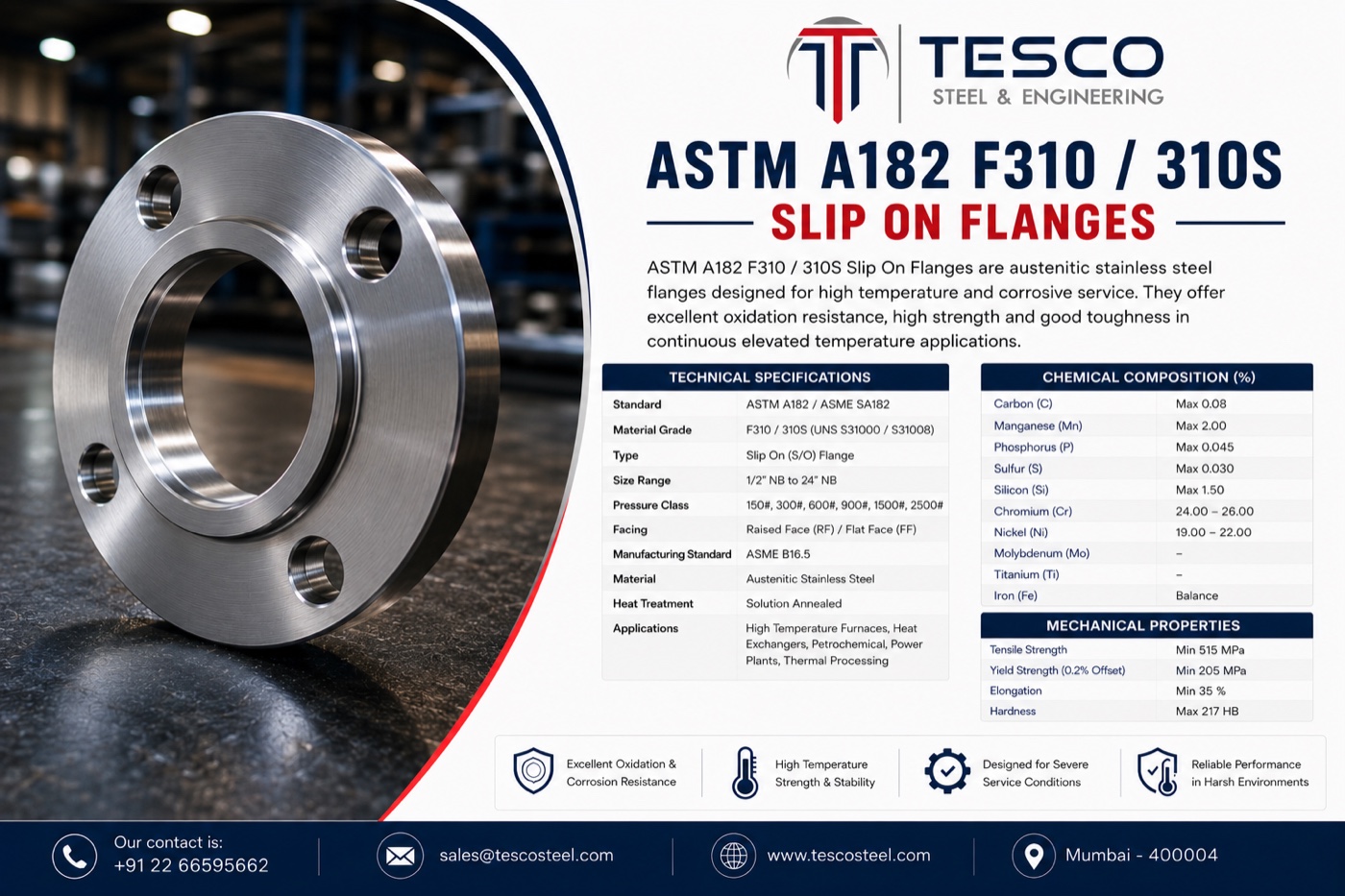
ASTM A182 F310 / 310S Slip On Flange — Specifications at a Glance
What is an ASTM A182 F310 Slip On Flange?
F310 = the furnace-territory stainless.ASTM A182 F310 / 310S doubles 304's recipe to 25Cr-20Ni: the chromium feeds a thick, adherent oxide scale, the nickel keeps the austenite stable beneath it — oxidation resistance to ~1035 °C cyclic / 1100 °C continuous, hundreds of degrees past every leaner grade. The flange of furnaces, kilns and hot flues, usually supplied as low-carbon 310S, dual-certified. As a slip-on: two fillet welds, E310 filler, no preheat, no PWHT.
Also searched as: SS 310 slip on flange, 310S slip on flange, heat resistant stainless flange, SA182 F310 slip on flange, S31000 / S31008 slip on flange, 1.4845 flange, 25Cr-20Ni flange — all refer to the product on this page.
Rule of thumb: to ~870 °C the choice is governed by creep stress (H grades) or cycling (stabilised grades). Past it, only the 25Cr-20Ni scale survives — that is 310's territory. Hotter still belongs to nickel alloys.
ASTM A182 F310 / 310S Chemical Composition
C
Mn
Si
P
S
Cr
Ni
Fe
0.15 max (310) 0.08 max (310S)
2.00 max
1.00 max
0.045 max
0.030 max
24.0-26.0
19.0-22.0
Bal
Values in weight %. Roughly double the chromium and nickel of 304 — the chromium builds the protective scale, the nickel keeps the structure stable and tough through extreme thermal exposure. Most supply is dual-certified 310/310S.
ASTM A182 F310 Mechanical Properties
Tensile Strength, MPa (ksi)
Yield Strength, Min, MPa (ksi)
Elongation % min (2")
Hardness, HB max
515 (75) min
205 (30) min
30
217
Familiar austenitic numbers at room temperature, supplied solution annealed — the grade's value is what remains at extreme heat, where the 25Cr-20Ni matrix retains useful strength and its scale long after leaner grades have oxidised away. Values demonstrated per heat on the EN 10204 certificate.
A182 F310 Slip On Flange Specifications
ASTM A182 F310 / 310S Slip On Flanges are available in the following specifications:
1/2"NB to 24"NB per ASME B16.5; larger patterns to order
Class
150#, 300#, 400#, 600#, 900#, 1500#, 2500#
Facing
Raised Face (SORF) — default; Flat Face or RTJ where the piping class specifies
Heat Treatment
Solution annealed per ASTM A182, thermal record retained
Service
Furnace-territory heat — alloy oxidation to ~1100 °C continuous; B16.5 flange ratings to 815 °C; cryogenic capable
Installation
Two fillet welds (hub + bore), pipe set back 1/8"; E310/ER310 consumables, no preheat, no PWHT
Atmosphere Note
Not for reducing sulfur-bearing hot gas — high nickel forms low-melting sulfides; review carburising service
Certification
EN 10204 3.1 (standard) / 3.2 witnessed
Equivalent Grades of ASTM A182 F310 / 310S
Standard
Werkstoff Nr.
UNS
JIS
EN
SS 310 / 310S
1.4845
S31000 / S31008
SUS 310S
X8CrNi25-21
ASME SA182 is the boiler-code twin. System partners: ASTM A312 TP310S pipe and A403 WP310S fittings — the heat-resisting trio of furnace and flue piping. Certificates always state every designation the heat satisfies.
Why A182 F310 Slip Ons Are Specified
A Scale That Survives 1000 °C
25% chromium regrows the protective oxide faster than furnace heat can spall it — hundreds of degrees past where 304-family grades scale away.
Stable to the Core
20% nickel keeps the austenite fully stable through extreme thermal exposure — no embrittling phase games, tough from −196 °C to furnace duty.
Ordinary Fabrication, Extraordinary Heat
E310 fillet welds, no preheat, no PWHT — furnace-grade metallurgy with everyday austenitic workshop practice.
310S by Default
Low-carbon 310S supply welds cleaner and stays tougher after long service — dual-certified so either specification is satisfied on one certificate.
How Our A182 F310 Slip On Flanges Are Manufactured
1
Forging — cut billet of certified A182 F310 / 310S heat is hot-forged into the flange blank, keeping full heat traceability from raw material to despatch.
2
Solution annealing — heated and quenched per ASTM A182 to restore the fully austenitic, corrosion-ready condition; furnace record retained.
3
Machining — hub, faces and bolt holes to ASME B16.5; the bore machined slightly over pipe OD per the slip-on tolerance.
4
Facing & finish — SORF raised face with serrated stock finish, flat face or RTJ groove; pickled and passivated on request.
5
Testing & marking — mechanical and chemical verification against the heat (intergranular corrosion testing where the order specifies), then permanent marking — dual 310/310S where the heat qualifies — with size, class and heat number.
6
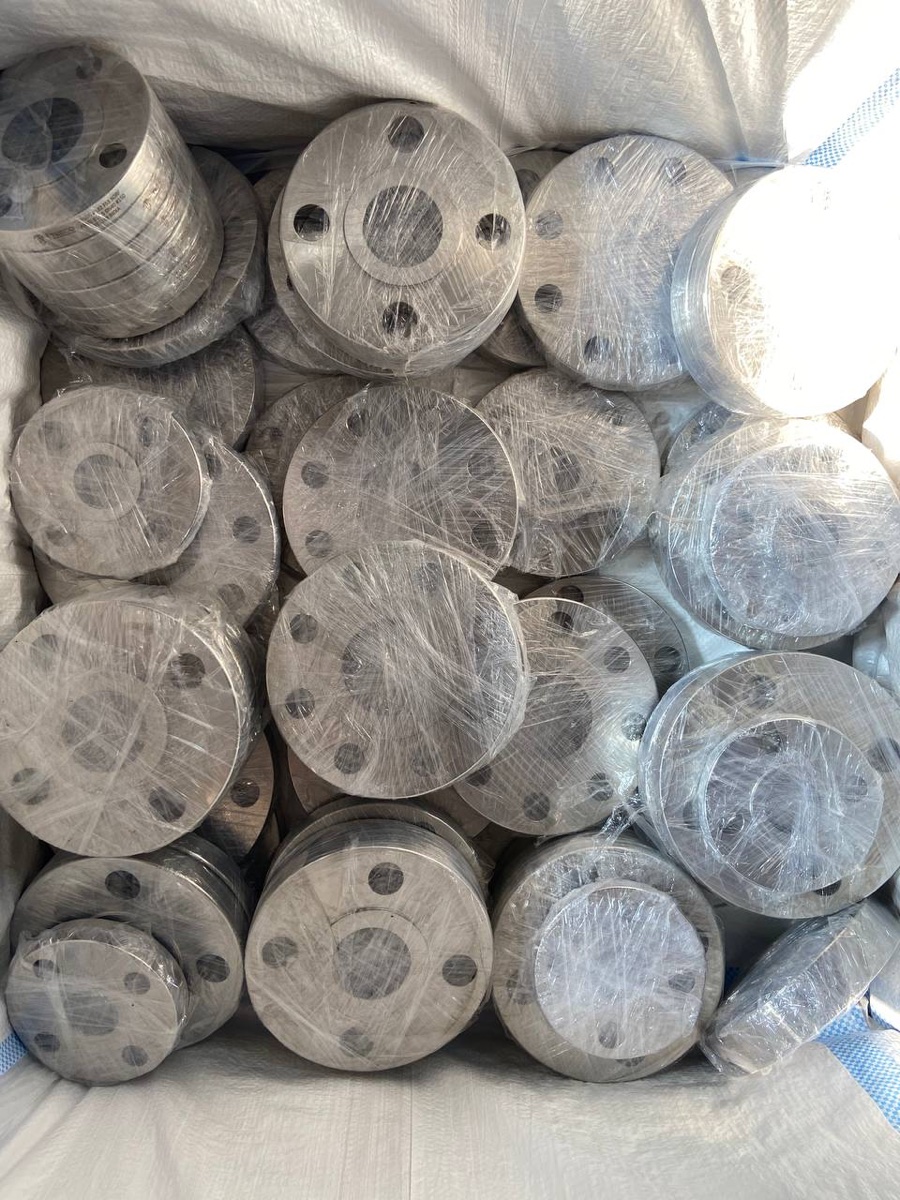
Certification & packing — EN 10204 3.1 MTC (3.2 witnessed on request), export-packed as pictured on this page.
Where A182 F310 Slip On Flanges Are Used
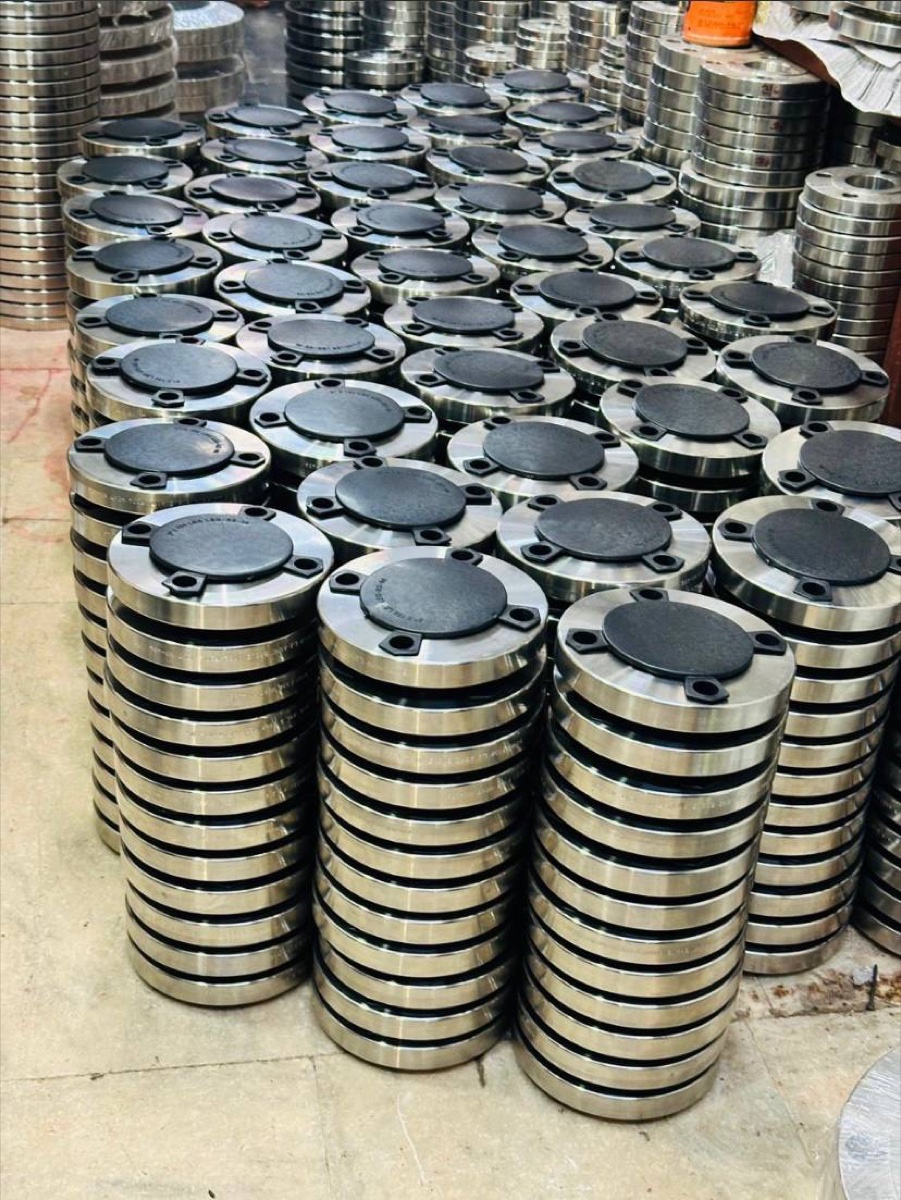
Furnace territory: industrial furnace and kiln connections, heat-treatment plant piping, radiant sections and hot flue-gas systems, thermal oxidisers and incinerators, combustion air preheat, power-plant hot ducting, and petrochemical fired equipment — the oxidising hot services leaner stainless cannot survive. Our stainless production and packing below:
Stainless Slip On Flanges — Wrapped & Bagged for ExportStainless Flanges — Face-Protected Stacks at Our Works
A182 F310 Slip On Flange Dimensions
F310 slip-on dimensions follow the ASME B16.5 slip-on tables — identical for every material. Full charts by class:
Example: “Slip On Flange, 4″ NB, ASME B16.5 Class 150, RF, ASTM A182 F310S (dual 310/310S), EN 10204 3.1 — 20 pcs.” Quotations normally within 24 hours with price, unit weight and delivery.
ASTM A182 F310 Slip On Flanges — Frequently Asked Questions
What is an ASTM A182 F310 slip on flange?
It is a slip-on flange forged from ASTM A182 F310 / 310S — the 25% chromium, 20% nickel heat-resisting stainless steel (UNS S31000 / S31008) — dimensioned to ASME B16.5. The flange slides over the pipe end and is secured with two fillet welds, and the doubled chromium and nickel build a thick, stable oxide scale that survives furnace-territory temperatures where every other standard stainless scales away. It is the flange of furnaces, kilns, heat-treatment plants and hot flue systems.
What is the difference between 310 and 310S?
Carbon — the same logic as 304 versus 304L. Straight 310 allows carbon to 0.15% for maximum hot strength; 310S caps it at 0.08%, improving weldability and toughness after long service, and is what mills melt and flange buyers receive by default — most material is dual-certified 310/310S on one certificate. A 310H variant with a controlled carbon minimum exists for creep-governed designs. State the version your specification names and the certificate follows.
What is the chemical composition of ASTM A182 F310 / 310S?
The defining recipe is 25Cr-20Ni: chromium 24.0-26.0%, nickel 19.0-22.0%, manganese 2.00% max, silicon 1.00% max, phosphorus 0.045% max, sulphur 0.030% max, with carbon 0.15% max for straight 310 and 0.08% max for 310S. Roughly double the chromium and nickel of 304 — the chromium builds the protective scale, the nickel keeps the structure stable and tough through extreme thermal exposure.
What are the mechanical properties of A182 F310 slip on flanges?
Tensile strength 515 MPa (75 ksi) minimum, yield strength 205 MPa (30 ksi) minimum, elongation 30% minimum in 2" and hardness 217 HB maximum — supplied solution annealed. Familiar austenitic numbers at room temperature; the grade's value is what remains at extreme heat, where the 25Cr-20Ni matrix retains useful strength and its scale long after leaner grades have oxidised away. Values are demonstrated per heat on the EN 10204 certificate.
Why does 310 resist heat better than other stainless grades?
Scale stability. Every stainless grows a chromium-oxide skin, but at furnace temperatures the leaner grades cannot regrow it as fast as it spalls — 304's practical oxidation limit is about 870 °C. With 25% chromium feeding the scale and 20% nickel keeping the austenite stable beneath it, 310 holds a protective, adherent oxide to roughly 1035 °C in cyclic and 1100 °C in continuous service — genuine furnace territory, achieved with ordinary austenitic fabrication.
What temperature range can F310 slip on flanges handle?
Two numbers matter. The alloy itself resists oxidation to roughly 1035 °C cyclic / 1100 °C continuous — the reason it is bought. The bolted joint is rated separately: ASME B16.5 tables run to 815 °C, and in practice gaskets and bolting set the working ceiling of any flanged connection. So 310 flanges typically serve the connections around furnace and flue systems — where 815 °C-class joints meet 1000 °C-class equipment — plus unrestricted cryogenic duty at the other extreme.
When is 310 chosen over 304H or 316H?
When oxidation, not creep stress, governs. The H grades carry the code's highest allowable stresses to 815 °C and are the right buy for pressure-governed creep design — but their scale gives out around 870 °C. 310 flips the trade: moderate code stresses, but a scale that survives hundreds of degrees hotter. Flue systems, furnace connections and low-pressure hot ducting live in exactly that regime, which is why they specify 310 over the H grades.
When is 310 chosen over the stabilised grades 321 and 347?
By temperature. The stabilised grades solve sensitization and serve cyclic duty superbly, but their oxidation limit sits near 870 °C like the rest of the 18-8 family. Past that, stabilisation is irrelevant — the steel itself scales away — and only the 25Cr-20Ni chemistry keeps a protective skin. The working split: 321/347 for cyclic duty to ~870 °C, 310 for the genuinely hot end beyond it.
Are there atmospheres where 310 should not be used?
Yes — reducing, sulfur-bearing atmospheres are the classic trap. The 20% nickel that stabilises the grade forms low-melting nickel sulfides when hot sulfur gas lacks oxygen, attacking the steel along grain boundaries. Oxidising sulfur service is tolerable; reducing flue or process gas with H2S is not — lower-nickel heat resistors or specialised alloys serve there. Strongly carburising atmospheres also merit review. For clean air, combustion gas and oxidising service, 310 is the standard answer.
How is an A182 F310 slip on flange welded to pipe?
With two fillet welds — hub outside, bore inside, pipe set back 1/8" (3 mm) — using matching E310/ER310 consumables, no preheat, no PWHT. The 310S low-carbon version is the friendlier welding proposition and is the default supply. The fully austenitic weld metal deserves modest heat input and care against hot cracking, but this is routine practice for any stainless fabricator.
What is the equivalent of ASTM A182 F310 in other standards?
ASME SA182 is the boiler-code twin; UNS S31000 (310) and S31008 (310S) the designations; the European equivalent is X8CrNi25-21, Werkstoff 1.4845; JIS practice uses SUS 310S. System partners specified alongside it: ASTM A312 TP310S pipe and A403 WP310S fittings — the heat-resisting trio of furnace and flue piping. Certificates always state every designation the heat satisfies.
Can F310 flanges be used at cryogenic temperatures too?
Yes — it is still an austenitic stainless, with no ductile-brittle transition, and its high nickel makes it exceptionally tough at deep cold. The same grade family serves both extremes of the temperature scale, though in practice 304L/316L cover cryogenic duty more economically. Where a plant standardises on one stainless across a furnace section and adjacent cold systems, 310's full-span capability is a genuine convenience.
What sizes and classes are A182 F310 slip on flanges available in?
From ½" to 24" NB per ASME B16.5 in Classes 150 through 2500, with larger patterns forged to order. 310/310S is project material rather than shelf stock — forged against the order from certified heats, usually dual-marked 310/310S — with standard sizes normally dispatching within a few weeks with EN 10204 3.1 certification. State the required delivery on the enquiry and we confirm the schedule with the quotation.
What details are needed to get an accurate A182 F310 slip on flange quotation?
Five elements plus commercial terms: (1) size and standard — e.g. 4" NB ASME B16.5; (2) pressure class — 150 through 2500; (3) facing — SORF (raised face) default, flat face or RTJ where specified; (4) grade — F310, 310S or dual-certified, with intergranular corrosion testing where the project specifies; (5) certification — EN 10204 3.1 or 3.2. No pipe schedule is needed for the slip-on bore. Add the quantity and destination and we return price, weight and delivery.
Who manufactures ASTM A182 F310 slip on flanges in India?
Tesco Steel & Engineering is an ISO 9001:2015 certified flange manufacturer based in Mumbai, India, forging ASTM A182 F310 / 310S slip on flanges from ½" to 24" NB per ASME B16.5 — alongside the hot-service grades 304H, 316H, 321 and 347 — in solution-annealed condition with full heat traceability and EN 10204 3.1/3.2 certification on every lot. Flanges are marked with grade, size, class and heat number and export to more than 50 countries.