Inconel 625 Long Weld Neck Flanges — UNS N06625 NiCrMo LWN Manufacturer
Tesco Steel & Engineering manufactures Inconel 625 long weld neck flanges — the bench's strong descendant: ASTM B564, UNS N06625, W.Nr. 2.4856, NiCr22Mo9Nb — with ASME B16.5 flange ends in Classes 150–2500 and the barrel made to order. The trades against Alloy 600 aim at wet severity: 8–10% molybdenum for a chloride film past PREN 50, and the famously precise 3.15–4.15% niobium delivering 827/414 MPa straight from the anneal — the strongest annealed certificate on this LWN bench, needing no ageing and surviving fabrication intact. The franchises stack on one certificate: subsea hardware, sour gas per NACE MR0175/ISO 15156, mixed reducing and oxidising acids, hot brines — the alloy engineers reach for when the service refuses to pick a single enemy. The honesty rides along: Grade 1 anneal for wet severity, Grade 2 for creep — order the condition the duty needs, and hand off to the single-enemy specialists — super duplex for seawater economics, 800H for code creep, C-276 for the reducing extremes — whenever one job can be done for less. One forging, one closing weld with ERNiCrMo-3 — the most borrowed filler wire in corrosion engineering. Facings: RF / FF / RTJ; small bore on the Inconel 625 socketweld. Every lot with EN 10204 3.1/3.2 MTC. ISO 9001:2015, made in Mumbai, India — exported to 50+ countries.
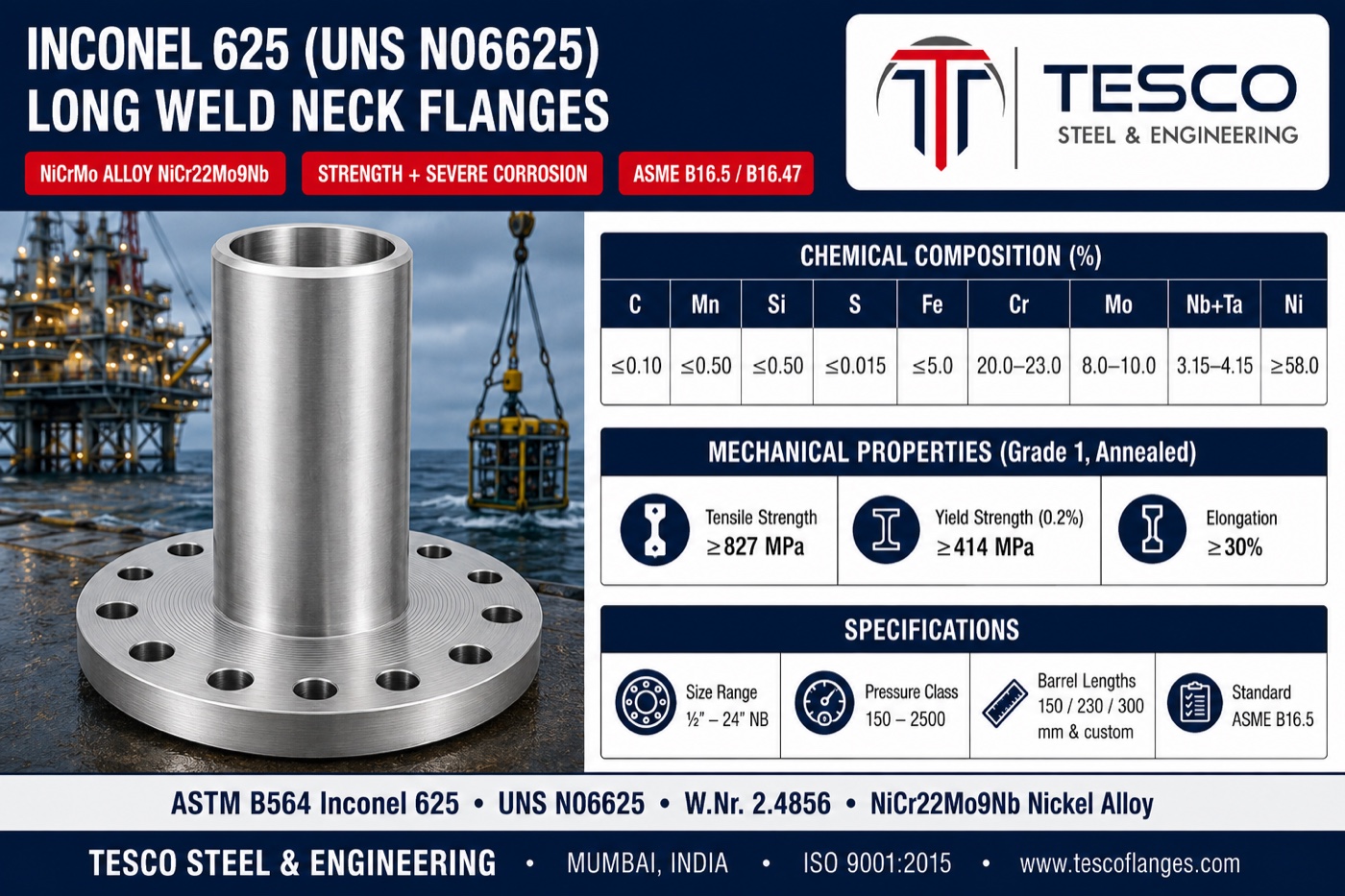
ASTM B564 · UNS N06625 · W.Nr. 2.4856NiCr22Mo9Nb — Mo for the Film, Nb for the Strength827 / 414 MPa — Strongest Annealed CertificatePREN >50 · NACE MR0175 Sour StandingSubsea · Acids · Hot Brines · HeatERNiCrMo-3 — The Borrowed FillerB16.5 Flange Ends · Class 150–2500EN 10204 3.1 / 3.2 · ISO 9001:2015
Inconel 625 Long Weld Neck Flanges — Specifications at a Glance
What is an Inconel 625 Long Weld Neck Flange?
The strong descendant, in the nozzle pattern. An Inconel 625 flange (UNS N06625, ASTM B564) whose neck continues as a long, heavy-walled straight barrel — the nozzle itself — bevelled for one closing butt weld at the manifold, vessel or subsea structure. Molybdenum 8–10% for a film past PREN 50; niobium 3.15–4.15% for 827/414 MPa straight from the anneal — the strongest annealed certificate on the bench, surviving fabrication intact. Franchises on one certificate: subsea, NACE MR0175 sour gas, mixed acids, hot brines. Welds with ERNiCrMo-3, no PWHT. Flange ends per ASME B16.5, Classes 150–2500; barrel length and bore stated by you. EN 10204 3.1 on every lot.
The rule of the do-everything alloy:625 wins when the service refuses to pick a single enemy — and hands off whenever a single-enemy specialist does that one job for less.
What the Mo + Nb Recipe Buys
The Film Past PREN 50
8–10% molybdenum on 20–23% chromium — pitting and crevice resistance above the super duplex twins, with nickel-base SCC immunity no iron-based grade can offer.
Strength Without Ageing
The precise 3.15–4.15% niobium works in solution: 827/414 MPa straight from the anneal — no precipitation cycle, no weld-zone ageing loss, the certificate survives fabrication intact.
Both Sides of the Acid Street
Chromium for oxidising media, molybdenum for reducing — mixed and swinging acid chemistry, the duty that defeats single-purpose alloys, is where 625 earns its keep.
The Sour-Service Standing
NACE MR0175/ISO 15156 practice for H2S environments — the oil field's own qualification, carried in the annealed condition this page supplies.
Specification Notes — Getting Inconel 625 Long Weld Necks Right
Three honest notes.Name the condition: Grade 1 anneal (our standard) maximises strength and corrosion performance to ~600 °C; Grade 2 solution anneal serves creep duty above — ordering the wrong one wastes the alloy's tailoring. Do not buy four franchises for one enemy: seawater strength alone reads the super duplex twins at iron-based prices, heat alone reads 600/601, and code creep reads 800H. And the reducing extremes still exist: hot concentrated hydrochloric and its kin push past even 8–10% molybdenum — the C-276 bench takes them, honestly.
How Our Inconel 625 LWN Flanges Are Manufactured
1
Forging — each piece individually forged from certified N06625 heats kept segregated on the nickel shelf, with the barrel integral — no welded build-ups.
2
Annealing — Grade 1 fine-grained anneal as standard (Grade 2 solution anneal to order); records retained against the heat number.
3
Verification — chemistry per heat with the molybdenum window and the 3.15–4.15% niobium certified; mechanicals per heat at the 827/414 line.
4
Machining — flange end to ASME B16.5; barrel turned to pattern (standard / HB / equal) and bored to the ordered schedule or drawing; RF serrations, flat face or RTJ groove per B16.20 — the subsea habitat's standard; weld end bevelled 37.5°.
5
Testing & marking — PMI reads the molybdenum and niobium lines on every piece — 625 must mix with neither its 600/601 neighbours nor the stainless shelf; marked with grade, size, schedule and heat number.
6
Certification & packing — EN 10204 3.1 MTC (3.2 witnessed on request); WPS guidance naming the ERNiCrMo-3 filler; faces and bevels protected, packed sea-worthy.
Where Inconel 625 LWN Flanges Are Used
Where the enemies stack: subsea oil and gas — manifold nozzles, hub connections, instrument flanges on trees and templates, alongside the 625-overlay economy of clad steel bodies — sour gas processing under NACE MR0175, chemical plants running mixed and swinging acids, hot brine and evaporator systems, marine and offshore hardware beyond the duplex envelope, aerospace-heritage hot ducting, and the vessel nozzles, standpipes and level bridles riding on all of them — often in Classes 900–2500 with ring-joint facings. One forging, one closing weld. Production and supply below:
Long Weld Necks — Machined at Our WorksLong Weld Neck — Heavy Barrel, Bevelled Weld EndDN600 RF Long Weld Neck — Large Diameter, B16.5 Drilling
Inconel 625 LWN Flange Dimensions
Flange-end dimensions are class-governed per ASME B16.5 (ratings per the alloy's tables); barrel length and bore per order. Full class-by-class charts:
Seven elements — the condition and the duty's full chemistry decide everything:
1
Size & standard — e.g. 4″ NB ASME B16.5.
2
Pressure class & facing — 150#–2500#; RF, FF or RTJ with ring number — the subsea and high-pressure standard.
3
Barrel length — overall, face to weld end: 150 / 230 / 300 mm stock or any stated length.
4
Barrel bore & pattern — pipe schedule to match or finished bore in mm; standard, heavy barrel or equal barrel; weld-end prep if non-standard.
5
Grade line, condition & duty — ASTM B564 Inconel 625 (UNS N06625), Grade 1 annealed (or Grade 2 for creep service) — with the duty stated fully: chemistry, H2S where sour standing is claimed, temperature — checking the super duplex, 600/800H and C-276 questions honestly.
6
Certification — EN 10204 3.1 (our standard) / 3.2 witnessed.
An Inconel 625 long weld neck flange is a forged nickel-chromium-molybdenum-niobium alloy flange — UNS N06625, W.Nr. 2.4856, NiCr22Mo9Nb, supplied to ASTM B564 — whose neck continues as a long, heavy-walled straight barrel that is itself the nozzle, bevelled at its far end for one closing butt weld made out at the manifold, vessel or subsea structure. 625 is the Inconel bench's strong descendant: 20-23% chromium and 8-10% molybdenum build a chloride film past PREN 50, and the precise 3.15-4.15% niobium delivers 827/414 MPa straight from the anneal — the strongest annealed certificate on this long weld neck bench — serving subsea hardware, sour gas per NACE MR0175 practice, mixed acids and hot brines on one certificate. Flange ends follow ASME B16.5 in Classes 150 to 2500; the barrel is machined to the ordered length and bore. Supplied Grade 1 annealed with EN 10204 3.1/3.2 certification.
How does a long weld neck differ from a standard weld neck flange?
Geometry and mission. A standard weld neck's hub tapers quickly down to the pipe's outside diameter and wall, ending in a weld bevel a few centimetres from the flange face — it is built to butt-weld to pipe and continue as a piping run. A long weld neck keeps a full-section straight barrel for its entire length: no taper to pipe dimensions, wall far heavier than the matching schedule, length made to order. The mission follows the shape — the LWN is not a fitting on a pipe run but a nozzle in its own right, projecting through insulation, vessel walls or exchanger channels, with the butt weld relocated to the shell side where the fabricator wants it. In one certified forging it replaces the weld neck flange, the pipe nipple and one whole circumferential weld.
How do the trades read against Alloy 600 — molybdenum for the film, niobium for the strength?
As the family's second great redesign, aimed at wet severity rather than heat. Iron becomes a tight ≤5.0% cap rather than 600's deliberate 6-10% ingredient, manganese is halved, and chromium rises to 20-23% — a cleaner, richer base. Then the two additions do the new work. Molybdenum at 8-10% transforms the film: chloride pitting and crevice resistance past PREN 50, standing in reducing acids that strip molybdenum-free alloys, and the sour-gas credentials the oil field writes into NACE MR0175. Niobium at the famously precise 3.15-4.15% does double duty: a potent solid-solution strengthener that nearly triples the yield without any heat treatment, and the same carbon-locking chemistry the stabilised stainless pages describe, keeping welds intergranular-safe as-welded. One recipe, four franchises — strength, chloride, acid and heat — which is why 625 became the alloy engineers reach for when the service refuses to pick a single enemy.
What does the strongest annealed certificate on the bench mean?
That no other grade on this long weld neck series certifies harder from a simple anneal. Grade 1 annealed 625 reads 827 MPa tensile and 414 MPa yield minimum — for calibration, Alloy 600 certifies 550/240, the super duplex twins 795-800/550, and the stainless wing sits far below — with only one certificate on the whole bench above it: Monel K-500's 965/690, bought through age-hardening and carrying that route's weld-zone complications. 625's strength needs no ageing, no precipitation cycle and no re-treatment after welding: the niobium works in solution, so the certificate survives fabrication intact — the practical reason subsea and aerospace specifications trust it. At a bolted flange the class system still governs the joint's rating, as everywhere on the bench; what the certificate buys in the LWN pattern is margin — nozzle loads, bending, pressure containment through the heavy barrel — and the confidence of a number that fabrication cannot take away.
What is the subsea franchise — the alloy the seabed specifies?
The most famous chapter of the alloy's modern career. Subsea oil and gas hardware lives in the worst of both worlds — seawater outside, sour hydrocarbons inside, inspection nearly impossible and failure unaffordable — and 625 answers all of it on one certificate: PREN past 50 against the seawater, NACE MR0175/ISO 15156 standing against the sour service, chloride-SCC immunity from the nickel base, and the annealed strength to carry structural loads. The seabed uses the alloy two ways, and both pass through our works' world: solid 625 forgings — the manifold nozzles, hub connections and instrument flanges this page forges — and 625 weld overlay, where ERNiCrMo-3 wire clads carbon-steel bodies with a corrosion-resistant skin, the economics that let a subsea tree be steel inside and 625 at every wetted sealing surface. Ring-joint facings dominate the habitat, machined per B16.20 in the same corrosion-resistant metal the groove must survive in.
What is the chemical composition of Inconel 625 (UNS N06625)?
Nickel ≥58.0%, chromium 20.0-23.0%, molybdenum 8.0-10.0%, niobium plus tantalum 3.15-4.15%, iron ≤5.0%, manganese ≤0.50%, carbon ≤0.10%, silicon ≤0.50%, aluminium ≤0.40%, titanium ≤0.40%, with phosphorus and sulphur each capped at 0.015%. Read the trades against Alloy 600: iron becomes a tight cap rather than a deliberate 6-10% ingredient, manganese is halved, chromium rises to 20-23% — and the two additions do the new work: molybdenum for the film, niobium for the strength. The famous decimals in the niobium range are real specification language, not marketing. Chemistry is verified per heat, PMI-confirmed with the molybdenum and niobium lines read on every piece — the lines that separate 625 from its 600 and 601 neighbours on the shelf — and travels on the EN 10204 3.1 MTC.
What are the mechanical properties — and the Grade 1 / Grade 2 honesty?
Grade 1 annealed — our standard supply — certifies tensile 827 MPa (120 ksi) minimum, yield 414 MPa (60 ksi) minimum, elongation 30% minimum, from cryogenic temperatures (no ductile-brittle transition) through the wet-service envelope. The honesty is that 625 has two personalities by heat treatment, and B564 names them: Grade 1's fine-grained anneal maximises strength and corrosion performance for service up to roughly 600°C — the subsea, sour and acid duties this page mostly serves; Grade 2, solution-annealed at higher temperature (690/276 MPa certified), trades room-temperature strength for the coarser grain that creep service above 600°C wants. Order the grade the duty needs: Grade 1 unless a high-temperature specification names otherwise — buying Grade 1 for creep service or Grade 2 for subsea both waste the alloy's tailoring. Ratings at the flange follow B16.5's tables for the alloy, checked at service temperature, and the heavy LWN barrel adds its stiffness where nozzle loads bear.
What is the ASTM B564 specification for Inconel 625 flanges?
The nickel bench's shared forging standard, in its most-specified severe-service chapter. ASTM B564 (ASME SB-564) spans the family from pure nickel through Monel, the Inconels and the Incoloys — one standard, many UNS numbers — and its N06625 chapter carries the forged flanges this page describes, including the Grade 1 and Grade 2 condition definitions of the mechanicals FAQ. Around it sit the product-form siblings: B446 for bar and rod, B444 for seamless pipe and tube, B443 for plate, sheet and strip, all to the same chemistry. Nothing changes at the flange end: dimensions, drilling and facings follow ASME B16.5 — ring-joint grooves per B16.20 for the subsea habitat — with pressure-temperature ratings from the alloy's tables. The order line reads 'ASTM B564 Inconel 625 (UNS N06625) Grade 1' with the EN designation NiCr22Mo9Nb / 2.4856 on the same certificate for European drawings.
What do the acid and sour-service credentials cover?
The wet-severity map that the molybdenum bought. In chlorides, PREN past 50 puts 625 above the super duplex twins and alongside the 6Mo super-austenitics for pitting and crevice resistance, with the nickel base adding the SCC immunity no iron-based grade can offer — hot brines, evaporators and marine duty inside the franchise. In acids, the combination works both sides of the electrochemical street: chromium handles the oxidising media, molybdenum the reducing — so mixed and swinging acid chemistry, the duty that defeats single-purpose alloys, is exactly where 625 earns its keep; only the concentrated reducing extremes push past it to C-276, as the hand-off FAQ says. In sour service, N06625 carries standing under NACE MR0175/ISO 15156 practice for H2S environments — the oil field's own qualification — in the annealed condition this page supplies. Name the chemistry fully on the enquiry and the map answers in one line.
When does 625 hand off — the bench's economics?
In every direction, because the do-everything alloy is rarely the cheapest way to do one thing. Down to 600 where the duty is heat plus simple chemistry and the strength premium buys nothing; down to 601 where the enemy is cyclic oxidation alone; down to the super duplex twins where seawater strength is the whole mission and iron-based economics serve — F53 and F55 carry PREN ≥40 at a fraction of the price when no sour or acid clause rides along. Across to Incoloy 800H for code-creep certificates on rated hot pressure parts, and to Grade 2 of this same alloy when creep service is named. Up to C-276 and the Hastelloy bench when concentrated reducing acids — hot hydrochloric above all — push past even 8-10% molybdenum. The honest rule: 625 wins when the service refuses to pick one enemy — strength plus chloride plus acid plus heat on one certificate — and hands off whenever a single-enemy specialist does that one job for less.
How is the closing weld on an Inconel 625 LWN made?
With the most borrowed filler wire in corrosion engineering, welding its own parent for once. ERNiCrMo-3 — matching 625's chemistry — clads subsea steel, overlays valve seats and joins half the dissimilar-metal combinations in the process industry; on this page it simply welds 625 to 625, keeping the joint's PREN, sour standing and strength identical to the forging's. The niobium repeats its stainless-bench trick — locking carbon so the weld and HAZ stay intergranular-safe as-welded — and no PWHT is required or wanted. The care points are the nickel family's: scrupulous cleanliness, since nickel punishes sulphur, paint and shop grime with cracking; a sluggish pool favouring modest heat input and good access, which the LWN's straight barrel provides; and on multi-pass work, controlled interpass temperature to keep the wet-service microstructure honest. The closing weld at the manifold or shell inherits the project's qualified procedure — subsea work under its own welding specification — and WPS guidance travels with every supply, filler class stated.
How are the barrel length and bore of a LWN specified?
Two numbers that belong on every enquiry. Length: measured overall from the flange face to the weld end — 150 mm (6"), 230 mm (9") and 300 mm (12") are the common stock lengths, and any length machines to order; state it explicitly, because 'long' is not a dimension. Bore: the barrel is drilled and bored to order — most commonly to match the inside diameter of the connecting pipe schedule, sometimes cylindrical special bores for level bridles, instrument standpipes or restriction work; state the schedule or the finished bore in millimetres. Add the weld-end preparation (standard 37.5° bevel unless told otherwise) and the nozzle is fully defined.
What sizes and pressure classes do Inconel 625 LWN flanges come in?
Flange ends follow ASME B16.5 from ½" to 24" NB in Classes 150, 300, 400, 600, 900, 1500 and 2500 — with the full class-by-class LWN dimension charts on this site — and larger diameters forge to order against B16.47 or drawing dimensions. Unlike most of the nickel bench, 625's order book reaches genuinely high classes: subsea and sour-gas systems run real pressure, so Classes 900, 1500 and 2500 appear routinely, usually with ring-joint facings per B16.20, alongside the 150/300 work of acid and brine process duty. The strong certificate keeps the B16.5 ratings generous per class, and the heavy-barrel pattern serves the nozzle-reinforcement calculations of high-pressure vessels. State size, class, facing (RTJ with ring number for the high-pressure habitat), barrel length and bore together, and our quotation returns price, unit weight and delivery per class.
What details are needed to get an accurate Inconel 625 LWN flange quotation?
Seven elements plus commercial terms: (1) size and dimensional standard — e.g. 4" NB ASME B16.5; (2) pressure class — 150 to 2500; (3) facing — RF, FF or RTJ with ring number (the subsea and high-pressure standard); (4) barrel length overall, face to weld end — 150/230/300 mm stock or any stated length; (5) barrel bore — pipe schedule to be matched or finished bore in millimetres, with pattern (standard, heavy barrel, equal barrel) and weld-end prep if non-standard; (6) the grade line — ASTM B564 Inconel 625, UNS N06625 — with the condition named (Grade 1 annealed our standard; Grade 2 solution-annealed for creep service) and the duty stated fully: chemistry, H2S where sour standing is claimed, temperature — so the 600/601 economics, the super duplex question and the C-276 extreme are all checked honestly; (7) certification — EN 10204 3.1 (our standard) or 3.2 witnessed. Add quantity and destination; quotations normally within 24 hours, with the alloy-market lead time quoted honestly.
Who manufactures Inconel 625 long weld neck flanges in India?
Tesco Steel & Engineering is an ISO 9001:2015 certified flange manufacturer based in Mumbai, India, producing Inconel 625 long weld neck flanges to ASTM B564 with B16.5 flange ends from ½" to 24" NB (larger to order) in Classes 150-2500, in standard, heavy-barrel and equal-barrel patterns — each forged individually from certified N06625 heats kept segregated on the nickel shelf, annealed to Grade 1 (Grade 2 solution anneal to order), machined with the barrel bored to the ordered schedule or drawing, ring-joint grooves per B16.20 where specified, bevelled for the closing weld, PMI-checked with the molybdenum and niobium lines read on every piece, and marked with grade, size, schedule and heat number. Supplied with EN 10204 3.1/3.2 certification and WPS guidance naming the ERNiCrMo-3 filler — alongside the Inconel 625 socketweld, weld neck and blind siblings, the 600 and 601 neighbours, and the complete long weld neck range. Exported to more than 50 countries.