

Tesco Steel & Engineering manufactures 45 degree lateral tees — buttweld pipe fittings whose branch joins the run at 45° instead of 90°, so flow merges or diverts smoothly, with lower turbulence, pressure drop and erosion than a standard tee. Made to ASME B16.9 / MSS SP-43 in equal and reducing patterns, NPS 1″–24″, STD / X-Strong / 10S. Grades: SS 304, 316, 310, 321, 904L, 254 SMO, Inconel 600/601, Incoloy 800, Monel 400/K500 and carbon steel — with custom sizes to drawing. ISO 9001:2015 certified. Made in India, exported worldwide.
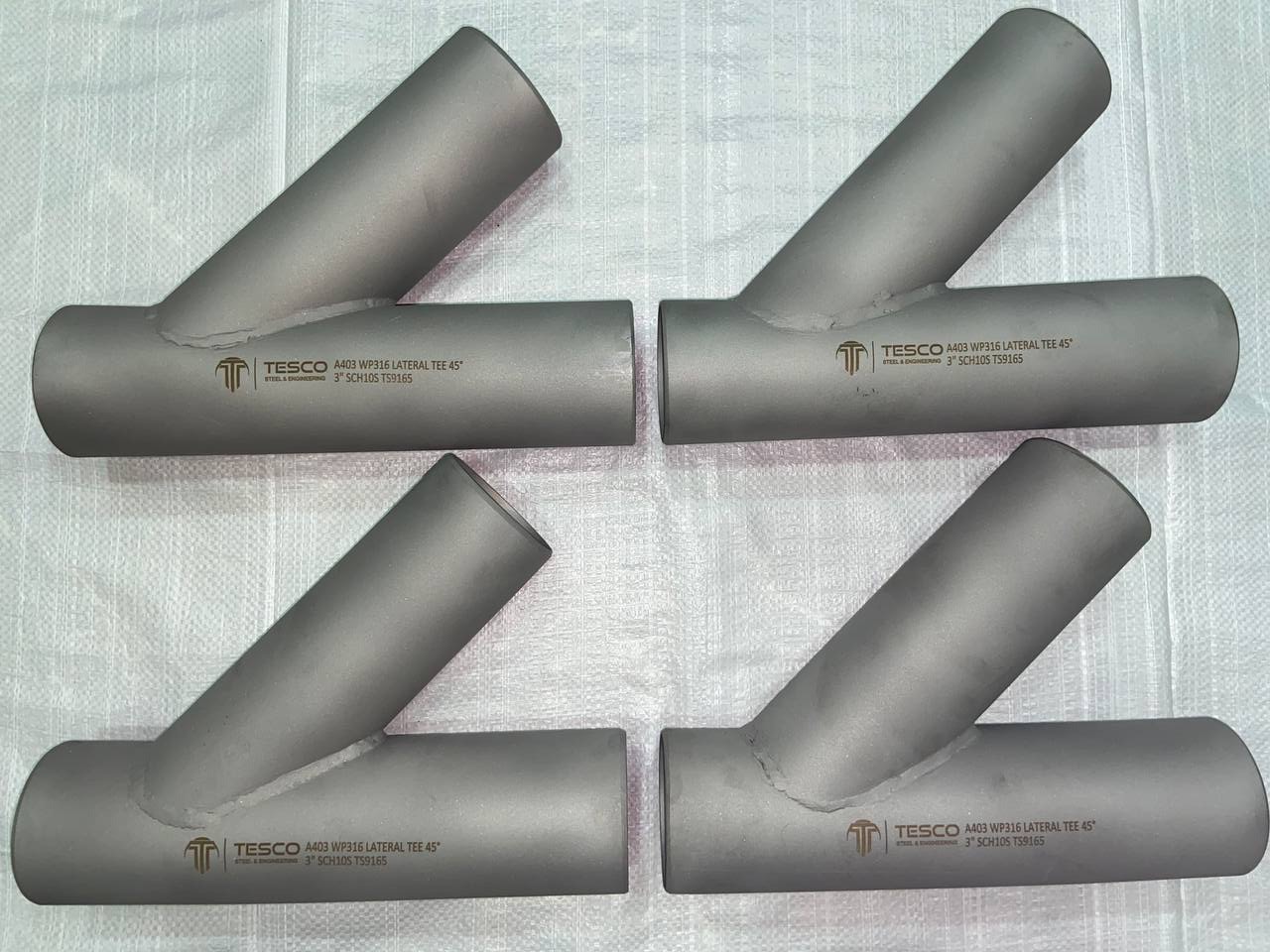
SS 316 (A403 WP316) Lateral Tee 45°
On a normal tee the branch meets the run at a right angle, which is compact but creates a sharp disturbance where the two flows collide. A lateral brings the branch in at 45°, so combining or dividing streams stay aligned and the junction sees far less turbulence and wear. That makes the 45° lateral the natural choice on pump and compressor discharge manifolds, drain and blowdown headers, relief and flare headers, slurry and pulp lines, and anywhere a branch should join the main line without a sharp pressure loss. As a buttweld fitting it gives a full-bore, full-strength welded joint with no internal obstruction.
Branch the same nominal size as the run — the standard 45° lateral for full-size branch connections.
Smaller branch than the run, for a smaller line merging into or tapping off a larger header at 45°.
Two standard dimensional patterns (different centre-to-end E&L, offset D, wall T and ID for the same size/schedule). Most sizes are Type B; some are Type C — see the dimensions sheet below.
A lateral keeps a straight run with a 45° branch; a true wye splits one line into two angled legs. Both give a smooth 45° flow split.
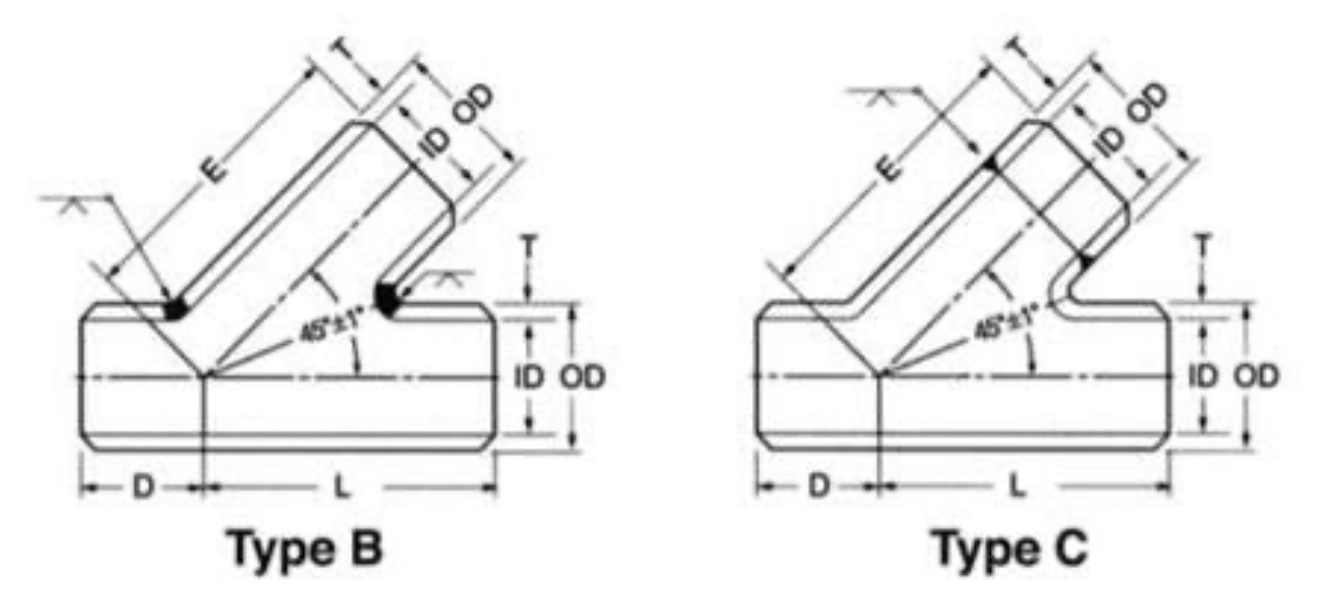
45° Lateral Tee — Type B & Type C Dimension Reference (E, D, L, T, OD, ID)
The diagram above shows the dimension symbols — E & L (centre-to-end of branch & run), D (offset), T (wall), OD and ID — for the Type B and Type C 45° laterals. Standard-wall (STD) and Extra-Strong (X-S) dimensions by nominal pipe size are tabulated below.
Standard Wall (STD)
| NPS | OD (in) | Type | E & L (in) | D (in) | Wall T (in) | ID (in) |
|---|---|---|---|---|---|---|
| 1″ | 1.315 | B | 5.75 | 1.75 | 0.133 | 1.049 |
| 1¼″ | 1.660 | B | 6.25 | 1.75 | 0.140 | 1.380 |
| 1½″ | 1.900 | B | 7.00 | 2.00 | 0.145 | 1.610 |
| 2″ | 2.375 | A/B | 8.00 | 2.50 | 0.154 | 2.067 |
| 2½″ | 2.875 | B | 9.50 | 2.50 | 0.203 | 2.469 |
| 3″ | 3.500 | B | 10.00 | 3.00 | 0.216 | 3.068 |
| 3½″ | 4.000 | B | 11.50 | 3.00 | 0.226 | 3.548 |
| 4″ | 4.500 | A/B | 12.00 | 3.00 | 0.237 | 4.026 |
| 5″ | 5.562 | B | 13.50 | 3.50 | 0.258 | 5.047 |
| 6″ | 6.625 | A/B | 14.50 | 3.50 | 0.280 | 6.065 |
| 8″ | 8.625 | B | 17.50 | 4.50 | 0.322 | 7.981 |
| 10″ | 10.750 | B | 20.50 | 5.00 | 0.365 | 10.020 |
| 12″ | 12.750 | B | 24.50 | 5.50 | 0.375 | 12.000 |
| 14″ | 14.000 | B | 27.00 | 6.00 | 0.375 | 13.250 |
| 16″ | 16.000 | B | 30.00 | 6.50 | 0.375 | 15.250 |
| 18″ | 18.000 | B | 32.00 | 7.00 | 0.375 | 17.250 |
| 20″ | 20.000 | B | 35.00 | 8.00 | 0.375 | 19.250 |
| 24″ | 24.000 | B | 40.50 | 9.00 | 0.375 | 23.250 |
Extra-Strong (X-S)
| NPS | OD (in) | E & L (in) | D (in) | Wall T (in) | ID (in) |
|---|---|---|---|---|---|
| 1″ | 1.315 | 6.50 | 2.00 | 0.179 | 0.957 |
| 1¼″ | 1.660 | 7.25 | 2.25 | 0.191 | 1.278 |
| 1½″ | 1.900 | 8.50 | 2.50 | 0.200 | 1.500 |
| 2″ | 2.375 | 8.00* | 2.50 | 0.128 | 1.939 |
| 2½″ | 2.875 | 9.00** | 2.50 | 0.276 | 2.323 |
| 3″ | 3.500 | 10.50 / 11.00 | 3.00 | 0.300 | 2.900 |
| 3½″ | 4.000 | 12.50 | 3.00 | 0.318 | 3.364 |
| 4″ | 4.500 | 12.00* | 3.00 | 0.337 | 3.826 |
| 5″ | 5.562 | 13.50** / 15.00 | 3.50 | 0.375 | 4.813 |
| 6″ | 6.625 | 14.50* | 3.50* | 0.432 | 5.761 |
| 8″ | 8.625 | 17.50** | 4.00** | 0.500 | 7.625 |
| 10″ | 10.750 | 20.50 / 24.00 | 5.00 / 5.50 | 0.500 | 9.750 |
| 12″ | 12.750 | 27.50 | 6.00 | 0.500 | 11.750 |
| 14″ | 14.000 | 31.00 | 6.50 | 0.500 | 13.000 |
| 16″ | 16.000 | 34.50 | 7.50 | 0.500 | 15.000 |
| 18″ | 18.000 | 37.50 | 8.00 | 0.500 | 17.000 |
| 20″ | 20.000 | 40.50 | 8.50 | 0.500 | 19.000 |
| 24″ | 24.000 | 47.50 | 10.00 | 0.500 | 23.000 |
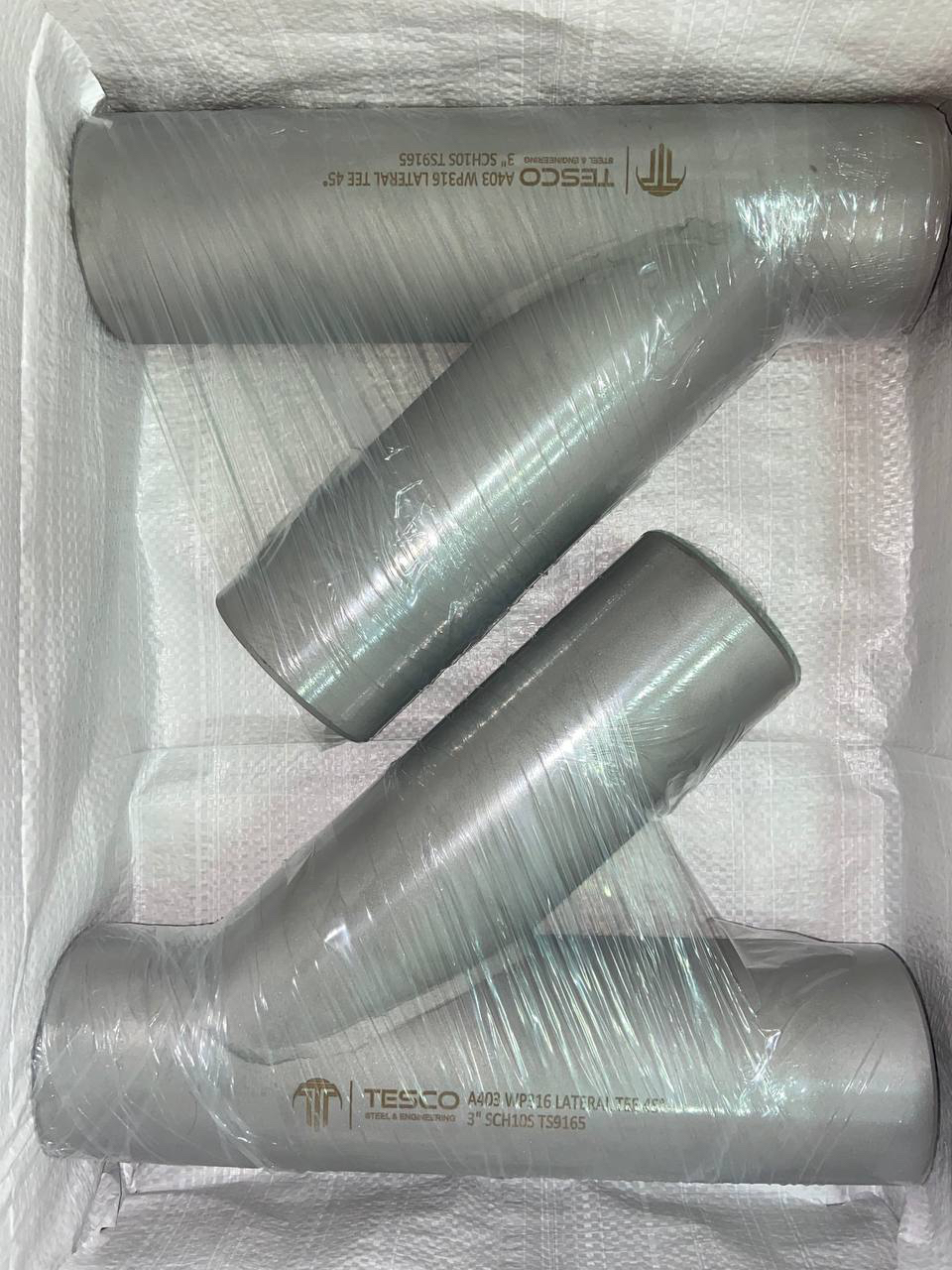
SS 316 Lateral Tees (Sch 10S) — Packed
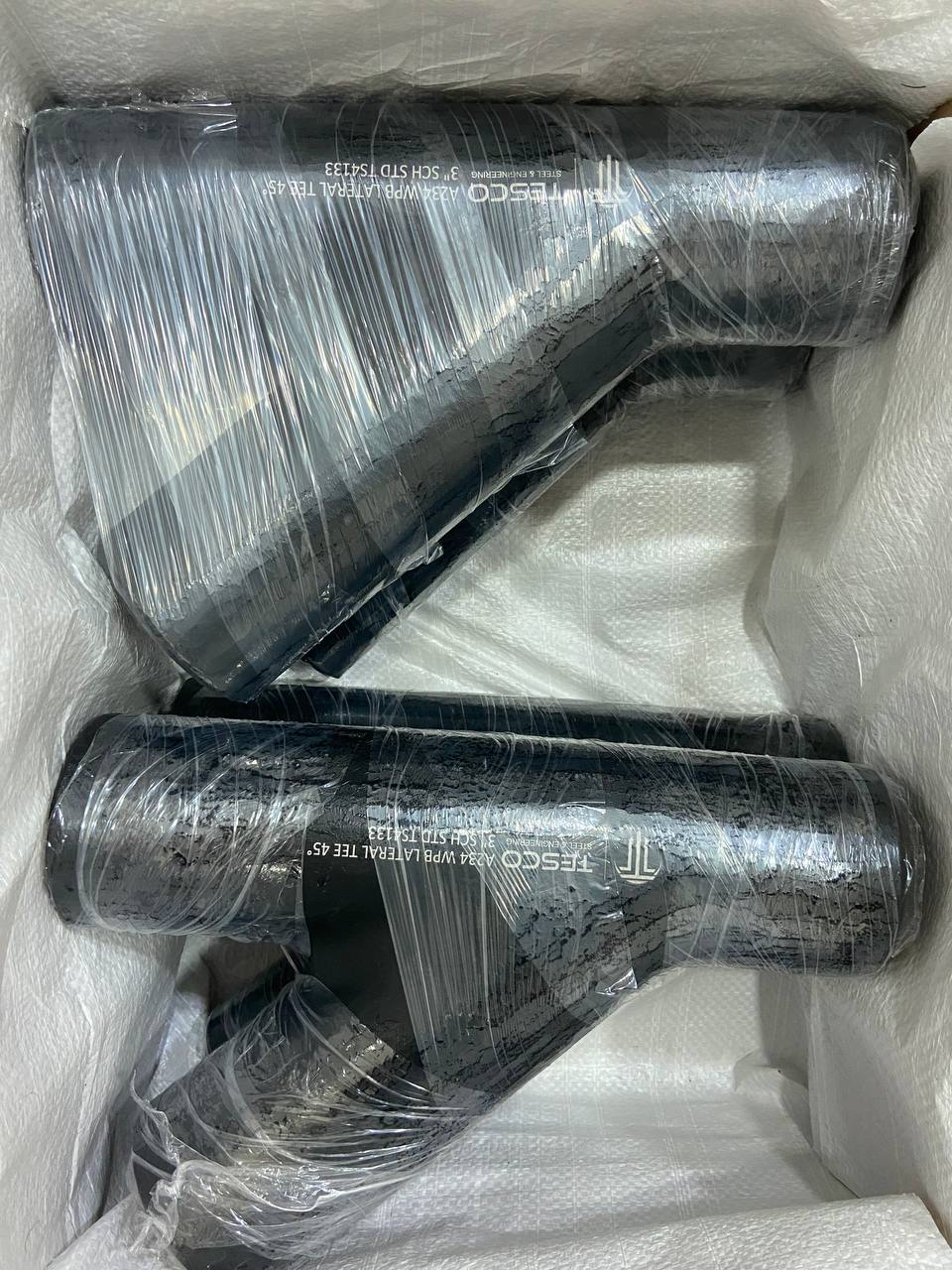
Carbon Steel Lateral Tees — Export Packing
The full lateral tee 45° dimensions sheet — Type B and Type C, STD and X-Strong, NPS 1″ to 24″ — is below. View it inline or download the PDF.
Type B & Type C patterns; OD, centre-to-end (E & L), offset (D), wall (T) and ID for STD and X-Strong, NPS 1″–24″.
⬇ Download Dimensions Sheet (PDF)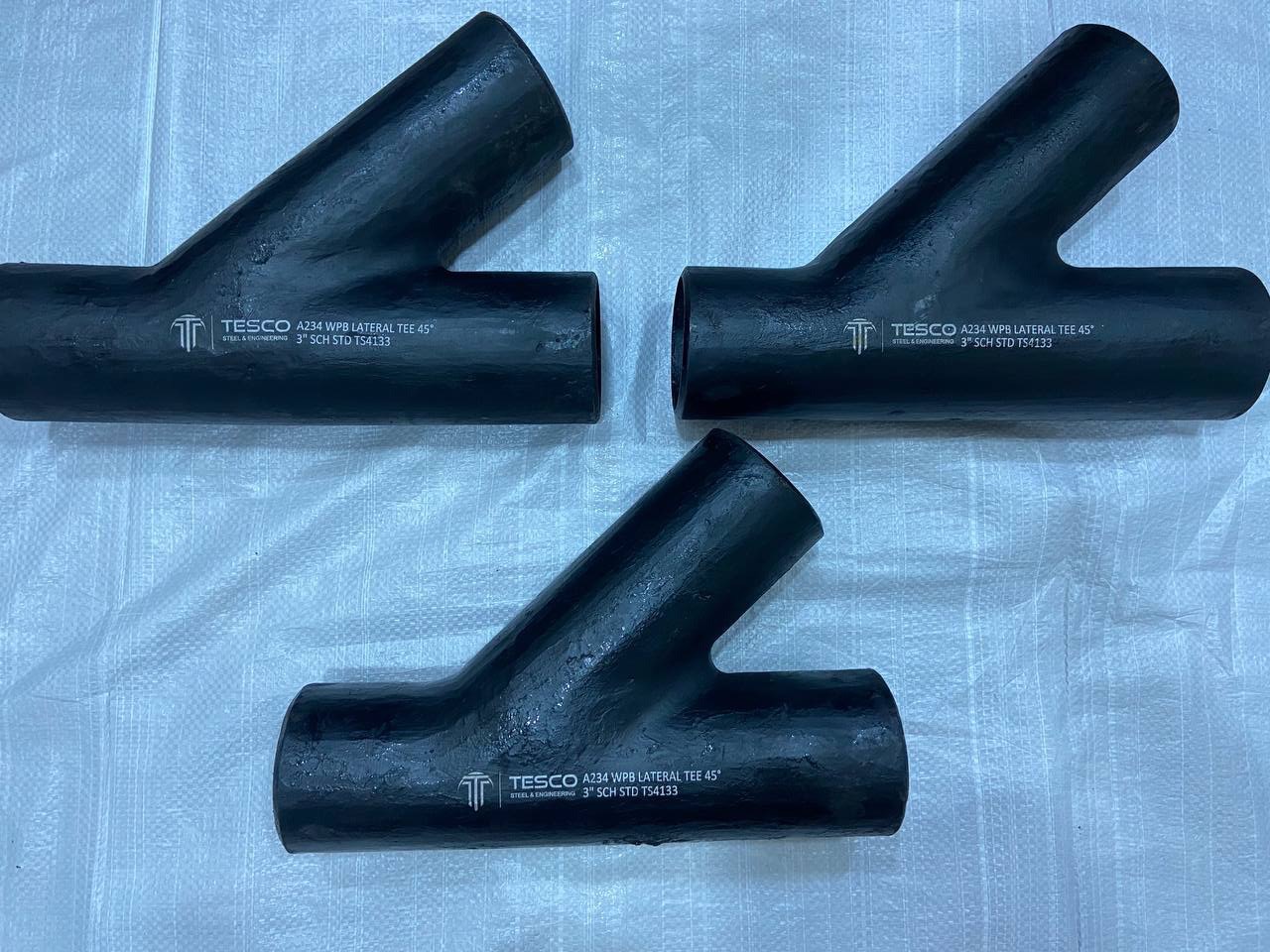
Carbon Steel (A234 WPB) Lateral Tee 45°
| Family | Grades | Spec | Typical use |
|---|---|---|---|
| Stainless steel | SS 304, SS 316, SS 310, SS 321 | ASTM A403 (WP304/316/310/321) | General & high-temperature corrosion-resistant lines |
| High-alloy stainless | 904L, 254 SMO | ASTM A403 / B649 | Aggressive acids, chloride & seawater service |
| Nickel alloys | Inconel 600, Inconel 601, Incoloy 800, Monel 400, Monel K500 | ASTM B366 | High temperature, reducing, seawater & corrosive media |
| Carbon steel | Carbon Steel (WPB) | ASTM A234 WPB | General & utility piping, water, steam, oil |
| Item | Standard |
|---|---|
| Fitting dimensions | ASME B16.9 (factory-made wrought buttweld fittings) |
| Lightweight / large | MSS SP-43 (stainless), MSS SP-75 (high-test) |
| Stainless / high-alloy material | ASTM A403 (304/316/310/321/904L) |
| Nickel-alloy material | ASTM B366 (Inconel, Incoloy, Monel) |
| Carbon-steel material | ASTM A234 WPB |
| Weld-bevel ends | ASME B16.25 |
| Marking / traceability | MSS SP-25 (grade, size, heat number stamped) |
| Certification | EN 10204 3.1 / 3.2 MTC, PMI on request |
The 45° branch keeps combining/dividing flow aligned, cutting the pressure loss a sharp 90° junction causes.
Smoother flow means less impingement wear — valuable on slurry, pulp and abrasive service.
Welded ends give a full-strength, unobstructed bore for high-pressure and high-temperature lines.
Made equal or reducing, in SS, high-alloy, nickel and carbon steel — matched to your line and medium.
| Industry | Typical use of 45° lateral tees |
|---|---|
| Oil & Gas / Refining | Pump & compressor discharge manifolds, relief & flare headers |
| Petrochemical & Chemical | Process branch connections in corrosion-resistant grades |
| Power & Fertilizer | Drain, blowdown and utility headers |
| Water & Wastewater | Combining flows, slurry & pulp lines, fire-water systems |
| Pulp & Paper / Mining | Abrasive slurry branches where erosion must be minimised |
What is a 45 degree lateral tee?
A 45 degree lateral tee is a buttweld pipe fitting in which the branch joins the main run pipe at a 45-degree angle instead of the usual 90 degrees. The angled branch lets flow enter or leave the run smoothly, with much lower turbulence, pressure drop and erosion than a standard 90-degree tee, so it is used where a branch must merge or divert flow gradually.
What is the difference between a lateral tee and a standard 90-degree tee?
In a standard tee the branch meets the run at 90 degrees, which causes turbulence and a sharp pressure drop where the flows meet. In a 45-degree lateral tee the branch meets the run at 45 degrees, so the combining or dividing flow stays smoother — lower turbulence, lower pressure loss and less erosion. Laterals are chosen where flow direction must change gradually, such as merging pump discharges, drains and relief headers.
What standards are 45 degree lateral tees made to?
Buttweld lateral tees are made to ASME B16.9 (factory-made wrought buttweld fittings) and MSS SP-43 (lightweight stainless fittings) or MSS SP-75 (high-test). Material specifications are ASTM A403 (wrought austenitic stainless), ASTM A234 (carbon and alloy steel) and ASTM B366 (nickel alloys). Weld-bevel ends follow ASME B16.25. The fitting is hard-stamped with grade, size and heat number for traceability.
What is the difference between Type B and Type C laterals?
Our dimensions sheet lists Type B and Type C laterals — two standard dimensional patterns for the 45-degree branch and run lengths (the centre-to-end E & L, offset D, wall T and inside diameter ID differ between them for the same pipe size and schedule). Most sizes are supplied to Type B; some are Type C, as marked in the dimensions sheet. Tell us your required pattern or send a drawing and we will match it.
What materials and grades are 45 degree lateral tees available in?
Stainless steel SS 304, SS 316, SS 310 and SS 321; high-alloy 904L and 254 SMO; nickel alloys Inconel 600, Inconel 601, Incoloy 800, Monel 400 and Monel K500; and carbon steel. These map to ASTM A403 (stainless / high-alloy), ASTM B366 (Inconel, Incoloy, Monel) and ASTM A234 WPB (carbon steel). The grade is chosen to match the medium, temperature and corrosivity of the line.
What sizes and schedules do you offer?
We make 45-degree lateral tees from NPS 1 inch to 24 inch, in Standard (STD) and Extra-Strong (X-S / XS) wall, and lighter schedules such as SCH 10S in stainless. Both equal laterals (branch same size as run) and reducing laterals (smaller branch) are made. Full centre-to-end, offset, wall and ID dimensions for every size are in our dimensions sheet, and custom sizes are made to drawing.
What is the difference between an equal and a reducing lateral tee?
An equal lateral has a branch the same nominal size as the run; a reducing lateral has a smaller branch than the run. Reducing laterals are common where a smaller line merges into or taps off a larger header at 45 degrees. We make both, and reducing laterals to the branch size you specify.
How are 45 degree lateral tees connected to the pipe?
They are buttweld (BW) fittings: the run and branch ends are bevelled to ASME B16.25 and welded directly to the matching pipe, giving a full-strength, full-bore joint with no internal obstruction. This makes laterals suitable for high-pressure, high-temperature and demanding service, the same as other buttweld fittings.
Why use a 45 degree lateral instead of a 90 degree branch connection?
A 45-degree lateral merges or splits flow gradually, which lowers turbulence, friction loss and pressure drop and reduces erosion at the junction — important on pump discharge headers, drains, slurry lines and relief/blowdown headers. A 90-degree tee is more compact but creates a sharper flow disturbance, so the lateral is chosen where smooth flow and low pressure loss matter.
Where are 45 degree lateral tees used?
On oil & gas, refinery, petrochemical, power, fertilizer, water and wastewater piping — wherever a branch must combine with or divert from a main line smoothly. Typical uses are pump and compressor discharge manifolds, drain and blowdown headers, relief and flare headers, slurry and pulp lines, and fire-water systems.
Are the lateral tees marked and traceable?
Yes. Each lateral tee is hard-stamped with the material specification and grade (for example A403 WP316 or A234 WPB), the size and schedule, and a heat / lot number, so it is fully traceable to its mill test certificate. Marking follows MSS SP-25.
Can you manufacture custom or non-standard lateral tees to a drawing?
Yes. Besides the standard ASME B16.9 / dimensions-sheet sizes, we make non-standard and reducing laterals, special angles, special wall thicknesses and exotic grades to your drawing or sample — a large part of our fittings work is made to customer specification.
Do you provide test certificates with lateral tees?
Yes. Lateral tees are supplied with EN 10204 3.1 (or 3.2 third-party) mill test certificates confirming chemistry, mechanical properties and heat-treatment condition, with positive material identification (PMI) and third-party inspection on request. Tesco Steel & Engineering is an ISO 9001:2015 certified manufacturer and exporter from Mumbai, India.
Is a 45 degree lateral tee the same as a 45 degree wye (Y-piece)?
They are closely related. A lateral tee has one branch joining a straight run at 45 degrees (the run stays straight), whereas a true wye splits one line into two equal legs that form a Y. Both give a smooth 45-degree flow split; the lateral keeps a straight main run with an angled branch, which is the more common buttweld pattern in process piping.