

Tesco Steel & Engineering forges and machines swage nipples — the small-bore pipe reducing fittings that step a line down from one size to the next over a single tapered body. We make both concentric and eccentric types to MSS SP-95, with wall thickness to ASME B36.10M / B36.19M, in plain, bevelled and NPT-threaded ends. Stocked across the full materials range — carbon steel, stainless 304/316, duplex 2205/2507, alloy steel F5–F91, LTCS, Monel, Inconel, Hastelloy, titanium and copper-nickel. Sizes 1/4″ to 4″, schedules STD through XXS. ISO 9001:2015 certified. Made in India.
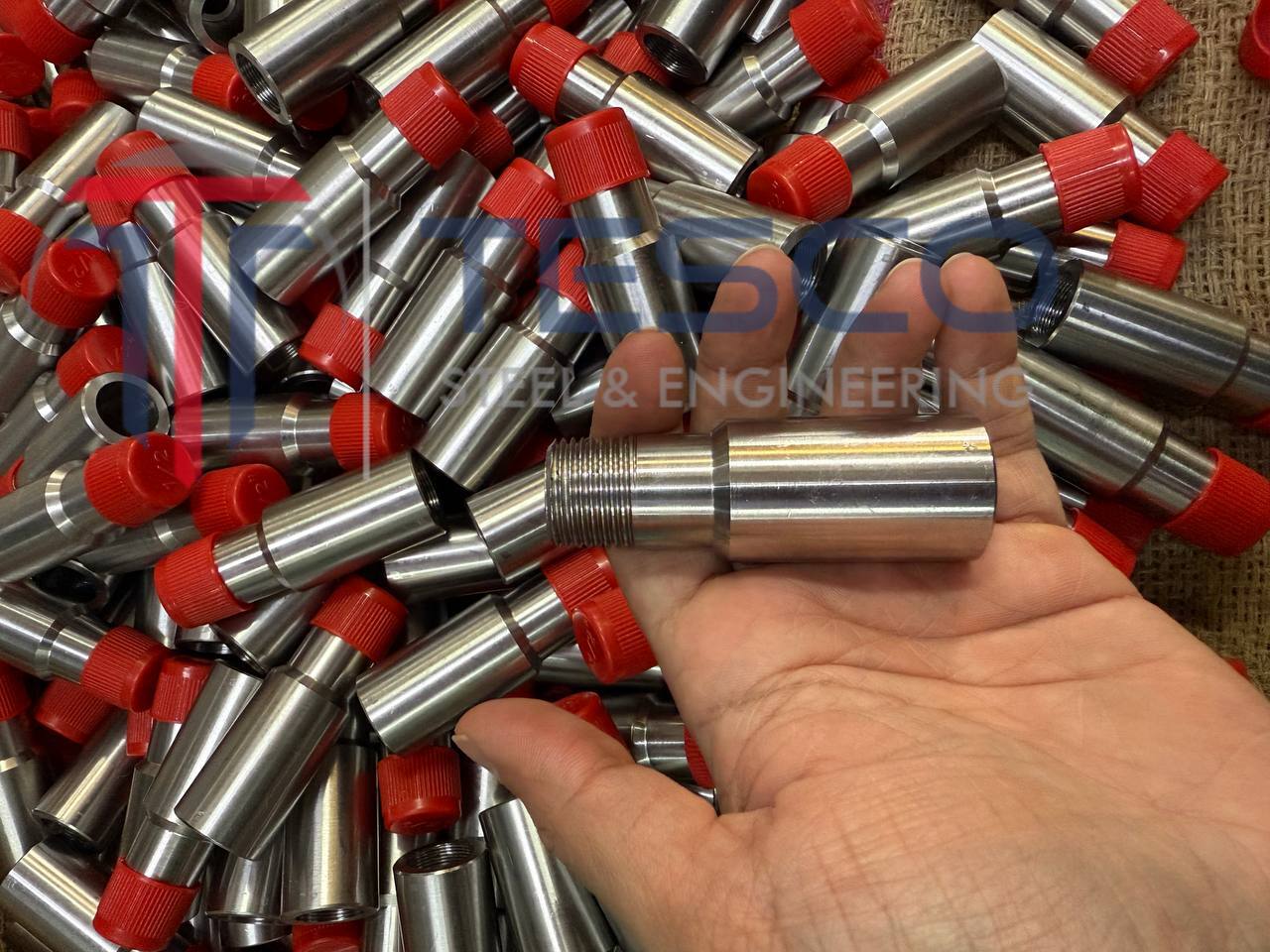
Stainless & Duplex Swage Nipples (304/316/904L/2205/2507)
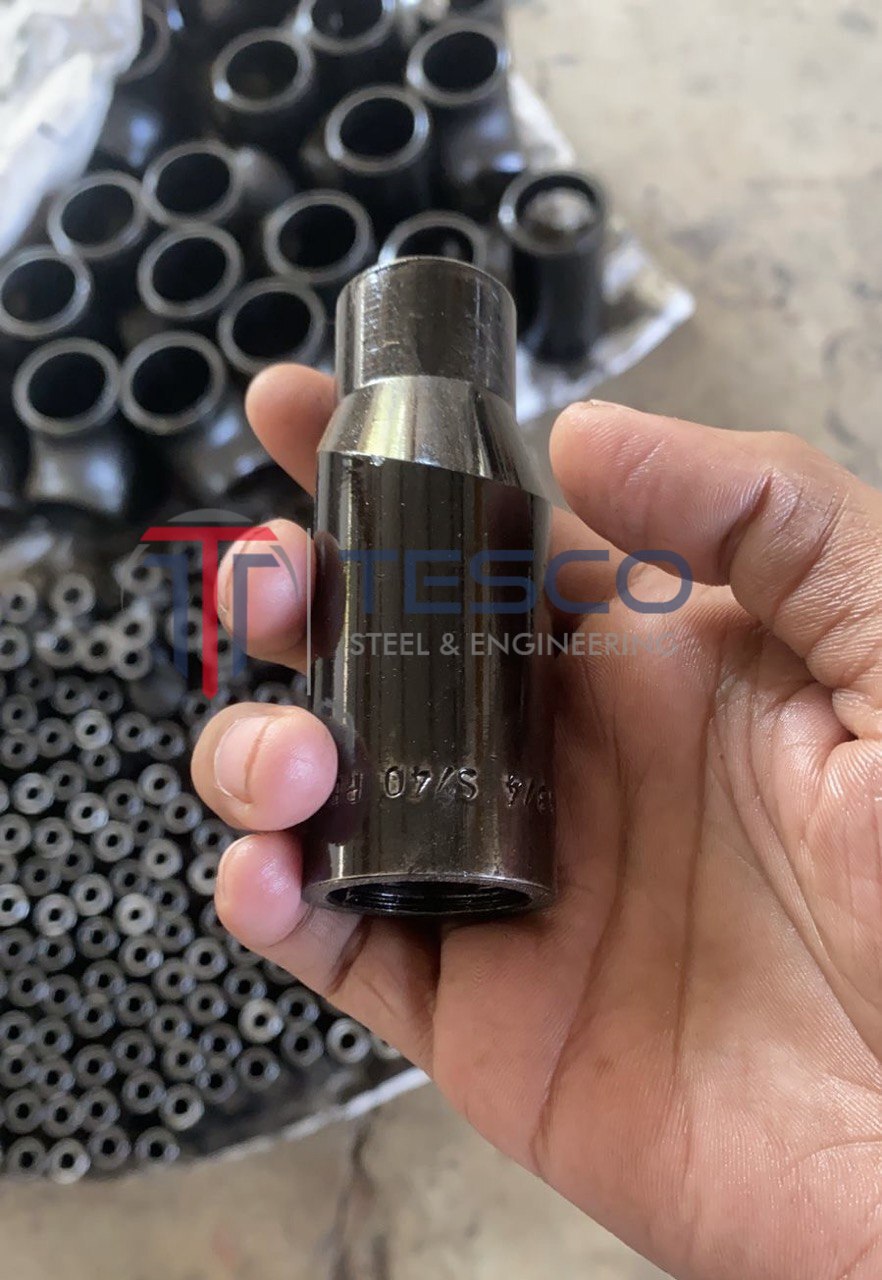
Carbon Steel & LTCS Swage Nipples (A105 / A350 LF2)
A swage nipple is the fitting you reach for when a pipe needs to drop one or two sizes over a short distance. It is a single forged piece with a large end and a small end blended by a smooth taper, so the bore reduces gradually rather than in a sharp step. Where a butt-weld reducer is the right tool for medium and large line reductions, the swage nipple is built for the small-bore work — the take-offs, drains, vents, sample points and instrument connections that make up a surprisingly large share of any plant’s fittings count. Because it carries pipe-style ends, it can be welded, butt-welded or simply screwed into place, which is exactly why it turns up on almost every piping isometric.
Both ends sit on the same centreline, so the taper is even all the way around. This is the default for vertical runs and for any reduction where keeping the bores concentric does not matter — the great majority of orders. The symmetrical body also makes it the natural choice when the nipple simply screws or welds into a fitting.
The two bores are offset, which leaves one side of the body flat. Run that flat side along the bottom of a horizontal line and the pipe invert stays level so liquid drains away completely; run it along the top and gas or vapour escapes without being trapped in a pocket. Eccentric nipples are the right call on pump suction lines, condensate and any service where pooling or air-locking has to be avoided.
Importantly, both types share the same MSS SP-95 outside diameters, wall thicknesses and overall lengths — the dimension table further down applies equally to concentric and eccentric nipples. Only the internal geometry, and therefore how the taper looks, is different.
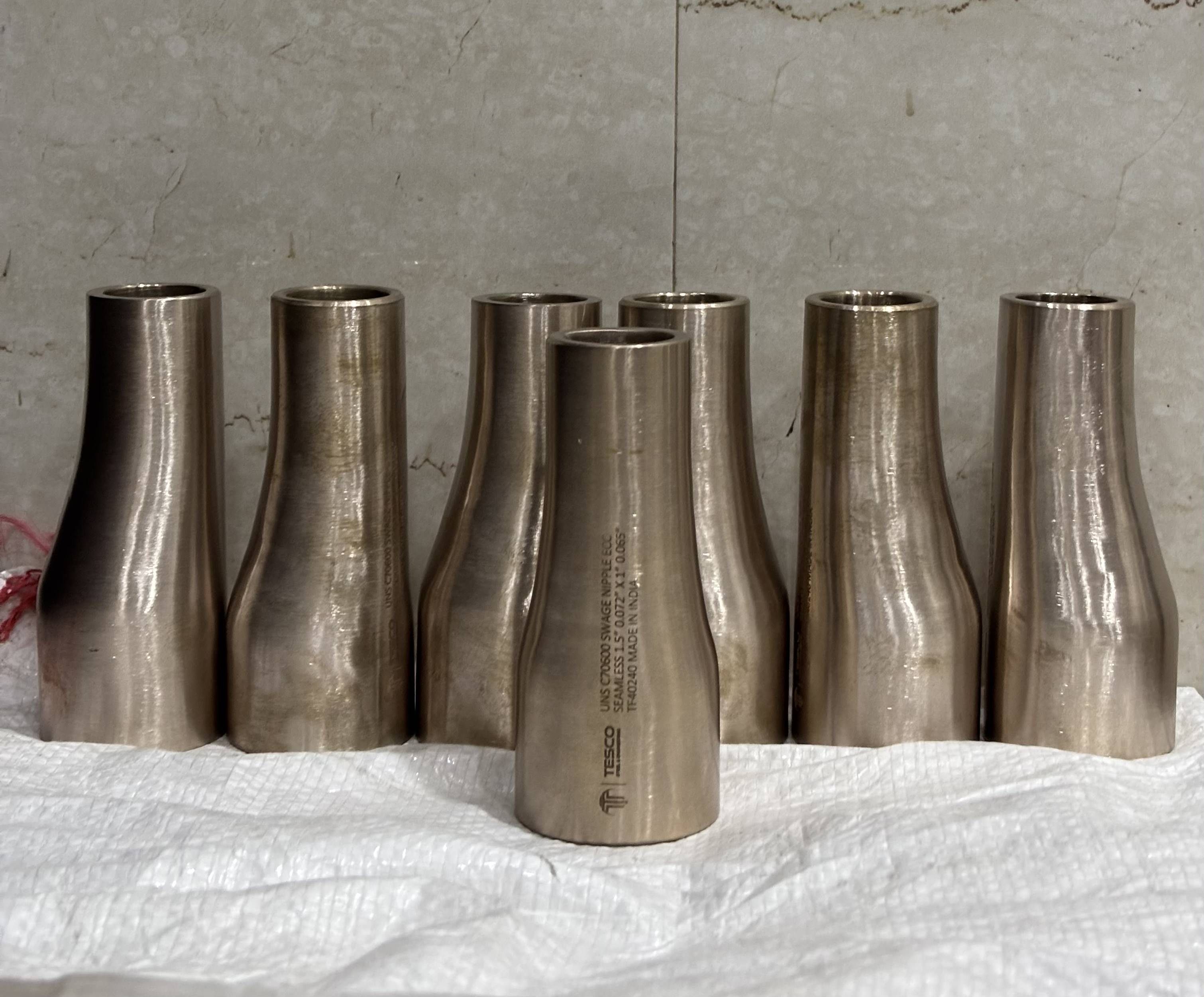
Forged Concentric Swage Nipples — Heat-Marked & Traceable
A swage nipple is ordered by stating how each end is finished. There are three finishes — plain (for socket welding or slip-fit), bevelled (for butt-welding) and threaded (NPT) — combined across the large and small ends to give nine standard codes:
| Code | Meaning | Typical Use |
|---|---|---|
| PBE | Plain Both Ends | Socket-weld / slip-fit reductions where both ends seat into a socket or coupling |
| BBE | Bevel Both Ends | Fully butt-welded lines — the most common configuration on welded piping |
| TBE | Thread Both Ends (NPT) | Threaded small-bore and utility work where both ends screw together |
| PSE / PLE | Plain Small End / Plain Large End | One plain end paired with a bevel or thread on the other |
| BSE / BLE | Bevel Small End / Bevel Large End | Butt-weld one end, plain or threaded on the other |
| TSE / TLE | Thread Small End / Thread Large End | e.g. BLE × TSE — weld the large end into a header, screw a valve or gauge onto the small end |
Bevelled ends are prepared to ASME B16.25 (37.5° standard bevel) and threaded ends are cut to ASME B1.20.1 NPT; BSPT to ISO 7-1 is available on request.
We manufacture and certify our swage nipples to the recognised dimensional and end-preparation standards for the product:
| Standard | What It Governs |
|---|---|
| MSS SP-95 (2014) | Dimensions of swage nipples and bull plugs — large-end OD, small-end OD and overall end-to-end length |
| ASME B36.10M | Wall thickness / schedule for carbon-steel and alloy-steel ends (STD, XS, Sch160, XXS) |
| ASME B36.19M | Wall thickness / schedule for stainless-steel ends |
| ASME B16.25 | Butt-weld (bevel) end preparation |
| ASME B1.20.1 | NPT taper pipe threads for threaded ends |
| MSS SP-25 | Standard marking system — size, schedule, grade, heat number |
| EN 10204 3.1 / 3.2 | Mill test certification & traceability |
A swage nipple has to match the pipe it sits in, so we produce them across the whole materials range we carry — from everyday carbon steel up to the nickel and titanium alloys. The table below lists the grades we supply against each material family and the governing material specification:
| Material Family | Grades We Supply | Material Standard |
|---|---|---|
| Carbon Steel | ASTM A105, A106 Gr B, A234 WPB | ASTM A105 / A106 / A234 |
| LTCS (Low-Temp Carbon Steel) | A350 LF2, A333 Gr 6, A420 WPL6 | ASTM A350 / A333 / A420 |
| Stainless Steel | 304 / 304L, 316 / 316L, 321, 347, 904L | ASTM A312 / A403 / A182 |
| Duplex & Super Duplex | 2205 (S31803 / S32205), 2507 (S32750 / S32760) | ASTM A790 / A815 / A182 F51-F55 |
| Alloy Steel (Chrome-Moly) | A182 F5, F9, F11, F22, F91 | ASTM A335 / A234 / A182 |
| Monel | Monel 400 (N04400), K500 (N05500) | ASTM B165 / B366 / B564 |
| Inconel | Inconel 600 (N06600), 625 (N06625), 825 | ASTM B167 / B366 / B564 |
| Hastelloy | C276 (N10276), C22 (N06022), B2 (N10665) | ASTM B622 / B366 / B564 |
| Titanium | Grade 2 (R50400), Grade 5 | ASTM B861 / B363 |
| Copper Nickel | 90/10 (C70600), 70/30 (C71500) | ASTM B466 / B122 |
| Bimetal | Bimetallic / clad (CS backing with alloy liner) | To customer specification |
The two reference drawings below show how the dimensions in the chart are measured — the large-end OD (D1), small-end OD (D2), overall length (A) and the two wall thicknesses (T1, T2) — together with the three standard end preparations: PBE (plain both ends), TBE (threaded both ends) and BBE (bevel both ends, 37.5° bevel with a 1.6 mm root face to ASME B16.25).
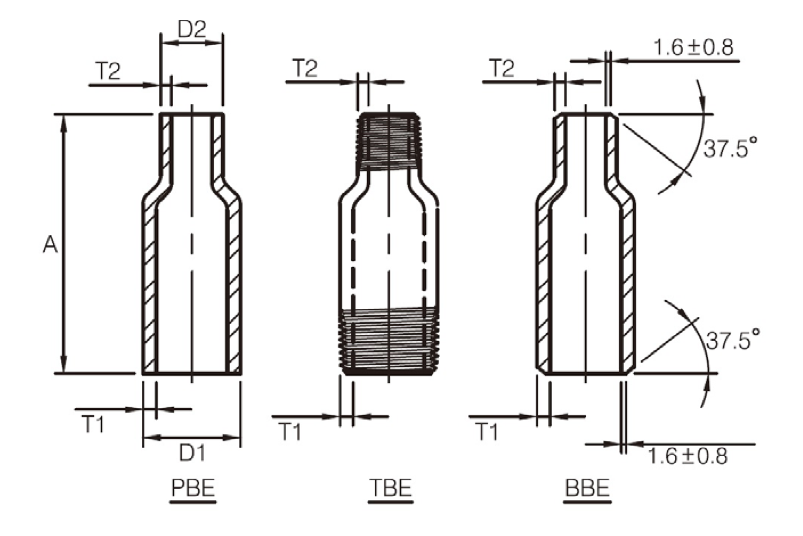
Concentric Swage Nipple — PBE / TBE / BBE Ends
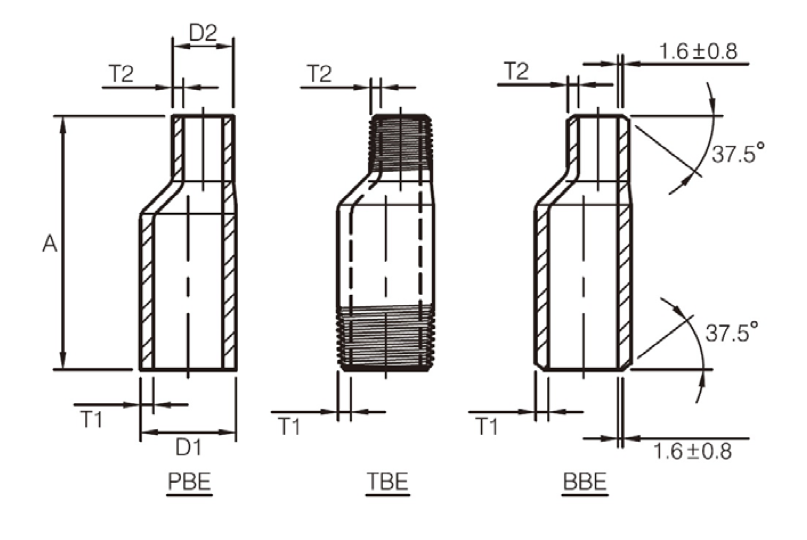
Eccentric Swage Nipple — PBE / TBE / BBE Ends
The chart below gives the full MSS SP-95 dimensions, in millimetres, for both concentric and eccentric swage nipples — large-end outside diameter (D1), small-end outside diameter (D2), and overall end-to-end length (A). Wall thickness is listed for each end and each schedule: T1 is the large-end wall and T2 the small-end wall, in STD/Sch40, XS/Sch80, Sch160 and XXS. A dash (–) means that schedule is not produced for that size. Wall thicknesses follow ASME B36.10M.
| Size (NPS) | D1 Large OD | D2 Small OD | A End-to-End | T1 — Large End Wall | T2 — Small End Wall | ||||||
|---|---|---|---|---|---|---|---|---|---|---|---|
| STD / 40 | XS / 80 | 160 | XXS | STD / 40 | XS / 80 | 160 | XXS | ||||
| 1/4″ × 1/8″ | 13.7 | 10.3 | 57 | 2.2 | 3.0 | 3.7 | 6.1 | 1.7 | 2.4 | – | – |
| 3/8″ × 1/8″ | 17.1 | 10.3 | 64 | 2.3 | 3.2 | 4.0 | 6.4 | 1.7 | 2.4 | – | – |
| 3/8″ × 1/4″ | 17.1 | 13.7 | 64 | 2.3 | 3.2 | 4.0 | 6.4 | 2.2 | 3.0 | – | – |
| 1/2″ × 1/8″ | 21.3 | 10.3 | 70 | 2.8 | 3.7 | 4.8 | 7.5 | 1.7 | 2.4 | – | – |
| 1/2″ × 1/4″ | 21.3 | 13.7 | 70 | 2.8 | 3.7 | 4.8 | 7.5 | 2.2 | 3.0 | – | – |
| 1/2″ × 3/8″ | 21.3 | 17.1 | 70 | 2.8 | 3.7 | 4.8 | 7.5 | 2.3 | 3.2 | – | – |
| 3/4″ × 1/8″ | 26.7 | 10.3 | 76 | 2.9 | 3.9 | 5.6 | 7.8 | 1.7 | 2.4 | – | – |
| 3/4″ × 1/4″ | 26.7 | 13.7 | 76 | 2.9 | 3.9 | 5.6 | 7.8 | 2.2 | 3.0 | – | – |
| 3/4″ × 3/8″ | 26.7 | 17.1 | 76 | 2.9 | 3.9 | 5.6 | 7.8 | 2.3 | 3.2 | – | – |
| 3/4″ × 1/2″ | 26.7 | 21.3 | 76 | 2.9 | 3.9 | 5.6 | 7.8 | 2.8 | 3.7 | 4.8 | 7.5 |
| 1″ × 1/8″ | 33.4 | 10.3 | 89 | 3.4 | 4.5 | 6.4 | 9.1 | 1.7 | 2.4 | – | – |
| 1″ × 1/4″ | 33.4 | 13.7 | 89 | 3.4 | 4.5 | 6.4 | 9.1 | 2.2 | 3.0 | – | – |
| 1″ × 3/8″ | 33.4 | 17.1 | 89 | 3.4 | 4.5 | 6.4 | 9.1 | 2.3 | 3.2 | – | – |
| 1″ × 1/2″ | 33.4 | 21.3 | 89 | 3.4 | 4.5 | 6.4 | 9.1 | 2.8 | 3.7 | 4.8 | 7.5 |
| 1″ × 3/4″ | 33.4 | 26.7 | 89 | 3.4 | 4.5 | 6.4 | 9.1 | 2.9 | 3.9 | 5.6 | 7.8 |
| 1-1/4″ × 1/8″ | 42.2 | 10.3 | 102 | 3.6 | 4.9 | 6.4 | 9.7 | 1.7 | 2.4 | – | – |
| 1-1/4″ × 1/4″ | 42.2 | 13.7 | 102 | 3.6 | 4.9 | 6.4 | 9.7 | 2.2 | 3.0 | – | – |
| 1-1/4″ × 3/8″ | 42.2 | 17.1 | 102 | 3.6 | 4.9 | 6.4 | 9.7 | 2.3 | 3.2 | – | – |
| 1-1/4″ × 1/2″ | 42.2 | 21.3 | 102 | 3.6 | 4.9 | 6.4 | 9.7 | 2.8 | 3.7 | 4.8 | 7.5 |
| 1-1/4″ × 3/4″ | 42.2 | 26.7 | 102 | 3.6 | 4.9 | 6.4 | 9.7 | 2.9 | 3.9 | 5.6 | 7.8 |
| 1-1/4″ × 1″ | 42.2 | 33.4 | 102 | 3.6 | 4.9 | 6.4 | 9.7 | 3.4 | 4.5 | 6.4 | 9.1 |
| 1-1/2″ × 1/8″ | 48.3 | 10.3 | 114 | 3.7 | 5.1 | 7.1 | 10.2 | 1.7 | 2.4 | – | – |
| 1-1/2″ × 1/4″ | 48.3 | 13.7 | 114 | 3.7 | 5.1 | 7.1 | 10.2 | 2.2 | 3.0 | – | – |
| 1-1/2″ × 3/8″ | 48.3 | 17.1 | 114 | 3.7 | 5.1 | 7.1 | 10.2 | 2.3 | 3.2 | – | – |
| 1-1/2″ × 1/2″ | 48.3 | 21.3 | 114 | 3.7 | 5.1 | 7.1 | 10.2 | 2.8 | 3.7 | 4.8 | 7.5 |
| 1-1/2″ × 3/4″ | 48.3 | 26.7 | 114 | 3.7 | 5.1 | 7.1 | 10.2 | 2.9 | 3.9 | 5.6 | 7.8 |
| 1-1/2″ × 1″ | 48.3 | 33.4 | 114 | 3.7 | 5.1 | 7.1 | 10.2 | 3.4 | 4.5 | 6.4 | 9.1 |
| 1-1/2″ × 1-1/4″ | 48.3 | 42.2 | 114 | 3.7 | 5.1 | 7.1 | 10.2 | 3.6 | 4.9 | 6.4 | 9.7 |
| 2″ × 1/8″ | 60.3 | 10.3 | 165 | 3.9 | 5.5 | 8.7 | 11.1 | 1.7 | 2.4 | – | – |
| 2″ × 1/4″ | 60.3 | 13.7 | 165 | 3.9 | 5.5 | 8.7 | 11.1 | 2.2 | 3.0 | – | – |
| 2″ × 3/8″ | 60.3 | 17.1 | 165 | 3.9 | 5.5 | 8.7 | 11.1 | 2.3 | 3.2 | – | – |
| 2″ × 1/2″ | 60.3 | 21.3 | 165 | 3.9 | 5.5 | 8.7 | 11.1 | 2.8 | 3.7 | 4.8 | 7.5 |
| 2″ × 3/4″ | 60.3 | 26.7 | 165 | 3.9 | 5.5 | 8.7 | 11.1 | 2.9 | 3.9 | 5.6 | 7.8 |
| 2″ × 1″ | 60.3 | 33.4 | 165 | 3.9 | 5.5 | 8.7 | 11.1 | 3.4 | 4.5 | 6.4 | 9.1 |
| 2″ × 1-1/4″ | 60.3 | 42.2 | 165 | 3.9 | 5.5 | 8.7 | 11.1 | 3.6 | 4.9 | 6.4 | 9.7 |
| 2″ × 1-1/2″ | 60.3 | 48.3 | 165 | 3.9 | 5.5 | 8.7 | 11.1 | 3.7 | 5.1 | 7.1 | 10.2 |
| 2-1/2″ × 1/8″ | 73.0 | 10.3 | 178 | 5.2 | 7.0 | 9.5 | 14.0 | 1.7 | 2.4 | – | – |
| 2-1/2″ × 1/4″ | 73.0 | 13.7 | 178 | 5.2 | 7.0 | 9.5 | 14.0 | 2.2 | 3.0 | – | – |
| 2-1/2″ × 3/8″ | 73.0 | 17.1 | 178 | 5.2 | 7.0 | 9.5 | 14.0 | 2.3 | 3.2 | – | – |
| 2-1/2″ × 1/2″ | 73.0 | 21.3 | 178 | 5.2 | 7.0 | 9.5 | 14.0 | 2.8 | 3.7 | 4.8 | 7.5 |
| 2-1/2″ × 3/4″ | 73.0 | 26.7 | 178 | 5.2 | 7.0 | 9.5 | 14.0 | 2.9 | 3.9 | 5.6 | 7.8 |
| 2-1/2″ × 1″ | 73.0 | 33.4 | 178 | 5.2 | 7.0 | 9.5 | 14.0 | 3.4 | 4.5 | 6.4 | 9.1 |
| 2-1/2″ × 1-1/4″ | 73.0 | 42.2 | 178 | 5.2 | 7.0 | 9.5 | 14.0 | 3.6 | 4.9 | 6.4 | 9.7 |
| 2-1/2″ × 1-1/2″ | 73.0 | 48.3 | 178 | 5.2 | 7.0 | 9.5 | 14.0 | 3.7 | 5.1 | 7.1 | 10.2 |
| 2-1/2″ × 2″ | 73.0 | 60.3 | 178 | 5.2 | 7.0 | 9.5 | 14.0 | 3.9 | 5.5 | 8.7 | 11.1 |
| 3″ × 1/8″ | 88.9 | 10.3 | 203 | 5.5 | 7.6 | 11.1 | 15.2 | 1.7 | 2.4 | – | – |
| 3″ × 1/4″ | 88.9 | 13.7 | 203 | 5.5 | 7.6 | 11.1 | 15.2 | 2.2 | 3.0 | – | – |
| 3″ × 3/8″ | 88.9 | 17.1 | 203 | 5.5 | 7.6 | 11.1 | 15.2 | 2.3 | 3.2 | – | – |
| 3″ × 1/2″ | 88.9 | 21.3 | 203 | 5.5 | 7.6 | 11.1 | 15.2 | 2.8 | 3.7 | 4.8 | 7.5 |
| 3″ × 3/4″ | 88.9 | 26.7 | 203 | 5.5 | 7.6 | 11.1 | 15.2 | 2.9 | 3.9 | 5.6 | 7.8 |
| 3″ × 1″ | 88.9 | 33.4 | 203 | 5.5 | 7.6 | 11.1 | 15.2 | 3.4 | 4.5 | 6.4 | 9.1 |
| 3″ × 1-1/4″ | 88.9 | 42.2 | 203 | 5.5 | 7.6 | 11.1 | 15.2 | 3.6 | 4.9 | 6.4 | 9.7 |
| 3″ × 1-1/2″ | 88.9 | 48.3 | 203 | 5.5 | 7.6 | 11.1 | 15.2 | 3.7 | 5.1 | 7.1 | 10.2 |
| 3″ × 2″ | 88.9 | 60.3 | 203 | 5.5 | 7.6 | 11.1 | 15.2 | 3.9 | 5.5 | 8.7 | 11.1 |
| 3″ × 2-1/2″ | 88.9 | 73.0 | 203 | 5.5 | 7.6 | 11.1 | 15.2 | 5.2 | 7.0 | 9.5 | 14.0 |
| 3-1/2″ × 1/8″ | 101.6 | 10.3 | 203 | 5.7 | 8.1 | – | – | 1.7 | 2.4 | – | – |
| 3-1/2″ × 1/4″ | 101.6 | 13.7 | 203 | 5.7 | 8.1 | – | – | 2.2 | 3.0 | – | – |
| 3-1/2″ × 3/8″ | 101.6 | 17.1 | 203 | 5.7 | 8.1 | – | – | 2.3 | 3.2 | – | – |
| 3-1/2″ × 1/2″ | 101.6 | 21.3 | 203 | 5.7 | 8.1 | – | – | 2.8 | 3.7 | 4.8 | 7.5 |
| 3-1/2″ × 3/4″ | 101.6 | 26.7 | 203 | 5.7 | 8.1 | – | – | 2.9 | 3.9 | 5.6 | 7.8 |
| 3-1/2″ × 1″ | 101.6 | 33.4 | 203 | 5.7 | 8.1 | – | – | 3.4 | 4.5 | 6.4 | 9.1 |
| 3-1/2″ × 1-1/4″ | 101.6 | 42.2 | 203 | 5.7 | 8.1 | – | – | 3.6 | 4.9 | 6.4 | 9.7 |
| 3-1/2″ × 1-1/2″ | 101.6 | 48.3 | 203 | 5.7 | 8.1 | – | – | 3.7 | 5.1 | 7.1 | 10.2 |
| 3-1/2″ × 2″ | 101.6 | 60.3 | 203 | 5.7 | 8.1 | – | – | 3.9 | 5.5 | 8.7 | 11.1 |
| 3-1/2″ × 2-1/2″ | 101.6 | 73.0 | 203 | 5.7 | 8.1 | – | – | 5.2 | 7.0 | 9.5 | 14.0 |
| 3-1/2″ × 3″ | 101.6 | 88.9 | 203 | 5.7 | 8.1 | – | – | 5.5 | 7.6 | 11.1 | 15.2 |
| 4″ × 1/4″ | 114.3 | 13.7 | 229 | 6.0 | 8.6 | 13.5 | 17.1 | 2.2 | 3.0 | – | – |
| 4″ × 3/8″ | 114.3 | 17.1 | 229 | 6.0 | 8.6 | 13.5 | 17.1 | 2.3 | 3.2 | – | – |
| 4″ × 1/2″ | 114.3 | 21.3 | 229 | 6.0 | 8.6 | 13.5 | 17.1 | 2.8 | 3.7 | 4.8 | 7.5 |
| 4″ × 3/4″ | 114.3 | 26.7 | 229 | 6.0 | 8.6 | 13.5 | 17.1 | 2.9 | 3.9 | 5.6 | 7.8 |
| 4″ × 1″ | 114.3 | 33.4 | 229 | 6.0 | 8.6 | 13.5 | 17.1 | 3.4 | 4.5 | 6.4 | 9.1 |
| 4″ × 1-1/4″ | 114.3 | 42.2 | 229 | 6.0 | 8.6 | 13.5 | 17.1 | 3.6 | 4.9 | 6.4 | 9.7 |
| 4″ × 1-1/2″ | 114.3 | 48.3 | 229 | 6.0 | 8.6 | 13.5 | 17.1 | 3.7 | 5.1 | 7.1 | 10.2 |
| 4″ × 2″ | 114.3 | 60.3 | 229 | 6.0 | 8.6 | 13.5 | 17.1 | 3.9 | 5.5 | 8.7 | 11.1 |
| 4″ × 2-1/2″ | 114.3 | 73.0 | 229 | 6.0 | 8.6 | 13.5 | 17.1 | 5.2 | 7.0 | 9.5 | 14.0 |
| 4″ × 3″ | 114.3 | 88.9 | 229 | 6.0 | 8.6 | 13.5 | 17.1 | 5.5 | 7.6 | 11.1 | 15.2 |
| 4″ × 3-1/2″ | 114.3 | 101.6 | 229 | 6.0 | 8.6 | 13.5 | 17.1 | 5.7 | 8.1 | – | – |
All dimensions in millimetres (mm). D1 = large-end outside diameter, D2 = small-end outside diameter, A = overall length. T1/T2 walls per ASME B36.10M; concentric and eccentric nipples share identical figures per MSS SP-95.
Swage nipples are small fittings that do a lot of work. Wherever a line has to step down to a smaller connection, one is usually doing the job:
| Sector | Typical Swage Nipple Duty |
|---|---|
| Refineries & petrochemical | Instrument take-offs, drain and vent points, chemical-injection quills, reductions from process headers to valves and branches |
| Power plants | Boiler and steam-line tappings, gauge and transmitter connections, sample points; alloy-steel F11/F22/F91 for high-temperature service |
| Oil & gas / offshore | Wellhead and manifold small-bore connections, utility air and hydraulic tappings; duplex, Inconel and Monel for sour and seawater service |
| Fertiliser & chemical | Corrosive-service reductions in stainless, Hastelloy and titanium for acids and aggressive media |
| Shipbuilding & marine | Seawater and ballast small-bore reductions in copper-nickel and super duplex |
| Water treatment & utilities | Drain, vent and instrument connections in carbon and stainless steel |
Concentric and eccentric, every size from 1/4″ to 4″, every schedule from STD to XXS, in any end combination — quoted and certified to one consistent standard.
The same nipple in carbon steel, stainless, duplex, chrome-moly alloy steel, LTCS, Monel, Inconel, Hastelloy, titanium or copper-nickel, so a mixed material order ships from a single source.
Swaged from seamless pipe with full heat traceability, hard-stamped per MSS SP-25, and backed by EN 10204 3.1 / 3.2 mill certificates.
Plain, ASME B16.25 bevel, or B1.20.1 NPT thread — mixed across the two ends however the line drawing calls for it.
Every alloy and stainless piece is positive-material-identification checked by XRF before it leaves the shop, so the grade in the crate is the grade on the certificate.
Bagged, boxed and crated for air or sea freight in ISPM-15 heat-treated wooden crates, exporting to 65+ countries.
Small fittings are easy to damage and easy to mix up, so we pack carefully. Each swage nipple is end-capped and poly-bagged, grouped by size and grade into labelled boxes for air freight, and consolidated into strapped, ISPM-15 heat-treated wooden crates for sea freight — every package tagged with size, grade and heat number for clean receipt at site.
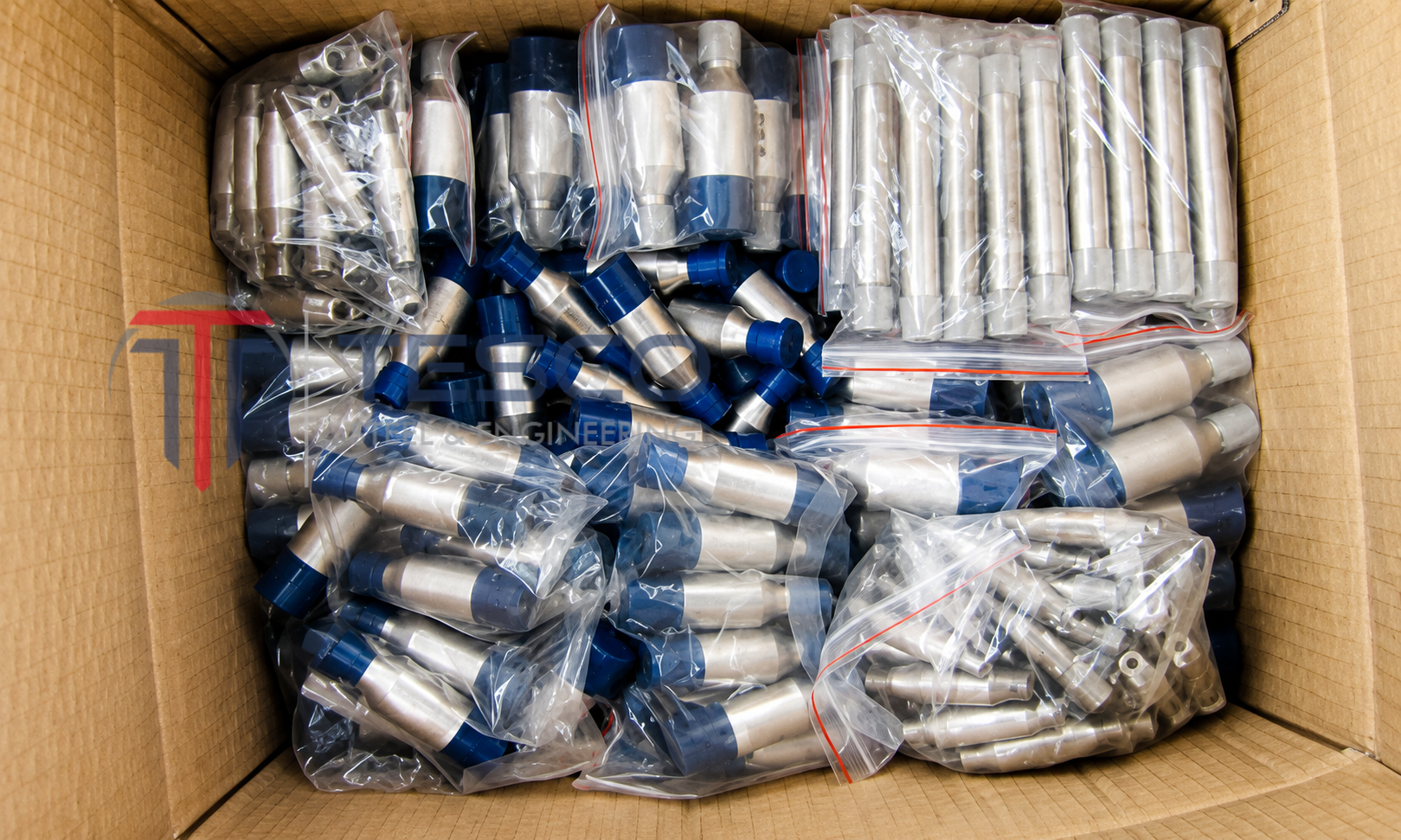
Air-Freight Packing — Bagged & Boxed by Size
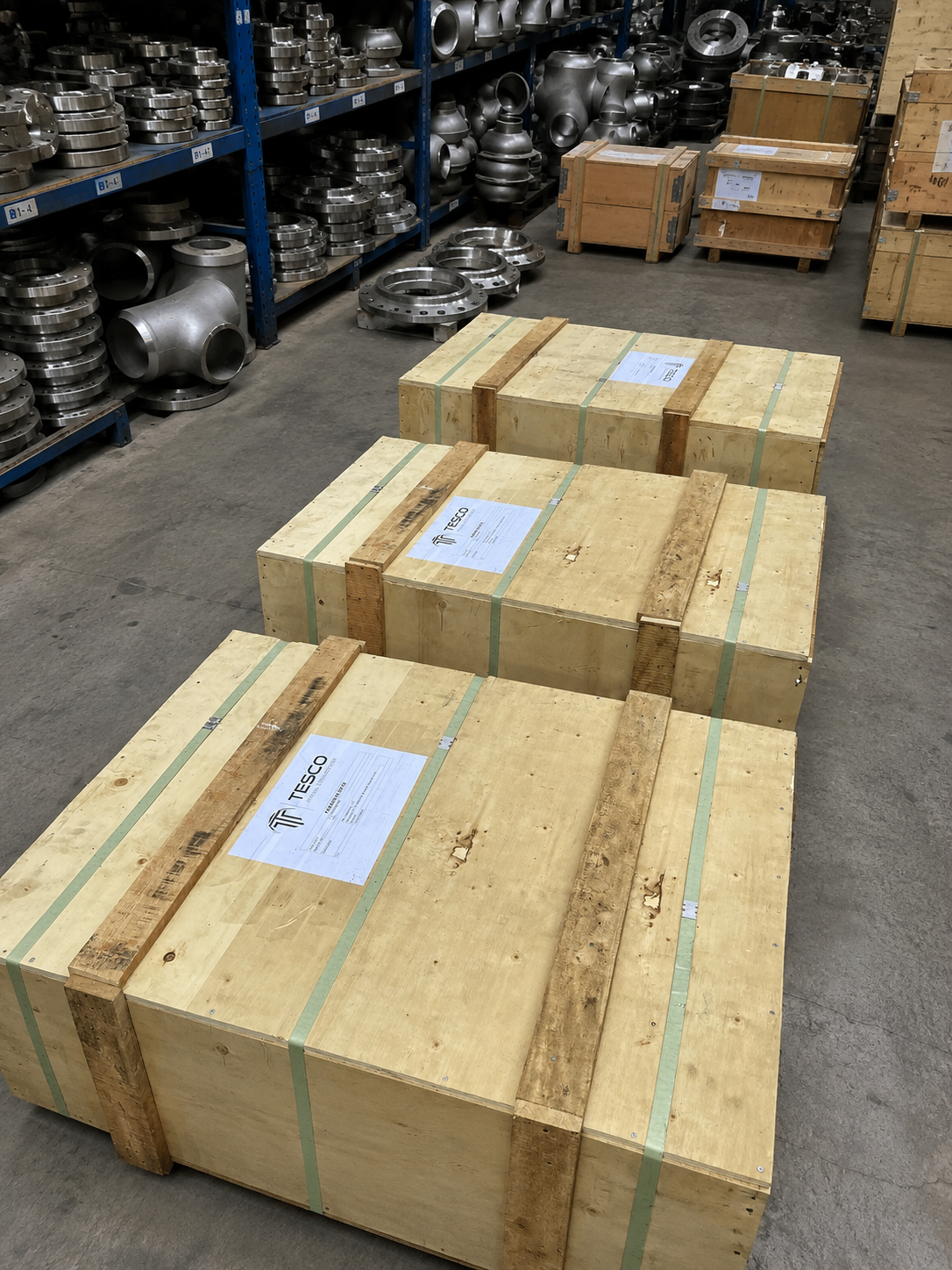
Sea-Freight Packing — ISPM-15 Wooden Crates
What is a swage nipple?
A swage nipple is a pipe fitting that joins two different pipe sizes. It has a larger end and a smaller end formed on one continuous tapered body, so it reduces the bore over a short, gradual transition. Unlike a butt-weld reducer, it is a nipple-style component with pipe-style ends — plain, bevelled or threaded — governed dimensionally by MSS SP-95. It is most often used for small-bore reductions on instrument, drain, vent and utility connections where a full reducer would be oversized.
What is the difference between a concentric and an eccentric swage nipple?
A concentric swage nipple keeps both ends on a common centreline, so the taper is symmetrical — the usual choice for vertical lines and general reductions. An eccentric swage nipple has the bores offset, leaving one side flat. That flat side runs along the bottom of a horizontal line to keep the invert level so liquid drains fully, or along the top to let gas escape without trapping. Both share identical MSS SP-95 outside diameters, lengths and wall thicknesses; only the geometry differs.
What is the difference between a swage nipple and a reducer?
A butt-weld reducer (ASME B16.9) is a short two-bevel fitting for medium and large bore reductions, welded into the run. A swage nipple (MSS SP-95) is a longer nipple-type fitting for small-bore reductions, and can be plain, bevelled for butt-welding, or threaded NPT to screw into a coupling, valve or boss. As a rule, reducers handle the larger line reductions and swage nipples handle the small instrument, drain, vent and branch connections.
What standard covers swage nipple dimensions?
Swage nipple dimensions — large-end OD, small-end OD and overall length — follow MSS SP-95 (current edition MSS SP-95-2014). Wall thickness for each end follows the pipe schedule it matches: ASME B36.10M for carbon and alloy steel, ASME B36.19M for stainless. Bevelled ends are prepared to ASME B16.25 and threaded ends cut to ASME B1.20.1 NPT. We manufacture and certify to these standards.
What end connection types are available (PBE, BBE, TBE)?
Nine combinations. Both ends the same: PBE (plain both ends), BBE (bevel both ends, butt-welding), TBE (thread both ends, NPT). Mixed ends: PSE/PLE (plain small/large end), BSE/BLE (bevel small/large end), TSE/TLE (thread small/large end). The most common are BBE for fully welded lines, TBE for threaded small-bore work, and BLE × TSE where the large end is welded into a header and the small end screws onto a valve or gauge.
What materials and grades are swage nipples available in?
Every material on our range. Carbon steel: A105, A106 Gr B, A234 WPB. LTCS: A350 LF2, A333 Gr 6, A420 WPL6. Stainless: 304/304L, 316/316L, 321, 347, 904L. Duplex and super duplex: 2205 (S31803/S32205) and 2507 (S32750/S32760). Alloy steel: A182 F5, F9, F11, F22, F91. Monel 400/K500; Inconel 600/625/825; Hastelloy C276/C22/B2; titanium Grade 2; and copper-nickel 90/10 (C70600) and 70/30 (C71500). Bimetallic / clad nipples are made to customer specification.
What sizes and schedules do you make?
Standard MSS SP-95 swage nipples run from 1/4″ up to 4″ nominal bore on the large end, reducing to any smaller standard size (for example 2″ × 1/2″). Each end is available in STD/Sch40, XS/Sch80, Sch160 and XXS walls, mixed independently between the two ends. Larger sizes and special bore combinations are made to order.
How are swage nipples manufactured?
They are produced from seamless pipe or bar. The large-bore pipe is hot or cold swaged (forged down) to form the reduced small end and the tapered transition, then both ends are machined to the required wall and finished plain, bevelled to ASME B16.25, or threaded to ASME B1.20.1. The piece is heat-treated as the grade requires, then dimensionally inspected, hardness and PMI checked, and stamped per MSS SP-25.
Where are swage nipples used?
Wherever small-bore reductions are needed: instrument take-offs, gauge and transmitter connections, drain and vent lines, sample points, chemical-injection quills, utility air and steam tappings, and reductions from a header to a valve or branch. They are standard hardware in refineries, petrochemical and fertiliser plants, power stations, oil and gas, shipbuilding and water treatment, with the grade chosen to match the line.
Can swage nipples be threaded with NPT?
Yes. Threaded ends are cut to ASME B1.20.1 NPT (tapered pipe thread); BSPT to ISO 7-1 is available on request. A nipple can be threaded on one end and bevelled or plain on the other — for instance a bevelled large end welded into a header and a threaded small end that screws straight into a valve, gauge or instrument fitting.
How are swage nipples marked, tested and certified?
Each piece is hard-stamped or laser-marked with size, schedule, grade, heat number and our logo to MSS SP-25. Testing covers chemical analysis, tensile/mechanical testing, hardness, PMI (XRF) and 100% dimensional inspection. Every batch ships with an EN 10204 Type 3.1 mill test certificate, upgraded to 3.2 with third-party witness (Bureau Veritas, Lloyd’s, SGS, TÜV) when required. We are ISO 9001:2015 certified.
What is a bull plug, and is it related to a swage nipple?
A bull plug is a short, closed-end nipple used to blank off a threaded or plain pipe end, covered by the same MSS SP-95 standard as the swage nipple. The two are often quoted together because they are made on the same equipment from the same pipe stock and grades. We supply bull plugs in the same material range and end configurations as our swage nipples.