
Tesco Steel & Engineering manufactures tube ferrules — protective sleeve inserts fitted into the inlet ends of boiler, heat-exchanger, and air-pre-heater tubes to shield the tube ends and tubesheet from erosion, thermal shock, and corrosion. By taking the punishment of high-velocity, particle-laden, hot gas or fluid at the tube inlet, ferrules dramatically extend tube and tubesheet life and cut costly downtime. Supplied in SS 304, 316, 310, 410, 2205, 2507, Monel 400/500, Hastelloy C22/C276/B2/B3, and ceramic. ISO 9001:2015 certified. Made in India.
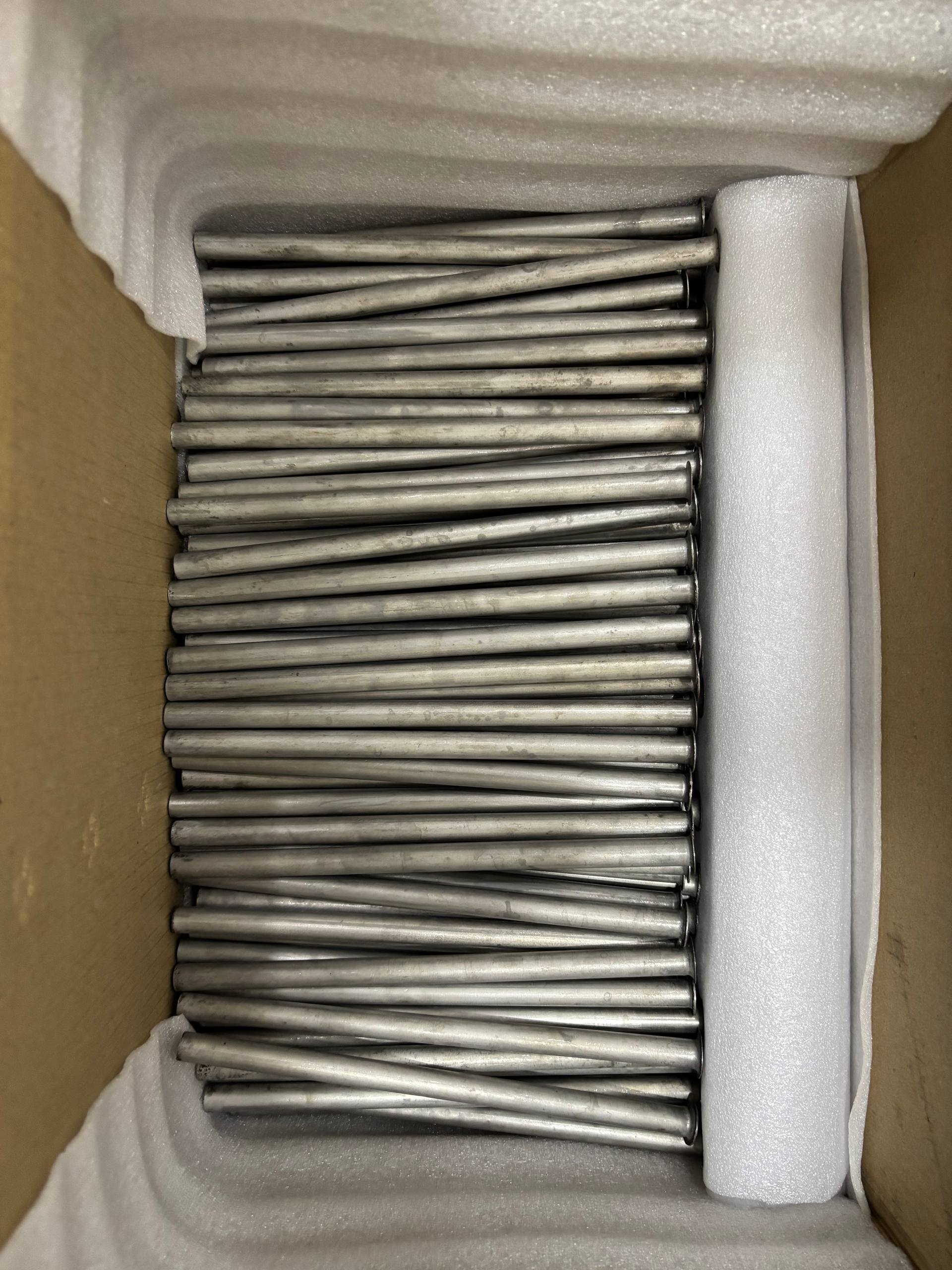
Boiler Tube Ferrules — Ready Stock
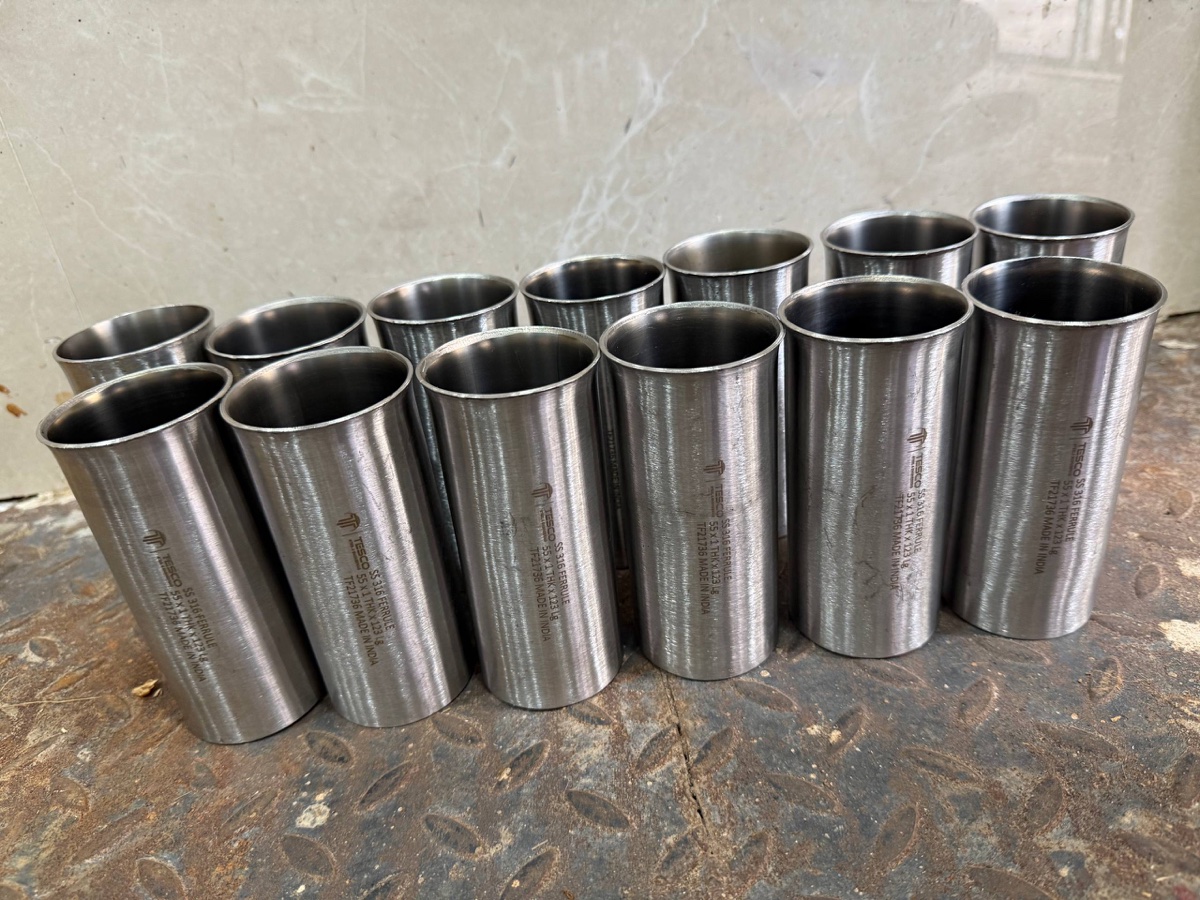
SS 316 Ferrules, 55 × 1 THK × 123 Lg — Marked, From Our Production
Tube ferrules are essential in fired boilers, waste-heat and process heat exchangers, and air pre-heaters. Tesco Steel & Engineering manufactures metal and ceramic ferrules and tubesheet erosion shields to suit the tube size, temperature, and media, complementing our tube sheets and heat-exchanger components.
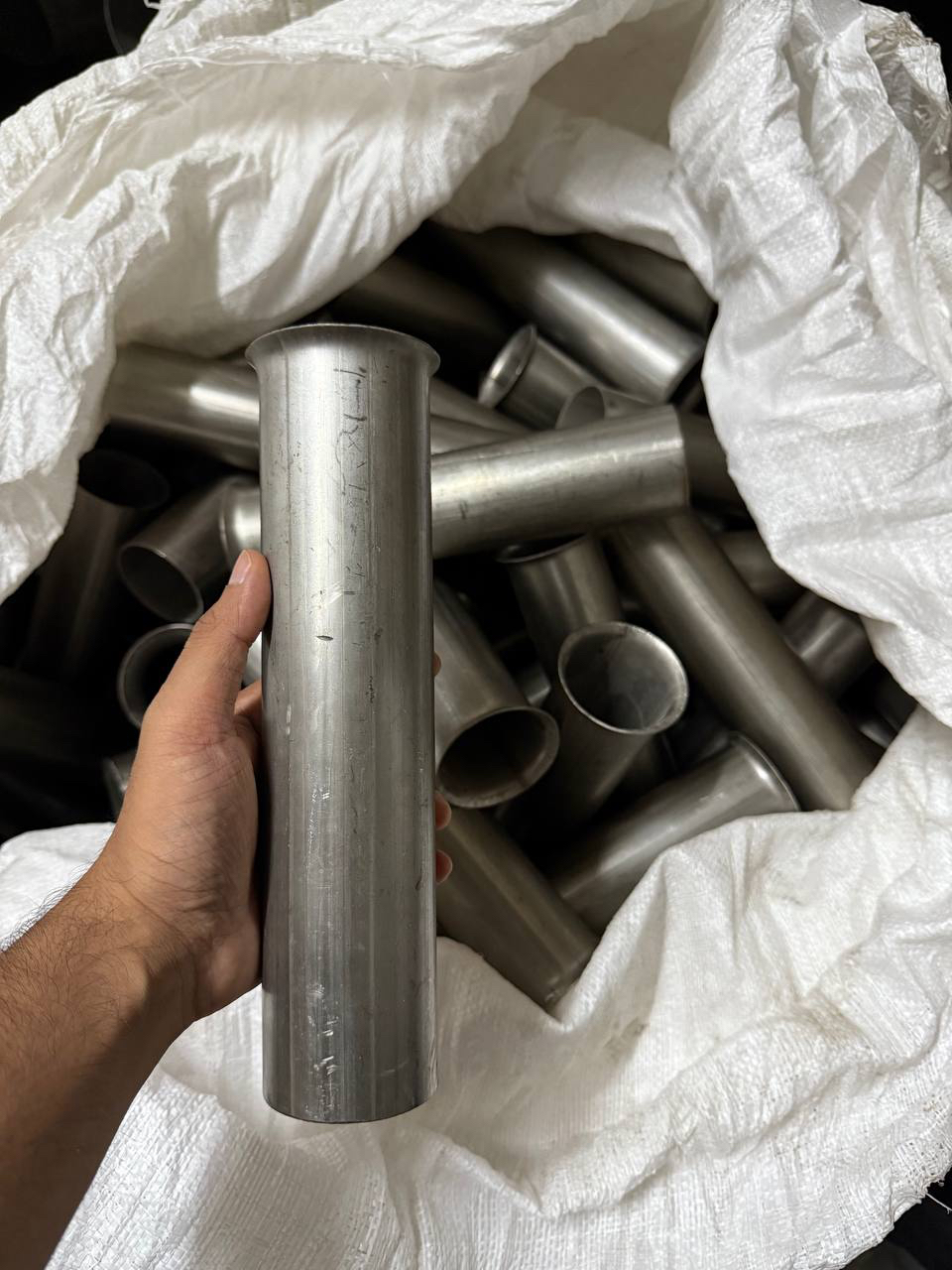
Flared Tube Ferrule (Erosion Sleeve) — the flare shields the tubesheet face described above
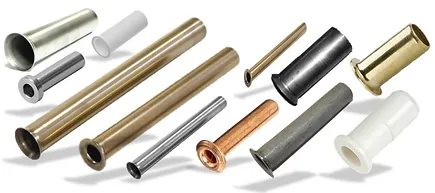
Tube Ferrule Types
| Type | Construction / Retention | Typical Use |
|---|---|---|
| Metal Sleeve Ferrule | Stainless / nickel-alloy sleeve, press-fit or flared | Boiler & heat-exchanger tube inlets |
| Flanged / Lipped Ferrule | Sleeve with a flared lip covering the tubesheet | Tubesheet face & joint protection |
| Snap-Ring Erosion Shield | Shield held by a snap ring in the tube | Easily replaceable inlet shields |
| Ceramic Ferrule | Cast/sintered ceramic, refractory-set | Very high temperature (e.g. SCR / waste-heat inlets) |
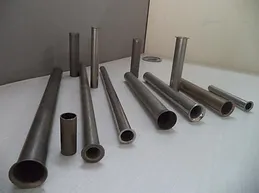
Heat-Exchanger / Air Pre-Heater Ferrules
| Equipment | Protected Area | Benefit |
|---|---|---|
| Fire-tube & water-tube boilers | Tube inlets & tubesheet | Resists flue-gas erosion & thermal shock |
| Shell & tube heat exchangers | Inlet tube ends | Stops inlet-end erosion & vibration wear |
| Air pre-heaters (APH) | Tube inlets | Protects against ash erosion |
| Waste-heat recovery units | Hot-gas inlet tubes | Handles abrasive, high-temp gas |
| Economizers | Tube inlets & bends | Reduces erosion failures |
| Material | Properties | Typical Use |
|---|---|---|
| SS 304 / 316 | Good corrosion resistance, general purpose | Standard heat-exchanger ferrules |
| SS 310 | Excellent high-temperature & scaling resistance | High-temperature boiler & APH inlets |
| SS 410 | Hard, wear-resistant martensitic | Erosion-heavy service |
| Duplex 2205 / Super Duplex 2507 | High strength & chloride resistance | Corrosive / chloride-laden gas |
| Monel 400 / 500 | Excellent in reducing & marine media | Corrosive, HF & seawater service |
| Hastelloy C22 / C276 / B2 / B3 | Superior acid & high-temperature resistance | Aggressive chemical & flue-gas service |
| Ceramic | Extreme temperature & abrasion resistance | SCR, incinerator & waste-heat inlets |
Shields the most vulnerable inlet ends and tubesheet from erosion, thermal shock, and corrosion, dramatically extending equipment life.
The ferrule wears in place of the tube and is replaced at a turnaround — far cheaper and faster than re-tubing the exchanger.
SS 304/316/310/410, Duplex 2205/2507, Monel, Hastelloy, and ceramic to match temperature, erosion, and corrosion demands.
Manufactured to your tube ID/OD, length, and retention method (press-fit, flared, snap-ring, or refractory-set) for an exact fit.
Snap-ring-retained shields install and replace quickly at the tube inlet without welding, minimising turnaround time.
ISO 9001:2015 manufacture with EN 10204 3.1 MTC on request; standard sizes held in stock for fast supply.
| Industry | Typical Use | Why Tube Ferrules |
|---|---|---|
| Power Generation | Boiler, economizer & APH tube inlets | Resist flue-gas erosion; SS 310 / ceramic |
| Refinery & Petrochemical | Process & waste-heat exchangers | Hastelloy / Monel for corrosive gas |
| Chemical Plants | Heat exchangers & reactors | Alloy ferrules for acid & high-temp media |
| Waste-to-Energy | Incinerator & waste-heat boilers | Ceramic ferrules for abrasive hot gas |
| Sugar & Cement | Boilers & air pre-heaters | Erosion protection on dusty gas |
| Oil & Gas | Fired heaters & exchangers | Duplex / nickel-alloy ferrules |
| Steel & Metals | Recuperators & heat recovery | High-temperature scaling resistance |
| Marine & Boilers | Ship boilers & exchangers | SS / Monel corrosion resistance |
Q1. What is a tube ferrule?
A tube ferrule is a short protective sleeve inserted into the inlet end of a boiler, heat-exchanger, or air-pre-heater tube. It shields the tube end and tubesheet from erosion, thermal shock, and corrosion caused by hot, high-velocity, often particle-laden gas or fluid entering the tube — taking the wear as a sacrificial, replaceable liner.
Q2. Why are tube ferrules used at the tube inlet?
The tube inlet is where hot gas or fluid first strikes the relatively cool tube end at high velocity, causing the worst erosion and thermal stress. A ferrule absorbs this attack so the thin tube wall and the tubesheet behind it are protected, preventing inlet-end tube failures and extending the life of the whole exchanger.
Q3. What types of tube ferrules are available?
Metal sleeve ferrules (press-fit or flared), flanged/lipped ferrules that cover the tubesheet face, snap-ring erosion shields for quick replacement, and ceramic ferrules for very high temperature service such as SCR and waste-heat inlets. The type is chosen for the temperature, erosion, and ease-of-replacement required.
Q4. What materials are tube ferrules made from?
SS 304, 316, 310, and 410; Duplex 2205 and Super Duplex 2507; Monel 400/500; Hastelloy C22, C276, B2, and B3; and ceramic. SS 310 and ceramic suit the highest temperatures, Duplex and nickel alloys suit corrosive gas, and martensitic/hard grades suit heavy erosion. The material is matched to the service.
Q5. How is a tube ferrule fitted?
Metal ferrules are fitted by press-fit, flaring, or a snap ring into the cleaned tube inlet; ceramic ferrules are set in refractory so the lip covers the tubesheet. The ferrule must cover the full inlet length at risk and protect the tube-to-tubesheet joint. Snap-ring shields can be installed and replaced without welding.
Q6. How often should ferrules be replaced?
Ferrules are sacrificial, so they are inspected at every turnaround/shutdown and replaced when worn. Replacing a ferrule is far cheaper and faster than re-tubing the exchanger, so timely replacement keeps the protected tubes and tubesheet in service much longer.
Q7. Are these the same as compression-fitting ferrules?
No. These are boiler/heat-exchanger sleeve ferrules that protect tube inlets from erosion. Compression-fitting ferrules are the small front and back ferrules that grip and seal tubing inside a tube fitting — a different product. This page covers the protective tube-inlet (boiler) ferrule.
Q8. Can ferrules be made to our tube sizes?
Yes. Tube ferrules are manufactured to your tube ID/OD, length, and chosen retention method (press-fit, flared, snap-ring, or refractory-set), in the alloy or ceramic suited to your temperature and media. Send your tube details and service conditions for a recommendation and quote.