
Tesco Steel & Engineering manufactures tube sheets (tubesheets) — precision-drilled plates that hold, locate, and seal the tubes in shell-and-tube heat exchangers and boilers, separating the tube-side and shell-side fluids. Each tube end is rolled (expanded) and/or welded into the tubesheet holes, which are laid out in TEMA tube patterns. Supplied as fixed, floating, and U-tube tubesheets in A105, SS 304, 316, 310, 410, Duplex 2205/2507, Monel 400/500, Hastelloy C22/C276/B2/B3, Inconel and Incoloy. 150–9000 lbs and PN6–PN25. ISO 9001:2015 certified. Made in India.
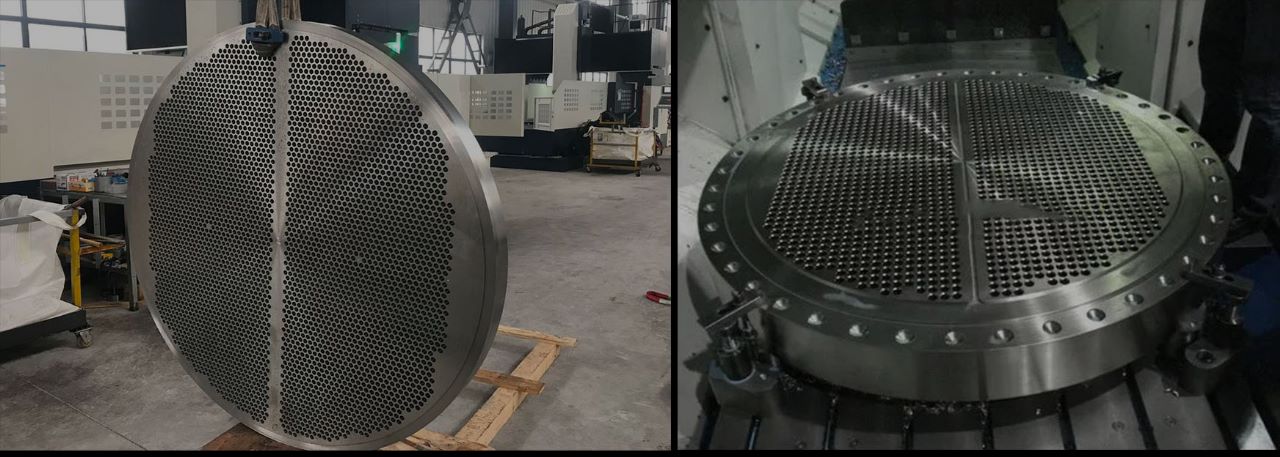
Tube Sheet
Tesco Steel & Engineering manufactures tubesheets for fixed, floating-head, and U-tube exchangers, CNC-drilled to the TEMA pattern, in carbon, stainless, duplex, and nickel-alloy grades — often supplied with matching tube ferrules to protect the tube inlets.
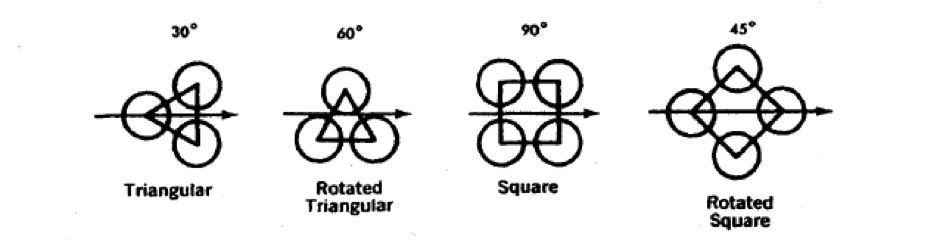
TEMA Drilling Patterns
| Pattern | Angle | Characteristics |
|---|---|---|
| Triangular (30°) | 30° | Most tubes in a given shell; best heat transfer; harder to clean externally |
| Rotated Triangular (60°) | 60° | High tube count; good heat transfer |
| Square (90°) | 90° | Cleaning lanes for mechanical cleaning of the shell side |
| Rotated Square (45°) | 45° | Cleanable with better turbulence than 90° |
Triangular patterns pack the most tubes for maximum heat transfer; square patterns leave straight lanes so the shell side can be mechanically cleaned. The pattern and pitch are chosen for the duty and fouling tendency.
| Type | Construction | Best For |
|---|---|---|
| Fixed Tubesheet | Tubesheets welded to the shell at both ends | Clean shell-side fluids; lowest cost |
| Floating-Head | One tubesheet free to move for thermal expansion | High thermal differential; removable bundle |
| U-Tube | Single tubesheet; tubes bent in a U | Large expansion; easy bundle removal |
| Double Tubesheet | Two tubesheets with a gap | Zero cross-contamination service |
| Clad / Overlay | Carbon steel base with alloy overlay on the wetted face | Economy with corrosion-resistant surface |
| Material | Properties | Typical Use |
|---|---|---|
| Carbon Steel (A105 / SA-516) | Strong, economical | Non-corrosive shell/tube fluids |
| SS 304 / 316 / 316L | Good corrosion resistance | General & chemical service |
| SS 310 / 410 | High-temperature / hard grades | Hot & erosive duties |
| Duplex 2205 / Super Duplex 2507 | High strength & chloride resistance | Seawater, offshore, chloride service |
| Monel 400 / 500 | Excellent in HF & marine media | HF, seawater, reducing media |
| Hastelloy C22 / C276 / B2 / B3 | Superior acid resistance | Aggressive chemical service |
| Inconel / Incoloy | High-temperature & corrosion resistance | High-temperature & corrosive exchangers |
| Parameter | Details |
|---|---|
| Product | Tube sheet / tubesheet for shell-and-tube heat exchangers & boilers |
| Types | Fixed, floating-head, U-tube, double, clad/overlay |
| Tube Patterns | Triangular 30°, rotated triangular 60°, square 90°, rotated square 45° (TEMA) |
| Pressure Class | 150, 300, 600, 900, 1500, 2500, 3000, 6000, 9000 lbs; PN6, PN10, PN16, PN25 and higher |
| Joint | Rolled (expanded), seal-welded, or strength-welded tube-to-tubesheet |
| Standards | TEMA, ASME Sec. VIII, IBR — as specified |
| Material | A105 / SA-516 carbon steel, SS 304/316/310/410, Duplex 2205/2507, Monel, Hastelloy, Inconel, Incoloy |
| Manufacture | CNC gun-drilled holes to pattern & pitch; grooved for rolled joints |
| Finish | Machined faces; clad/weld-overlay option on the wetted side |
| Certifications | ISO 9001:2015 | EN 10204 3.1 MTC on request |
Holes are gun-drilled to the exact TEMA pattern, pitch, and tolerance, with ligament accuracy for sound, leak-tight rolled and welded tube joints.
Fixed, floating-head, U-tube, double, and clad tubesheets to suit any shell-and-tube or boiler design and thermal-expansion need.
Carbon steel, stainless, duplex, Monel, Hastelloy, Inconel, and Incoloy — plus clad/overlay for economy with a corrosion-resistant face.
Tube holes are machined with grooves where required for strong, leak-tight rolled (expanded) tube-to-tubesheet joints.
Designed and supplied across the full pressure-class range (150–9000 lbs, PN6–PN25 and higher) to ASME / TEMA / IBR.
Supplied with matching tube ferrules to protect the tube inlets and tubesheet face from erosion and thermal shock.
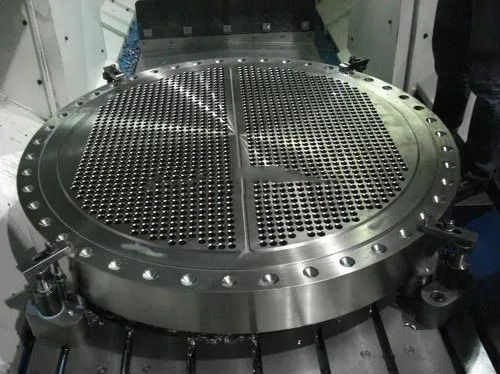
Drilled Tube Sheets
| Industry | Typical Use | Why Tesco Tube Sheets |
|---|---|---|
| Refinery & Petrochemical | Process heat exchangers & coolers | Duplex / nickel-alloy; ASME/TEMA |
| Power Generation | Condensers, feed-water heaters, boilers | High-pressure, high-temp grades |
| Chemical Plants | Reactors & corrosive-service exchangers | Hastelloy / Monel tubesheets |
| Oil & Gas / Offshore | Coolers & heat recovery | Super-duplex chloride resistance |
| Fertilizer & Sugar | Evaporators & heat exchangers | SS & clad tubesheets |
| Desalination | Seawater exchangers | Monel / titanium-clad faces |
| Marine | Coolers & condensers | Corrosion-resistant grades |
| HVAC & Process | Shell-and-tube heat exchangers | Carbon / SS economical builds |
Q1. What is a tube sheet?
A tube sheet (tubesheet) is a thick, precision-drilled plate that holds and seals the tubes in a shell-and-tube heat exchanger or boiler. Each tube is rolled and/or welded into a hole in the plate, so the tubesheet both supports the tube bundle and forms the leak-tight barrier separating the tube-side and shell-side fluids.
Q2. What are the TEMA tube patterns?
TEMA defines four tube-hole layouts: triangular (30°), rotated triangular (60°), square (90°), and rotated square (45°). Triangular patterns pack the most tubes for the best heat transfer; square patterns leave straight lanes so the shell side can be mechanically cleaned. The pattern and pitch are chosen for the heat duty and fouling tendency.
Q3. What types of tubesheet do you make?
Fixed tubesheets (welded to the shell at both ends), floating-head (one tubesheet free to move for thermal expansion), U-tube (single tubesheet with U-bent tubes), double tubesheets (for zero cross-contamination), and clad/overlay tubesheets (carbon steel with a corrosion-resistant alloy face). The type is chosen for thermal expansion, cleaning, and contamination requirements.
Q4. What materials are tubesheets made from?
Carbon steel (A105 / SA-516), SS 304/316/310/410, Duplex 2205 and Super Duplex 2507, Monel 400/500, Hastelloy C22/C276/B2/B3, and Inconel/Incoloy — or carbon steel with an alloy clad/overlay on the wetted face for economy. The grade is selected for the fluids, pressure, temperature, and corrosion allowance.
Q5. How are the tubes fixed into the tubesheet?
Tubes are rolled (expanded) into the holes, seal-welded, or both (strength-welded and expanded), giving a leak-tight joint that separates the two fluids. Tube holes are often machined with grooves to improve the grip and tightness of rolled joints. The joint method is set by the design pressure and service.
Q6. What pressure classes can you supply?
Tubesheets are designed and supplied across the full range — 150, 300, 600, 900, 1500, 2500, 3000, 6000, and 9000 lbs and PN6 to PN25 and higher — to ASME Section VIII, TEMA, and IBR as specified. Thickness is calculated for the design pressure, temperature, and corrosion allowance.
Q7. Are tubesheets and tube ferrules related?
Yes. The tubesheet carries and seals the tubes; tube ferrules are protective sleeves fitted into the tube inlets to shield the tube ends and the tubesheet face from erosion and thermal shock. They are commonly supplied together for exchangers and boilers in erosive, high-temperature service.
Q8. Can tubesheets be made to our drawing and code?
Yes. We manufacture tubesheets to your drawing, TEMA pattern, material, thickness, and pressure class, drilled and grooved to specification and certified to ASME / TEMA / IBR with EN 10204 3.1 MTC. Send your design data — fluids, pressures, temperatures, tube size, and pattern — for a quote.