
Tesco Steel & Engineering manufactures parallel keys — the parallel-sided steel keys, also called machine keys, shaft keys, feather keys or DIN 6885 keys, that sit in a shaft keyway and the mating hub to transmit torque and stop a gear, pulley, sprocket or coupling turning on its shaft. Made to DIN 6885, ISO 773, ISO 2491 and BS 46 in Forms A, B and C, in carbon, alloy, stainless and duplex steel, in standard and custom cross-sections and lengths. ISO 9001:2015 certified. Made in India.
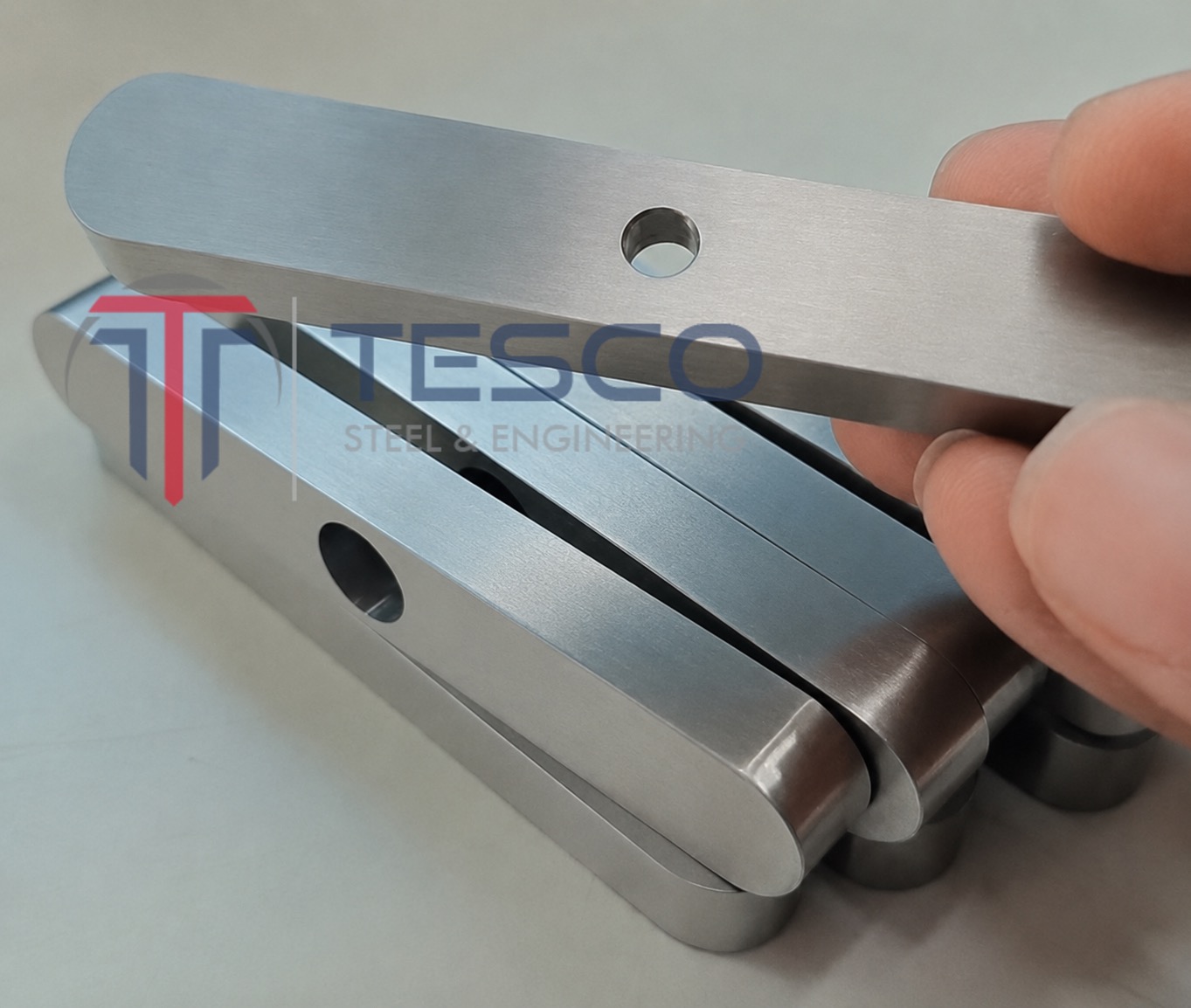
Parallel Keys (DIN 6885) — Duplex Stainless Steel 1.4410 / Super Duplex 2507
A parallel key is one of the simplest and most important machine elements in power transmission. It is a bar of steel with parallel (constant) sides that drops into a slot — the keyway — machined into a shaft, with the other half of the key sitting in a matching slot in the hub of a gear, pulley, sprocket, sheave or coupling. With the key bridging the two, torque passes from shaft to hub (or hub to shaft) and the two cannot rotate independently. It is called “parallel” to set it apart from taper and gib-head keys, and you will hear the same part called a machine key, a shaft key, or — after the German standard that most of the world follows — a DIN 6885 key.
The key sits half in the shaft keyway and half in the hub keyway. Drive torque is carried by the sides of the key bearing against the sides of the two keyways — not by the top and bottom, which is why a small radial clearance over the key is normal. Because the load is shared along the key’s length, the length is chosen to suit the hub width and the torque, while the cross-section is fixed by the shaft diameter. Done right, the key is the deliberate “weak link”: in a severe overload it shears before the shaft or hub is damaged, protecting the costlier parts.
Both ends radiused. Matches a keyway cut with an end mill (a closed, pocketed keyway). The most common form.
Both ends flat. Suits keyways that run out to the end of the shaft or are cut with a side/slot milling cutter.
A combination end form used where one end seats in a pocketed keyway and the other runs out.
Gib-head keys, feather keys and keys with set-screw flats are also available where the design calls for them.
| Standard | Scope |
|---|---|
| DIN 6885 | Parallel keys and keyways (drive-type fastenings); Forms A, B and C — the most widely used key standard |
| ISO 773 | Rectangular and square parallel keys and their keyways — dimensions |
| ISO 2491 | Thin parallel keys and their keyways — for reduced-depth keyseats |
| BS 46 | British Standard for keys and keyways (BS 46-1) |
| ASME B17.1 | US standard for keys and keyseats — supplied on request |
| Shaft diameter d (mm, over–to) | Key width × height (b × h, mm) |
|---|---|
| 6 – 8 | 2 × 2 |
| 8 – 10 | 3 × 3 |
| 10 – 12 | 4 × 4 |
| 12 – 17 | 5 × 5 |
| 17 – 22 | 6 × 6 |
| 22 – 30 | 8 × 7 |
| 30 – 38 | 10 × 8 |
| 38 – 44 | 12 × 8 |
| 44 – 50 | 14 × 9 |
| 50 – 58 | 16 × 10 |
| 58 – 65 | 18 × 11 |
| 65 – 75 | 20 × 12 |
| 75 – 85 | 22 × 14 |
| 85 – 95 | 25 × 14 |
| 95 – 110 | 28 × 16 |
| 110 – 130 | 32 × 18 |
Length is made to suit the hub width and torque. Keyway depths in the shaft (t₁) and hub (t₂) follow the same standard. Larger sizes and thin keys to ISO 2491 are made to order.
| Family | Grades | Typical use |
|---|---|---|
| Carbon steel | C45 / C45K, AISI 1045, AISI 1020, AISI 1018 | Everyday key steel — C45 / 1045 for general drives, 1018 / 1020 for lighter duty |
| Alloy steel | 4140, 4340, 42CrMo4, 8620 | High torque and shock loads; 8620 where a hard, wear-resistant case is wanted |
| Stainless steel | SS304 / 1.4301, SS316 / 1.4401, SS410, A4 | Corrosion resistance — SS304 general, SS316 / A4 marine & chemical, SS410 hardenable |
| Duplex steel | Duplex 2205, Super Duplex 2507 (1.4410) | High strength plus high corrosion resistance — offshore, marine, chemical |
The key width is normally finished to an h9 tolerance, and the working fit is set by the keyway tolerance — a free (sliding) fit where the hub must move, a normal fit for general assembly, or a close / interference fit where the key must be fixed. Key height is typically h11 (h9 for thin keys to ISO 2491) and length h14. Tell us the fit class you need and we hold the matching tolerance on the key.
| Sector | Where parallel keys are used |
|---|---|
| Power transmission | Gears, pulleys, sprockets, sheaves, couplings and flywheels on drive shafts |
| Rotating equipment | Electric motor, gearbox, pump, fan, blower and compressor shafts |
| Machinery & conveyors | Machine tools, conveyor drive and idler shafts, mixers and agitators |
| Marine / offshore / chemical | Stainless and duplex keys for corrosive, marine, food and chemical service |
Carbon, alloy, stainless and duplex from one supplier — matched to torque and corrosion needs.
Standard DIN 6885 / ISO 773 cross-sections, thin keys to ISO 2491, plus fully custom width, height and length.
Cut-to-length keys, feather keys, gib-head keys, or precision keystock bar for your own workshop.
EN 10204 3.1 mill test certificates and PMI on request, from an ISO 9001:2015 manufacturer.
What is a parallel key?
A parallel key is a machine element — a bar of steel with parallel (constant) sides — that sits in a keyway cut into a shaft and a matching slot in the hub of a gear, pulley, sprocket, coupling or sheave. By bridging the two it transmits torque and stops the hub rotating on the shaft. It is called “parallel” to distinguish it from taper and gib-head keys, and is also known as a machine key, shaft key, feather key or, after the German standard, a DIN 6885 key.
What is the difference between a parallel key, machine key, shaft key and feather key?
Machine key and shaft key are everyday names for the same thing as a parallel key — a parallel-sided key in a shaft-and-hub joint. A feather key is a parallel key that is fixed to the shaft (often by screws) while letting the hub slide along it axially, used where a component must move along the shaft yet still be driven. So all feather keys are parallel keys, but not all parallel keys are feather keys.
What is a DIN 6885 key and what are Forms A, B and C?
DIN 6885 is the German standard that defines parallel keys and their keyways. It specifies three end forms: Form A has both ends rounded (radiused), suited to keyways milled with an end mill; Form B has both ends square (flat), suited to keyways made with a side/slot mill or open keyways; and Form C has one rounded and one square end. The standard also fixes the cross-section (width × height) for each shaft diameter range.
What standards are your parallel keys made to?
We manufacture parallel keys to DIN 6885 (parallel keys and keyways, Forms A/B/C), ISO 773 (rectangular and square parallel keys and keyways), ISO 2491 (thin parallel keys and keyways) and BS 46 (the British Standard for keys and keyways). Keys to ASME B17.1 (the US standard) can also be supplied on request. The keyway form, cross-section and tolerances follow the chosen standard.
How do I choose the right parallel key size for my shaft?
The cross-section (width b × height h) is set by the shaft diameter, per DIN 6885 / ISO 773. As a guide: a 12–17 mm shaft uses a 5 × 5 key, 22–30 mm uses 8 × 7, 30–38 mm uses 10 × 8, 44–50 mm uses 14 × 9, 58–65 mm uses 18 × 11 and 75–85 mm uses 22 × 14. The length is normally set to the hub width and the torque to be carried. Send us the shaft diameter, hub width and torque and we will confirm the size.
What is the difference between a Form A and a Form B key?
A Form A key has rounded ends, which match the radiused ends a keyway gets when it is cut with an end mill (a closed, pocketed keyway). A Form B key has square, flat ends, which suit keyways that run out to the end of the shaft or are cut with a side/slot milling cutter. The torque-carrying ability is the same; the choice simply matches how the keyway was machined.
What materials and grades are parallel keys available in?
We make parallel keys in carbon steel — C45 / C45K, AISI 1045, AISI 1020 and AISI 1018; alloy steel — 4140, 4340, 42CrMo4 and 8620; stainless steel — SS304 / 1.4301, SS316 / 1.4401, SS410 and A4 (316-grade) stainless; and duplex / super duplex steel. C45 and 1045 are the everyday key steels; alloy grades are used for high torque; stainless and duplex for corrosive, marine, food and chemical service.
Which grade should I choose for my application?
For general drives, medium-carbon C45 / C45K or AISI 1045 keystock is the standard, economical choice. For high torque or shock loading, alloy steels such as 4140 / 42CrMo4 or 4340 give higher strength, and 8620 is used where a hard, wear-resistant case with a tough core is wanted. For corrosion resistance choose stainless — SS304 for general duty, SS316 / A4 for marine and chemical service, SS410 where a hardenable stainless is needed — and duplex or super duplex where both high strength and high corrosion resistance are required.
What is the difference between ISO 773 and ISO 2491?
ISO 773 covers standard rectangular and square parallel keys and their keyways. ISO 2491 covers thin parallel keys — keys with a reduced height for the same width — used where the shaft or hub cannot take a full-depth keyway, such as on thin-walled hubs or small components. We make both, with the keyway dimensions to match.
What tolerances and fits apply to parallel keys and keyways?
The key width is normally made to an h9 tolerance, and the fit is set by the keyway tolerance: a free (sliding) fit, a normal (tight) fit, or a close/interference fit, depending on whether the hub must slide or be fixed. Standard keyway tolerances such as the free, normal and interference classes in DIN 6885 / ISO 773 are used. Key height is typically h11 (h9 for thin keys) and length h14. Tell us the fit you need and we will hold the right tolerance.
What is keystock or key steel?
Keystock (key steel) is precision cold-drawn square or rectangular bar, held to key tolerances (typically h9 / h11), from which parallel keys are cut to length. We supply both finished keys cut to size and keystock in standard cross-sections and grades, so workshops can cut and fit keys on site. Gib-head keys and keys with set-screw flats can also be supplied.
Do you make custom sizes and provide test certificates?
Yes. We make parallel keys in all standard DIN 6885 / ISO 773 cross-sections and to custom width, height and length, in any of the listed grades, and supply finished keys, feather keys, gib-head keys and keystock. Material test certificates (EN 10204 3.1) and positive material identification (PMI) are provided on request. Tesco Steel & Engineering is an ISO 9001:2015 certified manufacturer and exporter from Mumbai, India.