Titanium Grade 5 Weld Neck Flanges — Ti-6Al-4V (UNS R56400)
Tesco Steel & Engineering forges Titanium Grade 5 weld neck flanges — Ti-6Al-4V, UNS R56400, Werkstoff Nr. 3.7165, the aerospace workhorse titanium alloy — to ASTM B381 F-5, from 1/2″ NB to 56″ NB in ASME B16.5 Class 150–2500 and European PN patterns. 6% aluminium + 4% vanadium engineer a two-phase structure delivering roughly 2.5× CP titanium's strength — 828 MPa yield minimum — while keeping titanium's self-healing oxide film and half-of-steel density (4.43 g/cm³). Built for subsea hardware, riser and hydraulic systems, and weight-critical process duty where the stress analysis outruns Grade 2. Welded by GTAW with ERTi-5 under full inert-gas discipline. Supplied with PMI/XRF and EN 10204 3.1/3.2 on request. ISO 9001:2015, made in Mumbai, India — exported worldwide.
Ti-6Al-4V · Grade 5 · UNS R56400 · 3.7165
895 MPa TS / 828 MPa YS min
ASTM B381 F-5 / ASME SB-381
2.5× CP Strength · Half Steel's Weight
Subsea · Hydraulic · Weight-Critical
1/2″ – 56″ NB · Class 150–2500
ISO 9001:2015 · Exported Worldwide
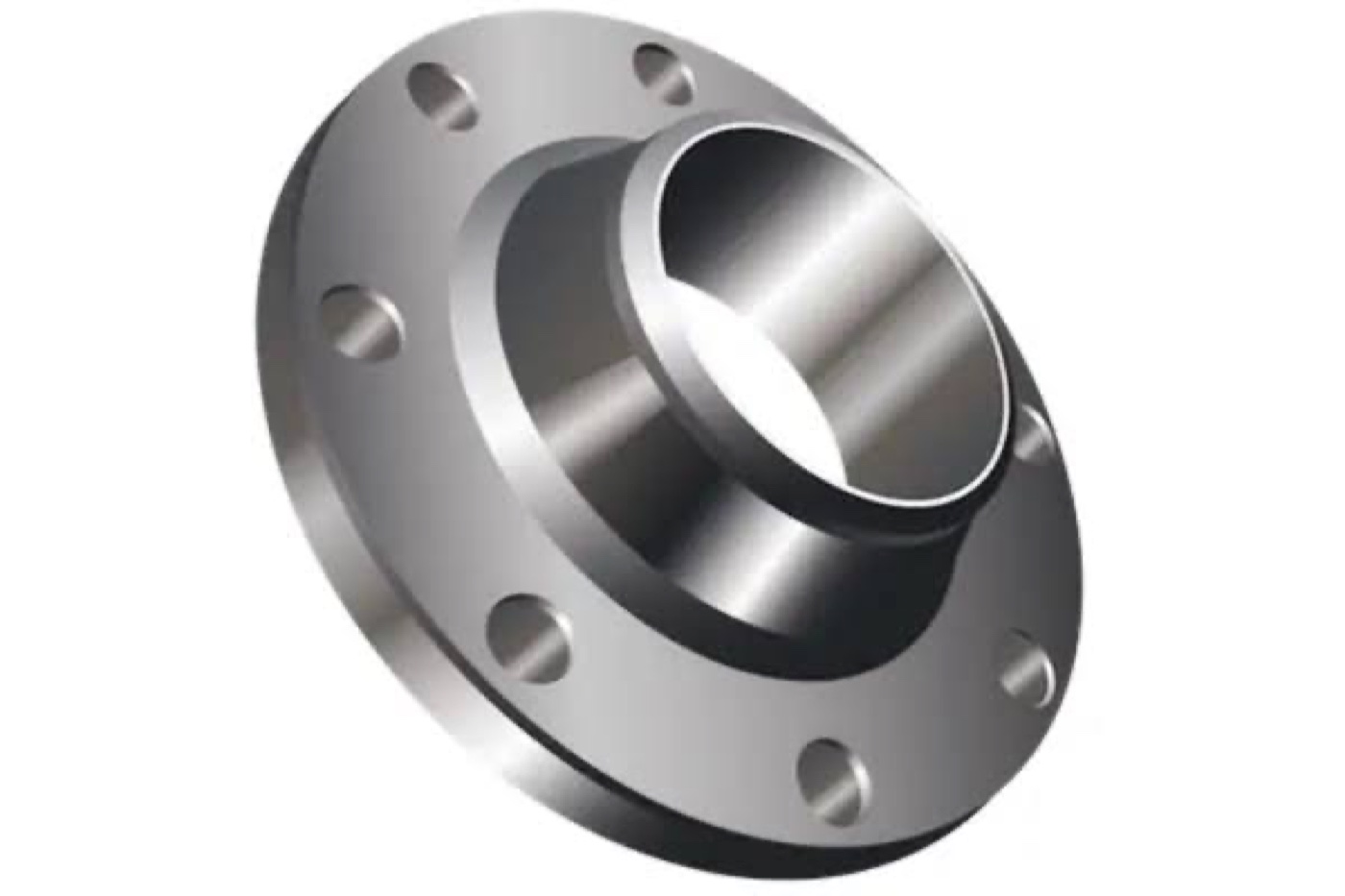
Titanium Grade 5 Weld Neck Flange — Ti-6Al-4V (UNS R56400), Raised Face
What is a Titanium Grade 5 Weld Neck Flange?
Titanium Grade 5 — universally known as Ti-6Al-4V (UNS R56400 / 3.7165) — is titanium with its strength engineered up: aluminium stabilizes the alpha phase, vanadium the beta phase, and the resulting two-phase structure delivers 895 MPa tensile / 828 MPa yield minimums — roughly 2.5× CP titanium — while the surface keeps the same self-healing oxide film. A Titanium Grade 5 weld neck flange pairs that metallurgy with a long tapered hub butt-welded to the pipe, forged to ASTM B381 F-5.
The division of labour in the family: Grade 2 is the corrosion workhorse for static seawater and chemical piping; Grade 5 takes the hardware that works for a living — subsea, hydraulic, rotating, high-pressure — where strength-to-weight is the buying criterion. More than half of all titanium produced worldwide is this one alloy.
One designation note: in the UNS system titanium carries R-numbers — Ti-6Al-4V is R56400. The spelling “N56400” circulates widely in supplier listings, and we keep it searchable — but certificates and standards all say R56400.
Also searched as: Ti-6Al-4V flange, Ti 6-4 flange, Titanium Gr. 5 flange, UNS R56400 flange (often listed as UNS N56400), 3.7165 flange, ASTM B381 F-5 flange — all refer to the product on this page.
Chemical Composition of Titanium Grade 5
| Ti | Fe | O | Al | V |
|---|
| 90.00 min | 0.25 max | 0.20 max | 5.50-6.75 | 3.50-4.50 |
Values in weight %. Aluminium (alpha) and vanadium (beta) engineer the two-phase structure that carries the strength; the oxygen cap tunes the strength-ductility balance. Held tighter still (O 0.13, Fe 0.25), the same alloy becomes Grade 23 ELI — the fracture-critical variant.
Mechanical Properties of Titanium Grade 5
| Tensile Strength, MPa | Yield Strength, Min, MPa | Elongation % min. |
|---|
| 895 [130000] | 828 [120000] | 10 |
Minimums per ASTM B381 F-5, annealed — typical production runs ~950/880 MPa. At 4.43 g/cm³ that is high-strength-steel performance at little more than half steel's weight: the number pair that made Ti-6Al-4V the world's most-used titanium alloy.
Designations of Titanium Grade 5
| UNS | Werkstoff Nr. | Standard |
|---|
| R56400 | 3.7165 | Titanium Gr. 5 |
System partners: ASTM B861 seamless / B862 welded pipe, B363 butt-weld fittings, B265 plate, B348 bar and B381 F-5 forgings. Family: CP Grades 1–4, Pd-bearing Grade 7, and ELI Grade 23.
Titanium Grade 5 Weld Neck Flange Specifications
| Titanium Grade 5 Weld Neck Flanges are available in the following specifications: |
|---|
| Size | 1/2"NB to 56"NB |
| Class | 150#, 300#, 400#, 600#, 900#, 1500#, 2500# |
| Sch (Schedule) | XS, XXS, STD & Schedule 20, 40, 80, 160 |
| Pressure Ratings | PN 2.5 - PN 400 |
| Standards | ASTM B381 F-5 / ASME SB-381; ASME B16.5, ASME B16.47, EN 1092-1, DIN 2631–2635, BS 4504 |
| Condition | Annealed (stress-relieved on request); bright machined faces, protected for shipment |
| Other Services | PMI / XRF alloy verification on Titanium Grade 5 Weld Neck Flanges
Dye-penetrant examination & hydrostatic testing
Degreased, chloride-free cleaning & packing
Project-specific marking, wrapping & export packing |
Why Ti-6Al-4V Owns the Strength-to-Weight Conversation
2.5× CP Titanium's Strength
828 MPa yield minimum from the engineered alpha-beta structure — pressure classes and stress cases CP titanium cannot carry.
High-Strength Steel at 56% of the Mass
4.43 g/cm³ with no coating, no corrosion allowance — the arithmetic that wins subsea and weight-critical designs.
Titanium's Film, Unchanged
The same self-healing oxide protects it in seawater and oxidizing chlorides — strength gained, corrosion immunity kept.
The World's Most-Used Titanium
Over half of global titanium production is Ti-6Al-4V — five decades of aerospace, marine and medical case history behind every forging.
Full Titanium Range In-House
Grades 1, 2, 4, 5 and 7 flanges from one source — the service picks the grade, the certificates arrive matched.
Welding Titanium Grade 5 — ERTi-5 Under Full Shielding
Grade 5 welds by GTAW with ERTi-5 filler under the same total inert-gas discipline as all titanium — torch shielding, trailing shields, full back purge, absolute cleanliness, weld colour checked (bright silver passes) — plus tighter heat-input control, because the two-phase structure is sensitive to weld thermal cycles; stress relief is common on highly loaded joints. Many Grade 5 flanges avoid the question entirely: bolted, not welded, with properties certified on the MTC.
Grade-selection note: if the joint is corrosion-led rather than strength-led,
Grade 2 does the job at lower cost and easier fabrication; reducing acids move the duty to
Grade 7 or the nickel alloys; fracture-critical work calls for
Grade 23 ELI. State the stress case, medium and temperature in the enquiry and the grade follows.
Where Titanium Grade 5 Weld Neck Flanges Are Used
Subsea and offshore lead — riser systems, hydraulic circuits, naval hardware — then high-pressure chemical and PTA components, rotating machinery, aerospace ground systems and weight-critical skids. Weld neck flange production:
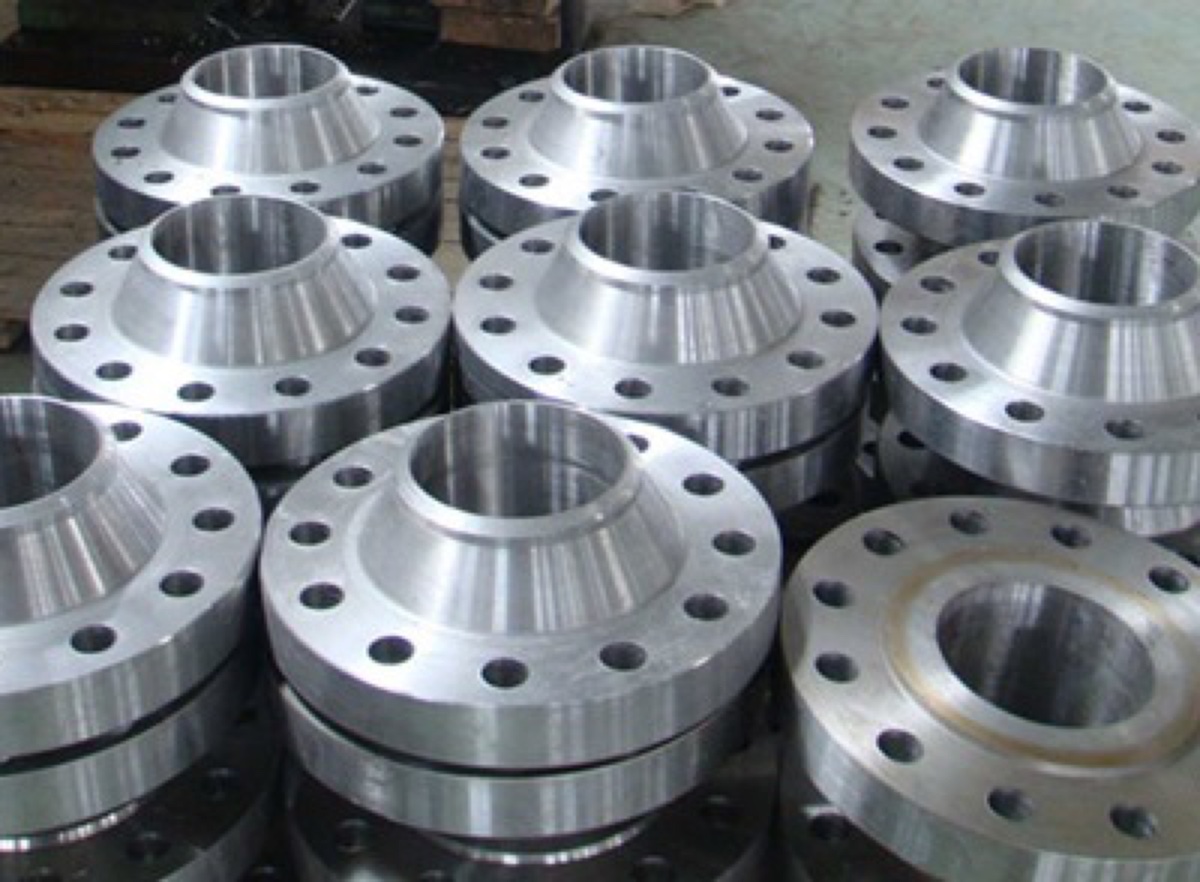
Weld Neck Flanges — Machined & Stacked in Production
Titanium Grade 5 Weld Neck Flange Dimensions
Titanium Grade 5 weld neck flanges share their dimensions with every other material in the same class — OD, thickness, hub, bore, bolt circle and bolting per the standard tables (at roughly half the weight). Full ASME B16.5 charts:
European PN dimensions are published on the EN 1092-1 Type 11, DIN 2631–2635 and BS 4504 pages.
Price List & How to Order
Grade 5 pricing tracks titanium alloy mill markets plus the testing scope, so we quote live with a stated validity rather than publish a static list. To get a firm quotation, usually within 24 hours:
1
List your requirement — size (NB), class or PN, standard (ASME B16.5 / B16.47 / EN / DIN / BS), grade (Gr. 5 — or 23 ELI), pipe schedule or bore, and quantity.
2
State the service & testing scope — stress case, medium and temperature, plus 3.2 witness, PMI or project specifications.
Titanium Grade 5 Weld Neck Flanges — Frequently Asked Questions
What is a Titanium Grade 5 (Ti-6Al-4V) weld neck flange?
It is a weld neck flange forged from Ti-6Al-4V — Titanium Grade 5, UNS R56400 / 3.7165, the aerospace workhorse titanium alloy with 6% aluminium and 4% vanadium — to ASTM B381 F-5. The long tapered hub is butt-welded to the pipe with the bore matched to the schedule, giving a radiographable joint in an alloy that delivers roughly two and a half times CP titanium's strength at about half the weight of steel.
What is the idea behind the Ti-6Al-4V chemistry?
Strength through phase engineering. Aluminium stabilizes titanium's alpha phase and vanadium its beta phase, so the alloy solidifies as a fine two-phase structure far stronger than pure titanium — 828 MPa yield minimum against Grade 2's 275 — while the surface still grows the same self-healing oxide film that makes titanium famously corrosion resistant. One alloy accounts for more than half of all titanium used worldwide precisely because of that combination.
What is the difference between Titanium Grade 5 and Grade 2?
Grade 2 is commercially pure titanium — the corrosion workhorse, ductile, easy to weld, 345 MPa tensile minimum. Grade 5 is an engineered alloy at 895 MPa minimum, roughly two and a half times stronger, chosen when the stress analysis, pressure class or weight budget outruns CP titanium. Grade 2 keeps a slight edge in corrosion resistance and fabricability; Grade 5 wins wherever strength-to-weight rules. For most static seawater piping Grade 2 suffices — Grade 5 takes the hardware that works for a living.
Is the correct designation UNS N56400 or R56400?
R56400. In the UNS system titanium and its alloys carry R-numbers — R50400 for Grade 2, R56400 for Grade 5 — while N-numbers belong to nickel alloys. The spelling N56400 circulates widely in supplier listings, so we keep it searchable, but every certificate, standard and mill document identifies Ti-6Al-4V as UNS R56400. An enquiry under either spelling is quoted as the same material.
What is the difference between Grade 5 and Grade 23 (Ti-6Al-4V ELI)?
Grade 23 is the extra-low-interstitial version of the same alloy — oxygen and iron held tighter — which buys improved fracture toughness and ductility at a small strength cost. It is the medical-implant and cryogenic variant. Standard Grade 5 covers industrial flange duty; specify ELI when the project's fracture-mechanics requirements call for it, and we quote accordingly.
What are the equivalent designations for Titanium Grade 5?
UNS R56400; Werkstoff Nr. 3.7165; ASTM Grade 5 across the product standards — B381 F-5 forgings, B861/B862 pipe, B363 fittings, B265 plate and B348 bar; and the universal names Ti-6Al-4V, Ti 6-4 or Titanium Grade 5. An enquiry in any of these designations is quoted as the same material.
What is the chemical composition of Titanium Grade 5?
Titanium balance (roughly 90%), aluminium 5.50 to 6.75%, vanadium 3.50 to 4.50%, with the interstitials controlled — oxygen 0.20% maximum and iron 0.25% maximum on this specification. Aluminium stabilizes the alpha phase, vanadium the beta phase, and the oxygen window fine-tunes the strength-ductility balance.
What are the mechanical properties of Titanium Grade 5 flanges?
Per ASTM B381 F-5 in the annealed condition: tensile strength 895 MPa (130 ksi) minimum, yield strength 828 MPa (120 ksi) minimum and elongation 10% minimum — with typical production material running around 950/880 MPa. At a density of 4.43 g/cm3 that is steel-beating strength at little more than half steel's weight, which is why the alloy owns the strength-to-weight conversation.
Which pipe and fittings do Titanium Grade 5 weld neck flanges mate with?
ASTM B861 seamless or B862 welded Grade 5 pipe, with B363 butt-weld fittings and B265 plate completing the system — or Grade 2 runs where only the flanged connections need the extra strength, with the weld procedure qualified for the dissimilar-grade joint. The weld neck bore is machined to the pipe schedule you state, so the bore runs flush through the joint.
How are Titanium Grade 5 flanges welded to pipe?
GTAW with ERTi-5 filler under the same total inert-gas discipline as all titanium — torch shielding, trailing shields, full back purge, absolute cleanliness — plus extra care on heat input because Ti-6Al-4V's two-phase structure is sensitive to weld thermal cycles. Post-weld stress relief is common on highly loaded joints. Many Grade 5 applications avoid the question: the flange is bolted, not welded, and arrives with its properties certified.
Is Titanium Grade 5 as corrosion resistant as Grade 2?
Very nearly. The same self-healing oxide film protects it in seawater, brines and oxidizing chlorides, and for most process media the two grades are interchangeable on corrosion grounds. Grade 2 keeps a small edge in crevice-corrosion margin at high temperature and in some hot reducing media, so corrosion-led services default to CP titanium while strength-led services take Grade 5 — with both immune to the chloride SCC that limits stainless.
Where does Titanium Grade 5 outperform steel and nickel alloys?
Wherever the design is weight- or strength-limited in a corrosive environment. A Grade 5 flange matches high-strength steel numbers at 56% of the mass with no coating or corrosion allowance, which is why subsea equipment, offshore hydraulic and riser systems, naval hardware and weight-critical process skids specify it. Against nickel CRAs it adds the strength dimension: 625-class corrosion behaviour in seawater with nearly twice the yield strength at half the density.
What are the limitations of Titanium Grade 5?
The same film-dependent chemistry limits as all titanium — reducing acids (hot uninhibited HCl and H2SO4) and any hydrofluoric acid are excluded, dry chlorine is hazardous — plus alloy-specific ones: service is generally kept below about 350-400 °C, weldments need qualified thermal control, and machining is slower than steel. Cost per kilogram is high, so the alloy is specified where its strength-to-weight actually earns money, not as a general-purpose material.
What testing and certification do you supply with Titanium Grade 5 flanges?
Every lot ships with EN 10204 3.1 mill test certificates covering chemical analysis — including the aluminium and vanadium windows and the oxygen and iron interstitial limits — mechanical properties and heat treatment, with 3.2 certification witnessed by Lloyd's, DNV, BV or TÜV on request. We also offer PMI/XRF verification, hydrostatic testing and dye-penetrant examination, with full heat-number traceability.
Where are Titanium Grade 5 weld neck flanges used?
Subsea and offshore hardware, riser and hydraulic systems, naval and marine equipment, high-pressure chemical and PTA plant components, rotating and reciprocating machinery, aerospace ground systems, and weight-critical skids and modules. Wherever a corrosive environment meets a stress analysis that CP titanium cannot carry, Grade 5 is the answer.
What sizes and standards do you manufacture Titanium Grade 5 weld neck flanges in?
From 1/2 inch NB to 56 inch NB: ASME B16.5 Class 150 to 2500 up to 24 inch, ASME B16.47 above, and European PN 2.5 to PN 400 patterns to EN 1092-1, DIN and BS 4504. Raised face is standard, ring joint on request, and every bore is machined to the mating pipe schedule from Sch 10 through XXS.
Do you keep Titanium Grade 5 weld neck flanges in stock? What is the lead time?
Grade 5 is a project alloy ordered against subsea, offshore and chemical specifications, so flanges are forged to order — typically 4 to 6 weeks depending on size, class and testing scope. Titanium alloy mill prices move with the market, so quotations carry a validity period.
Do you export Titanium Grade 5 flanges outside India?
Yes. Tesco Steel & Engineering is an ISO 9001:2015 certified manufacturer based in Mumbai, and titanium alloy flanges ship to offshore, chemical and marine projects across the Middle East, Europe, Africa, Southeast Asia and the Americas. Flanges travel face-protected and seaworthy-packed, with full heat-number and test traceability.