ASTM A182 F904L Slip On Flanges — SS 904L / 1.4539 Manufacturer
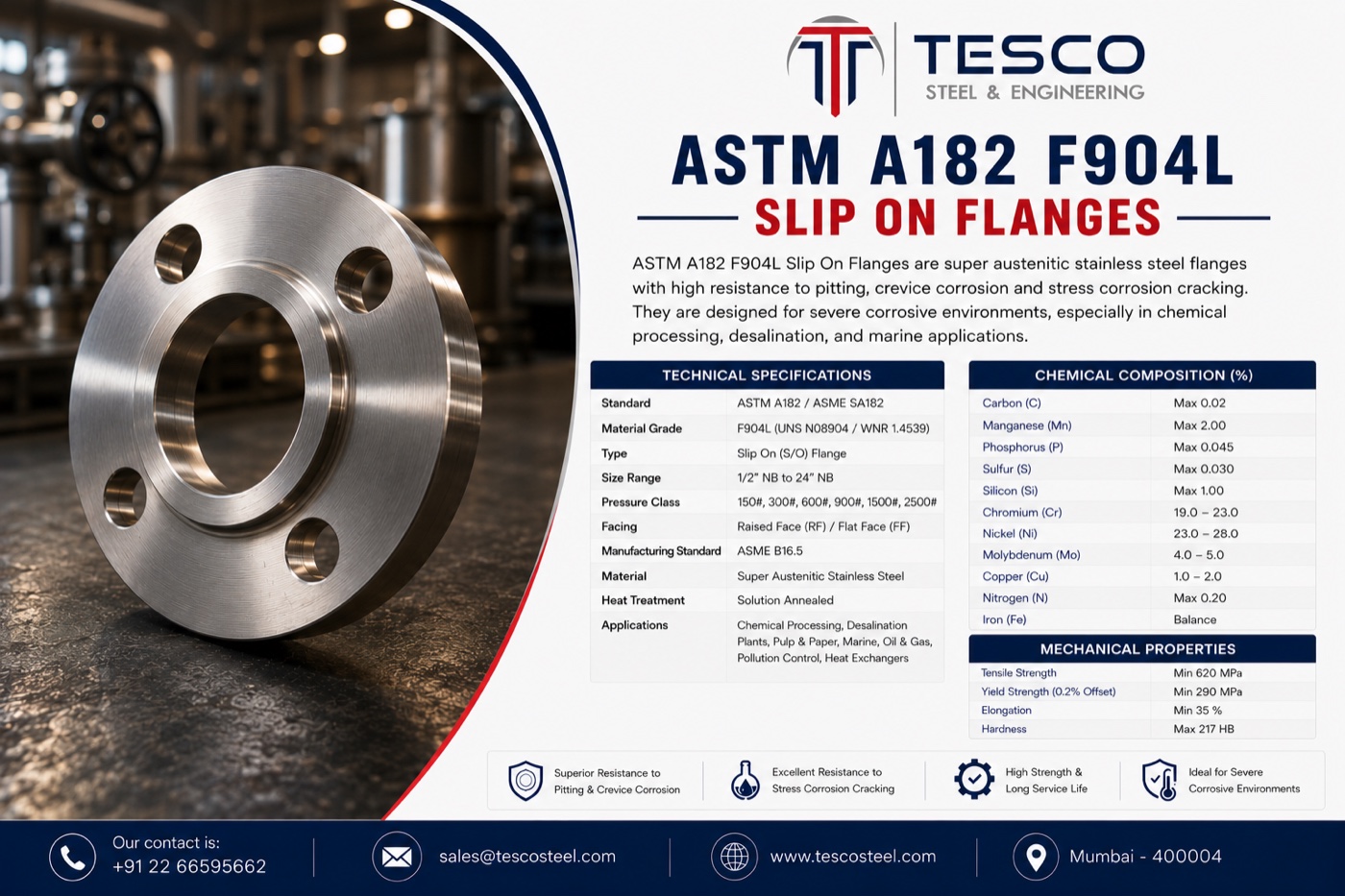
Tesco Steel & Engineering forges ASTM A182 F904L slip on flanges — super austenitic 904L (UNS N08904, Werkstoff 1.4539), the 25Ni-20Cr-4.5Mo grade whose deliberate copper addition resists the reducing acids that attack every ordinary stainless — to ASME B16.5 Class 150–2500 from ½″ to 24″ NB, larger patterns to order. The bridge between stainless and nickel alloys: sulphuric and phosphoric acid plants, scrubber loops and severe chloride duty, with near-immunity to chloride SCC. Supplied solution annealed, with 317L below and 254 SMO above on the corrosion ladder. Every lot with EN 10204 3.1/3.2 MTC. ISO 9001:2015, made in Mumbai, India — exported to 50+ countries.
ASTM A182 F904L Slip On Flange — Specifications at a Glance
What is an ASTM A182 F904L Slip On Flange?
F904L = stainless at the doorstep of the nickel alloys.ASTM A182 F904L (UNS N08904) doubles the nickel to 23–28%, pushes molybdenum to 4–5%, and adds the signature 1–2% copper that lets it passivate in reducing acids like sulphuric — where 316L and 317L corrode actively. PREN ~34–36, near-immune to chloride SCC, intrinsically low-carbon. As a slip-on: two fillet welds, E385 filler, no preheat, no PWHT.
Also searched as: SS 904L slip on flange, 904L SORF flange, N08904 slip on flange, 1.4539 slip on flange, super austenitic slip on flange, SA182 F904L slip on flange, 904L acid grade flange — all refer to the product on this page. See also our 904L flanges overview.
Rule of thumb: chloride pitting alone climbs the molybdenum ladder; the moment reducing acids join in, the copper-and-nickel route through 904L is the economical answer before true nickel alloys.
ASTM A182 F904L (UNS N08904) Chemical Composition
C
Mn
Si
P
S
Cr
Ni
Mo
Cu
N
Fe
0.020 max
2.00 max
1.00 max
0.045 max
0.035 max
19.0-23.0
23.0-28.0
4.0-5.0
1.0-2.0
0.10 max
Bal
Values in weight % for UNS N08904. The copper is the signature — it unlocks reducing-acid service — while the nickel is so high that UNS files the grade in the N-series alongside nickel alloys. Carbon at 0.020% max makes the L intrinsic: there is no standard-carbon 904.
ASTM A182 F904L Mechanical Properties
Tensile Strength, MPa (ksi)
Yield Strength, Min, MPa (ksi)
Elongation % min (2")
Hardness, HB max
490 (71) min
215 (31) min
35
217
Gentle austenitic numbers with exceptional ductility — 904L is bought for its chemistry, not its strength. Supplied solution annealed; where strength drives a chloride design, duplex 2205 offers double the yield. Values demonstrated per heat on the EN 10204 certificate.
A182 F904L Slip On Flange Specifications
ASTM A182 F904L Slip On Flanges are available in the following specifications:
1/2"NB to 24"NB per ASME B16.5; EN 1092-1 flanges in 1.4539 and larger patterns to order
Class
150#, 300#, 400#, 600#, 900#, 1500#, 2500#
Facing
Raised Face (SORF) — default; Flat Face or RTJ where the piping class specifies
Heat Treatment
Solution annealed per ASTM A182, thermal record retained
Service
Sulphuric & phosphoric acid, scrubber and severe chloride duty; near-immune to chloride SCC; cryogenic capable
Installation
Two fillet welds (hub + bore), pipe set back 1/8"; E385/ER385 consumables, low heat input, no preheat, no PWHT
Testing
Intergranular corrosion testing (e.g. ASTM A262) on request
Certification
EN 10204 3.1 (standard) / 3.2 witnessed
Equivalent Grades of ASTM A182 F904L
Standard
Werkstoff Nr.
UNS
EN
Common Name
SS 904L
1.4539
N08904
X1NiCrMoCu25-20-5
Alloy 904L
ASME SA182 F904L is the boiler-code twin. System partners: ASTM A312 TP904L pipe (also supplied under the nickel-alloy specification B677) and matching 904L butt-weld fittings. Certificates always state every designation the heat satisfies.
Why A182 F904L Slip Ons Are Specified
Passive Where Others Corrode Actively
The copper addition holds passivity in dilute-to-mid sulphuric acid — corrosion rates orders of magnitude below 316L/317L across a broad band.
Chloride SCC, Effectively Solved
At 25% nickel, the stress-corrosion cracking that retires 304/316 in warm chlorides simply stops being a design concern.
Stainless Habits, Nickel-Alloy Performance
Welds like an austenitic, prices below the true nickel alloys — the economical first step past the stainless ladder.
A Finish Famous Beyond Industry
The grade's cleanliness and polishability made it luxury watchmaking's steel of choice — the same qualities show on machined flange faces.
How Our A182 F904L Slip On Flanges Are Manufactured
1
Forging — cut billet of certified A182 F904L / 1.4539 heat is hot-forged into the flange blank, keeping full heat traceability from raw material to despatch.
2
Solution annealing — heated and quenched per ASTM A182 to keep the high-alloy austenite clean of intermetallic phases; furnace record retained.
3
Machining — hub, faces and bolt holes to ASME B16.5; the bore machined slightly over pipe OD per the slip-on tolerance.
4
Facing & finish — SORF raised face with serrated stock finish, flat face or RTJ groove; pickled and passivated on request.
5
Testing & marking — mechanical and chemical verification against the heat (ASTM A262 intergranular testing where the order specifies), then permanent marking of grade, size, class and heat number.
6
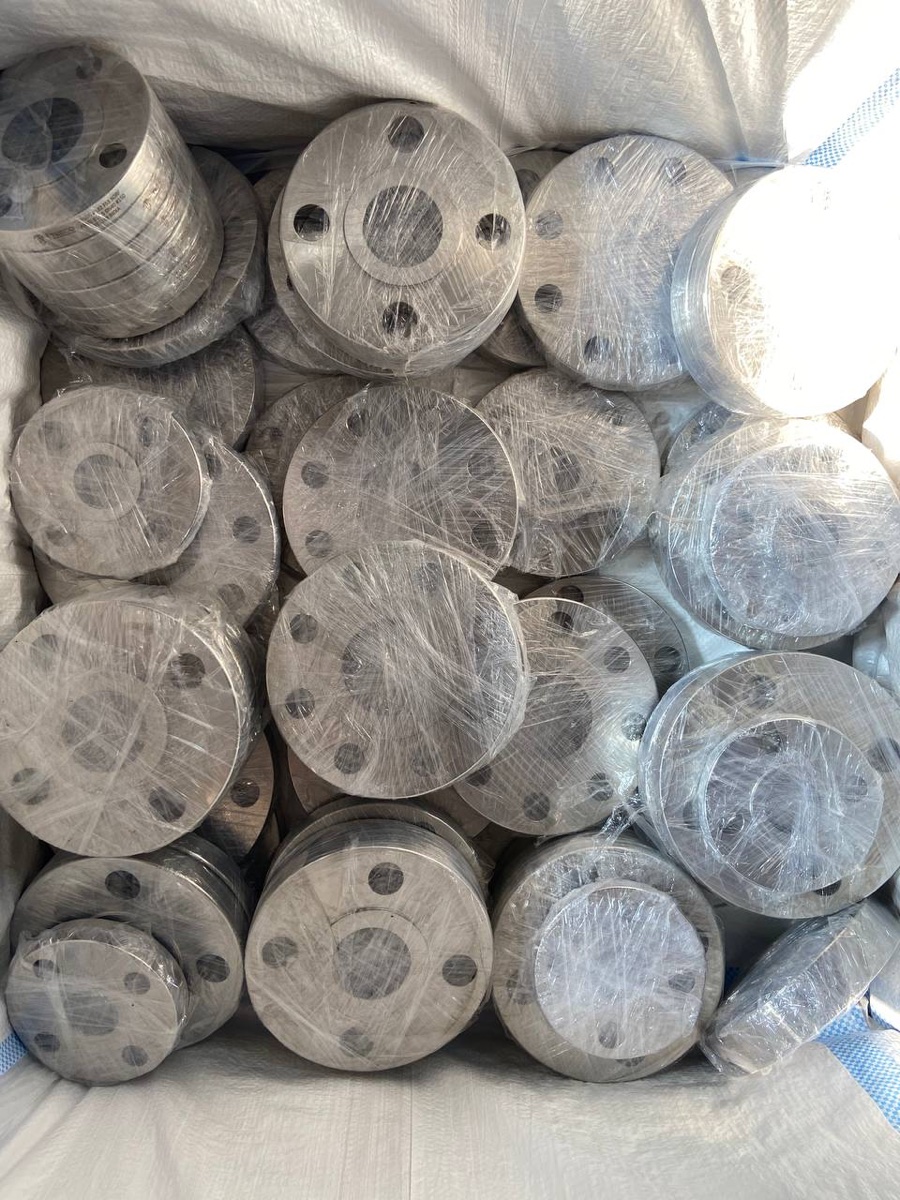
Certification & packing — EN 10204 3.1 MTC (3.2 witnessed on request), export-packed as pictured on this page.
Where A182 F904L Slip On Flanges Are Used
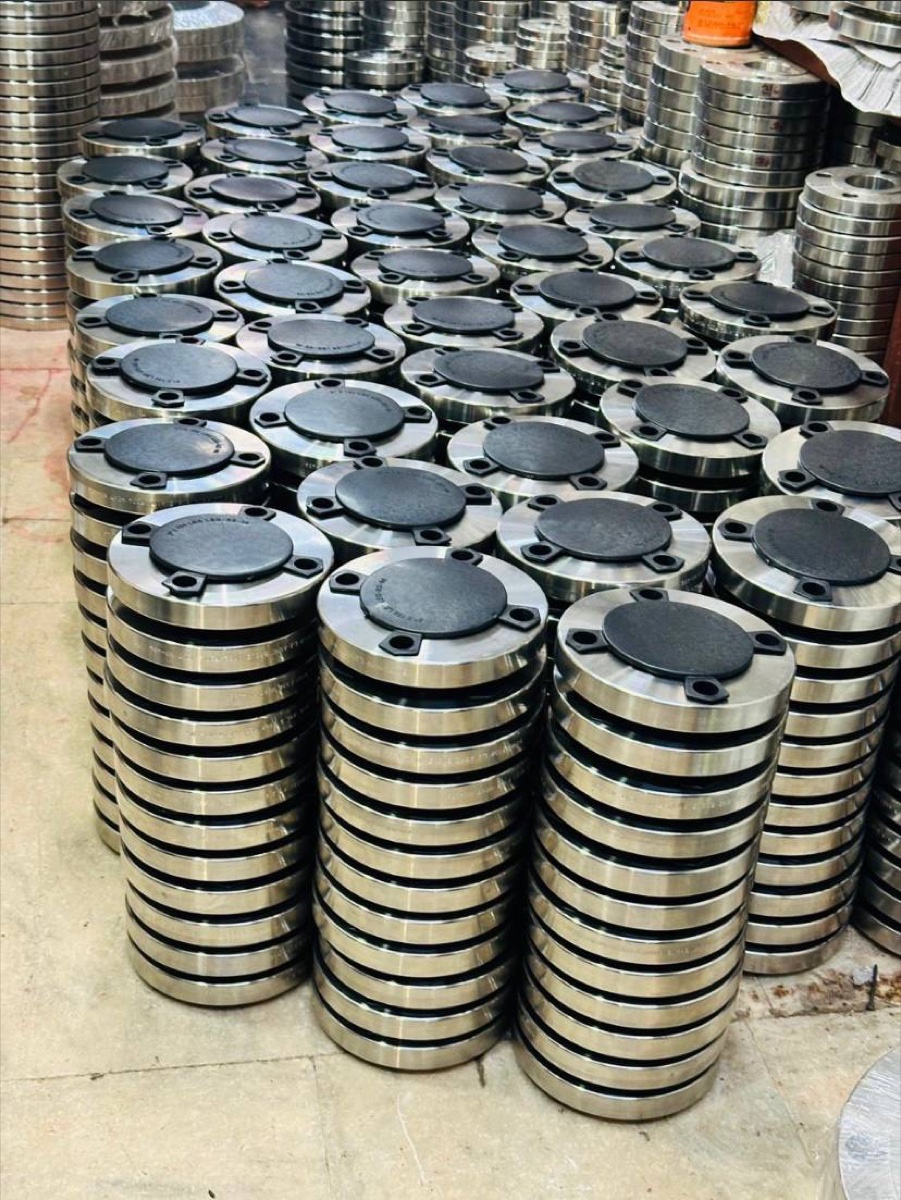
Acid-plus-chloride territory: sulphuric and phosphoric acid plants, fertiliser complexes, FGD scrubber loops with low-pH condensates, pulp-and-paper bleach chemistry, hot acidic brines, seawater-adjacent process systems, pharmaceutical fine-chemical duty, and heat exchangers in aggressive media. Our stainless production and packing below:
Stainless Slip On Flanges — Wrapped & Bagged for ExportStainless Flanges — Face-Protected Stacks at Our Works
A182 F904L Slip On Flange Dimensions
F904L slip-on dimensions follow the ASME B16.5 slip-on tables — identical for every material. Full charts by class:
Example: “Slip On Flange, 4″ NB, ASME B16.5 Class 150, RF, ASTM A182 F904L (1.4539), EN 10204 3.1 — 15 pcs.” Quotations normally within 24 hours with price, unit weight and delivery.
ASTM A182 F904L Slip On Flanges — Frequently Asked Questions
What is an ASTM A182 F904L slip on flange?
It is a slip-on flange forged from ASTM A182 F904L — super austenitic stainless steel 904L (UNS N08904, Werkstoff 1.4539) — dimensioned to ASME B16.5. The flange slides over the pipe end and is secured with two fillet welds, and the 25% nickel, 20% chromium, 4.5% molybdenum chemistry with its deliberate copper addition resists the reducing acids that attack every ordinary stainless. It is the bridge grade between stainless steel and nickel alloys — sulphuric acid plants, scrubbers and severe chloride duty.
What makes 904L different from ordinary stainless steel?
Three things at once: nickel roughly doubled to 23-28%, molybdenum pushed to 4-5%, and — the signature — a deliberate 1-2% copper addition. The copper lets the alloy passivate in reducing acids like sulphuric, where 316L and even 317L corrode actively; the high nickel makes it essentially immune to chloride stress-corrosion cracking; the molybdenum lifts the PREN to about 34-36. It is stainless pushed to the doorstep of the nickel alloys.
What is the chemical composition of ASTM A182 F904L?
For UNS N08904: carbon 0.020% max, manganese 2.00% max, silicon 1.00% max, phosphorus 0.045% max, sulphur 0.035% max, chromium 19.0-23.0%, nickel 23.0-28.0%, molybdenum 4.0-5.0%, copper 1.0-2.0% and nitrogen 0.10% max. The nickel outweighs the iron's usual companions so heavily that UNS classifies it in the N-series alongside nickel alloys — and the very low carbon makes the L designation intrinsic to the grade.
What are the mechanical properties of A182 F904L slip on flanges?
Per ASTM A182: tensile strength 490 MPa (71 ksi) minimum, yield strength 215 MPa (31 ksi) minimum and elongation 35% minimum in 2" — supplied solution annealed, typically under about 217 HB. Gentle austenitic numbers with exceptional ductility; 904L is bought for its chemistry, not its strength. Where strength drives a chloride design, duplex 2205 offers double the yield. Values are demonstrated per heat on the EN 10204 certificate.
Why does 904L contain copper?
For reducing acids — sulphuric above all. In dilute-to-mid concentrations of sulphuric acid, ordinary stainless cannot hold its passive film and corrodes actively; copper in solid solution shifts the alloy's electrochemistry so passivity survives, cutting corrosion rates by orders of magnitude across a broad concentration and temperature band. Phosphoric acid, acid sulphates and scrubber condensates benefit the same way. The copper is the reason the grade exists.
What is the difference between 904L and 317L?
317L is 316L with more molybdenum — still a chloride-focused grade. 904L changes category: double the nickel, another point of molybdenum, plus the copper that unlocks reducing-acid service. In practical terms, 317L is the step for chloride pitting when 316L fails; 904L is the step when acids join the chlorides — sulphuric-bearing scrubber loops, acid plant piping, hot acidic brines. It also brings near-immunity to chloride SCC that no lean austenitic can match.
What is the difference between 904L and 6-moly 254 SMO?
Different emphases at the top of the austenitic ladder. 254 SMO (S31254) pushes molybdenum to ~6% with high nitrogen for a PREN of ~43 — the chloride-pitting champion, built for hot seawater. 904L carries less molybdenum (PREN ~34-36) but more nickel and its copper, making it the stronger choice against reducing acids. The working split: seawater and severe chloride pitting favour 6-moly; sulphuric and mixed acid-chloride chemistry favour 904L. We forge both.
How does 904L compare with duplex 2205?
Similar PREN (~34-36 both), opposite characters. Duplex brings double the yield strength and economy — less nickel — with a 250 °C service ceiling and duplex welding discipline. 904L brings the copper for reducing acids, near-immunity to chloride SCC through sheer nickel, full austenitic weldability and no temperature ceiling. Chloride-plus-strength duty favours duplex; acid-plus-chloride chemistry, and services where fabrication simplicity matters, favour 904L.
Is 904L a stainless steel or a nickel alloy?
Officially both worlds claim it. Metallurgically it is a super austenitic stainless steel — iron is still the largest constituent — but its 23-28% nickel places it in the UNS N-series (N08904) alongside the nickel alloys, and it is often stocked and priced with them. The classification quirk is a fair summary of its role: stainless fabrication and cost habits, with a first step into nickel-alloy corrosion performance. Beyond it, Alloy 20 and the true nickel alloys continue the ladder.
Why is 904L famous outside the process industries?
Luxury watchmaking adopted it — most famously Rolex, which machines its cases from 904L for the corrosion resistance and the fine polish its structure takes. For piping buyers the anecdote carries a useful truth: the grade's cleanliness, ductility and surface quality are exceptional, which shows in machined flange faces and in service against acidic, staining media. The specification reasons remain the copper, nickel and molybdenum.
How is an A182 F904L slip on flange welded to pipe?
With two fillet welds — hub outside, bore inside, pipe set back 1/8" (3 mm) — using matching E385/ER385 (904L) consumables, no preheat, no PWHT, and no sensitization concern at 0.020% carbon. As a fully austenitic, high-alloy weld metal it deserves low heat input and interpass control against hot cracking and molybdenum segregation — routine care for any shop that welds super austenitics — but it remains far simpler than duplex practice.
What temperature range can F904L slip on flanges handle?
The full austenitic span: no ductile-brittle transition downward, so cryogenic duty is unrestricted, and no duplex-style 250 °C ceiling upward — ASME B16.5 rates it through the stainless tables. Its services are typically wet and warm — acid circuits, scrubbers, brines below about 200 °C — and its high nickel keeps chloride SCC at bay in exactly the warm-chloride band where 304/316 crack. Sustained high-temperature duty belongs to the H grades and heat resistors instead.
What sizes and classes are A182 F904L slip on flanges available in?
From ½" to 24" NB per ASME B16.5 in Classes 150 through 2500, with larger patterns and EN 1092-1 flanges in 1.4539 forged to order. 904L is premium project material — forged against the order from certified heats — with standard sizes normally dispatching within a few weeks with EN 10204 3.1 certification. State the required delivery on the enquiry and we confirm the schedule with the quotation.
What details are needed to get an accurate A182 F904L slip on flange quotation?
Five elements plus commercial terms: (1) size and standard — e.g. 4" NB ASME B16.5; (2) pressure class — 150 through 2500; (3) facing — SORF (raised face) default, flat face or RTJ where specified; (4) grade — ASTM A182 F904L (N08904 / 1.4539), with intergranular corrosion testing where the project specifies; (5) certification — EN 10204 3.1 or 3.2. No pipe schedule is needed for the slip-on bore. Add the quantity and destination and we return price, weight and delivery.
Who manufactures ASTM A182 F904L slip on flanges in India?
Tesco Steel & Engineering is an ISO 9001:2015 certified flange manufacturer based in Mumbai, India, forging ASTM A182 F904L / 1.4539 slip on flanges from ½" to 24" NB per ASME B16.5 — alongside 317L below it and 254 SMO above it on the corrosion ladder — in solution-annealed condition with full heat traceability and EN 10204 3.1/3.2 certification on every lot. Flanges are marked with grade, size, class and heat number and export to more than 50 countries.