
Tesco Steel & Engineering manufactures helical coils — pipe and tube wound into a spiral (helix) to pack a large heat-transfer surface into a compact space for heating, cooling, and heat exchange in tanks, reactors, and vessels. The coil carries one fluid (steam, hot oil, water, or refrigerant) while the surrounding vessel holds the process fluid, transferring heat efficiently with a long flow path. Wound to single, nested, tapered, flat, basket, zig-zag, trombone, and box patterns. SS 304, 316, 310, 410, Duplex 2205/2507, Monel 400/500, Hastelloy C22/C276/B2/B3. 150–9000 lbs / PN6–PN25. ISO 9001:2015 certified. Made in India.
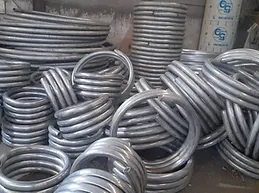
Helical Coil
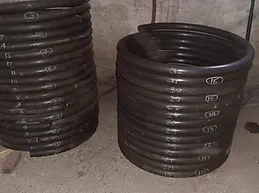
Heat-Exchanger Coil

Single Helical Coil
Tesco Steel & Engineering custom-winds helical coils in many geometries and materials to suit the vessel, duty, and medium, and also supplies limpet (half-pipe) coils welded to vessel walls, plus tube sheets and tube ferrules for shell-and-tube exchangers.
Single Helical

Nested

Tapered

Flat / Pancake

Basket

Zig-Zag

Flat Zig-Zag

Collapsed Zig-Zag

Continuous Zig-Zag

Rectangular Box

Trombone
Heat-Exchanger
| Shape | Description | Typical Use |
|---|---|---|
| Single Helical | One continuous spiral | General tank heating/cooling |
| Nested | Concentric helices | High surface area in one vessel |
| Tapered | Conical helix | Conical / dished vessels |
| Flat / Pancake | Spiral in one plane | Shallow tanks & vessel bottoms |
| Basket | Cage-like coil | Large-volume immersion |
| Zig-Zag (flat / collapsed / continuous) | Serpentine bends | Plate & panel-style exchange |
| Rectangular Box | Coil to a box outline | Rectangular tanks |
| Trombone | Hairpin/return-bend bank | Spray & immersion cooling |
| Material | Properties | Typical Use |
|---|---|---|
| SS 304 / 316 / 316L | Good corrosion resistance | General process heating/cooling |
| SS 310 / 410 | High-temperature / hard grades | Hot-oil & high-temp duties |
| Duplex 2205 / Super Duplex 2507 | High strength & chloride resistance | Seawater & chloride service |
| Monel 400 / 500 | Excellent in HF & marine media | HF, brine & seawater cooling |
| Hastelloy C22 / C276 / B2 / B3 | Superior acid resistance | Aggressive chemical reactors |
| Carbon Steel (A105) | Strong, economical | Non-corrosive heating duties |
| Parameter | Details |
|---|---|
| Product | Helical / process pipe & tube coils for heating, cooling & heat exchange |
| Shapes | Single, nested, tapered, flat/pancake, basket, zig-zag, rectangular box, trombone |
| Medium | Steam, thermic/hot oil, hot & chilled water, refrigerant, glycol |
| Pressure Class | 150, 300, 600, 900, 1500, 2500, 3000, 6000, 9000 lbs; PN6–PN25 and higher |
| Construction | Seamless / welded pipe or tube, custom-wound to coil diameter & pitch |
| Ends | Flanged, threaded, butt/socket-weld inlet & outlet |
| Material | SS 304/316/310/410, Duplex 2205/2507, Monel 400/500, Hastelloy C22/C276/B2/B3, A105 carbon steel |
| Standards | ASME, TEMA, IBR — as specified |
| Certifications | ISO 9001:2015 | EN 10204 3.1 MTC on request |
| Criterion | Helical Coil | Limpet (Half-Pipe) Coil |
|---|---|---|
| Location | Immersed inside the vessel | Welded outside the vessel wall |
| Heat transfer | Direct to the product (high duty) | Through the vessel wall (jacketed) |
| Cleaning | Coil is inside the product | Vessel interior stays clear |
| Best for | Maximum duty, immersion heating/cooling | Clean interiors, jacket-style heat/cool |
For external half-pipe jackets welded to a vessel wall, see limpet coils; helical coils give the highest duty by sitting directly in the product.
A long flow path and curved-flow turbulence pack a large, efficient heat-transfer surface into a compact coil immersed in the product.
Wound to your coil diameter, pitch, height, and shape — single, nested, tapered, flat, basket, zig-zag, box, or trombone — to fit the tank or reactor.
SS 304/316/310/410, Duplex, Monel, Hastelloy, and carbon steel to match the medium, product, temperature, and corrosion duty.
Designed for the full pressure-class range so the coil safely carries steam, hot oil, or high-pressure water.
Made from seamless or welded pipe/tube with flanged, threaded, or weld ends to suit the inlet/outlet connection.
Manufactured and tested to ASME / TEMA / IBR as specified, with ISO 9001:2015 quality and EN 10204 3.1 MTC on request.
| Industry | Typical Use | Why Helical Coil |
|---|---|---|
| Chemical & Pharma | Reactor & vessel heating/cooling | High duty; Hastelloy/SS for the product |
| Food & Beverage | Tank heating, cooking & cooling | SS 316 hygienic immersion coils |
| Oil & Gas | Storage-tank & process heating | Robust steam/hot-oil coils |
| Power & Boilers | Feed-water & process heat exchange | High-pressure coil ratings |
| Breweries & Distilleries | Wort & batch cooling/heating | Trombone & immersion coils |
| Plating & Process Baths | Bath heating/cooling | Corrosion-resistant alloy coils |
| HVAC & Refrigeration | Chilled-water & refrigerant coils | Compact, efficient surface |
| Water & Effluent | Tank temperature control | Economical immersion heating |
Q1. What is a helical coil?
A helical coil is a pipe or tube wound into a spiral (helix) and used as a heat-transfer surface. A heating or cooling medium flows through the coil while the process fluid surrounds it in a tank, reactor, or vessel, so heat passes through the coil wall. The spiral packs a long flow path and large surface area into a compact space for efficient heating or cooling.
Q2. What coil shapes do you manufacture?
Single helical, nested, tapered, flat/pancake, basket, zig-zag (flat, collapsed, and continuous), rectangular box, and trombone coils — wound to your vessel and duty. The shape is chosen to fit the tank or reactor and give even, efficient heat coverage.
Q3. What is the difference between a helical coil and a limpet coil?
A helical coil is immersed inside the vessel and transfers heat directly to the product, giving high duty. A limpet (half-pipe) coil is welded to the outside of the vessel wall as a jacket, keeping the interior clear. Choose a helical coil for maximum duty by direct immersion and a limpet coil for clean interiors and jacket-style heating/cooling.
Q4. What medium flows through the coil?
Steam, thermic (hot) oil, hot or chilled water, glycol, or refrigerant — whatever heats or cools the product. Steam and hot oil run hot and at higher pressures, so the coil material and pressure rating are selected for the medium and its temperature.
Q5. What materials are helical coils made from?
SS 304/316/310/410, Duplex 2205 and Super Duplex 2507, Monel 400/500, Hastelloy C22/C276/B2/B3, and A105 carbon steel. The grade is chosen to be compatible with both the coil-side medium and the surrounding product, and for the temperature and corrosion conditions.
Q6. Why is a coiled tube better than a straight one for heat transfer?
The helical shape packs much more pipe length (and surface area) into a given volume, and the curved flow creates secondary swirl flow that raises the heat-transfer coefficient compared with a straight tube. Together these give a high heat duty in a compact, robust coil.
Q7. What pressure classes are available?
Coils are designed across the full range — 150, 300, 600, 900, 1500, 2500, 3000, 6000, and 9000 lbs and PN6 to PN25 and higher — to ASME / TEMA / IBR as specified, so the coil safely carries steam, hot oil, or high-pressure water on the coil side.
Q8. Can coils be made to our vessel and drawing?
Yes. Helical coils are custom-wound to your coil diameter, pitch, height, shape, material, and pressure class, with the inlet/outlet connections you require, and certified to the applicable code with EN 10204 3.1 MTC. Send your vessel dimensions, duty, and medium for a recommendation and quote.