
Tesco Steel & Engineering manufactures limpet coils — half-pipe (half-round) coils welded spirally to the outside of a vessel, tank, or reactor to heat or cool the contents through the wall. A heating/cooling medium (steam, hot oil, water) flows through the half-pipe channel while the vessel wall transfers the heat to the product inside. The welded half-pipe also stiffens the shell and withstands much higher jacket pressure than a conventional jacket, keeping the vessel interior completely clear. SS 304, 316, 310, 410, Duplex 2205/2507, Monel 400/500, Hastelloy C22/C276/B2/B3, and A105. 150–9000 lbs / PN6–PN25. ISO 9001:2015 certified. Made in India.
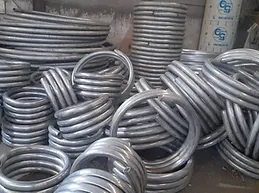
Limpet Coil
Limpet coils are a standard way to temperature-control reactors and storage vessels in process plants. Tesco Steel & Engineering forms and welds limpet (half-pipe) coils to vessels in a full range of alloys, and also supplies immersed helical coils, tube sheets, and tube ferrules.
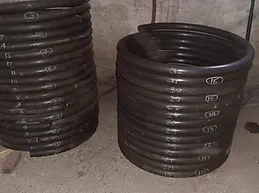
Half-Pipe Heat-Transfer Coil
| Criterion | Limpet (Half-Pipe) Coil | Internal Helical Coil | Conventional Jacket |
|---|---|---|---|
| Location | Welded outside the vessel wall | Immersed inside the vessel | Outer shell around the vessel |
| Vessel interior | Completely clear | Occupied by the coil | Clear |
| Jacket pressure | High (channel + welds) | Coil-side pressure | Lower (large annular space) |
| Shell strength | Reinforced/stiffened | Unchanged | Unchanged |
| Heat transfer | High (fast, turbulent flow) | Highest (direct immersion) | Moderate |
Choose a limpet coil for a clear interior with a high-pressure jacket and a stiffer shell; choose an immersed helical coil for the highest direct duty.
| Section | Description | Notes |
|---|---|---|
| Half-Round Pipe | Pipe split to a half-circle, welded to the shell | Most common; smooth, efficient channel |
| Angle Section | Angle bar forming a triangular channel | Economical for larger vessels |
| Channel / Box | Formed channel section | For specific flow/area needs |
| Material | Properties | Typical Use |
|---|---|---|
| SS 304 / 316 / 316L | Good corrosion resistance | General process vessels & reactors |
| SS 310 / 410 | High-temperature / hard grades | Hot-oil & high-temp jackets |
| Duplex 2205 / Super Duplex 2507 | High strength & chloride resistance | Seawater & chloride service |
| Monel 400 / 500 | Excellent in HF & marine media | HF, brine & seawater cooling |
| Hastelloy C22 / C276 / B2 / B3 | Superior acid resistance | Aggressive chemical reactors |
| Carbon Steel (A105) | Strong, economical | Non-corrosive heating jackets |
| Parameter | Details |
|---|---|
| Product | Limpet (half-pipe) coil jacket for vessels, tanks & reactors |
| Channel Section | Half-round pipe, angle, or formed channel — wound spirally |
| Medium | Steam, thermic/hot oil, hot & chilled water, glycol |
| Pressure Class | 150, 300, 600, 900, 1500, 2500, 3000, 6000, 9000 lbs; PN6–PN25 and higher |
| Attachment | Continuous fillet-welded to the vessel shell |
| Ends | Flanged / threaded / weld inlet & outlet, multi-zone option |
| Material | SS 304/316/310/410, Duplex 2205/2507, Monel 400/500, Hastelloy C22/C276/B2/B3, A105 carbon steel |
| Standards | ASME, TEMA, IBR — as specified |
| Certifications | ISO 9001:2015 | EN 10204 3.1 MTC on request |
The small welded half-pipe channel withstands much higher pressure than a conventional jacket, ideal for high-pressure steam and hot-oil heating.
The continuous welds reinforce the vessel shell, often allowing a thinner shell and resisting vacuum and external loads.
Being entirely external, the limpet coil leaves the vessel interior completely clear — easy to clean, mix, and inspect.
The narrow channel keeps the medium fast and turbulent for a high heat-transfer coefficient, and multi-zone coils give staged control.
SS 304/316/310/410, Duplex, Monel, Hastelloy, and carbon steel matched to the medium, product, temperature, and corrosion duty.
Formed and welded to your vessel diameter, height, channel size, pitch, and number of zones, certified to ASME / TEMA / IBR.
| Industry | Typical Use | Why Limpet Coil |
|---|---|---|
| Chemical & Pharma | Jacketed reactors & vessels | High-pressure jacket; clear interior |
| Food & Beverage | Cooking, mixing & storage vessels | SS 316; easy-clean interior |
| Oil & Gas | Heated storage & process tanks | Steam/hot-oil jackets; robust |
| Paints & Resins | Reactor temperature control | Even heating; high duty |
| Distilleries & Breweries | Fermenter & vessel heating/cooling | Clean interior; efficient transfer |
| Specialty Chemicals | Corrosive-product reactors | Hastelloy / Monel channels |
| Edible Oil & Sugar | Process & storage vessels | Hot-oil/steam jackets |
| Water & Effluent | Heated treatment tanks | Economical external jacket |
Q1. What is a limpet coil?
A limpet coil is a half-pipe (half-round) channel welded spirally around the outside of a vessel, tank, or reactor to form a heating or cooling jacket. A medium flows through the half-pipe channel and heat passes through the vessel wall to the product inside. It keeps the vessel interior clear and reinforces the shell.
Q2. How is a limpet coil different from an internal helical coil?
A limpet coil is welded to the outside of the vessel and transfers heat through the wall, leaving the interior completely clear. An internal helical coil is immersed inside the vessel and transfers heat directly to the product, giving the highest duty but occupying the interior. Choose a limpet coil for a clear, easy-clean interior and a high-pressure jacket.
Q3. How is a limpet coil different from a conventional jacket?
A conventional jacket is a large outer shell surrounding the vessel with a wide annular gap, limited to lower pressures. A limpet coil is a small welded half-pipe channel that withstands much higher pressure, keeps the medium fast and turbulent for better heat transfer, and stiffens the shell — often allowing a thinner vessel wall.
Q4. What medium flows through a limpet coil?
Steam, thermic (hot) oil, hot or chilled water, or glycol — whatever heats or cools the product. Steam and hot oil run hot and at higher pressures, so the channel material and pressure class are selected to suit the medium and its temperature.
Q5. What materials are limpet coils made from?
SS 304/316/310/410, Duplex 2205 and Super Duplex 2507, Monel 400/500, Hastelloy C22/C276/B2/B3, and A105 carbon steel. The channel material is normally matched to the vessel shell and chosen for the medium, temperature, and corrosion conditions.
Q6. Can a limpet jacket be split into zones?
Yes. The limpet coil can be wound as multiple independent zones, each with its own inlet and outlet, so different sections of the vessel can be heated or cooled separately or in stages. This gives better temperature control over the height of a tall reactor or storage vessel.
Q7. What pressure can a limpet coil handle?
Because the half-pipe channel is small and welded to the strong vessel shell, limpet coils handle high jacket pressures and are designed across the full pressure-class range — 150 to 9000 lbs and PN6 to PN25 and higher — to ASME / TEMA / IBR, far exceeding a conventional jacket.
Q8. Can limpet coils be made to our vessel and drawing?
Yes. Limpet coils are formed and welded to your vessel diameter, height, channel size, pitch, number of zones, material, and pressure class, with the connections you require, and certified to the applicable code with EN 10204 3.1 MTC. Send your vessel details, duty, and medium for a recommendation and quote.