Titanium UNS R50400 Slip On Flanges — Grade 2 Manufacturer
Tesco Steel & Engineering forges titanium Grade 2 slip on flanges — commercially pure titanium (UNS R50400, Werkstoff 3.7035) — to ASTM B381 grade F-2 and ASME B16.5 Class 150–2500 from ½″ to 24″ NB, larger patterns to order. A self-healing oxide film gives effectively unlimited life in seawater — stagnant, crevice and chlorinated included — ownership of wet chlorine and hypochlorite where even Hastelloy hands over, and nitric acid capability nickel alloys lack — at 4.51 g/cm³, 57% the weight of steel. Where our acid ladder ends, titanium begins. Every lot with EN 10204 3.1/3.2 MTC, hydrogen reported. ISO 9001:2015, made in Mumbai, India — exported to 50+ countries.
Titanium Gr 2 · CP Ti · R50400ASTM B381 F-2 · 3.7035Ti Balance · O 0.25 / Fe 0.30 maxDensity 4.51 — 57% of SteelASME B16.5 Class 150–2500345 MPa TS / 275 MPa YS minEN 10204 3.1 / 3.2 · ISO 9001:2015
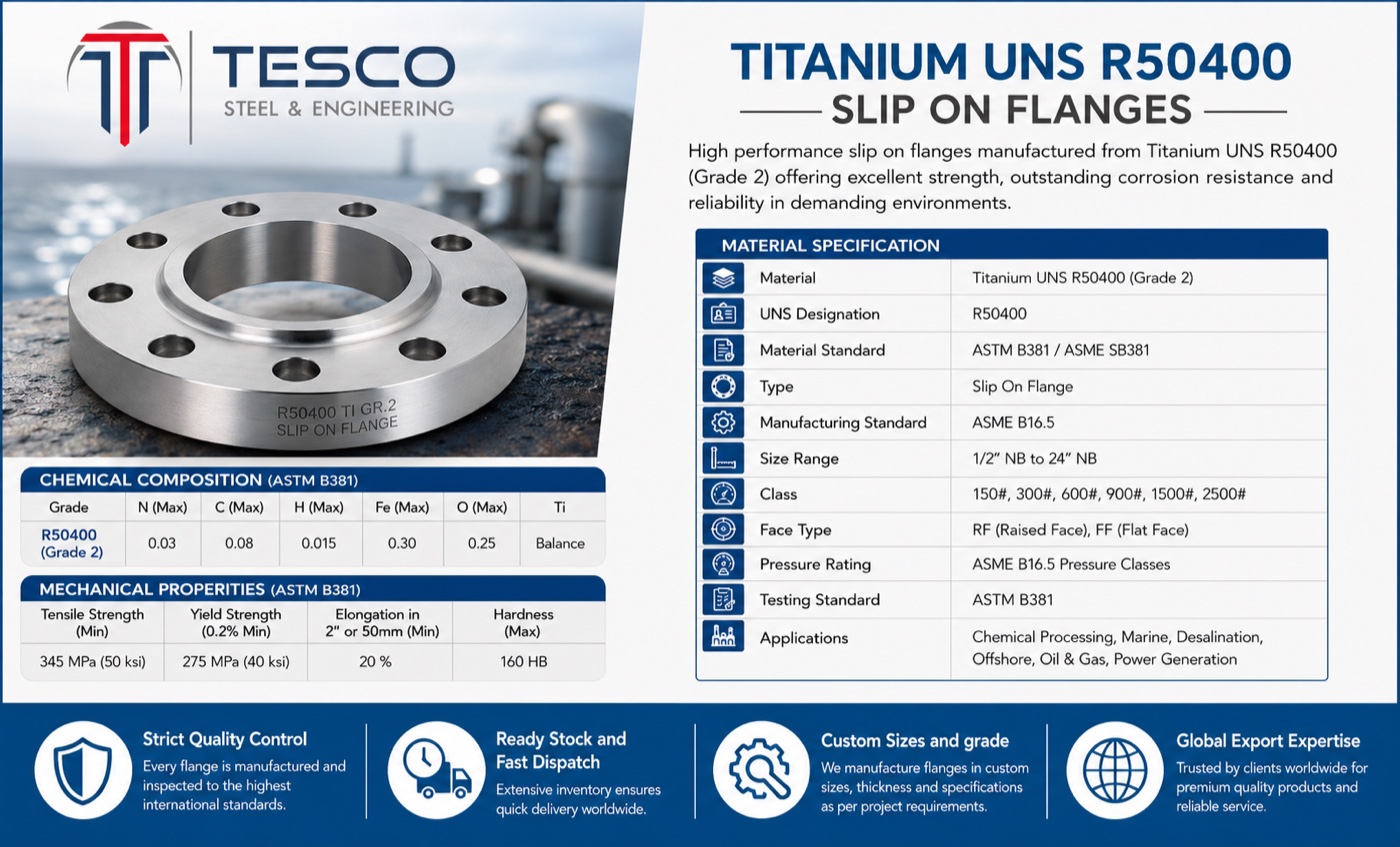
Titanium UNS R50400 Slip On Flange — Specifications at a Glance
What is a Titanium UNS R50400 Slip On Flange?
Titanium Grade 2 = the metal whose armour repairs itself. A TiO₂ film that water helps rebuild makes seawater duty — stagnant, crevice, chlorinated, hot — effectively permanent, and hands titanium the chemistry nickel cannot hold: wet chlorine, hypochlorite, nitric acid. All at 4.51 g/cm³ — 57% the weight of steel. One famous rule: wet chlorine yes, dry chlorine never (fire risk). As a slip-on: two fillet welds, GTAW with ERTi-2 under full argon coverage, no preheat, no PWHT — forged to ASTM B381, not A182.
Also searched as: Titanium Grade 2 slip on flange, CP titanium SORF flange, ASTM B381 F-2 slip on flange, 3.7035 slip on flange, Ti Gr 2 flange — all refer to the product on this page. See also our Titanium Gr 2 flanges overview and Titanium hub.
Rule of thumb: nickel owns the reducing street, titanium owns the oxidising one — and in seawater, titanium is the metal with nothing left to prove.
Titanium Grade 2 (UNS R50400) Chemical Composition
Ti
O
Fe
C
N
H
Balance
0.25 max
0.30 max
0.08 max
0.03 max
0.015 max
Values in weight % for UNS R50400 per ASTM B381. The tiny numbers are the whole specification: oxygen and iron set the strength (how the CP grades differ), and hydrogen is capped hardest — absorbed hydrogen embrittles titanium, which is why our certificates report it and welding practice guards against it.
Titanium Grade 2 Mechanical Properties
Tensile Strength, MPa (ksi)
Yield Strength 0.2%, Min, MPa (ksi)
Elongation % min
Density
345 (50) min
275 (40) min
20
4.51 g/cm³
Per ASTM B381 grade F-2, annealed. Carbon-steel-class strength at 57% of the weight — a strength-to-weight ratio beyond most stainless — and tough at cryogenic temperatures with no ductile-brittle transition. Values demonstrated per heat on the EN 10204 certificate.
Titanium UNS R50400 Slip On Flange Specifications
Titanium Grade 2 Slip On Flanges are available in the following specifications:
Two fillet welds (hub + bore), pipe set back 1/8"; GTAW with ERTi-2 under full argon coverage incl. trailing & back purge, weld colour inspected
Testing
Interstitial analysis incl. hydrogen reported per heat; PMI on request
Certification
EN 10204 3.1 (standard) / 3.2 witnessed
Equivalent Grades of Titanium Grade 2
Trade Names
ASTM Forging
UNS
Werkstoff Nr.
Fittings
Pipe / Plate / Bar
Titanium Grade 2 / CP Ti Gr 2 / Ti Gr.2
B381 F-2
R50400
3.7035
B363 WPT2
B861-B862 / B265 / B348
ASME SB-381 is the boiler-code twin. Not an A182 grade and not the nickel B-series — titanium carries its own ASTM family. Grade neighbours: Gr 1 (softest), Gr 5 Ti-6Al-4V (strength), Gr 7 Pd (hot reducing acids).
Why Titanium Grade 2 Slip Ons Are Specified
Seawater, Solved Permanently
Flowing, stagnant, polluted, chlorinated or hot — the self-healing TiO₂ film makes attack unmeasurable, and crevice corrosion stays silent to ~75 °C. Desalination plants are built on it.
The Wet-Chlorine Metal
Where the nickel ladder ends — wet chlorine, hypochlorite, chlorine dioxide — titanium's water-maintained film thrives. Chlor-alkali cell rooms and bleach plants standardised on it.
Nitric Acid, Inverted
The oxidising acid that attacks chromium-free nickel alloys is titanium's friend — the film only grows stronger. The two families complete each other.
Half the Weight
4.51 g/cm³ — 57% of steel, half of nickel alloy. Across hundreds of offshore or skid joints, the structural, crane and freight savings often pay the material premium.
Titanium's armour needs water. In wet chlorine the film heals continuously and the metal is effectively immortal; in dry chlorine there is nothing to rebuild it, bare titanium reacts directly, and the reaction can ignite the metal — roughly 0.7–1% moisture is the rule of thumb, and dry-side duty belongs to nickel alloys. Also off the table: hydrofluoric acid (dissolves the film — Monel's domain), hot uninhibited reducing acids (Gr 7 or Hastelloy), and hydrogen-rich conditions incl. cathodic over-protection (embrittlement). And remember titanium is galvanically noble — insulate it from bare steel neighbours, or the steel pays the bill. State the stream and we confirm the metal honestly.
How Our Titanium Grade 2 Slip On Flanges Are Manufactured
1
Forging — cut billet of certified R50400 heat is hot-forged into the flange blank, keeping full heat traceability from raw material to despatch.
2
Annealing — per ASTM B381; furnace record retained, interstitial pickup controlled.
3
Machining — hub, faces and bolt holes to ASME B16.5 with titanium-dedicated tooling; the bore machined slightly over pipe OD per the slip-on tolerance.
4
Facing & finish — SORF raised face with serrated stock finish, flat face or RTJ groove; iron-contamination-free handling throughout.
5
Testing & marking — mechanical and full interstitial verification against the heat, hydrogen reported (PMI where the order specifies), then permanent marking of standard, grade, size, class and heat number.
6
Certification & packing — EN 10204 3.1 MTC (3.2 witnessed on request), export-packed for sea or air freight.
Where Titanium Grade 2 Slip On Flanges Are Used
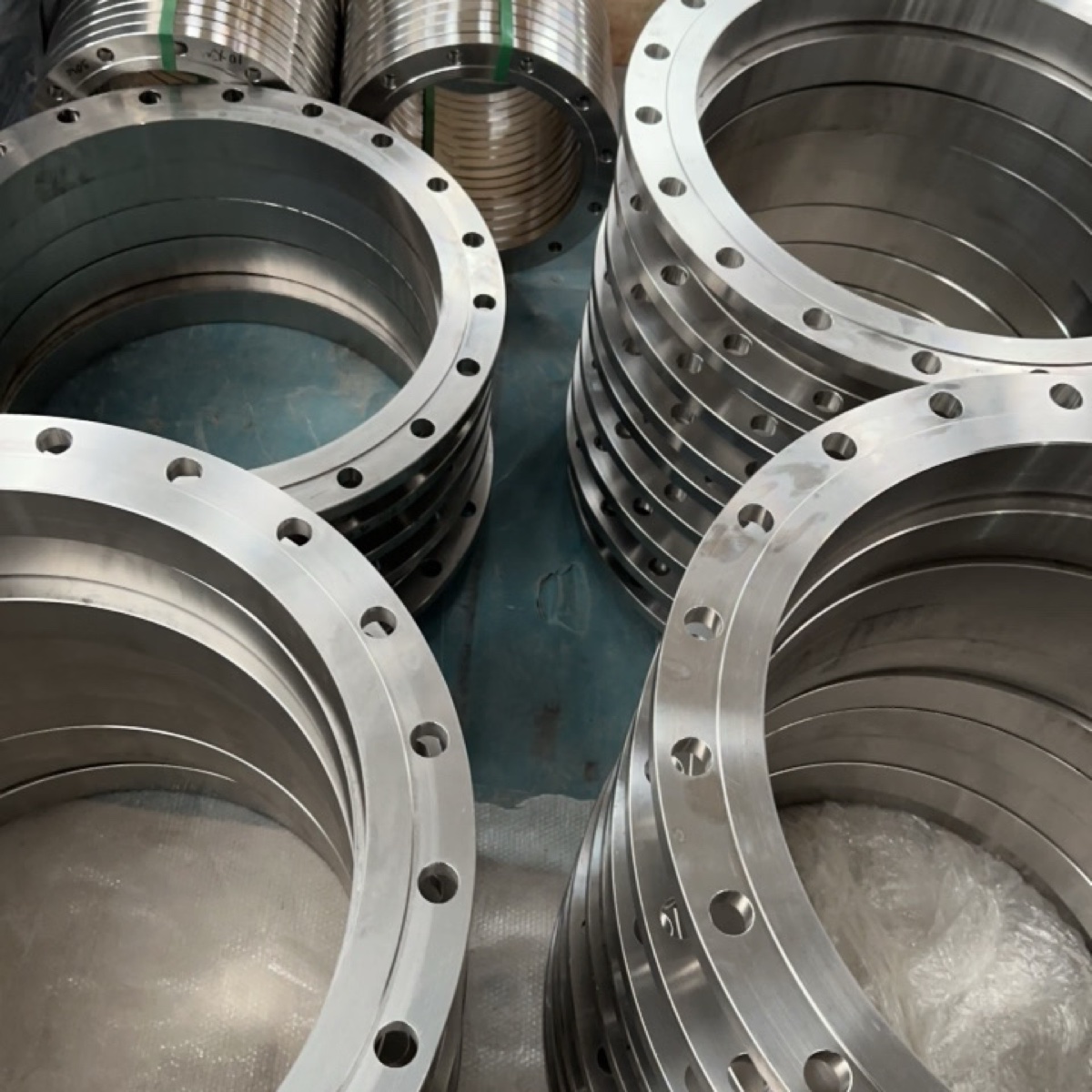
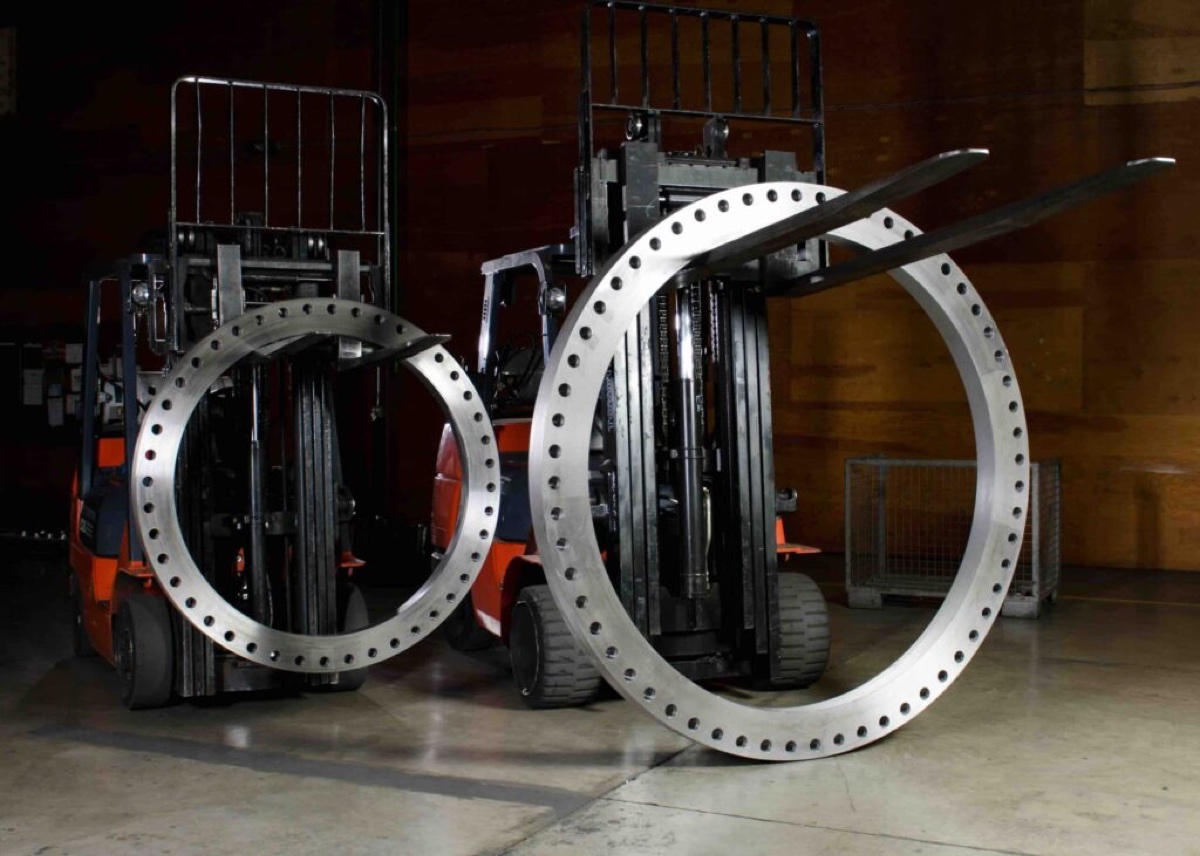
Wherever seawater and wet chlorine rule: desalination plants (MSF and RO), chlor-alkali cell rooms, pulp-and-paper bleach plants, coastal power and process cooling systems, offshore firewater and service piping where weight matters, condenser and heat-exchanger circuits, nitric acid service and chloride-heavy chemistry that has defeated the stainless ladder. Slip-ons serve the moderate-pressure utility and transfer connections; weld necks take the critical lines. Production scale below:
Large-Diameter Slip On Flanges — EN 1092-1 Patterns to OrderGiant-Diameter Flanges — Forklift-Scale Production
Titanium UNS R50400 Slip On Flange Dimensions
Titanium slip-on dimensions follow the ASME B16.5 slip-on tables — identical for every material (the weight, at 57% of steel, is where titanium differs). Full charts by class:
How to Specify & Order a Titanium Grade 2 Slip On Flange
Five elements — no bore schedule, since the slip-on bore suits the pipe OD:
1
Size & standard — e.g. 4″ NB ASME B16.5.
2
Pressure class & facing — Class 150–2500, SORF (default), flat face or RTJ where specified.
3
Grade & stream — Titanium Gr 2 / UNS R50400 — ASTM B381 F-2 (3.7035); state moisture in chlorine service and gasket-face temperature in hot brine so we can confirm Gr 2 vs Gr 7.
4
Certification & testing — EN 10204 3.1 (standard) or 3.2 witnessed; hydrogen reported as standard, PMI where the project specifies.
Example: “Slip On Flange, 4″ NB, ASME B16.5 Class 150, RF, Titanium Gr 2 / ASTM B381 F-2 (R50400), EN 10204 3.1 — 10 pcs.” Quotations normally within 24 hours with price, unit weight and delivery.
Titanium UNS R50400 Slip On Flanges — Frequently Asked Questions
What is a titanium UNS R50400 slip on flange?
It is a slip-on flange forged from commercially pure titanium Grade 2 (UNS R50400, ASTM B381 grade F-2, Werkstoff 3.7035) — dimensioned to ASME B16.5. The flange slides over the pipe end and is secured with two fillet welds. Titanium's self-healing oxide film gives it effectively unlimited life in seawater including stagnant and crevice conditions, ownership of wet chlorine and hypochlorite chemistry where even Hastelloy hands over, and nitric acid capability the nickel alloys lack — all at 4.51 g/cm³, roughly 57% the weight of a steel flange.
What is titanium Grade 2?
The workhorse of commercially pure titanium. The CP grades differ only in permitted oxygen and iron — Grade 1 is softest and most formable, Grade 2 balances strength and ductility, Grades 3 and 4 trade ductility for strength — and Grade 2 is the one industry standardised on for piping, vessels and flanges. It is not an alloy in the conventional sense: the corrosion resistance is the element's own, delivered through a tenacious TiO₂ film that reforms instantly wherever it is scratched. Designations: UNS R50400, Werkstoff 3.7035; forged flanges are governed by ASTM B381.
What is the chemical composition of titanium Grade 2?
For UNS R50400: titanium balance, with only interstitial limits — oxygen 0.25% max, iron 0.30% max, carbon 0.08% max, nitrogen 0.03% max and hydrogen 0.015% max. Those tiny numbers are the entire specification: oxygen and iron set the strength (which is how the CP grades differ), and hydrogen is capped hardest because absorbed hydrogen embrittles titanium — why certificates report it and why welding practice guards against it.
What are the mechanical properties of titanium Grade 2 slip on flanges?
Per ASTM B381 grade F-2: tensile strength 345 MPa (50 ksi) minimum, 0.2% yield strength 275 MPa (40 ksi) minimum and elongation 20% minimum — carbon-steel-class strength at 4.51 g/cm³, which is the real story: a titanium flange weighs about 57% of its steel twin, and its strength-to-weight ratio exceeds most stainless. Tough at cryogenic temperatures with no ductile-brittle transition. Values are demonstrated per heat on the EN 10204 certificate.
Why is titanium the seawater and wet chlorine metal?
Because its protective film is an oxide that water itself helps maintain. In chloride media the TiO₂ film is essentially inert and self-healing, so seawater — flowing, stagnant, polluted or hot — causes no measurable attack, and crevice corrosion only enters the conversation above roughly 75-80 °C. Wet chlorine, hypochlorite and chlorine dioxide follow the same rule: the moisture sustains the film, making titanium the standard material of chlor-alkali cell rooms, bleach plants and chlorinated seawater systems where every steel and most nickel alloys pit.
Why does titanium handle wet chlorine but not dry chlorine?
The famous inversion — and a genuine safety point. Titanium's protection is its oxide film, and water is what repairs it: in wet chlorine the film heals continuously and the metal is effectively immortal. In dry chlorine there is no moisture to rebuild the film, bare titanium reacts directly with the gas, and the reaction is exothermic enough to ignite the metal — titanium can literally burn in dry chlorine. The rule of thumb is roughly 0.7-1% water minimum. Dry chlorine duty belongs to nickel alloys like Inconel 600 — precisely the opposite of the wet side. State the moisture condition on the enquiry; it decides the metal.
How does titanium Grade 2 compare with nickel alloys like C-276 or 625?
They rule opposite sides of the electrochemical street. Nickel alloys own reducing chemistry — hot HCl, HF via Monel, dry halogens — where titanium's oxide film cannot survive. Titanium owns the oxidising side: wet chlorine, hypochlorite, nitric acid, chlorides of every kind, where its film thrives and even C-276 concedes. In seawater both work, but titanium does it without crevice anxiety to ~75 °C, without biofouling-driven pitting, at half the weight and often below nickel-alloy prices. The two families are complements, not competitors — which is why our acid ladder ends with both.
What is the difference between titanium Grades 1, 2, 5 and 7?
Grade 1 (R50250) is the softest CP grade — maximum formability, specified for deep-drawn and lined equipment. Grade 2 (R50400) is the standard: the strength-ductility balance that piping and flanges use. Grade 5 (Ti-6Al-4V, R56400) is the aerospace alloy — nearly nickel-alloy strength at titanium weight, used where load governs, at some cost in corrosion margin and weldability. Grade 7 (R52400) is Grade 2 plus a trace of palladium, extending resistance into hot reducing acids and raising the crevice temperature — the upgrade when Grade 2's limits pinch. We supply Grades 1, 2, 5 and 7.
To what temperature does titanium Grade 2 resist seawater crevice corrosion?
Open-surface seawater attack is effectively nil at any practical temperature, and crevice corrosion — the mechanism that lives under gaskets and deposits — stays silent up to roughly 75-80 °C in natural and chlorinated seawater. Above that band, tight crevices in hot brine can initiate attack, and the answer is palladium-bearing Grade 7 or Grade 12, whose crevice thresholds run far higher. For desalination brine heaters and hot chlorinated systems, state the metal temperature at the gasket face and we confirm the grade honestly.
How much lighter is a titanium flange than a steel one?
At 4.51 g/cm³ against carbon steel's 7.85 and nickel alloys' 8.4-8.9, a titanium Grade 2 flange weighs about 57% of its steel twin and roughly half of a nickel-alloy one — a 24" Class 150 slip-on saves tens of kilograms per joint. On offshore topsides, where structure is costed per tonne, and on skid-mounted and transport-limited packages, that saving compounds across hundreds of joints into structural steel, crane and freight economies that often pay for the material premium by themselves.
How is a titanium slip on flange welded to pipe?
With two fillet welds — hub outside, bore inside, pipe set back 1/8" (3 mm) — by GTAW with matching ERTi-2 filler, and one discipline above all: total inert-gas coverage. Hot titanium absorbs oxygen, nitrogen and hydrogen from air, so the weld pool, the cooling bead and the back side are all argon-shielded (trailing shields and purge dams are standard kit), and the result is judged by colour — bright silver passes, straw is marginal, blue or grey is cut out. No preheat, no PWHT; cleanliness and shielding are the whole craft.
Which ASTM standard covers titanium UNS R50400 slip on flanges?
ASTM B381 (ASME SB-381), the titanium forging specification, where Grade 2 forgings are designated F-2 — not A182 or the nickel B-series. System partners follow titanium's own family: seamless pipe to ASTM B861, welded pipe to B862, plate to B265, bar to B348 and welding fittings to ASTM B363 (WPT2). Certificates state UNS R50400, the standard, the annealed condition, the interstitial analysis including hydrogen, and the heat number together.
Where are titanium Grade 2 slip on flanges typically used?
Desalination plants — MSF and RO alike — chlor-alkali cell rooms and wet chlorine systems, pulp-and-paper bleach plants, seawater cooling in coastal power and process plants, offshore firewater and service systems where weight matters, heat-exchanger and condenser circuits, nitric acid service, and chloride-heavy chemical duty that has defeated the stainless ladder. Slip-ons serve the moderate-pressure utility and transfer connections; weld necks take the critical lines — both forged from the same certified heats.
Where does titanium Grade 2 not belong?
Four honest lines. Hydrofluoric acid: dissolves the oxide film — that duty is Monel's. Dry chlorine: fire risk, as covered above — nickel alloys instead. Hot reducing acids: uninhibited hot HCl and strong sulphuric attack CP titanium — Grade 7 or the Hastelloy family take over. And hydrogen: absorbed hydrogen embrittles titanium, so cathodic over-protection and hydrogen-rich process streams need design care. One system note: titanium is galvanically noble — insulate it from bare steel neighbours, or the steel pays the bill.
Who manufactures titanium UNS R50400 slip on flanges in India?
Tesco Steel & Engineering is an ISO 9001:2015 certified flange manufacturer based in Mumbai, India, forging titanium Grade 2 / UNS R50400 slip on flanges from ½" to 24" NB per ASTM B381 and ASME B16.5 — alongside the full R50400 range of weld neck, blind and socketweld flanges and titanium Grades 1, 5 and 7 — with full heat traceability, hydrogen reported on every certificate, PMI on request, and EN 10204 3.1/3.2 certification on every lot. Exported to more than 50 countries.