254 SMO Slip On Flanges — 6-Moly UNS S31254 / F44 Manufacturer
Tesco Steel & Engineering forges 254 SMO slip on flanges — the 6% molybdenum super austenitic (UNS S31254, ASTM A182 F44, Werkstoff 1.4547) whose PREN of ~43 makes it the chloride-pitting champion of the stainless family — to ASME B16.5 Class 150–2500 from ½″ to 24″ NB, larger patterns to order. Built for hot seawater, desalination and the severest chloride duty: the fully austenitic alternative to super duplex, with no temperature ceiling and 1.5× the strength of ordinary stainless. Supplied solution annealed, with 904L below it on the corrosion ladder. Every lot with EN 10204 3.1/3.2 MTC. ISO 9001:2015, made in Mumbai, India — exported to 50+ countries.
254 SMO · ASTM A182 F44 · S31254Werkstoff 1.4547 · X1CrNiMoCuN20-18-7Mo 6.0–6.5% · PREN ~43ASME B16.5 Class 150–2500½″ – 24″ NB · SORF650 MPa TS / 300 MPa YS minEN 10204 3.1 / 3.2 · ISO 9001:2015
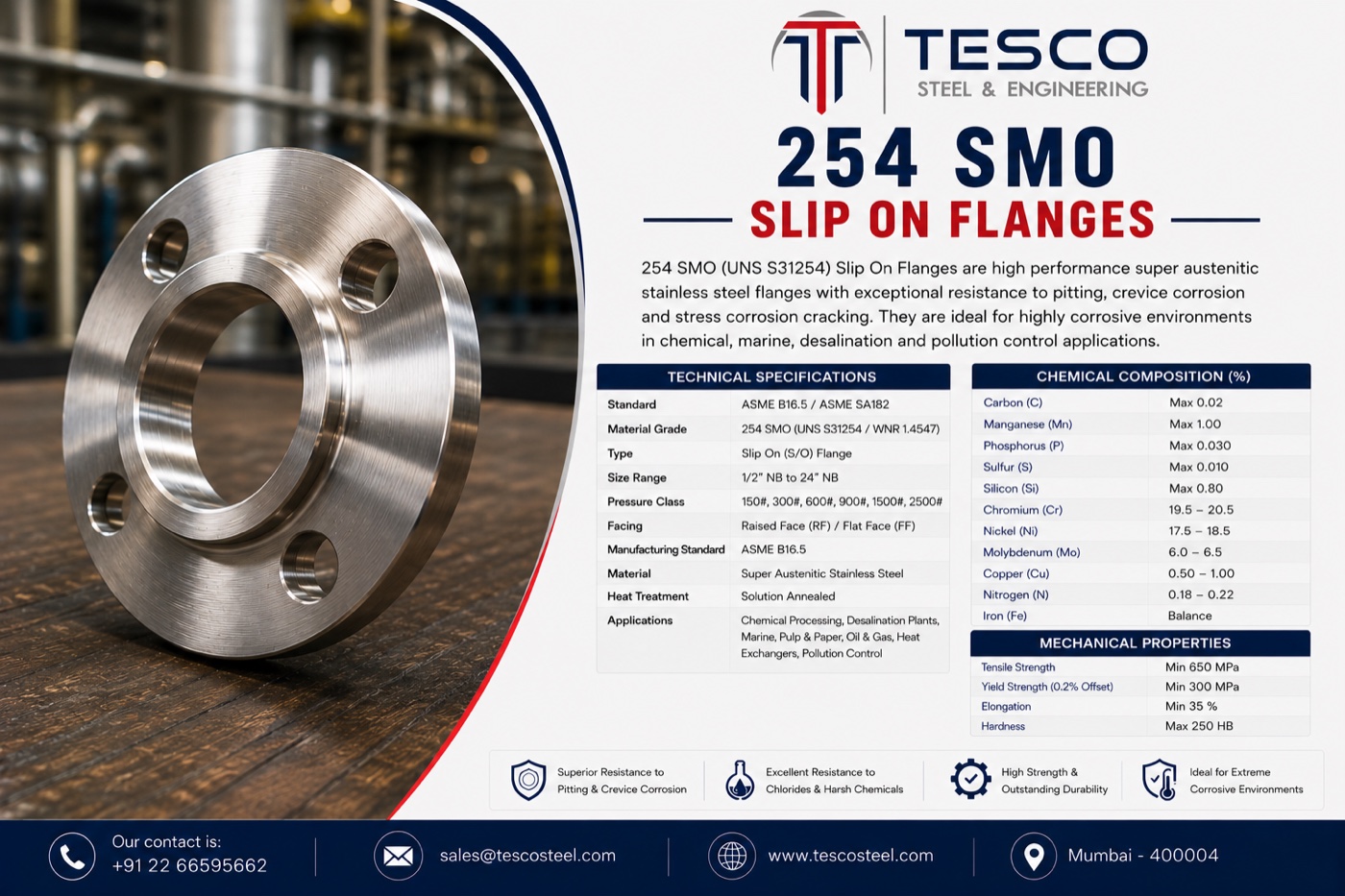
254 SMO Slip On Flange — Specifications at a Glance
What is a 254 SMO Slip On Flange?
254 SMO = where the chloride ladder ends. The 6-moly super austenitic (UNS S31254 / A182 F44) triples 316's molybdenum and boosts nitrogen to ~0.2%, reaching PREN ~43 — critical pitting and crevice temperatures above real hot-seawater conditions. Fully austenitic: no duplex temperature ceiling, cryogenic capable, 650/300 MPa strength. As a slip-on: two fillet welds with over-alloyed Alloy 625 filler (the 6-moly rule), no preheat, no PWHT.
Also searched as: 254 SMO SORF flange, UNS S31254 slip on flange, ASTM A182 F44 slip on flange, 6-moly / 6Mo slip on flange, 1.4547 slip on flange, SMO 254 flange — all refer to the product on this page. See also our 254 SMO flanges overview.
Rule of thumb: 254 SMO is where stainless chloride thinking ends — beyond it the answers are titanium and nickel alloys. Against super duplex at PREN parity, the choice is structure: austenitic flexibility vs duplex strength.
254 SMO (UNS S31254) Chemical Composition
C
Mn
Si
P
S
Cr
Ni
Mo
Cu
N
Fe
0.020 max
1.00 max
0.80 max
0.030 max
0.010 max
19.5-20.5
17.5-18.5
6.0-6.5
0.50-1.00
0.18-0.22
Bal
Values in weight % for UNS S31254. Note the tight ranges and very low sulphur — 6-moly metallurgy is precision chemistry — and the nitrogen as a load-bearing element, feeding both the PREN and the strength.
254 SMO Mechanical Properties
Tensile Strength, MPa (ksi)
Yield Strength, Min, MPa (ksi)
Elongation % min (2")
Hardness, HB max
650 (94) min
300 (44) min
35
250
The nitrogen makes 254 SMO markedly stronger than ordinary austenitics — roughly 1.5× the yield of 316L — while keeping full austenitic ductility and toughness. Supplied solution annealed; values demonstrated per heat on the EN 10204 certificate.
254 SMO Slip On Flange Specifications
254 SMO Slip On Flanges are available in the following specifications:
1/2"NB to 24"NB per ASME B16.5; EN 1092-1 flanges in 1.4547 and larger patterns to order
Class
150#, 300#, 400#, 600#, 900#, 1500#, 2500#
Facing
Raised Face (SORF) — default; Flat Face or RTJ where the piping class specifies
Heat Treatment
Solution annealed per ASTM A182, thermal record retained
Service
Hot seawater, firewater, desalination & severest chloride duty — no duplex-style temperature ceiling; cryogenic capable
Installation
Two fillet welds (hub + bore), pipe set back 1/8"; over-alloyed ENiCrMo-3 (Alloy 625) filler, low heat input, no preheat, no PWHT
Testing
ASTM G48 pitting/crevice corrosion testing on request
Certification
EN 10204 3.1 (standard) / 3.2 witnessed
Equivalent Grades of 254 SMO
Trade Name
ASTM Forging
UNS
Werkstoff Nr.
EN
254 SMO
A182 F44
S31254
1.4547
X1CrNiMoCuN20-18-7
ASME SA182 F44 is the boiler-code twin. System partners: ASTM A312 (S31254) pipe and A403 (S31254) fittings. Sister 6-moly alloys such as AL-6XN (N08367) occupy the same duty class — certificates state every designation the heat satisfies.
Why 254 SMO Slip Ons Are Specified
PREN ~43 — Past the Super Duplex Threshold
Critical pitting and crevice temperatures above real hot-seawater conditions — the stainless family's last word against chlorides.
Austenitic Freedom
No 250 °C duplex ceiling, unrestricted cryogenic capability, no embrittling-phase design games — thermal flexibility super duplex cannot offer.
Strength From Nitrogen
650/300 MPa — roughly 1.5× the yield of 316L — with full austenitic ductility and toughness retained.
SCC Solved Twice Over
High nickel plus the nitrogen-hardened film: chloride stress-corrosion cracking is simply not a design concern.
Forging — cut billet of certified S31254 heat is hot-forged into the flange blank, keeping full heat traceability from raw material to despatch.
2
Solution annealing — heated and rapidly quenched per ASTM A182 to keep the high-moly austenite clean of intermetallic phases — the critical step in 6-moly supply; furnace record retained.
3
Machining — hub, faces and bolt holes to ASME B16.5; the bore machined slightly over pipe OD per the slip-on tolerance.
4
Facing & finish — SORF raised face with serrated stock finish, flat face or RTJ groove; pickled and passivated on request.
5
Testing & marking — mechanical and chemical verification against the heat (ASTM G48 pitting/crevice testing where the order specifies), then permanent marking of grade, size, class and heat number.
6
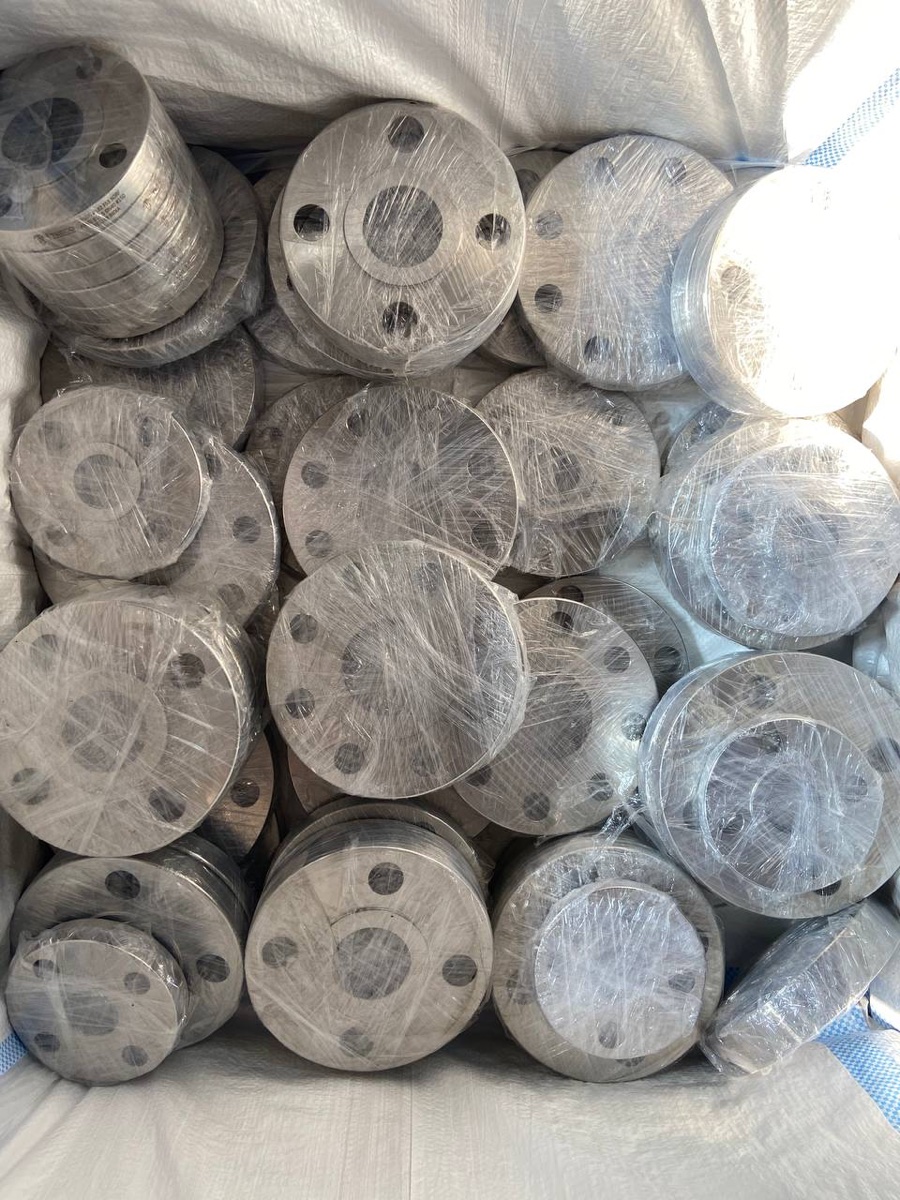
Certification & packing — EN 10204 3.1 MTC (3.2 witnessed on request), export-packed as pictured on this page.
Where 254 SMO Slip On Flanges Are Used
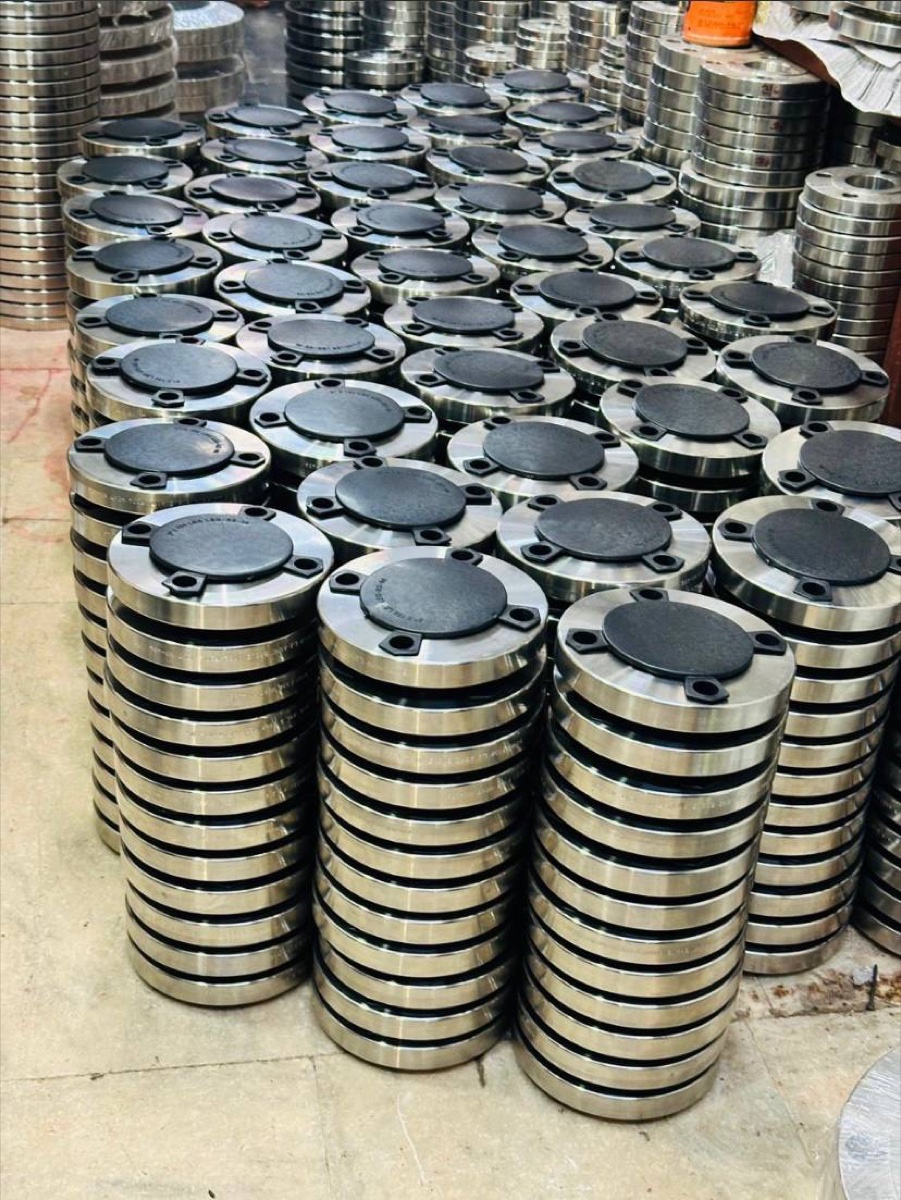
The severest chloride services: offshore seawater and firewater systems, desalination plants (notably SWRO high-pressure sections), FGD absorbers with high-chloride low-pH loops, pulp-and-paper bleach plants, chemical tankers, condensers and heat exchangers in brackish or polluted cooling water — the duties that have already retired 316L, 317L and duplex. Our stainless production and packing below:
Stainless Slip On Flanges — Wrapped & Bagged for ExportStainless Flanges — Face-Protected Stacks at Our Works
254 SMO Slip On Flange Dimensions
254 SMO slip-on dimensions follow the ASME B16.5 slip-on tables — identical for every material. Full charts by class:
Example: “Slip On Flange, 4″ NB, ASME B16.5 Class 150, RF, 254 SMO / A182 F44 (S31254), EN 10204 3.1 — 10 pcs.” Quotations normally within 24 hours with price, unit weight and delivery.
254 SMO Slip On Flanges — Frequently Asked Questions
What is a 254 SMO slip on flange?
It is a slip-on flange forged from 254 SMO — the 6% molybdenum super austenitic stainless steel (UNS S31254, ASTM A182 F44, Werkstoff 1.4547) — dimensioned to ASME B16.5. The flange slides over the pipe end and is secured with two fillet welds, and the 20Cr-18Ni-6Mo chemistry with high nitrogen delivers a PREN of about 43: the chloride-pitting champion of the stainless family, built for hot seawater, desalination and the severest chloride process duty.
What does 6-moly mean — and why does it matter?
It is the family name for super austenitics carrying roughly 6% molybdenum — triple 316's dose. Molybdenum is the element that hardens a stainless steel's passive film against chloride pitting, and at 6%, boosted further by ~0.2% nitrogen, the PREN reaches about 43 — past the super duplex threshold. That moves the critical pitting and crevice temperatures above real hot-seawater conditions, which is precisely the duty the 6-moly grades were invented for.
What is the chemical composition of 254 SMO?
For UNS S31254: carbon 0.020% max, manganese 1.00% max, silicon 0.80% max, phosphorus 0.030% max, sulphur 0.010% max, chromium 19.5-20.5%, nickel 17.5-18.5%, molybdenum 6.0-6.5%, copper 0.50-1.00% and nitrogen 0.18-0.22%. Note the tightness of the ranges and the very low sulphur — 6-moly metallurgy is precision chemistry, and the nitrogen is a load-bearing element for both pitting resistance and strength.
What are the mechanical properties of 254 SMO slip on flanges?
Tensile strength 650 MPa (94 ksi) minimum, yield strength 300 MPa (44 ksi) minimum, elongation 35% minimum in 2" and hardness 250 HB maximum — supplied solution annealed. The nitrogen makes it markedly stronger than ordinary austenitics (roughly 1.5× the yield of 316L) while keeping full austenitic ductility and toughness. Values are demonstrated per heat on the EN 10204 certificate.
What is the difference between 254 SMO and 316L?
Two full steps of the chloride ladder. 316L's 2-3% molybdenum gives a PREN of ~24-26 — coastal-atmosphere territory; 254 SMO's 6% molybdenum and high nitrogen give ~43 — genuine hot-seawater immersion territory, plus half again the strength. Between them sit 317L, duplex and 904L. The two grades bracket the stainless world: 316L is where chloride thinking starts, 254 SMO is where it ends before nickel alloys and titanium.
How does 254 SMO compare with super duplex F53/F55?
PREN parity (~43 vs ≥40), different structures. Super duplex adds higher strength (550 vs 300 MPa yield) and costs less in nickel — but carries the duplex 250 °C service ceiling, embrittling-phase discipline and duplex welding rules. 254 SMO stays fully austenitic: no temperature ceiling, unrestricted cryogenic capability, better tolerance of stagnant and hot acidic conditions, simpler fabrication culture. Weight-critical offshore strength favours super duplex; thermal flexibility and fabrication simplicity favour 6-moly.
How does 254 SMO compare with 904L?
Different emphases at the top of the austenitic ladder. 904L carries more nickel and its signature copper, making it the stronger choice against reducing acids like sulphuric; 254 SMO carries far more molybdenum and nitrogen, making it decisively better against chloride pitting and crevice attack — and notably stronger (300 vs 215 MPa yield). The working split: acid-plus-chloride chemistry favours 904L; seawater and severe chloride pitting favour 254 SMO. We forge both.
Can 254 SMO slip on flanges be used in seawater?
Yes — this is the grade's home ground, and the honest answer that ends the escalation running through 316L and 317L. With critical pitting and crevice temperatures sitting above real service conditions, 254 SMO handles immersed, stagnant and chlorinated seawater, firewater systems and hot brines — the duties for which it competes head-to-head with super duplex on offshore platforms and in desalination plants worldwide.
What temperature range can 254 SMO slip on flanges handle?
The full austenitic span — its quiet advantage over super duplex. No ductile-brittle transition downward, so cryogenic duty is unrestricted; no 250 °C duplex ceiling upward, with ASME B16.5 rating it through the stainless tables. Long exposure in the 600-900 °C band can precipitate intermetallic phases, as with all high-moly grades, so sustained furnace-range duty belongs elsewhere — but across the wet, hot, chloride-laden services it is bought for, temperature is simply not a design constraint.
How is a 254 SMO slip on flange welded to pipe?
With two fillet welds — hub outside, bore inside, pipe set back 1/8" (3 mm) — but with the 6-moly quirk: matching filler is not used, because molybdenum segregates as the weld solidifies and leaves depleted paths for pitting. Practice is an over-alloyed nickel-base filler, typically ENiCrMo-3 (Alloy 625), whose 9% molybdenum keeps the weld at least as noble as the parent. Low heat input, interpass control, no preheat, no PWHT — standard super austenitic care.
Is 254 SMO the same as ASTM A182 F44?
Yes — 254 SMO is the original trade name (Outokumpu/Avesta), while F44 is the grade's designation within ASTM A182 for forgings, UNS S31254 the universal number, and 1.4547 the European Werkstoff. Piping specifications may call any of the four; certificates state them together. Sister 6-moly alloys such as AL-6XN (N08367) occupy the same duty class — where a specification names one explicitly, we supply and certify accordingly.
Where are 254 SMO slip on flanges typically used?
Wherever chlorides are hottest and most concentrated: seawater and firewater systems on offshore platforms, desalination plants (notably SWRO high-pressure sections), flue-gas desulfurization absorbers with high-chloride low-pH loops, pulp-and-paper bleach plants, chemical tankers, condenser and heat-exchanger service in brackish or polluted cooling water, and chloride-bearing process chemistry that has already retired 316L, 317L and duplex.
What sizes and classes are 254 SMO slip on flanges available in?
From ½" to 24" NB per ASME B16.5 in Classes 150 through 2500, with larger patterns and EN 1092-1 flanges in 1.4547 forged to order. 254 SMO is premium project material — forged against the order from certified heats — with standard sizes normally dispatching within a few weeks with EN 10204 3.1 certification. State the required delivery on the enquiry and we confirm the schedule with the quotation.
What details are needed to get an accurate 254 SMO slip on flange quotation?
Five elements plus commercial terms: (1) size and standard — e.g. 4" NB ASME B16.5; (2) pressure class — 150 through 2500; (3) facing — SORF (raised face) default, flat face or RTJ where specified; (4) grade — 254 SMO / A182 F44 (S31254), with ASTM G48 corrosion testing where the project specifies; (5) certification — EN 10204 3.1 or 3.2. No pipe schedule is needed for the slip-on bore. Add the quantity and destination and we return price, weight and delivery.
Who manufactures 254 SMO slip on flanges in India?
Tesco Steel & Engineering is an ISO 9001:2015 certified flange manufacturer based in Mumbai, India, forging 254 SMO / ASTM A182 F44 slip on flanges from ½" to 24" NB per ASME B16.5 — alongside 904L below it and the super duplex grades beside it on the corrosion ladder — in solution-annealed condition with full heat traceability and EN 10204 3.1/3.2 certification on every lot. Flanges are marked with grade, size, class and heat number and export to more than 50 countries.