UNS N04400 Slip On Flanges — Monel 400 Manufacturer
Tesco Steel & Engineering forges Monel 400 slip on flanges — the classic ~67% nickel, ~30% copper alloy (UNS N04400, Werkstoff 2.4360, NiCu30Fe), the oldest nickel alloy still in front-line service — to ASTM B564 and ASME B16.5 Class 150–2500 from ½″ to 24″ NB, larger patterns to order. At home in flowing seawater and brine, the industry standard for hydrofluoric acid, excellent in caustic soda and dry chlorine, and immune to chloride SCC — sister to Monel K-500 and neighbour to copper-nickel on the marine ladder. The hero photo below is our own marked production. Every lot with EN 10204 3.1/3.2 MTC. ISO 9001:2015, made in Mumbai, India — exported to 50+ countries.
Monel 400 · Alloy 400 · N04400ASTM B564 · 2.4360 · NiCu30FeNi 63% min · Cu 28–34%ASME B16.5 Class 150–2500½″ – 24″ NB · SORF480 MPa TS / 195 MPa YS minEN 10204 3.1 / 3.2 · ISO 9001:2015
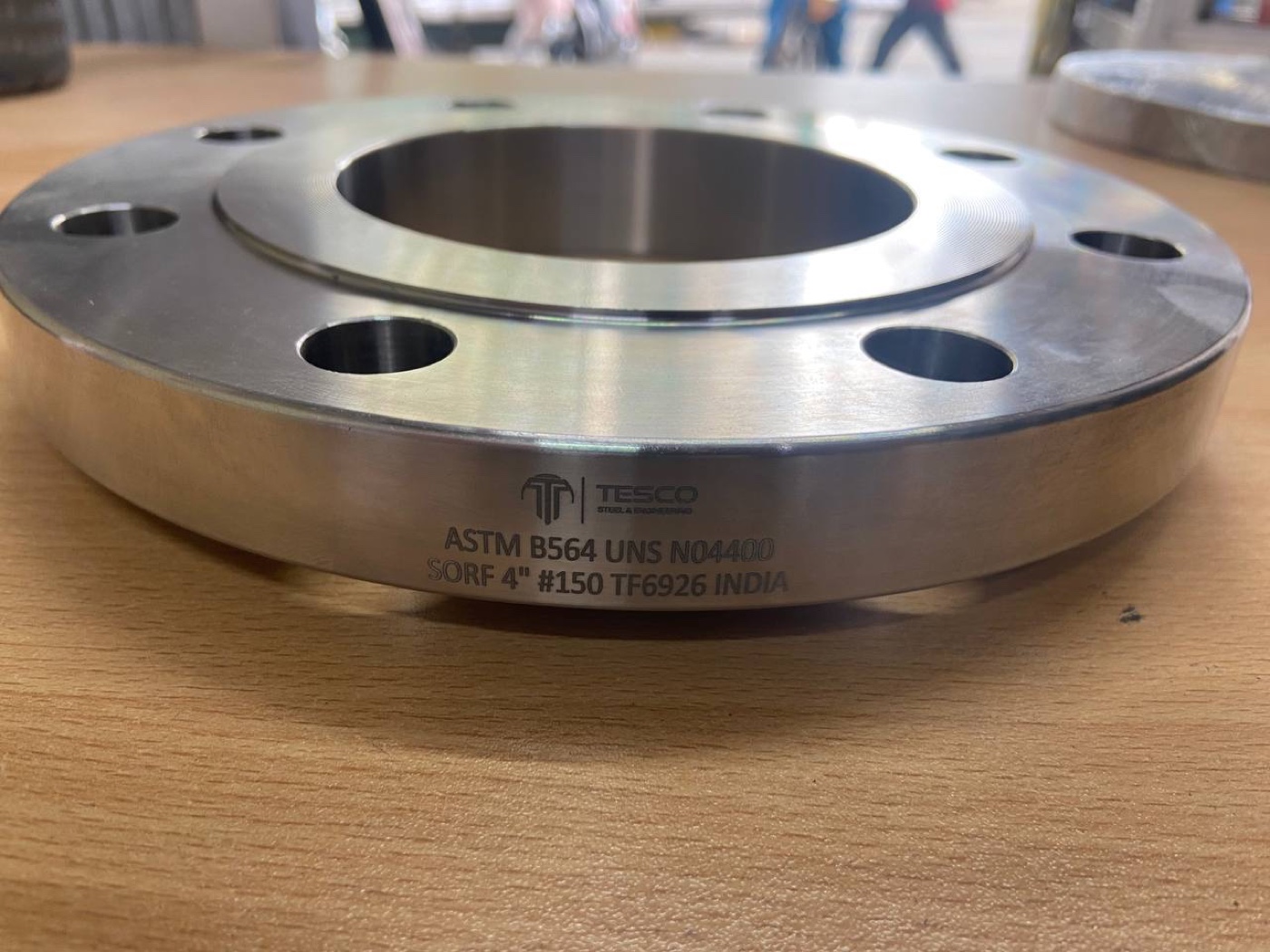
Monel 400 SORF Slip On Flange, 4″ Class 150 — Marked ASTM B564 UNS N04400 With Heat Number, From Our Production
What is a UNS N04400 Slip On Flange?
Monel 400 = the original nickel alloy, still unbeaten in its lane. A ~67Ni-30Cu solid solution (UNS N04400 / 2.4360 / NiCu30Fe) developed in 1905: outstanding in flowing seawater, the default for hydrofluoric acid, strong in caustic and dry chlorine, and — with no chromium film to crack — immune to chloride SCC. As a slip-on: two fillet welds with ERNiCu-7 filler, no preheat, no PWHT — forged to ASTM B564, not A182.
Also searched as: Monel 400 slip on flange, Alloy 400 SORF flange, ASTM B564 N04400 slip on flange, 2.4360 / NiCu30Fe slip on flange, nickel-copper slip on flange — all refer to the product on this page. See also our Monel 400 flanges overview and ASTM B564 Monel 400 flanges.
The Marine & Reducing-Acid Map — Where Monel 400 Fits
Rule of thumb: Monel is the reducing-side specialist — no chromium means no passive film to strip, which is why HF, caustic and deaerated brines suit it and oxidising media do not. Where chromium is needed, the enquiry moves to Inconel or Hastelloy.
Monel 400 (UNS N04400) Chemical Composition
Ni (+Co)
Cu
Fe
Mn
C
Si
S
63.0 min
28.0-34.0
2.5 max
2.0 max
0.3 max
0.5 max
0.024 max
Values in weight % for UNS N04400 per ASTM B564. Note what is absent: chromium. Monel's corrosion resistance comes from the inherent nobility of the nickel-copper matrix, not a passive film — the key to reading where it excels (reducing media) and where it must not go (oxidising media).
Monel 400 Mechanical Properties
Tensile Strength, MPa (ksi)
Yield Strength 0.2%, Min, MPa (ksi)
Elongation % min (2")
Density
480 (70) min
195 (28) min
35
8.80 g/cm³
Per ASTM B564, annealed condition. Tough from cryogenic temperatures upward with no ductile-brittle transition. The high density means a Monel flange is noticeably heavier than its stainless twin — allow for it in freight estimates; we state unit weights on every quotation. Values demonstrated per heat on the EN 10204 certificate.
UNS N04400 Slip On Flange Specifications
Monel 400 Slip On Flanges are available in the following specifications:
Two fillet welds (hub + bore), pipe set back 1/8"; ERNiCu-7 / ENiCu-7 filler, low heat input, no preheat, no PWHT
Testing
PMI verification and dye-penetrant examination on request
Certification
EN 10204 3.1 (standard) / 3.2 witnessed
Equivalent Grades of Monel 400
Trade Names
ASTM Forging
UNS
Werkstoff Nr.
EN
Monel 400 / Alloy 400 / Nickel-Copper 400
B564
N04400
2.4360
NiCu30Fe
ASME SB-564 is the boiler-code twin. System partners follow the same B-series logic: ASTM B165 seamless pipe, ASTM B366 welding fittings (WPNC) and ASTM B127 plate. Not an A182 grade — nickel-alloy flanges are governed by the B-series standards, exactly as marked on the flange pictured above.
Why Monel 400 Slip Ons Are Specified
The Hydrofluoric Acid Default
HF rules out glass, most metals and nearly all stainless — Monel 400 resists it across essentially all concentrations, which is why HF alkylation units are built around N04400.
Flowing Seawater, Solved Since 1905
Impingement, turbulence and cavitation resistance beyond the cupronickels, with complete chloride SCC immunity — the working parts of marine systems have trusted it for a century.
Caustic & Dry Chlorine
Sodium and potassium hydroxide across the concentration range, plus dry chlorine and fluorine chemistry — the reducing-side services that strip passive films off chromium grades.
Nothing to Sensitise
A simple solid solution: welds with ERNiCu-7 need no preheat and no PWHT, and there is no carbide chemistry or embrittling phase to manage — fabrication stays honest.
The Honest Limits — Where Monel 400 Does Not Belong
No chromium cuts both ways. Oxidising media attack Monel rapidly: nitric acid, ferric and cupric chloride, wet chlorine and aerated ammonia systems are off the table, and sulphur-bearing atmospheres embrittle nickel alloys above roughly 370 °C. In seawater the caveat is stagnation: superb under flow, Monel can pit beneath deposits and in permanently stagnant immersion — duties better served by super duplex or 254 SMO. Within its reducing-side lane — HF, caustic, brines, moving seawater — it remains one of the most dependable materials ever made.
How Our Monel 400 Slip On Flanges Are Manufactured
1
Forging — cut billet of certified N04400 heat is hot-forged into the flange blank, keeping full heat traceability from raw material to despatch.
2
Annealing — softened and homogenised per ASTM B564; furnace record retained.
3
Machining — hub, faces and bolt holes to ASME B16.5; the bore machined slightly over pipe OD per the slip-on tolerance.
4
Facing & finish — SORF raised face with serrated stock finish, flat face or RTJ groove.
5
Testing & marking — mechanical and chemical verification against the heat (PMI where the order specifies), then permanent marking of standard, grade, size, class and heat number — exactly as on the flange pictured on this page.
6
Certification & packing — EN 10204 3.1 MTC (3.2 witnessed on request), export-packed for sea or air freight.
Where UNS N04400 Slip On Flanges Are Used
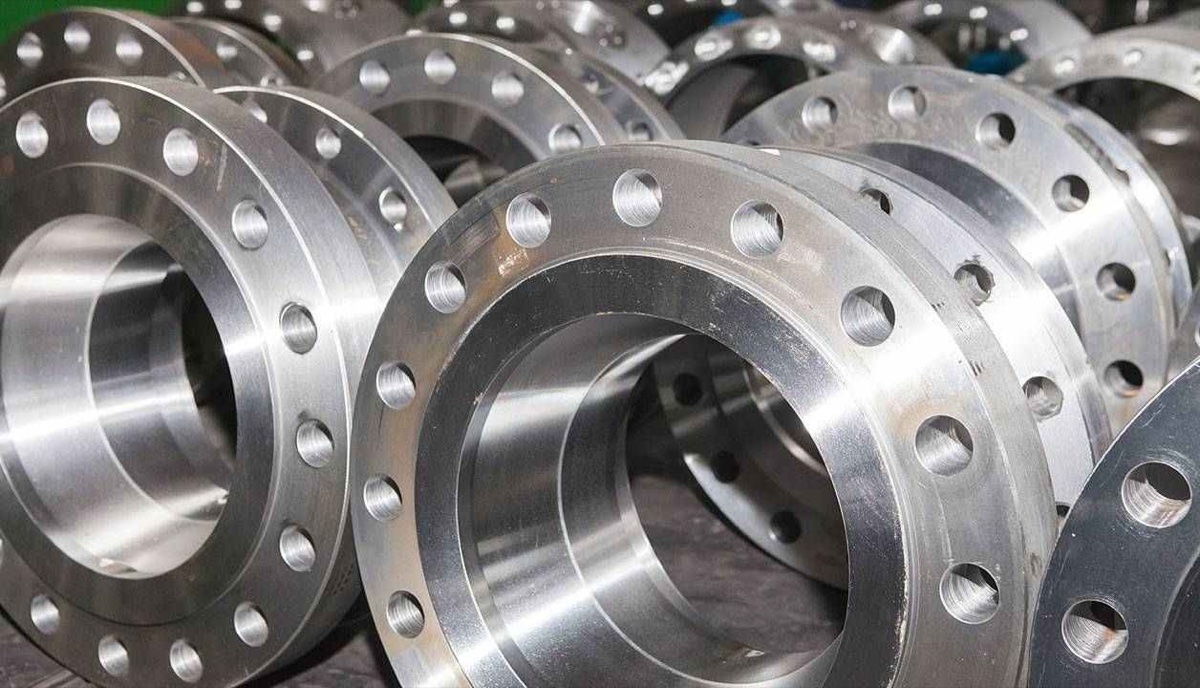
Refinery HF alkylation units first, then marine and offshore seawater systems (pump and valve connections, firewater, brine and ballast lines), desalination plants, caustic soda production, dry chlorine and fluorine chemistry, salt works and chemical-plant heat exchangers — slip-ons on utility, transfer and lower-pressure connections, weld necks on the critical lines. Slip-on production at scale below:
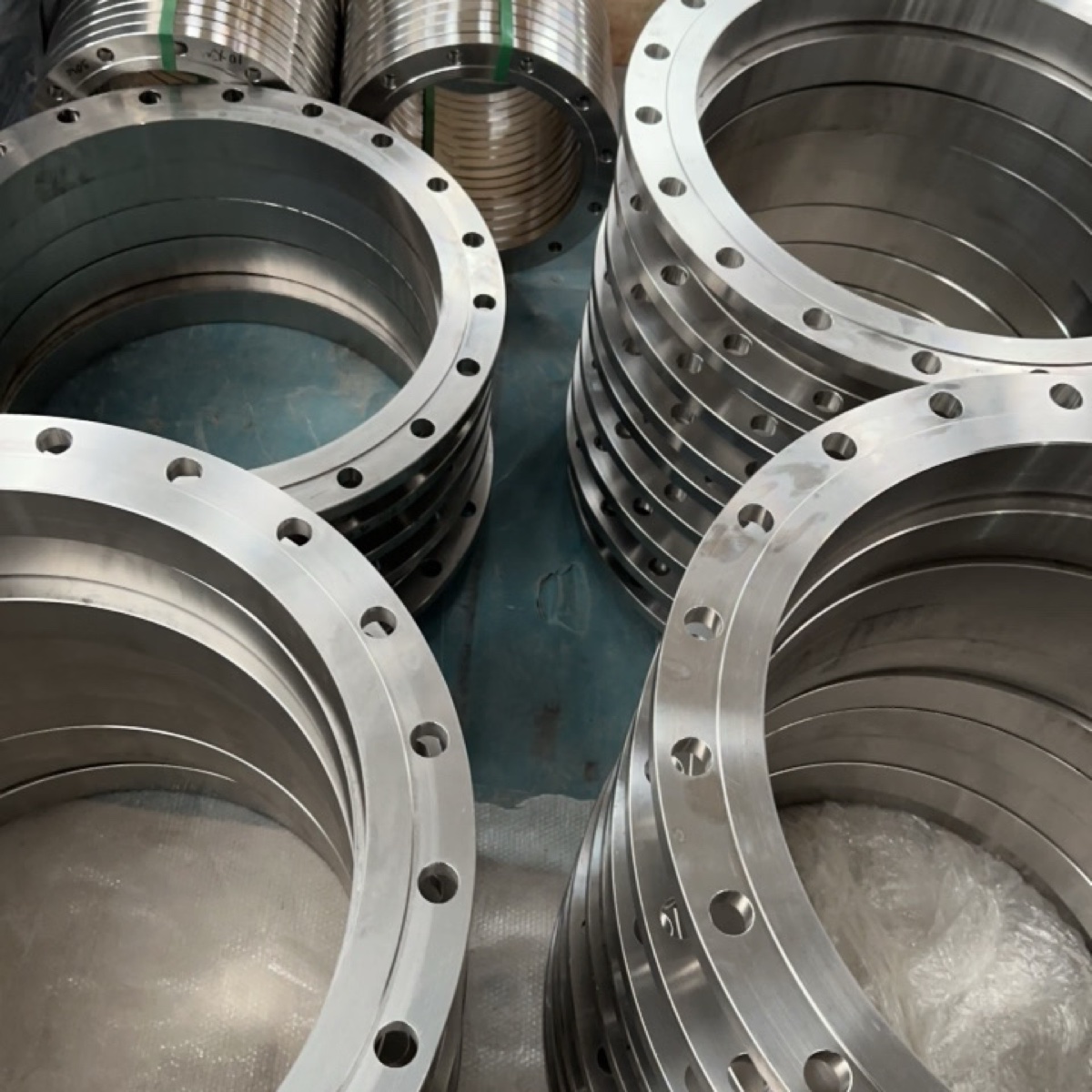
Large-Bore Slip On Flanges — Machined & Ready for DespatchLarge-Diameter Slip On Flanges — EN 1092-1 Patterns to Order
UNS N04400 Slip On Flange Dimensions
Monel 400 slip-on dimensions follow the ASME B16.5 slip-on tables — identical for every material. Full charts by class:
Example: “Slip On Flange, 4″ NB, ASME B16.5 Class 150, RF, Monel 400 / ASTM B564 (N04400), EN 10204 3.1 — 10 pcs.” Quotations normally within 24 hours with price, unit weight and delivery.
UNS N04400 Slip On Flanges — Frequently Asked Questions
What is a UNS N04400 slip on flange?
It is a slip-on flange forged from Monel 400 — the classic nickel-copper alloy carrying roughly 67% nickel and 30% copper (UNS N04400, ASTM B564, Werkstoff 2.4360) — dimensioned to ASME B16.5. The flange slides over the pipe end and is secured with two fillet welds. The chemistry gives a rare combination: excellent resistance to flowing seawater and brine, the industry-standard answer to hydrofluoric acid, strong performance in caustic and dry chlorine, and complete immunity to chloride stress corrosion cracking.
What is Monel 400?
The oldest nickel alloy still in front-line service — developed in 1905 and named after International Nickel's president Ambrose Monell. It is a solid-solution nickel-copper alloy, essentially the natural ratio of the Sudbury ore it was first made from. Designations: UNS N04400, Werkstoff 2.4360, EN NiCu30Fe, often simply Alloy 400; forged flanges are governed by ASTM B564. A century on, nothing cheaper has displaced it from seawater, hydrofluoric acid and caustic duty.
What is the chemical composition of Monel 400?
For UNS N04400: nickel (plus cobalt) 63.0% minimum, copper 28.0-34.0%, iron 2.5% max, manganese 2.0% max, carbon 0.3% max, silicon 0.5% max and sulphur 0.024% max. Note what is absent: no chromium. Monel does not rely on a chromium passive film, which is exactly why it thrives in the reducing environments — hydrofluoric acid, deaerated brines, caustic — that strip that film off stainless steels.
What are the mechanical properties of Monel 400 slip on flanges?
Per ASTM B564 in the annealed condition: tensile strength 480 MPa (70 ksi) minimum, 0.2% yield strength 195 MPa (28 ksi) minimum and elongation 35% minimum. Density is notably high at 8.80 g/cm³ — a Monel flange is heavier than its stainless twin. The alloy is tough from cryogenic temperatures up to its rated service range with no ductile-brittle transition. Values are demonstrated per heat on the EN 10204 certificate.
Why is Monel 400 the hydrofluoric acid alloy?
Hydrofluoric acid attacks glass, dissolves the protective oxides of most metals, and rules out nearly the entire stainless family — but the nickel-copper matrix of Monel 400 resists it across essentially all concentrations and to the boiling point in air-free conditions. That makes N04400 the default material of HF alkylation units in refineries and of fluorine chemistry generally — the one service where the specification conversation starts, rather than ends, with Monel.
Can Monel 400 slip on flanges be used in seawater?
Yes, with one honest caveat that experienced marine engineers know: Monel 400 is outstanding in flowing seawater, where it resists impingement, turbulence and cavitation better than copper-nickels and gains complete chloride SCC immunity — but under stagnant conditions and deposits it can pit, because it lacks chromium and molybdenum. So it excels in pump and valve trim, propeller shafts and moving seawater systems, while permanently stagnant immersion is better served by super duplex or 6-moly grades.
What is the difference between Monel 400 and 316L stainless steel?
Different corrosion philosophies. 316L relies on a chromium-molybdenum passive film — excellent in oxidising environments, vulnerable to chloride SCC and crevice attack. Monel 400 relies on the inherent nobility of its nickel-copper matrix — immune to chloride SCC, untroubled by hydrofluoric acid and caustic that damage stainless, and far better in flowing seawater. The trade: Monel costs several times more, and in oxidising acids like nitric the positions reverse completely, with 316L serene and Monel attacked.
How does Monel 400 compare with copper-nickel 90/10 and 70/30?
Monel is essentially cupronickel with the ratio reversed — copper-rich 90/10 and 70/30 become nickel-rich 70/30 — and the properties scale accordingly. Monel 400 is roughly twice as strong, markedly better against impingement, cavitation and erosion at high water velocities, and adds the hydrofluoric and caustic capability cupronickels lack. Copper-nickels counter with lower cost and better resistance to biofouling. Typical split: Cu-Ni for large seawater piping runs, Monel for the pumps, valves, fittings and flanges that work hardest.
What is the difference between Monel 400 and Monel K-500?
Same nickel-copper base, different strength mechanism. K-500 (UNS N05500) adds aluminium and titanium so it can be age-hardened to roughly three times the yield strength of annealed 400 — which is why it appears as pump shafts, drill collars and fasteners. Alloy 400 remains the flange and piping standard: it is easier to weld (K-500 generally is not welded), fully tough, and its corrosion resistance is essentially identical. Specify 400 for the joint, K-500 where the part itself must be strong.
Where does Monel 400 not work?
In oxidising media — the flip side of having no chromium. Nitric acid, ferric and cupric chloride solutions, wet chlorine and other strongly oxidising streams attack it rapidly, and ammonia above trace levels can corrode it in aerated systems. Temperature adds one more line: sulphur-bearing atmospheres embrittle nickel alloys above roughly 370 °C. Within reducing chemistry — HF, caustic, brines, deaerated acids — it remains one of the most dependable materials ever made.
How is a UNS N04400 slip on flange welded to pipe?
With two fillet welds — hub outside, bore inside, pipe set back 1/8" (3 mm) — using matching nickel-copper filler: ERNiCu-7 (Monel filler metal 60) for TIG/MIG or ENiCu-7 electrodes. No preheat and no post-weld heat treatment are required; the alloy is a simple solid solution with nothing to sensitise or embrittle. Standard nickel-alloy discipline applies: scrupulously clean joints (nickel alloys are intolerant of sulphur contamination — no marking crayons or oily fingerprints), low heat input, interpass control.
Which ASTM standard covers Monel 400 slip on flanges?
ASTM B564 (ASME SB-564), the nickel-alloy forging specification — not A182, which covers stainless and alloy steels. The flange pictured on this page carries the marking of our own production: ASTM B564 UNS N04400, SORF, size, class and heat number. System partners follow the same B-series logic: seamless pipe to ASTM B165, welding fittings to ASTM B366 (WPNC) and plate to ASTM B127.
Where are UNS N04400 slip on flanges typically used?
Refinery HF alkylation units first and foremost, then marine and offshore seawater systems — pump and valve connections, firewater, brine and ballast lines — desalination plants, caustic soda production and handling, dry chlorine and fluorine chemistry, salt production, and heat-exchanger service in chemical plants. On these systems the slip-on pattern serves utility, transfer and lower-pressure connections, with weld necks specified on the critical lines.
What sizes and classes are Monel 400 slip on flanges available in?
From ½" to 24" NB per ASME B16.5 in Classes 150 through 2500, with larger diameters and EN 1092-1 patterns in 2.4360 forged to order — the large-bore slip-on production pictured on this page shows the upper end of the range. Monel 400 is project material forged against the order from certified N04400 heats, normally dispatching within a few weeks with EN 10204 3.1 certification; state the required delivery on the enquiry and we confirm the schedule with the quotation.
Who manufactures UNS N04400 slip on flanges in India?
Tesco Steel & Engineering is an ISO 9001:2015 certified flange manufacturer based in Mumbai, India, forging Monel 400 / UNS N04400 slip on flanges from ½" to 24" NB per ASTM B564 and ASME B16.5 — alongside the full N04400 range of weld neck, blind, socketweld, threaded, lapped joint and spectacle blind flanges, and Monel K-500 — with full heat traceability and EN 10204 3.1/3.2 certification on every lot. Every flange is permanently marked with standard, grade, size, class and heat number, as pictured on this page. Exported to more than 50 countries.