Monel 400 Long Weld Neck Flanges — UNS N04400 Nickel-Copper LWN Manufacturer
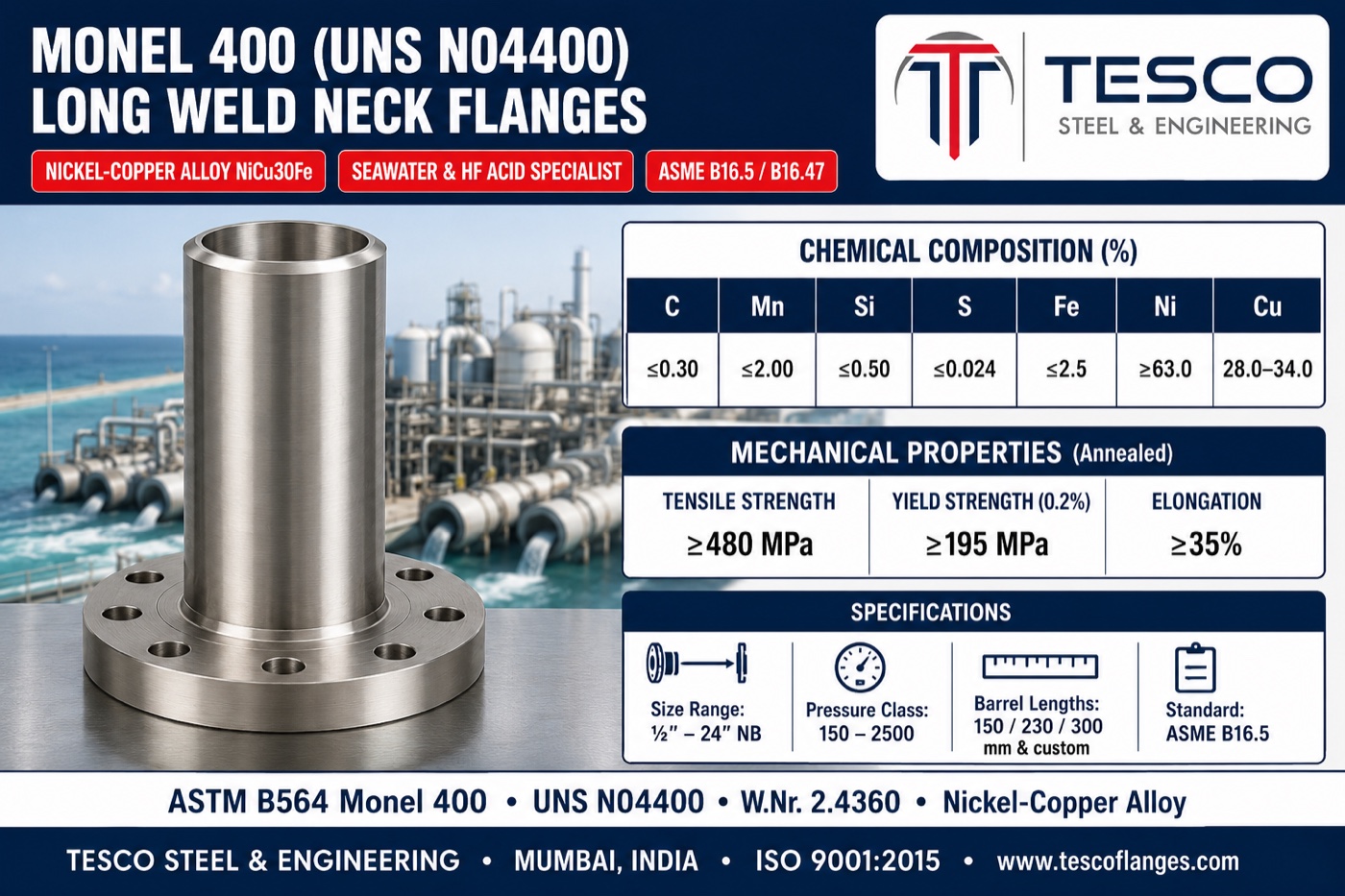
Tesco Steel & Engineering manufactures Monel 400 long weld neck flanges — the oldest alloy on the bench: ASTM B564, UNS N04400, W.Nr. 2.4360, NiCu30Fe — with ASME B16.5 flange ends in Classes 150–2500 and the barrel made to order. In continuous service since 1905, the recipe is the ore's own: two-thirds nickel, one-third copper — and it still holds two franchises nothing on the iron bench touches: flowing seawater and hydrofluoric acid, with chloride-SCC immunity built into the nickel base. A true single-phase solid solution: nothing precipitates, nothing sensitises — welds with ERNiCu-7 and no PWHT, ever. The nickel bench opens where the ladders end: 904L and the acid ladder behind, the copper-nickel cousins below for seawater economics, the K-500 sibling for strength, Inconel and Hastelloy beyond. One forging, one closing weld. Facings: RF / FF / RTJ; small bore on the Monel 400 socketweld. Every lot with EN 10204 3.1/3.2 MTC. ISO 9001:2015, made in Mumbai, India — exported to 50+ countries.
ASTM B564 · UNS N04400 · W.Nr. 2.4360NiCu30Fe — In Service Since 1905Ni ≥63% · Cu 28–34% — The Ore's RatioFlowing Seawater & HF Acid FranchisesChloride-SCC Immune · No PWHT480 / 195 MPa AnnealedB16.5 Flange Ends · Class 150–2500EN 10204 3.1 / 3.2 · ISO 9001:2015
Monel 400 Long Weld Neck Flanges — Specifications at a Glance
What is a Monel 400 Long Weld Neck Flange?
The oldest alloy on the bench, in the nozzle pattern. A Monel 400 flange (UNS N04400, ASTM B564) whose neck continues as a long, heavy-walled straight barrel — the nozzle itself — bevelled for one closing butt weld at the desalination header, seawater intake or HF alkylation shell. Two-thirds nickel, one-third copper — in service since 1905, holding the flowing-seawater and hydrofluoric-acid franchises with chloride-SCC immunity built in. Single-phase: no PWHT, welds with ERNiCu-7. Supplied annealed — 480/195/35. Flange ends per ASME B16.5, Classes 150–2500; barrel length and bore stated by you. EN 10204 3.1 on every lot.
The rule of the original: where chloride and fluoride chemistry rule out iron — moving seawater under stress, HF in any strength — the 1905 recipe is still the first name written; where economics carry long seawater lines, the copper cousins take them, and where heat or oxidising acids govern, the benches beyond begin.
What the Nickel-Copper Recipe Buys
The Hydrofluoric Franchise — Nearly Absolute
HF strips the chromium oxide films every stainless depends on; Monel needs no film — the nickel-copper solid solution resists all concentrations to well over 100°C, anchoring refinery HF alkylation worldwide.
Flowing Seawater, Under Stress
Immune to chloride SCC and hard against erosion-corrosion at velocity — the combination that displaced brass and bronze from stressed marine hardware a century ago and still holds the position.
Nothing to Sensitise, Ever
A true single-phase solid solution — no carbides, no sigma, no ageing: welds with ERNiCu-7, no PWHT, and the fabrication simplicity is part of what the grade sells.
Tough From Cryogenic Up
No ductile-brittle transition anywhere in its range — properties hold from cryogenic temperatures to around 480°C, with 35% elongation absorbing forging, machining and the closing weld.
Specification Notes — Getting Monel 400 Long Weld Necks Right
Three honest notes.The seawater franchise reads ‘flowing’: in stagnant water marine growth can pit the surface under deposits — keep Monel where water moves, design out dead pockets, and give permanently stagnant zones to the copper-nickel cousins whose surface discourages the fouling itself; the SCC immunity stands regardless. The standard is B564, not A182: nickel alloys forge to their own standard — write ASTM B564 Monel 400 on the order line and expect the alloy market's lead times behind it. And resist the K-500 reflex: flange strength is class-governed — the age-hardened sibling buys nothing at a bolted joint that B16.5 rates identically, so the nozzle answer is 400 unless a specification explicitly demands otherwise.
How Our Monel 400 LWN Flanges Are Manufactured
1
Forging — each piece individually forged from certified N04400 heats kept segregated on the nickel shelf, with the barrel integral — no welded build-ups.
2
Annealing — the single-phase alloy's one heat treatment: softened and homogenised, nothing to precipitate and nothing to age; records retained against the heat number.
3
Verification — chemistry per heat with the nickel floor (≥63.0%) and copper window certified; mechanicals per heat at the 480/195 line.
4
Machining — flange end to ASME B16.5; barrel turned to pattern (standard / HB / equal) and bored to the ordered schedule or drawing; RF serrations, flat face or RTJ groove per B16.20; weld end bevelled 37.5°.
5
Testing & marking — PMI reads the unmistakable nickel-copper signature on every piece — Monel can mix with neither the stainless shelf nor the cupronickel bins; marked with grade, size, schedule and heat number.
6
Certification & packing — EN 10204 3.1 MTC (3.2 witnessed on request); WPS guidance naming the ERNiCu-7 filler; faces and bevels protected, packed sea-worthy.
Where Monel 400 LWN Flanges Are Used
Where the two franchises live: desalination plants — intake headers, evaporator and brine-heater nozzles, pump connections — naval and commercial marine seawater systems, offshore fire-water and cooling circuits, refinery HF alkylation units end to end, hydrofluoric acid production and handling, caustic evaporators and salt works, and the column nozzles, instrument standpipes and level-bridle connections that ride on all of them. Flowing water and fluoride chemistry, one forging, one closing weld. Production and supply below:
Long Weld Necks — Machined at Our WorksLong Weld Neck — Heavy Barrel, Bevelled Weld EndDN600 RF Long Weld Neck — Large Diameter, B16.5 Drilling
Monel 400 LWN Flange Dimensions
Flange-end dimensions are class-governed per ASME B16.5 (ratings per the N04400 material group); barrel length and bore per order. Full class-by-class charts:
Seven elements — the service named confirms the position on the bench:
1
Size & standard — e.g. 6″ NB ASME B16.5.
2
Pressure class & facing — 150#–2500#; RF, FF or RTJ with ring number.
3
Barrel length — overall, face to weld end: 150 / 230 / 300 mm stock or any stated length.
4
Barrel bore & pattern — pipe schedule to match or finished bore in mm; standard, heavy barrel or equal barrel; weld-end prep if non-standard.
5
Grade line & service — ASTM B564 Monel 400 (UNS N04400) — the nickel bench's forging standard, not A182; the service named — flowing seawater, HF alkylation, caustic — confirming the position against the copper cousins and the K-500 strength question.
6
Certification — EN 10204 3.1 (our standard) / 3.2 witnessed.
A Monel 400 long weld neck flange is a forged nickel-copper alloy flange — UNS N04400, W.Nr. 2.4360, NiCu30Fe, supplied to ASTM B564 — whose neck continues as a long, heavy-walled straight barrel that is itself the nozzle, bevelled at its far end for one closing butt weld made out at the desalination header, seawater intake or HF alkylation vessel shell. Monel 400 is the oldest alloy on the bench — roughly two-thirds nickel and one-third copper, in continuous service since 1905 — holding two franchises nothing on the iron bench touches: flowing seawater and hydrofluoric acid, with chloride stress corrosion cracking immunity built into the nickel base. Flange ends follow ASME B16.5 in Classes 150 to 2500; the barrel is machined to the ordered length and bore. Supplied annealed at 480/195 MPa with EN 10204 3.1/3.2 certification.
How does a long weld neck differ from a standard weld neck flange?
Geometry and mission. A standard weld neck's hub tapers quickly down to the pipe's outside diameter and wall, ending in a weld bevel a few centimetres from the flange face — it is built to butt-weld to pipe and continue as a piping run. A long weld neck keeps a full-section straight barrel for its entire length: no taper to pipe dimensions, wall far heavier than the matching schedule, length made to order. The mission follows the shape — the LWN is not a fitting on a pipe run but a nozzle in its own right, projecting through insulation, vessel walls or exchanger channels, with the butt weld relocated to the shell side where the fabricator wants it. In one certified forging it replaces the weld neck flange, the pipe nipple and one whole circumferential weld.
Why is Monel 400 called the oldest alloy on the bench?
Because it predates stainless steel itself. Monel was first produced in 1905 — named for company president Ambrose Monell — by smelting a Canadian ore body whose nickel and copper occurred naturally at roughly two to one, so the alloy's defining ratio was the ground's own recipe before it was anyone's design. That accident of geology turned out to be a masterpiece: the nickel brings nobility in reducing environments and immunity to chloride stress corrosion cracking, the copper deepens the seawater and hydrofluoric acid electrochemistry, and the single-phase solid solution they form is tough, ductile and weldable with nothing to precipitate and nothing to sensitise. A century of desalination plants, navy seawater systems and refinery HF units later, the original nickel alloy still holds franchises nothing newer has taken from it — which is why a 1905 recipe remains a stocked, specified, current grade on this bench.
What are Monel 400's two franchises — seawater and hydrofluoric acid?
The two services where the nickel-copper recipe is the industry's default answer. Flowing seawater first: Monel 400 resists moving seawater outstandingly, is immune to the chloride stress corrosion cracking that stalks the stainless bench, and shrugs off the erosion-corrosion that eats copper alloys at velocity — which is why desalination plants, navy systems and offshore seawater services have specified it for a century. Hydrofluoric acid second, and more absolutely: HF attacks the protective oxides that every stainless steel depends on, so the iron bench simply exits — while Monel 400 resists all concentrations of HF to well over 100°C and anchors the HF alkylation units of refineries worldwide as the standard material of construction. Add the supporting duties — caustic alkalis, salt production, dry chlorine and hydrogen chloride gas — and the franchise map is drawn: where chloride and fluoride chemistry rule out iron, the oldest nickel alloy is still the first name written.
What is the chemical composition of Monel 400 (UNS N04400)?
Nickel 63.0% minimum, copper 28.0-34.0%, iron 2.5% maximum, manganese 2.00% maximum, carbon 0.30% maximum, silicon 0.50% maximum and sulphur 0.024% maximum. Two features distinguish this specification from every stainless chemistry on the site: nickel is a floor, not a range — the balance of the alloy after the named elements, which is why the certificate reads a minimum — and there is no chromium column at all: Monel does not build a chromium oxide film but relies on the inherent nobility of the nickel-copper solid solution, which is exactly why it survives the fluoride and reducing chemistries that strip chromium films from stainless. The two-thirds/one-third ratio echoes the Sudbury ore the alloy was first smelted from in 1905. Chemistry is verified per heat, PMI-confirmed on the unmistakable nickel-copper signature, and travels on the EN 10204 3.1 MTC.
What are the mechanical properties of Monel 400 long weld neck flanges?
Annealed to ASTM B564: tensile strength 480 MPa (70 ksi) minimum, yield strength 195 MPa (28 ksi) minimum, elongation 35% minimum — the profile of a true single-phase solid solution: moderate strength, exceptional toughness and ductility, and properties that hold from cryogenic temperatures to around 480°C with no ductile-brittle transition anywhere in the range. The alloy strengthens only by cold work — there is no heat treatment that hardens it, which is precisely its fabrication virtue: nothing precipitates, nothing sensitises, nothing needs post-weld attention. Where a specification genuinely needs more strength in the same chemistry family, the age-hardening K-500 sibling nearly triples the yield — its own FAQ below draws the line. For nozzle duty the annealed numbers serve exactly as the class system intends: flange geometry is class-governed, ratings follow B16.5's group for N04400, and the generous elongation absorbs forging, machining and the closing weld.
What is the ASTM B564 specification — the nickel bench's forging standard?
The second grade on this site's LWN bench to leave A182 behind — and the introduction to the standard that carries the rest of the nickel world. A182 is a steel forging specification; nickel alloys forge to ASTM B564 (ASME SB-564), the nickel-alloy forging standard shared by Monel, the Inconel family, the Incoloy family and the Hastelloy grades alike — one standard, many UNS numbers, which is why 'B564' appears across this site's entire nickel shelf. Its N04400 chapter covers the forged flanges this page describes; B127 covers Monel plate, B165 the seamless pipe and tube, B164 the bar. Nothing changes at the flange end: dimensions, drilling and facings still follow ASME B16.5, with pressure-temperature ratings from B16.5's own material group for N04400. The order line is simply 'ASTM B564 Monel 400 (UNS N04400)' — with the alloy market's supply chain, and lead times, behind it.
What is the stagnant-seawater honesty every Monel purchaser should hear?
That the seawater franchise reads 'flowing' for a reason. In moving seawater Monel 400 is outstanding; in stagnant or low-velocity seawater, marine organisms foul the surface, and under those deposits the alloy can pit — the classic crevice chemistry that finds any material relying on surface nobility. The practical consequences are design habits, not disqualifications: keep Monel where water moves — pump columns, headers, heat-exchanger service, intake screens with flow — avoid designing pockets that trap dead water against the metal, and for permanently stagnant zones consider the copper-nickel cousins, whose copper surface discourages the fouling itself. The distinction to keep clear: this is deposit pitting, not stress corrosion cracking — Monel's SCC immunity in chlorides stands regardless of velocity, which is exactly why it displaced brass and bronze from stressed seawater hardware a century ago. Named honestly, the franchise stays a franchise.
Monel 400 or copper-nickel — the seawater decision?
Position and pocket. The copper-nickel cousins — 90/10 and 70/30, with their own LWN pages on this site — are seawater alloys from the copper side of the family: economical, naturally biofouling-resistant thanks to their copper surface, and the standard for large-bore seawater transport piping. Monel 400 approaches from the nickel side: substantially stronger, far more resistant to erosion-corrosion at velocity and to acid excursions, and immune to ammonia-side stress corrosion concerns that can touch copper alloys — at a substantially higher price per kilogram. The practical split follows the plant: cupronickel carries the long seawater lines and coolers where economics govern; Monel takes the stressed, fast-flowing and critical positions — pump shafts and trim, high-velocity headers, fittings that see sand-laden or turbulent water, and the nozzles this page forges. Where the two meet in one system, both weld and both certify — and the galvanic pairing between them is famously benign.
Monel 400 or K-500 — when does the stronger sibling matter?
When a specification demands strength the solid solution cannot give. Monel K-500 (UNS N05500) is Monel 400 plus aluminium and titanium, age-hardened so that gamma-prime precipitates nearly triple the yield strength while keeping essentially the same seawater chemistry — the recipe behind pump shafts, valve stems, fasteners and drill collars in marine service. For flanging, the honest guidance runs the other way: flange strength is class-governed, so the standard nozzle answer is 400, not K-500 — the extra yield buys nothing at a bolted joint that B16.5 rates identically, while the age-hardened structure adds cost, procurement time and weld-zone complications (the heat-affected zone loses its ageing, so welded K-500 joints need re-ageing or accept local softening). We forge K-500 flanging only where a specification explicitly demands it — matched-material rules on K-500 equipment, typically — and quote 400 everywhere else on this page's duties.
How is the closing weld on a Monel 400 LWN made?
As benignly as welding gets on the alloy shelf. Monel 400 is a single-phase solid solution: no preheat beyond dryness, no PWHT ever, nothing to sensitise and no interpass anxiety beyond ordinary cleanliness — the fabrication simplicity is a genuine part of what the grade sells. The consumable of record is ERNiCu-7 (the Monel 60 of trade usage), matching the nickel-copper chemistry so the joint carries the same seawater and HF credentials as the forging. The care points are the nickel family's usual ones: scrupulous cleanliness — nickel alloys punish sulphur, paint, marking crayon and shop grime with weld cracking, so degrease before striking an arc — and slightly sluggish weld-pool behaviour that favours modest heat input and good access, which the LWN's straight barrel provides by design. The closing weld at the header or shell inherits the plant's own qualified procedure, and WPS guidance travels with every supply, filler class stated.
How are the barrel length and bore of a LWN specified?
Two numbers that belong on every enquiry. Length: measured overall from the flange face to the weld end — 150 mm (6"), 230 mm (9") and 300 mm (12") are the common stock lengths, and any length machines to order; state it explicitly, because 'long' is not a dimension. Bore: the barrel is drilled and bored to order — most commonly to match the inside diameter of the connecting pipe schedule, sometimes cylindrical special bores for level bridles, instrument standpipes or restriction work; state the schedule or the finished bore in millimetres. Add the weld-end preparation (standard 37.5° bevel unless told otherwise) and the nozzle is fully defined.
What sizes and pressure classes do Monel 400 LWN flanges come in?
Flange ends follow ASME B16.5 from ½" to 24" NB in Classes 150, 300, 400, 600, 900, 1500 and 2500 — with the full class-by-class LWN dimension charts on this site — and larger diameters forge to order against B16.47 or drawing dimensions. The order book mirrors the two franchises: desalination and seawater systems concentrate in Classes 150 and 300 — large connections, modest pressures, the chemistry as the load — while refinery HF alkylation units, which run modest pressures but unforgiving consequence, specify their classes with the unit's own piping specification and often add the heavy-barrel pattern for nozzle reinforcement. State size, class, barrel length and bore together — the four numbers define the forging — and our quotation returns price, unit weight and delivery per class, with the alloy-market supply honesty stated up front.
What details are needed to get an accurate Monel 400 LWN flange quotation?
Seven elements plus commercial terms: (1) size and dimensional standard — e.g. 6" NB ASME B16.5; (2) pressure class — 150 to 2500; (3) facing — RF (the default), FF or RTJ with ring number; (4) barrel length overall, face to weld end — 150/230/300 mm stock or any stated length; (5) barrel bore — pipe schedule to be matched or finished bore in millimetres, with pattern (standard, heavy barrel, equal barrel) and weld-end prep if non-standard; (6) the grade line — ASTM B564 Monel 400, UNS N04400 — with the service named (flowing seawater, HF alkylation, caustic) so the position is confirmed against the copper-nickel cousins below and the K-500 sibling's strength question; (7) certification — EN 10204 3.1 (our standard) or 3.2 witnessed. Add quantity and destination; quotations normally within 24 hours, with the alloy-market lead time quoted honestly.
Who manufactures Monel 400 long weld neck flanges in India?
Tesco Steel & Engineering is an ISO 9001:2015 certified flange manufacturer based in Mumbai, India, producing Monel 400 long weld neck flanges to ASTM B564 with B16.5 flange ends from ½" to 24" NB (larger to order) in Classes 150-2500, in standard, heavy-barrel and equal-barrel patterns — each forged individually from certified N04400 heats kept segregated on the nickel shelf, annealed, machined with the barrel bored to the ordered schedule or drawing, bevelled for the closing weld, PMI-checked on the unmistakable nickel-copper signature on every piece, and marked with grade, size, schedule and heat number. Supplied with EN 10204 3.1/3.2 certification and WPS guidance naming the ERNiCu-7 filler — alongside the Monel 400 socketweld, weld neck and blind siblings, the K-500 sibling, the copper-nickel cousins and the complete long weld neck range. Exported to more than 50 countries.