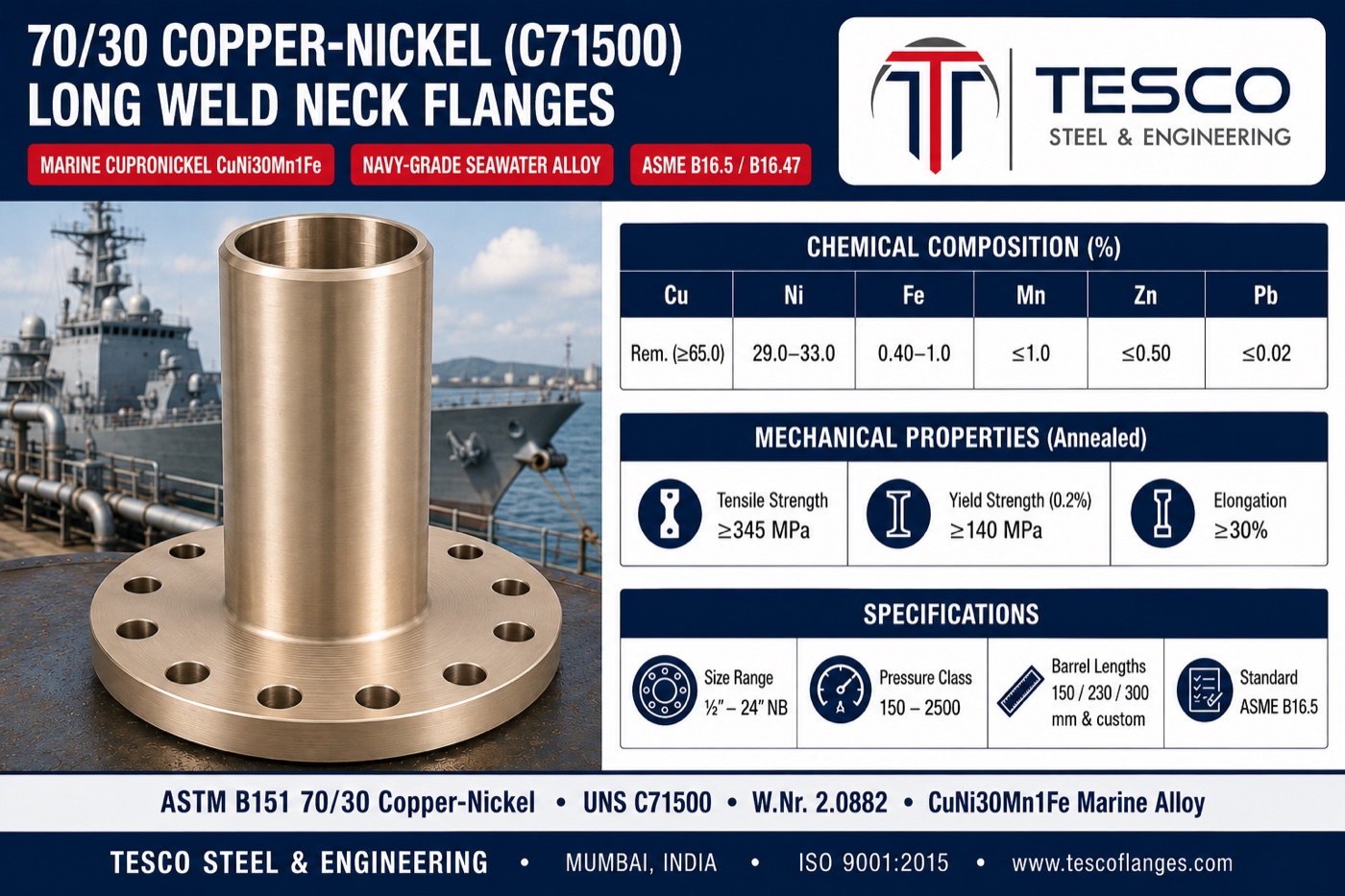
70/30 Copper-Nickel Long Weld Neck Flanges — UNS C71500 Navy-Grade Cupronickel LWN Manufacturer
Tesco Steel & Engineering manufactures 70/30 copper-nickel long weld neck flanges — the cupronickel family's severe sibling: ASTM B151, UNS C71500, EN CuNi30Mn1Fe (CW354H / W.Nr. 2.0882) — with ASME B16.5 flange ends in Classes 150–2500 and the barrel made to order. Against the 90/10, the nickel triples — and everything the ten percent bought, thirty buys harder: a tougher film, roughly half again more velocity allowance, better standing in polluted and brackish water, and the stronger 345/140 MPa certificate behind the naval franchise — shock-rated combatants and submarines trust exactly this grade. The subtlety is in the iron: the dose eases to 0.40–1.0%, because at thirty percent the nickel itself is the erosion armour. The family traits stay: the copper surface sheds biofouling, the galvanic pairing with the noble bank stays benign, and the boundary stays honest — sand and cavitation go to C71640, the erosion specialist, and stressed critical hardware to Monel. Heritage: EEMUA 145 / DIN 86037, collars forged alongside the full LWN. One forging, one closing weld with matching ERCuNi. Facings: RF / FF / RTJ; small bore on the 70/30 socketweld. Every lot with EN 10204 3.1/3.2 MTC. ISO 9001:2015, made in Mumbai, India — exported to 50+ countries.
ASTM B151 · UNS C71500 · W.Nr. 2.0882CuNi30Mn1Fe — The Navy-Grade CupronickelTriple the Nickel — The Severe SiblingHalf Again More Velocity AllowanceBiofouling-Resistant Copper Surface345 / 140 MPa AnnealedB16.5 Flange Ends · Class 150–2500EN 10204 3.1 / 3.2 · ISO 9001:2015
70/30 Copper-Nickel Long Weld Neck Flanges — Specifications at a Glance
What is a 70/30 Copper-Nickel Long Weld Neck Flange?
The severe sibling, in the nozzle pattern. A 70/30 copper-nickel flange (UNS C71500, ASTM B151) whose neck continues as a long, heavy-walled straight barrel — the nozzle itself — bevelled for one closing butt weld at the seawater main, cooler shell or naval system. Triple the 90/10's nickel: tougher film, half again more velocity, better standing in polluted water, and the stronger 345/140 certificate the navies trust — while the iron eases to 0.40–1.0%, because the nickel itself is now the armour. Biofouling resistance carried over. EEMUA 145 / DIN 86037 heritage; welds with matching ERCuNi, no PWHT. Flange ends per ASME B16.5, Classes 150–2500; barrel length and bore stated by you. EN 10204 3.1 on every lot.
The rule of the family:transport reads 90/10, severity reads 70/30, sand reads C71640 — and stress leaves the family for the noble bank; the enquiry's service line usually names the grade in one sentence.
What Triple the Nickel Buys
The Tougher Film
At thirty percent nickel the protective film self-heals faster and stands harder water — polluted harbours, brackish estuaries and sulphide-touched commissioning that would stress the lean alloy.
Half Again More Velocity
The pipeline allowance rises by roughly half again over the 90/10's — and local excursions at pumps, valves and bends that strip the lean film leave the rich one standing.
The Naval Certificate
345/140 MPa — a clear step above the 90/10 — the margin that lets shock-rated combatant and submarine systems trust cupronickel where vibration and duty run hard.
The Family Traits, Kept
Biofouling resistance, galvanic gentleness and fabrication ease all carry over — the copper surface still sheds marine growth without chlorination.
Specification Notes — Getting 70/30 Long Weld Necks Right
Three honest notes.The boundary still exists: cupronickel remains a film on a copper base — sand-laden flow and cavitation still find it, so the erosion extreme goes to C71640 and stressed critical hardware to Monel. Do not buy severity you do not need: for ordinary transport duty the 90/10 does the work at a fraction of the nickel cost — state the velocity and water quality, and let the family split honestly. And the copper family's enemies carry over: sulphide-polluted commissioning water attacks the immature film (ferrous sulphate dosing is the traditional protection), and ammonia chemistry can stress-crack any copper alloy — name both when credible.
How Our 70/30 CuNi LWN Flanges Are Manufactured
1
Material — certified C71500 stock to ASTM B151, kept segregated on the copper-alloy shelf — the two cupronickels must never mix; barrel integral, no welded build-ups.
2
Annealing — the solid-solution alloy's one heat treatment; records retained against the heat number.
3
Verification — chemistry per heat with the thirty-percent nickel window and the eased iron range certified; mechanicals per heat at the 345/140 line.
4
Machining — flange end to ASME B16.5 (or EEMUA 145 / DIN 86037 collar patterns to order); barrel turned to pattern and bored to the ordered schedule or drawing; RF serrations, flat face or RTJ groove per B16.20; weld end bevelled 37.5°.
5
Testing & marking — PMI reads nickel and iron on every piece — the lines that separate 70/30 from 90/10 and from C71640; marked with grade, size, schedule and heat number.
6
Certification & packing — EN 10204 3.1 MTC (3.2 witnessed on request); WPS guidance naming the matching ERCuNi filler; faces and bevels protected, packed sea-worthy.
Where 70/30 CuNi LWN Flanges Are Used
Where the specifications call the water severe: naval combatant and submarine seawater systems — shock-rated cooling, firemain and auxiliary circuits and their cooler and pump nozzles — high-velocity headers and pump discharge lines, harbour and estuarine installations in polluted or brackish water, the hotter cooling and process duties at the top of the copper family's envelope, and offshore and desalination positions specified a grade harder than the transport runs. The collar pattern serves the same systems where EEMUA or the naval standard writes it. One forging, one closing weld. Production and supply below:
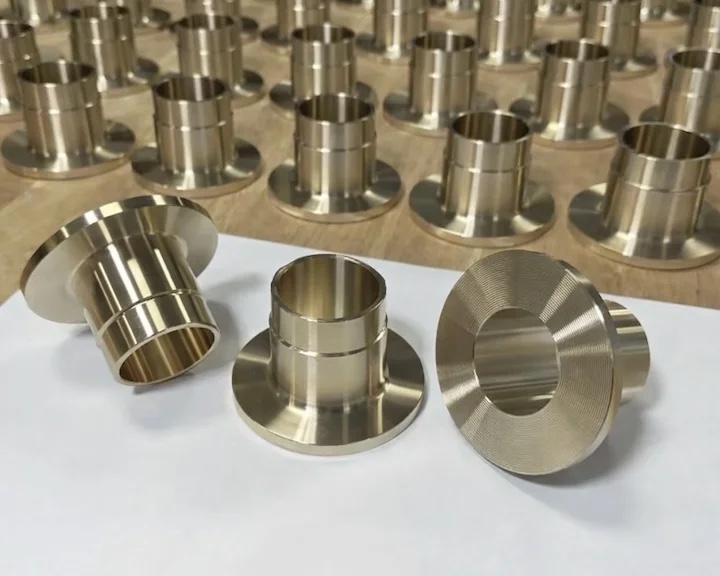
70/30 CuNi Long Weld Neck — Tall Barrel, B16.5 Flange EndCopper-Nickel Welding-Neck Collars — EEMUA 145 Pattern, Machined at Our Works
70/30 CuNi LWN Flange Dimensions
Flange-end dimensions are class-governed per ASME B16.5 (ratings per the copper-alloy tables); barrel length and bore per order. Full class-by-class charts:
Seven elements — the severity stated splits the family honestly:
1
Size & standard — e.g. 8″ NB ASME B16.5, or the EEMUA 145 / DIN 86037 pattern where the specification writes it.
2
Pressure class & facing — 150#–2500#; RF, FF (common in marine practice) or RTJ with ring number.
3
Barrel length — overall, face to weld end: 150 / 230 / 300 mm stock or any stated length.
4
Barrel bore & pattern — pipe schedule to match or finished bore in mm; standard, heavy barrel or equal barrel; weld-end prep if non-standard.
5
Grade line & severity — ASTM B151 70/30 copper-nickel, UNS C71500 / CuNi30Mn1Fe — with the service named and its severity stated (velocity, water quality, shock rating), so the 90/10 economics and the C71640 / Monel questions are checked honestly.
6
Certification — EN 10204 3.1 (our standard) / 3.2 witnessed.
What is a 70/30 copper-nickel long weld neck flange?
A 70/30 copper-nickel long weld neck flange is a forged navy-grade cupronickel flange — UNS C71500, EN CuNi30Mn1Fe (CW354H / W.Nr. 2.0882), supplied to ASTM B151 — whose neck continues as a long, heavy-walled straight barrel that is itself the nozzle, bevelled at its far end for one closing butt weld made out at the seawater main, cooler shell or naval system. 70/30 is the cupronickel family's severe sibling: triple the nickel of the 90/10 buys a tougher film, roughly half again more velocity allowance, better standing in polluted water and a clearly stronger certificate — while the copper surface keeps the family's biofouling resistance. Flange ends follow ASME B16.5 in Classes 150 to 2500; the barrel is machined to the ordered length and bore. Supplied annealed at 345/140 MPa with EN 10204 3.1/3.2 certification.
How does a long weld neck differ from a standard weld neck flange?
Geometry and mission. A standard weld neck's hub tapers quickly down to the pipe's outside diameter and wall, ending in a weld bevel a few centimetres from the flange face — it is built to butt-weld to pipe and continue as a piping run. A long weld neck keeps a full-section straight barrel for its entire length: no taper to pipe dimensions, wall far heavier than the matching schedule, length made to order. The mission follows the shape — the LWN is not a fitting on a pipe run but a nozzle in its own right, projecting through insulation, vessel walls or exchanger channels, with the butt weld relocated to the shell side where the fabricator wants it. In one certified forging it replaces the weld neck flange, the pipe nipple and one whole circumferential weld.
What does tripling the nickel buy — and what does the family keep?
Everything the ten percent bought, bought harder. At thirty percent nickel the protective film is tougher and self-heals faster, the velocity allowance rises by roughly half again over the 90/10's, standing in polluted, brackish and sulphide-touched water improves markedly, and the certificate steps up to 345/140 MPa — the margin that lets shock-rated naval systems trust the alloy. The temperature envelope stretches too, which is why the 70/30 rather than the 90/10 serves hotter cooling and process duty within the copper family. And the family traits carry over intact: the copper surface still sheds biofouling — the alloy stays inhospitable to marine growth without chlorination — the galvanic gentleness in mixed systems remains, and the fabrication character is unchanged. What is paid is simply nickel: the 70/30 costs markedly more per kilogram, which is why the economics FAQ splits the family the way every navy and yard splits it.
Why does the iron dose ease against the 90/10's — the armour subtlety?
Because the armour changes hands. In the lean 90/10, the deliberate 1.00-1.80% iron is what reinforces the film against flowing seawater — the erosion armour, floor and all, without which the alloy would not survive velocity. In the 70/30 the specification writes iron at 0.40-1.0% — lower, and deliberately so: at thirty percent nickel the nickel itself does the armour's work, building a film robust enough that the heavy iron dose is no longer needed and its metallurgical side-effects are better avoided. The design lesson is the family's in miniature: every element earns its place, and the same protection can be bought two ways — cheaply with iron in the lean alloy, intrinsically with nickel in the rich one. Where erosion is the named enemy beyond even the 70/30's standing, the family keeps a specialist: C71640, a 70/30 fortified with roughly 2% iron and 2% manganese for tube and exchanger duty in sand-laden water — available on enquiry, with the grade hub carrying its note.
What is the chemical composition of 70/30 copper-nickel (UNS C71500)?
Copper the remainder (at least 65.0%), nickel 29.0-33.0%, iron 0.40-1.0%, manganese ≤1.0%, zinc ≤0.50%, lead ≤0.02%. The certificate reads from the copper side with the remainder convention, and the two ranges tell the grade's story: the nickel window is the thirty percent that names the alloy and buys its severity standing, and the iron drops against the 90/10's dose — deliberately, as the armour FAQ explains, because in the rich alloy the nickel itself reinforces the film. The tight lead ceiling guards hot workability and weldability as across the family. Chemistry is verified per heat — nickel and iron both PMI-confirmed on every piece, since the two cupronickels must never mix on the shelf — and travels on the EN 10204 3.1 MTC.
What are the mechanical properties of 70/30 CuNi long weld neck flanges?
Annealed: tensile strength 345 MPa (50 ksi) minimum, yield strength 140 MPa (20 ksi) minimum, elongation 30% minimum — a clear step above the 90/10's certificate, and the reason the harder marine specifications reach for this grade. The step matters most where systems are shock-rated, vibration-heavy or simply run harder: naval combatants and submarines, high-duty pump circuits, and the hotter cooling and process services at the top of the copper family's envelope. The engineering frame is still the copper side's: B16.5's copper-alloy tables assign the ratings honestly, a properly classed flange carries its duty with normal margins, the heavy LWN barrel adds stiffness where nozzle loads bear, and there is no ductile-brittle transition anywhere in the range. Where strength beyond the family's reach is the mission — real stress, real velocity, criticality — the noble bank takes over, exactly as the Monel hand-off describes.
What are ASTM B151 and the EEMUA 145 heritage for 70/30?
The same copper-side standards shelf as the 90/10's, one grade over. Our 70/30 flanges certify to ASTM B151 — the copper-nickel rod and bar specification whose stock our forgings machine from — with the EN designation CuNi30Mn1Fe (CW354H, W.Nr. 2.0882) on the same certificate for European drawings. The shipbuilding heritage applies with extra force here: EEMUA 145 and DIN 86037 wrote the marine flange standards around cupronickel pipework, and the naval specifications that lean hardest on 70/30 — surface combatants, submarines — inherit that tradition. From it comes the welding-neck collar pattern in this page's photograph: a cupronickel stub end faced on one side, carried by a loose backing flange so the alloy wets the water and cheaper steel takes the bolt load. We forge both patterns: the full B16.5 long weld neck this page describes, and EEMUA-style collars to order. Flange-end dimensions, drilling and facings follow ASME B16.5; ratings per its copper-alloy tables.
What are 70/30's velocity limits — and where does C71640 enter?
Higher than the 90/10's, but the family's boundary still exists. The thirty percent nickel lifts the pipeline allowance by roughly half again — and locally, at pump discharges, throttled valves and tight bends, the richer film shrugs off excursions that would strip the lean alloy — which is precisely why severe and fast positions move up the family. But cupronickel remains a film on a copper base: sand-laden flow, cavitation and genuinely high velocity will still find it, and the design rules still deserve respect. The family's own answer for the erosion extreme is C71640 — a 70/30 fortified with roughly 2% iron and 2% manganese, the tube-side specialist for sand-laden and estuarine water — while beyond the copper family altogether the hand-off is the noble bank's: Monel for stressed, fast, critical hardware. The smaller honesty notes carry over from the 90/10 page: sulphide-polluted commissioning water attacks the immature film, and ammonia chemistry can stress-crack any copper alloy — name both when they are credible.
70/30 or 90/10 copper-nickel — how is the pair split?
Severity against economics, inside one family — the same split the 90/10 page describes, read from the rich side. 90/10 carries the great majority of marine pipework: cooling mains, firewater, ballast, the long transport runs where cupronickel's economics are the whole point, and nothing about the duty demands more than the lean alloy gives. 70/30 takes the positions the specifications call severe: higher-velocity headers and pump circuits, polluted harbours and brackish estuaries, shock-rated and vibration-heavy naval systems, and the hotter services at the top of the copper envelope — paying triple the nickel for the standing. Navies draw the line their own way, many specifying 70/30 broadly for robustness across combatant systems. Both grades weld with the same ERCuNi consumable, certify the same way and pair benignly, so mixed systems are routine — and the enquiry's service line usually names the grade in one sentence.
70/30 copper-nickel or Monel 400 — where does the copper family end?
At stress, extreme velocity and criticality — the same boundary the whole copper side shares, met one rung higher. 70/30 extends the family's reach: more velocity, harder water, stronger certificate. Monel changes the basis: a nickel-base alloy with copper rather than a copper-base alloy with nickel, several times stronger against erosion at velocity, structurally trustworthy under real stress, and immune to the ammonia stress-cracking that shadows every copper alloy — at several times the price. The practical line: where a severe seawater system is still fundamentally transport — carrying water through headers, coolers and mains — 70/30 is usually the honest answer; where a component is stressed, fast, sand-laden or too critical to size around a velocity rule — pump internals, stressed nozzles, high-energy systems — the noble bank takes it. The galvanic pairing between the two is famously benign, so the mixed system is the normal design, not a compromise; both benches are stocked at our works and quoted side by side.
How is the closing weld on a 70/30 CuNi LWN made?
With the same habits as everywhere in the copper family — and for this grade the filler is a true match. The consumable of record is ERCuNi, the 70/30-type copper-nickel filler: on the 90/10 it welds over-alloyed, on this page it welds matching, so joint and parent read the same chemistry line. No preheat beyond dryness, no PWHT; copper's high thermal conductivity drains heat from the joint fast, so procedures favour a touch more heat input and shorter arcs than a stainless welder expects — slightly less so here than on the lean alloy, since thirty percent nickel slows the drain. Cleanliness matters as everywhere on the non-ferrous shelf: oxide, oil and marking crayon off before the arc strikes. The closing weld at the main, cooler or naval system inherits the yard's own qualified procedure — naval work usually under its own welding standard — and WPS guidance travels with every supply, filler class stated.
How are the barrel length and bore of a LWN specified?
Two numbers that belong on every enquiry. Length: measured overall from the flange face to the weld end — 150 mm (6"), 230 mm (9") and 300 mm (12") are the common stock lengths, and any length machines to order; state it explicitly, because 'long' is not a dimension. Bore: the barrel is drilled and bored to order — most commonly to match the inside diameter of the connecting pipe schedule, sometimes cylindrical special bores for level bridles, instrument standpipes or restriction work; state the schedule or the finished bore in millimetres. Add the weld-end preparation (standard 37.5° bevel unless told otherwise) and the nozzle is fully defined.
What sizes and pressure classes do 70/30 CuNi LWN flanges come in?
Flange ends follow ASME B16.5 from ½" to 24" NB in Classes 150, 300, 400, 600, 900, 1500 and 2500 — with the full class-by-class LWN dimension charts on this site — and larger diameters forge to order against B16.47 or drawing dimensions, with EEMUA 145 and DIN 86037 patterns machined where marine specifications demand. The order book sits a class harder than the 90/10's: Classes 150 and 300 still dominate, but the naval and high-duty systems that specify 70/30 reach for 300 and above more often, in the generous diameters of cooling and firemain work, with facings named by the system standard (flat face common against wafer valves and rubber-lined mains). State size, class, barrel length and bore together — the four numbers define the forging — and our quotation returns price, unit weight and delivery per class.
What details are needed to get an accurate 70/30 CuNi LWN flange quotation?
Seven elements plus commercial terms: (1) size and dimensional standard — e.g. 8" NB ASME B16.5, or the EEMUA 145 / DIN 86037 pattern where the specification writes it; (2) pressure class — 150 to 2500; (3) facing — RF, FF (common in marine practice) or RTJ with ring number; (4) barrel length overall, face to weld end — 150/230/300 mm stock or any stated length; (5) barrel bore — pipe schedule to be matched or finished bore in millimetres, with pattern (standard, heavy barrel, equal barrel) and weld-end prep if non-standard; (6) the grade line — ASTM B151 70/30 copper-nickel, UNS C71500 / CuNi30Mn1Fe — with the service named and its severity stated (velocity, water quality, shock rating), so the 90/10 economics and the C71640 or Monel questions are checked honestly; (7) certification — EN 10204 3.1 (our standard) or 3.2 witnessed. Add quantity and destination; quotations normally within 24 hours.
Who manufactures 70/30 copper-nickel long weld neck flanges in India?
Tesco Steel & Engineering is an ISO 9001:2015 certified flange manufacturer based in Mumbai, India, producing 70/30 copper-nickel long weld neck flanges to ASTM B151 with B16.5 flange ends from ½" to 24" NB (larger to order) in Classes 150-2500, in standard, heavy-barrel and equal-barrel patterns — plus EEMUA 145 and DIN 86037 welding-neck collars where marine specifications demand — each machined from certified C71500 stock kept segregated on the copper-alloy shelf, with the barrel bored to the ordered schedule or drawing, bevelled for the closing weld, PMI-checked with nickel and iron both read on every piece so the two cupronickels never mix, and marked with grade, size, schedule and heat number. Supplied with EN 10204 3.1/3.2 certification and WPS guidance naming the ERCuNi filler — alongside the 90/10 sibling pages, the Monel bench and the complete long weld neck range. Exported to more than 50 countries.