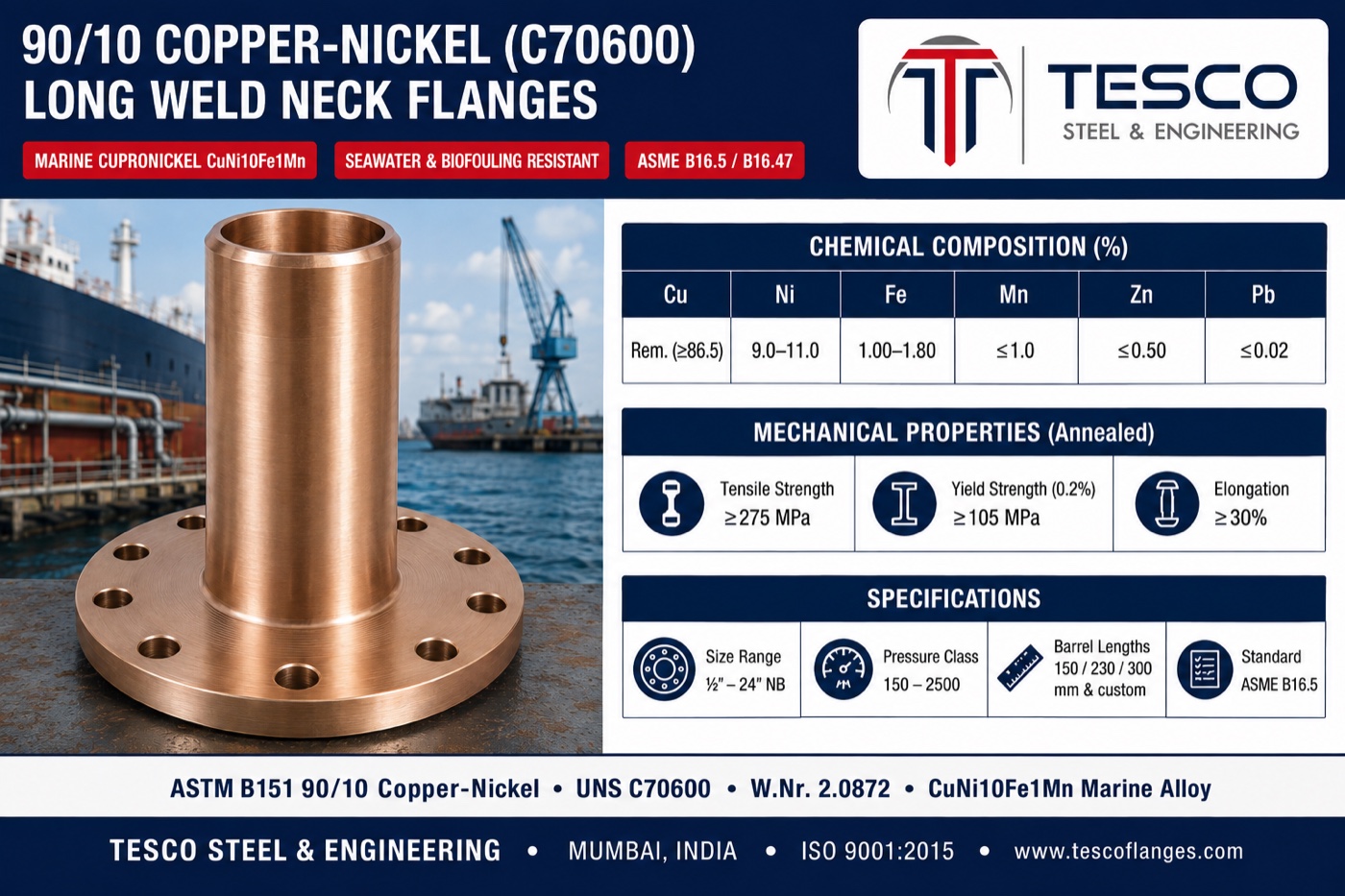
90/10 Copper-Nickel Long Weld Neck Flanges — UNS C70600 Marine Cupronickel LWN Manufacturer
Tesco Steel & Engineering manufactures 90/10 copper-nickel long weld neck flanges — the bench crosses to copper: ASTM B151, UNS C70600, EN CuNi10Fe1Mn (CW352H / W.Nr. 2.0872) — with ASME B16.5 flange ends in Classes 150–2500 and the barrel made to order. The design reads from the copper side: ten percent nickel turns the sea's oldest friendly metal into an engineering alloy, and a deliberate 1.00–1.80% iron addition armours the film against erosion. The franchise answers every noble alloy's honesty box: the copper surface sheds marine biofouling, so 90/10 tolerates stagnation the way Monel tolerates velocity — complementary benches, split by the process sheet. Heritage in the shipyards: EEMUA 145 and DIN 86037, with the welding-neck collar pattern forged alongside the full LWN. The honest boundary is stated too: the velocity rules are the specification — beyond them, 70/30 and Monel take over. One forging, one closing weld with ERCuNi. Facings: RF / FF / RTJ; small bore on the 90/10 socketweld. Every lot with EN 10204 3.1/3.2 MTC. ISO 9001:2015, made in Mumbai, India — exported to 50+ countries.
ASTM B151 · UNS C70600 · W.Nr. 2.0872CuNi10Fe1Mn — The Marine CupronickelBiofouling-Resistant Copper SurfaceIron 1.00–1.80% — The Erosion ArmourEEMUA 145 & DIN 86037 Heritage275 / 105 MPa AnnealedB16.5 Flange Ends · Class 150–2500EN 10204 3.1 / 3.2 · ISO 9001:2015
90/10 Copper-Nickel Long Weld Neck Flanges — Specifications at a Glance
What is a 90/10 Copper-Nickel Long Weld Neck Flange?
The marine cupronickel, in the nozzle pattern. A 90/10 copper-nickel flange (UNS C70600, ASTM B151) whose neck continues as a long, heavy-walled straight barrel — the nozzle itself — bevelled for one closing butt weld at the seawater main, cooler shell or ballast system. The bench's first copper-side alloy: ten percent nickel makes the engineering alloy, deliberate iron (1.00–1.80%) armours the film, and the copper surface sheds biofouling — stagnation-tolerant where the noble alloys are not. EEMUA 145 / DIN 86037 shipbuilding heritage; welds with ERCuNi, no PWHT. Supplied annealed — 275/105/30, honest copper-alloy numbers. Flange ends per ASME B16.5, Classes 150–2500; barrel length and bore stated by you. EN 10204 3.1 on every lot.
The rule of the two banks:transport reads copper, severity reads noble — the galvanic pairing between them is famously benign, so mixed systems are normal marine practice.
What the 90/10 Recipe Buys
Biofouling Resistance, By Chemistry
The copper surface is inhospitable to barnacles, mussels and biofilm — lines stay clean without chlorination, and the under-deposit attack that stalks noble alloys in dead water largely never starts.
The Iron Armour
1.00–1.80% iron, deliberately added, floor and all — dissolved iron reinforces the protective film against flowing seawater, the difference between a copper alloy that erodes and one that serves decades.
The Transport Economics
Kilometres of marine pipework at a fraction of nickel-alloy cost — the reason EEMUA 145 and the world's shipyards wrote their seawater standards around exactly this metal.
Benign in Mixed Systems
Galvanically gentle against Monel, bronze and steel — cupronickel lines with noble-alloy pumps and stressed hardware are standard practice, not a compromise.
Specification Notes — Getting 90/10 Long Weld Necks Right
Three honest notes.The velocity rules are the specification: above ~3.5 m/s in pipeline service — and locally at throttled valves, orifices and tight bends — erosion-corrosion strips the film faster than it reforms; size the lines to the rule, and give the fast, stressed positions to 70/30 or Monel. Commissioning water matters: sulphide-polluted harbour water attacks the immature film — ferrous sulphate dosing is the traditional protection while it forms, and excess chlorination thins the film too. And ammonia is the copper family's enemy: dirty ports and refrigeration leaks can stress-crack copper alloys — where ammonia chemistry is credible, the duty belongs to the nickel bench.
How Our 90/10 CuNi LWN Flanges Are Manufactured
1
Material — certified C70600 stock to ASTM B151, kept segregated on the copper-alloy shelf — cupronickel must never mix with the brass or bronze bins; barrel integral, no welded build-ups.
2
Annealing — the solid-solution alloy's one heat treatment; records retained against the heat number.
3
Verification — chemistry per heat with the nickel window and the deliberate iron range certified; mechanicals per heat at the 275/105 line.
4
Machining — flange end to ASME B16.5 (or EEMUA 145 / DIN 86037 collar patterns to order); barrel turned to pattern and bored to the ordered schedule or drawing; RF serrations, flat face or RTJ groove per B16.20; weld end bevelled 37.5°.
5
Testing & marking — PMI reads the copper-nickel signature on every piece; marked with grade, size, schedule and heat number.
6
Certification & packing — EN 10204 3.1 MTC (3.2 witnessed on request); WPS guidance naming the ERCuNi filler; faces and bevels protected, packed sea-worthy.
Where 90/10 CuNi LWN Flanges Are Used
Where seawater is carried rather than fought: shipboard cooling mains and their cooler and condenser nozzles, firewater and sprinkler systems, ballast piping and sea chests on naval and commercial hulls, offshore platform seawater lift and ring mains under EEMUA 145, desalination intake and brine transport, and coastal power and LNG cooling circuits — with the welding-neck collar pattern serving the same systems where the specification writes EEMUA. Modest pressures, generous diameters, one forging, one closing weld. Production and supply below:
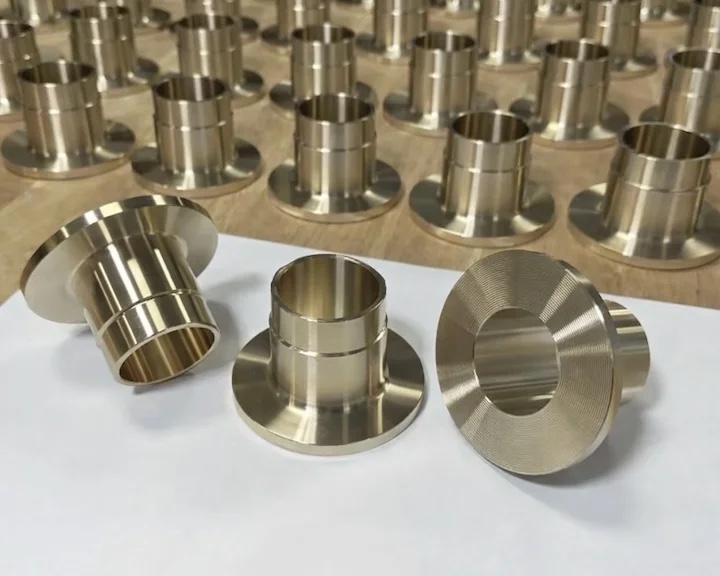
90/10 CuNi Long Weld Neck — Tall Barrel, B16.5 Flange EndCopper-Nickel Welding-Neck Collars — EEMUA 145 Pattern, Machined at Our Works
90/10 CuNi LWN Flange Dimensions
Flange-end dimensions are class-governed per ASME B16.5 (ratings per the copper-alloy tables); barrel length and bore per order. Full class-by-class charts:
Seven elements — the service and design velocity confirm the rung:
1
Size & standard — e.g. 8″ NB ASME B16.5, or the EEMUA 145 / DIN 86037 pattern where the specification writes it.
2
Pressure class & facing — 150#–2500# (150/300 the marine standard); RF, FF (common in marine practice) or RTJ with ring number.
3
Barrel length — overall, face to weld end: 150 / 230 / 300 mm stock or any stated length.
4
Barrel bore & pattern — pipe schedule to match or finished bore in mm; standard, heavy barrel or equal barrel; weld-end prep if non-standard.
5
Grade line & service — ASTM B151 90/10 copper-nickel, UNS C70600 / CuNi10Fe1Mn — with the service named and design velocity where known, so the 70/30 question is checked honestly.
6
Certification — EN 10204 3.1 (our standard) / 3.2 witnessed.
Example: “LWN Flange FF, 10″ NB, ASME B16.5 Class 150, barrel 230 mm, Sch 40 bore, standard pattern, ASTM B151 UNS C70600, seawater cooling main nozzles — design velocity 2.5 m/s, EN 10204 3.1 — 12 pcs.” Quotations normally within 24 hours with price, unit weight and delivery.
What is a 90/10 copper-nickel long weld neck flange?
A 90/10 copper-nickel long weld neck flange is a forged marine cupronickel flange — UNS C70600, EN CuNi10Fe1Mn (CW352H / W.Nr. 2.0872), supplied to ASTM B151 — whose neck continues as a long, heavy-walled straight barrel that is itself the nozzle, bevelled at its far end for one closing butt weld made out at the seawater main, cooler shell or ballast system. 90/10 is the long weld neck bench's first copper-side alloy: ten percent nickel turns copper into an engineering seawater alloy, a deliberate 1.00-1.80% iron addition armours the film against erosion, and the copper surface sheds the marine biofouling that troubles every noble alloy in stagnant water. Flange ends follow ASME B16.5 in Classes 150 to 2500; the barrel is machined to the ordered length and bore. Supplied annealed at 275/105 MPa with EN 10204 3.1/3.2 certification.
How does a long weld neck differ from a standard weld neck flange?
Geometry and mission. A standard weld neck's hub tapers quickly down to the pipe's outside diameter and wall, ending in a weld bevel a few centimetres from the flange face — it is built to butt-weld to pipe and continue as a piping run. A long weld neck keeps a full-section straight barrel for its entire length: no taper to pipe dimensions, wall far heavier than the matching schedule, length made to order. The mission follows the shape — the LWN is not a fitting on a pipe run but a nozzle in its own right, projecting through insulation, vessel walls or exchanger channels, with the butt weld relocated to the shell side where the fabricator wants it. In one certified forging it replaces the weld neck flange, the pipe nipple and one whole circumferential weld.
Why does the bench cross to copper — and what do the nickel and iron do?
Because for carrying seawater in bulk, the economics belong to the copper side. This page is the first C-prefix UNS number on our long weld neck bench: copper is the base — the sea's oldest friendly metal, naturally resistant and naturally hostile to marine growth — and the alloying reads from that side. The ten percent nickel is what turns soft, weak commercial copper into an engineering alloy: strength, film quality and erosion standing all rise with it, while the alloy keeps copper's surface chemistry and its price advantage over the nickel bench. The iron is the subtle line: 1.00-1.80% as a deliberate range, floor and all — dissolved iron reinforces the protective oxide film against flowing seawater's mechanical attack, and it is the difference between a copper alloy that erodes at velocity and one that serves decades in cooling mains. Nothing here is accidental: 90/10 is a designed seawater alloy wearing a simple name.
What is the biofouling franchise — the answer to the noble alloys' honest note?
The property every noble alloy on this site concedes in its own honesty box. Monel, the stainless families and the duplex grades all rely on surface nobility — and in stagnant seawater, marine organisms settle on that noble surface, and the crevice chemistry under their deposits is where pitting begins. Copper-nickel's surface runs the opposite chemistry: the slow release of copper ions makes the metal inhospitable to barnacles, mussels and biofilm, so the surface stays clean without chlorination — and with no deposits, the under-deposit attack that stalks the noble alloys in dead water largely never starts. That is why 90/10 is the default for long seawater transport lines, intake systems and ship hull piping where water sometimes stands: the alloy tolerates stagnation the way the noble bench tolerates velocity. The two sides are complementary, not rivals — the Monel page sends its stagnant zones here, and this page sends its stressed, fast-flowing positions there.
What is the chemical composition of 90/10 copper-nickel (UNS C70600)?
Copper the remainder (at least 86.5%), nickel 9.0-11.0%, iron 1.00-1.80%, manganese ≤1.0%, zinc ≤0.50%, lead ≤0.02%. Three readings matter. Copper is the base — the C-prefix UNS number says so, and the certificate reads from the copper side with the remainder convention. The nickel is the ten percent that makes the engineering alloy: film quality, strength and erosion standing all rise with it. And the iron is deliberate, floor and all — the erosion armour of its own FAQ, a range rather than a ceiling because too little fails the film and too much destabilises it. The tight lead ceiling guards hot workability and weldability. Chemistry is verified per heat, PMI-confirmed on the copper-nickel signature, and travels on the EN 10204 3.1 MTC.
What are the mechanical properties of 90/10 CuNi long weld neck flanges?
Annealed: tensile strength 275 MPa (40 ksi) minimum, yield strength 105 MPa (15 ksi) minimum, elongation 30% minimum — copper-alloy numbers, stated honestly, and entirely sufficient for the duty: seawater cooling, firewater and ballast systems run at modest pressures, and ASME B16.5's copper-alloy pressure-temperature tables already reflect the metal's strength, so a properly classed flange carries its rating with normal margins and the heavy LWN barrel adds stiffness where nozzle loads bear. The temperature envelope suits the habitat — from well below freezing (no ductile-brittle transition) to the modest warmth of cooling circuits; cupronickel is not a heat alloy and does not pretend to be. Where a seawater system genuinely needs strength — high-pressure headers, stressed hardware, velocity beyond the design rule — the hand-off FAQs point up the bench to 70/30 and to Monel.
What are ASTM B151 and the EEMUA 145 heritage?
The copper side keeps its own standards shelf. Our 90/10 flanges certify to ASTM B151 — the copper-nickel rod and bar specification whose stock our forgings machine from — with the EN designation CuNi10Fe1Mn (CW352H, W.Nr. 2.0872) on the same certificate for European drawings. The heritage that actually shaped the product, though, is the shipbuilding standards: EEMUA 145 — the offshore industry's copper-nickel flange standard — and DIN 86037, the German shipbuilding series, both written around cupronickel seawater pipework. From that tradition comes the pattern in this page's photograph: the welding-neck collar, a cupronickel stub end faced on one side, carried by a loose backing flange — often galvanised steel — so the expensive alloy wets the water and the cheap steel takes the bolt load. We forge both patterns: the full B16.5 long weld neck this page describes, and EEMUA-style collars to order. Flange-end dimensions, drilling and facings follow ASME B16.5; ratings per its copper-alloy tables.
What are 90/10's velocity limits — the honest design rule?
The franchise's boundary, stated plainly. The iron-reinforced film that protects 90/10 is still a film on a soft metal, and above roughly 3.5 metres per second in pipeline service — and locally at throttled valves, orifices, tight bends and pump discharges — flowing seawater strips it faster than it reforms: erosion-corrosion, the copper alloys' classic failure. The design rules are well understood and shipyards live by them: size lines to keep velocity inside the limit, ease the geometry where flow accelerates, and where a position is inherently fast, stressed or sand-laden, change alloy — 70/30 stands more velocity, and Monel shrugs it off, which is exactly the hand-off its page describes. Two smaller honesty notes travel with the big one: sulphide-polluted harbour water attacks the film during commissioning (ferrous sulphate dosing is the traditional protection while the film matures), and ammonia chemistry — dirty ports, refrigeration leaks — can stress-crack copper alloys and belongs to the nickel bench. Inside the rules, the alloy serves for decades; the rules are the specification.
90/10 or 70/30 copper-nickel — how is the pair split?
Economics against severity, inside one family. 70/30 (UNS C71500) triples the nickel, and everything the nickel bought at ten percent it buys more of at thirty: a stronger certificate, a tougher film, roughly half again more velocity allowance, and better standing in polluted and brackish water — at a markedly higher price, since nickel is the cost in a cupronickel. The practical split follows the system drawing: 90/10 carries the great majority of marine pipework — cooling mains, firewater, ballast, the long transport runs where its economics are the whole point; 70/30 takes the severe positions — higher-velocity headers, pump suctions in dirty water, systems specified hotter or harder. Navies split the same way, many specifying 70/30 broadly for robustness. Both weld with the same ERCuNi consumable and both certify the same way, so mixed systems are routine; our 70/30 pages carry the sibling's own story.
90/10 copper-nickel or Monel 400 — the seawater decision from the copper side?
The same decision the Monel page argues, seen from the other bank. Copper-nickel wins the transport question: for the kilometres of cooling, firewater and ballast piping that simply carry seawater at design velocity, 90/10 does the duty at a fraction of the nickel alloy's cost, sheds biofouling without chlorination, and tolerates the stagnant zones that trouble every noble alloy. Monel wins the severity question: at velocity beyond the copper rules, under real stress, in sand-laden or turbulent water, and wherever a component is too critical to size around a velocity limit, the nickel-copper alloy's strength and erosion standing take over — at several times the price per kilogram. The pairing is famously benign galvanically, so mixed systems are normal practice: cupronickel lines, noble-alloy pumps and stressed hardware. The process sheet usually decides in one line — transport reads 90/10, severity reads Monel — and both benches are stocked at our works.
How is the closing weld on a 90/10 CuNi LWN made?
With the copper family's own habits, and none of them difficult. The consumable of record is ERCuNi — the 70/30-type copper-nickel filler that welds both grades of the family, slightly over-alloyed against the 90/10 base so the joint's film chemistry never reads leaner than the parent. No preheat beyond dryness, no PWHT; copper's high thermal conductivity is the one practical difference from the nickel bench — heat drains from the joint fast, so procedures favour a touch more heat input and shorter arcs than a stainless welder expects, and fit-up benefits from the good access the LWN's straight barrel provides. Cleanliness matters as everywhere on the non-ferrous shelf: oxide, oil and marking crayon off before the arc strikes. The closing weld at the main or cooler shell inherits the plant's or yard's own qualified procedure, and WPS guidance travels with every supply, filler class stated.
How are the barrel length and bore of a LWN specified?
Two numbers that belong on every enquiry. Length: measured overall from the flange face to the weld end — 150 mm (6"), 230 mm (9") and 300 mm (12") are the common stock lengths, and any length machines to order; state it explicitly, because 'long' is not a dimension. Bore: the barrel is drilled and bored to order — most commonly to match the inside diameter of the connecting pipe schedule, sometimes cylindrical special bores for level bridles, instrument standpipes or restriction work; state the schedule or the finished bore in millimetres. Add the weld-end preparation (standard 37.5° bevel unless told otherwise) and the nozzle is fully defined.
What sizes and pressure classes do 90/10 CuNi LWN flanges come in?
Flange ends follow ASME B16.5 from ½" to 24" NB in Classes 150, 300, 400, 600, 900, 1500 and 2500 — with the full class-by-class LWN dimension charts on this site — and larger diameters forge to order against B16.47 or drawing dimensions, with EEMUA 145 and DIN 86037 patterns machined where marine specifications demand. The order book is the most class-concentrated on the bench: seawater transport runs at modest pressures, so Classes 150 and 300 dominate almost completely, in generous diameters — the economics of the alloy are the point, and the class tables' copper-alloy ratings carry the duty with normal margins. State size, class, barrel length and bore together — the four numbers define the forging — with the facing named (flat face is common against wafer valves and rubber-lined mains), and our quotation returns price, unit weight and delivery per class.
What details are needed to get an accurate 90/10 CuNi LWN flange quotation?
Seven elements plus commercial terms: (1) size and dimensional standard — e.g. 8" NB ASME B16.5, or the EEMUA 145 / DIN 86037 pattern where the specification writes it; (2) pressure class — 150 to 2500, with 150/300 the marine standard; (3) facing — RF, FF (common in marine practice) or RTJ with ring number; (4) barrel length overall, face to weld end — 150/230/300 mm stock or any stated length; (5) barrel bore — pipe schedule to be matched or finished bore in millimetres, with pattern (standard, heavy barrel, equal barrel) and weld-end prep if non-standard; (6) the grade line — ASTM B151 90/10 copper-nickel, UNS C70600 / CuNi10Fe1Mn — with the service named (cooling main, firewater, ballast) and design velocity where known, so the 70/30 question is checked honestly; (7) certification — EN 10204 3.1 (our standard) or 3.2 witnessed. Add quantity and destination; quotations normally within 24 hours.
Who manufactures 90/10 copper-nickel long weld neck flanges in India?
Tesco Steel & Engineering is an ISO 9001:2015 certified flange manufacturer based in Mumbai, India, producing 90/10 copper-nickel long weld neck flanges to ASTM B151 with B16.5 flange ends from ½" to 24" NB (larger to order) in Classes 150-2500, in standard, heavy-barrel and equal-barrel patterns — plus EEMUA 145 and DIN 86037 welding-neck collars where marine specifications demand — each machined from certified C70600 stock kept segregated on the copper-alloy shelf, with the barrel bored to the ordered schedule or drawing, bevelled for the closing weld, PMI-checked on the copper-nickel signature on every piece, and marked with grade, size, schedule and heat number. Supplied with EN 10204 3.1/3.2 certification and WPS guidance naming the ERCuNi filler — alongside the 70/30 sibling pages, the Monel bench and the complete long weld neck range. Exported to more than 50 countries.