UNS N05500 Slip On Flanges — Monel K-500 Manufacturer
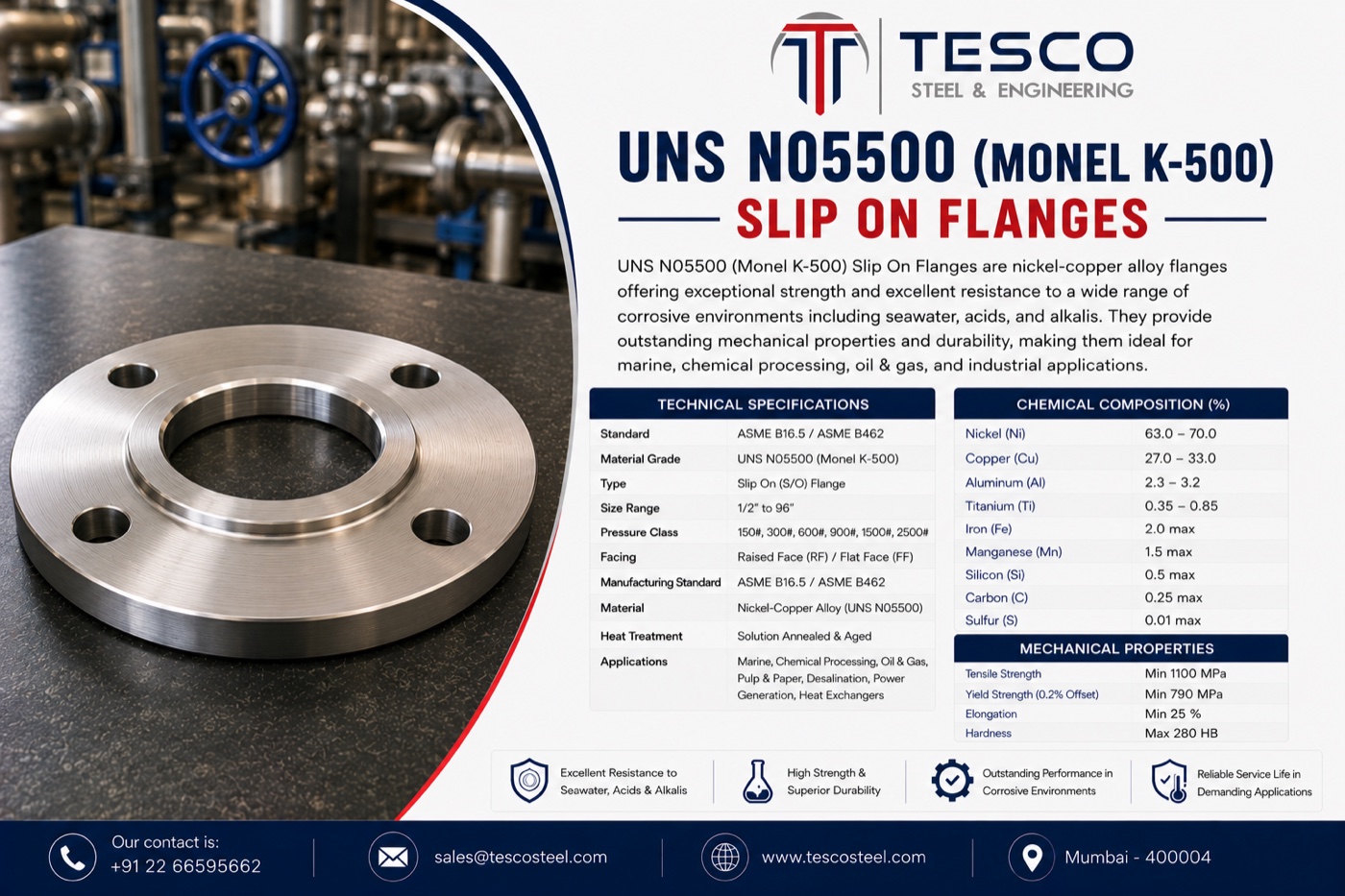
Tesco Steel & Engineering forges Monel K-500 slip on flanges — the age-hardenable nickel-copper-aluminium alloy (UNS N05500, Werkstoff 2.4375, NiCu30Al) — to ASTM B865 with ASME B16.5 dimensions, Class 150–2500, from ½″ to 24″ NB, larger patterns to order. Aluminium and titanium precipitates give it roughly three times the yield strength of Monel 400 — 895/585 MPa age-hardened — while keeping the family's corrosion character: flowing seawater, HF acid, caustic, chloride SCC immunity, plus a non-magnetic, spark-resistant nature prized in oil-tool and subsea hardware. Supplied age-hardened with thermal records, every lot with EN 10204 3.1/3.2 MTC. ISO 9001:2015, made in Mumbai, India — exported to 50+ countries.
Monel K-500 · K Monel · N05500ASTM B865 · 2.4375 · NiCu30AlAl 2.3–3.15% · Ti 0.35–0.85%ASME B16.5 Class 150–2500½″ – 24″ NB · SORF895 MPa TS / 585 MPa YS min (aged)EN 10204 3.1 / 3.2 · ISO 9001:2015
Monel K-500 Slip On Flange — Specifications at a Glance
What is a UNS N05500 Slip On Flange?
Monel K-500 = Monel 400 with a superalloy trick. Add ~3% aluminium + 0.5% titanium to the nickel-copper base, age-harden at 540–610 °C, and gamma-prime precipitates triple the yield strength (895/585 MPa vs 480/195) — while the corrosion character stays Monel: flowing seawater, HF acid, caustic, chloride SCC immunity, plus non-magnetic and spark-resistant. Forged to ASTM B865 (not B564, not A182); as a slip-on, welding needs judgement — see the honest note below.
Also searched as: Monel K500 slip on flange, K Monel SORF flange, ASTM B865 N05500 slip on flange, 2.4375 / NiCu30Al slip on flange, QQ-N-286 flange — all refer to the product on this page. See also our UNS N05500 flanges overview and Monel K-500 flanges.
Rule of thumb: K-500 = Monel corrosion resistance where the part itself must be strong. If the flange only needs Monel chemistry at piping stresses, Alloy 400 is the standard and welds freely; if strength must go higher still, the enquiry moves to Inconel 718.
Monel K-500 (UNS N05500) Chemical Composition
Ni (+Co)
Cu
Al
Ti
Fe
Mn
C
Si
S
63.0 min
27.0-33.0
2.30-3.15
0.35-0.85
2.0 max
1.5 max
0.25 max
0.5 max
0.010 max
Values in weight % for UNS N05500 per ASTM B865. The aluminium and titanium are the defining additions — they form the γ′ Ni₃(Al,Ti) precipitates during ageing. Without them the analysis reads like Monel 400; with them it is a different engineering material.
Monel K-500 Mechanical Properties
Condition
Tensile Strength, MPa (ksi)
Yield Strength 0.2%, Min, MPa (ksi)
Elongation % min
Annealed + age-hardened (standard supply)
895 (130) min
585 (85) min
20
Hot-worked + age-hardened
965 (140) min
690 (100) min
20
Monel 400, annealed — for comparison
480 (70) min
195 (28) min
35
Per ASTM B865. Roughly three times the yield of Monel 400, held from cryogenic temperatures to ~480 °C. Density 8.44 g/cm³. The heat-treatment condition is part of the specification — our certificates state it with the thermal record. Values demonstrated per heat on the EN 10204 certificate.
UNS N05500 Slip On Flange Specifications
Monel K-500 Slip On Flanges are available in the following specifications:
Material
Monel K-500 / K Monel — ASTM B865 (UNS N05500, Werkstoff 2.4375, NiCu30Al); QQ-N-286 on request
Size
1/2"NB to 24"NB to ASME B16.5 dimensions; larger diameters and custom patterns to order
Class
150#, 300#, 400#, 600#, 900#, 1500#, 2500#
Facing
Raised Face (SORF) — default; Flat Face (SOFF) or RTJ where the piping class specifies
Heat Treatment
Solution treated and age-hardened (540–610 °C precipitation cycle) per ASTM B865, thermal record retained
Welding needs judgement — weld annealed with ERNiCu-7 then age; welded joints reach only Alloy 400 strength (see note below)
Testing
PMI verification and hardness testing on request
Certification
EN 10204 3.1 (standard) / 3.2 witnessed
Equivalent Grades of Monel K-500
Trade Names
ASTM
UNS
Werkstoff Nr.
EN
Military
Monel K-500 / K Monel / Alloy K500
B865
N05500
2.4375
NiCu30Al
QQ-N-286
Not B564 (that covers Monel 400 and other non-hardenable nickel alloys), not A182 (stainless and alloy steels) — N05500 forgings belong to ASTM B865, with flange dimensions from ASME B16.5. Sister spec for the plain grade: Monel 400 to B564.
Why Monel K-500 Slip Ons Are Specified
Three Times the Strength, Same Monel Chemistry
895/585 MPa age-hardened against 480/195 for Alloy 400 — with the seawater, HF and caustic behaviour of the family essentially untouched.
Non-Magnetic to Deep Cold
The magnetic transition sits below −100 °C — the classic material of MWD drill collars and instrument housings that must not disturb directional surveys.
Spark-Resistant, Cryogenic-Tough
No ductile-brittle transition and non-sparking behaviour — safety margins that matter in hydrocarbon and cryogenic marine systems.
The Superalloy Mechanism
γ′ precipitation — the same strengthening that powers jet-engine alloys — applied to a proven 1920s marine base. Heat treatment condition documented on every certificate.
K-500's strength does not survive an arc. The alloy welds in the annealed condition with ERNiCu-7, but weld metal does not age-harden — a welded joint sits at roughly Monel 400 strength — and welding already-aged material risks HAZ cracking. So be deliberate: if the design needs a routine welded slip-on, Monel 400 is usually the honest specification; if K-500 strength is essential at the connection, prefer bolted or threaded joints, or weld before ageing where fabrication allows. One more subsea note: aged K-500 under cathodic protection is a known hydrogen-embrittlement consideration — flag the service on the enquiry and we advise on the specific case.
How Our Monel K-500 Slip On Flanges Are Manufactured
1
Forging — cut billet of certified N05500 heat is hot-forged into the flange blank, keeping full heat traceability from raw material to despatch.
2
Solution treatment — softened and homogenised per ASTM B865, preparing the matrix for ageing.
3
Age-hardening — the defining step: held at 540–610 °C on a controlled cycle while γ′ precipitates form and the strength triples; full thermal record retained.
4
Machining — hub, faces and bolt holes to ASME B16.5; the bore machined slightly over pipe OD per the slip-on tolerance.
5
Testing & marking — tensile, hardness and chemical verification against the heat (PMI where the order specifies), then permanent marking of standard, grade, size, class and heat number.
6
Certification & packing — EN 10204 3.1 MTC stating the age-hardened condition (3.2 witnessed on request), export-packed for sea or air freight.
Where UNS N05500 Slip On Flanges Are Used
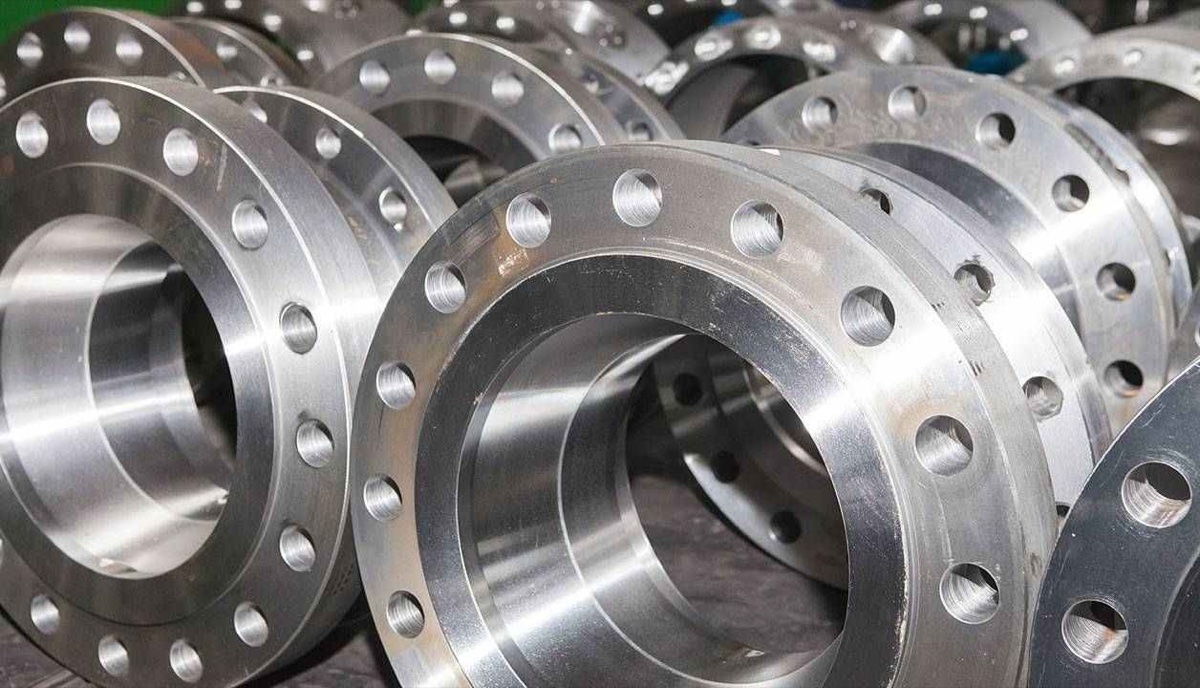
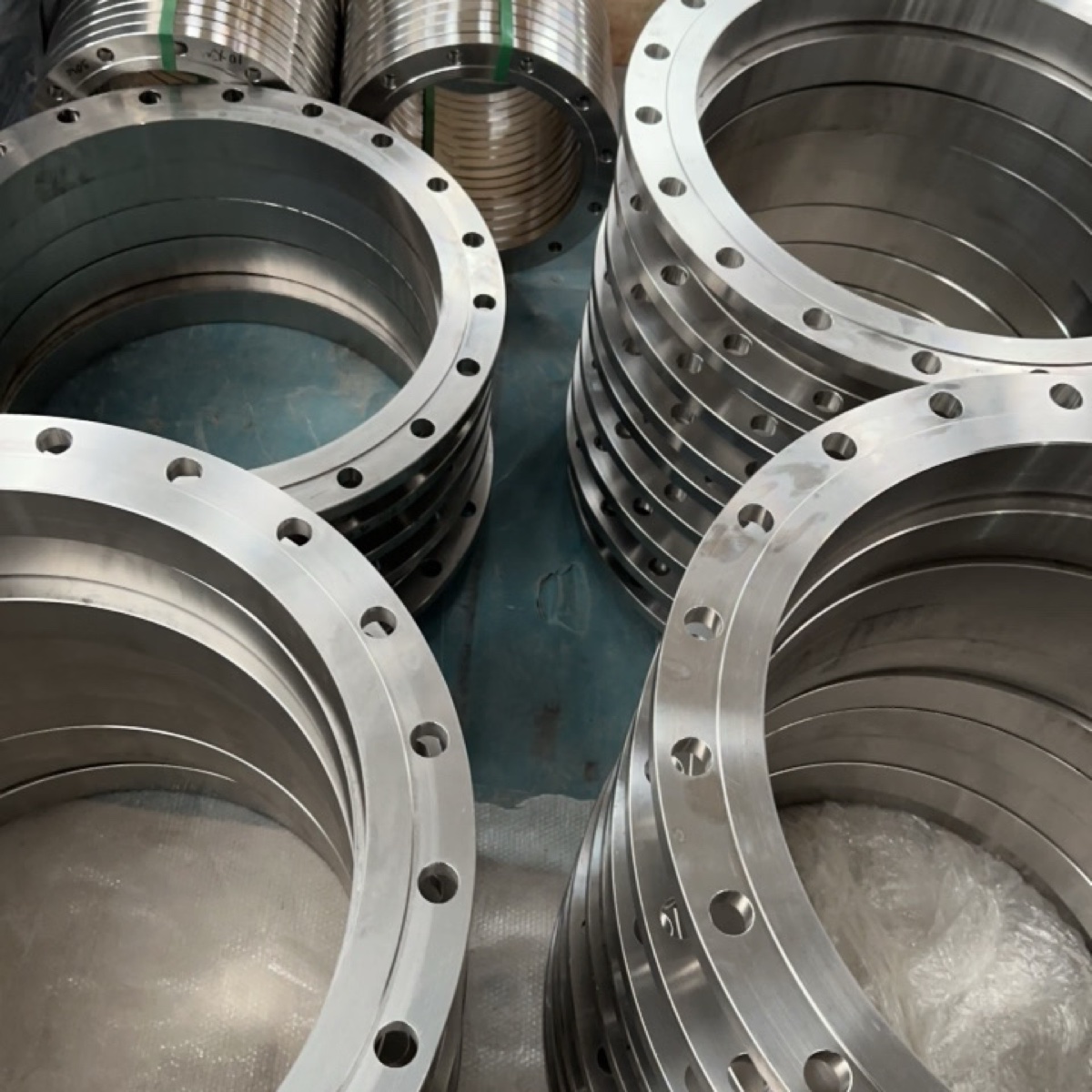
Where Monel chemistry and high strength meet: oil-and-gas downhole and wellhead hardware, non-magnetic MWD drill-collar systems, subsea and naval equipment, pump and valve assemblies with K-500 shafts and trim, elevated-pressure seawater injection and firewater systems, and HF or caustic plant connections matching K-500 equipment. K-500 flanges are specialist items — general-purpose Monel flanging remains Alloy 400 territory. Slip-on production at scale below:
Large-Bore Slip On Flanges — Machined & Ready for DespatchLarge-Diameter Slip On Flanges — EN 1092-1 Patterns to Order
UNS N05500 Slip On Flange Dimensions
Monel K-500 slip-on dimensions follow the ASME B16.5 slip-on tables — identical for every material. Full charts by class:
Example: “Slip On Flange, 4″ NB, ASME B16.5 Class 150, RF, Monel K-500 / ASTM B865 (N05500), age-hardened, EN 10204 3.1 — 10 pcs.” Quotations normally within 24 hours with price, unit weight and delivery.
UNS N05500 Slip On Flanges — Frequently Asked Questions
What is a UNS N05500 slip on flange?
It is a slip-on flange forged from Monel K-500 — the age-hardenable nickel-copper-aluminium alloy (UNS N05500, ASTM B865, Werkstoff 2.4375) — dimensioned to ASME B16.5. The flange slides over the pipe end and is secured with two fillet welds. K-500 keeps the corrosion character of Monel 400 — flowing seawater, hydrofluoric acid, caustic, chloride SCC immunity — and adds roughly three times the yield strength through precipitation hardening, plus a non-magnetic, spark-resistant nature prized in oil-tool and marine hardware.
What is Monel K-500?
The high-strength member of the Monel family, introduced in the 1920s. Adding about 3% aluminium and 0.5% titanium to the classic nickel-copper base created an alloy that can be age-hardened: heat treatment precipitates fine gamma-prime particles that block dislocation motion, tripling the strength while barely touching the corrosion resistance. The K distinguishes it from plain Alloy 400. Designations: UNS N05500, Werkstoff 2.4375, NiCu30Al, often written K Monel or Monel K500.
Is UNS N05500 the same as Monel 400?
No — a frequent mix-up worth settling. Monel 400 is UNS N04400: the plain solid-solution nickel-copper alloy, moderate strength, freely weldable, forged to ASTM B564. Monel K-500 is UNS N05500: the same base plus aluminium and titanium, age-hardened to roughly three times the yield strength, forged to ASTM B865, and generally not welded. Corrosion behaviour is essentially shared; strength, weldability, specification and price are not. This page is the K-500 page; for N04400 see our Monel 400 slip on flanges.
What is the chemical composition of Monel K-500?
For UNS N05500: nickel (plus cobalt) 63.0% minimum, copper 27.0-33.0%, aluminium 2.30-3.15%, titanium 0.35-0.85%, iron 2.0% max, manganese 1.5% max, carbon 0.25% max, silicon 0.5% max and sulphur 0.010% max. The aluminium and titanium are the defining additions — they form the gamma-prime precipitates during age-hardening that give K-500 its strength. Without them the analysis reads like Monel 400; with them it becomes a different engineering material.
What are the mechanical properties of Monel K-500 slip on flanges?
Per ASTM B865 in the annealed and age-hardened condition: tensile strength 895 MPa (130 ksi) minimum, 0.2% yield strength 585 MPa (85 ksi) minimum and elongation 20% minimum — with hot-worked and aged material rated higher still at 965/690 MPa (140/100 ksi). Compare Monel 400's 480/195 MPa: K-500 delivers roughly three times the yield. Strength holds from cryogenic temperatures to around 480 °C, and values are demonstrated per heat on the EN 10204 certificate.
How does age-hardening give K-500 its strength?
By precipitation. After solution treatment, the alloy is held around 540-610 °C for several hours, during which the aluminium and titanium form sub-microscopic gamma-prime particles — Ni₃(Al,Ti) — coherently locked into the nickel-copper matrix. Dislocations must cut or bypass these particles, so the metal resists deformation: yield strength triples. The mechanism is the same one that powers modern superalloys, applied to a 1920s marine alloy — and it is why heat treatment condition must always be stated on a K-500 order.
When should I choose K-500 over Monel 400?
Choose by what does the work. If the component itself must be strong — shafts, stems, fasteners, drill collars, high-pressure hardware, or flanges matching K-500 equipment — specify K-500. If the component mainly needs Monel corrosion resistance at ordinary piping stresses, Alloy 400 is the standard: cheaper, freely weldable and equally corrosion-proof in the same media. In practice most Monel piping and flanging is 400, with K-500 reserved for the parts where its tripled strength earns the premium.
Can Monel K-500 slip on flanges be welded?
With reservations — and honest suppliers say so. K-500 is weldable in the annealed condition using nickel-copper filler (ERNiCu-7), but the weld metal does not respond to age-hardening, so the joint stays at roughly Monel 400 strength, and welding aged material risks cracking in the heat-affected zone. Where a welded slip-on joint is the design, Monel 400 is usually the better specification; where K-500 strength is essential at the connection, bolted, threaded or specially engineered joints — welded before ageing where possible — are preferred. We advise on the specific case at enquiry.
Does K-500 have the same corrosion resistance as Monel 400?
Essentially yes — the age-hardening additions barely disturb the nickel-copper chemistry that does the corrosion work. Flowing seawater and brine, hydrofluoric acid, caustic and dry chlorine remain home ground, and chloride stress corrosion cracking immunity is retained. The same honest limits carry over too: pitting is possible under stagnant seawater and deposits, and oxidising media — nitric acid, ferric chloride, wet chlorine — attack it. One K-500-specific note: in the aged, high-strength condition it can be sensitive to hydrogen embrittlement under cathodic protection, a known subsea design consideration.
Is Monel K-500 non-magnetic?
Yes — and it stays non-magnetic down to well below ambient temperatures, because the additions push the magnetic transition below −100 °C. Combined with high strength and seawater resistance, this is why K-500 is the classic material for measurement-while-drilling (MWD) drill collars and instrument housings, where the tool must not disturb directional survey readings. The alloy is also spark-resistant, adding safety value in hydrocarbon service.
Which ASTM standard covers UNS N05500 flanges?
ASTM B865 — the specification for UNS N05500 rod, bar, wire, forgings and forging stock — with flange dimensions taken from ASME B16.5. It is not an A182 grade (stainless and alloy steels), not B564 (which covers Monel 400 and other non-hardenable nickel alloys), and not B462 (Alloy 20). Military and aerospace paperwork may also cite QQ-N-286, the long-standing federal K-500 specification. Certificates state the standard, condition (age-hardened) and heat number together.
Where are UNS N05500 slip on flanges typically used?
Where Monel corrosion resistance and high strength meet: oil-and-gas downhole and wellhead hardware, non-magnetic MWD drill-collar systems, subsea and naval equipment, pump and valve assemblies with K-500 shafts and trim, seawater injection and firewater systems at elevated pressure, and HF alkylation or caustic plant connections that must match K-500 equipment. Flanges in K-500 are specialist items — normally specified to match K-500 piping or machinery rather than as general-purpose flanging, which remains Monel 400 territory.
What sizes and classes are Monel K-500 slip on flanges available in?
From ½" to 24" NB to ASME B16.5 dimensions in Classes 150 through 2500, with larger diameters and custom patterns forged to order — the large-bore slip-on production pictured on this page shows the scale we machine. K-500 is strictly project material, forged against the order from certified N05500 heats and age-hardened with full thermal records; delivery is typically a few weeks depending on heat availability. State the required condition (age-hardened is standard) and delivery on the enquiry and we confirm the schedule with the quotation.
What temperature range can K-500 slip on flanges handle?
From deep cryogenic service — the alloy is tough with no ductile-brittle transition and stays non-magnetic — up to roughly 480 °C, where the age-hardened strength begins to fade as the precipitates coarsen; long exposure above about 600 °C progressively over-ages and softens the alloy. The nickel-alloy caution on sulphur-bearing atmospheres above roughly 370 °C applies as it does to all Monels. In its real habitat — wet, corrosive, high-load service near ambient — temperature is rarely the limiting factor.
Who manufactures UNS N05500 slip on flanges in India?
Tesco Steel & Engineering is an ISO 9001:2015 certified flange manufacturer based in Mumbai, India, forging Monel K-500 / UNS N05500 slip on flanges from ½" to 24" NB per ASTM B865 with ASME B16.5 dimensions — alongside the full N05500 range of weld neck, blind, socketweld, threaded, lapped joint and spectacle blind flanges, and the complete Monel 400 programme — supplied age-hardened with full heat traceability, PMI on request, and EN 10204 3.1/3.2 certification on every lot. Exported to more than 50 countries.