Monel K-500 Long Weld Neck Flanges — UNS N05500 Age-Hardened LWN Manufacturer
Tesco Steel & Engineering manufactures Monel K-500 long weld neck flanges — the strength sibling of Monel 400: ASTM B865, UNS N05500, W.Nr. 2.4375, NiCu30Al — with ASME B16.5 flange ends in Classes 150–2500 and the barrel made to order. The K is the aluminium-titanium hardening pair: age-hardening precipitates gamma-prime through the 400's nickel-copper base and nearly triples the yield — 965/690 MPa, the strongest certificate on this LWN bench — while the family's seawater credentials and chloride-SCC immunity carry over. The page is honest about its own place: flange strength is class-governed, so K-500 flanging is forged where a specification explicitly demands it — matched-material nozzles on age-hardened equipment, naval systems with QQ-N-286 heritage, non-magnetic and subsea hardware — and the closing-weld ageing honesty is stated, not hidden. One forging, one closing weld. Facings: RF / FF / RTJ; small bore on the K-500 socketweld. Every lot with EN 10204 3.1/3.2 MTC and ageing furnace records. ISO 9001:2015, made in Mumbai, India — exported to 50+ countries.
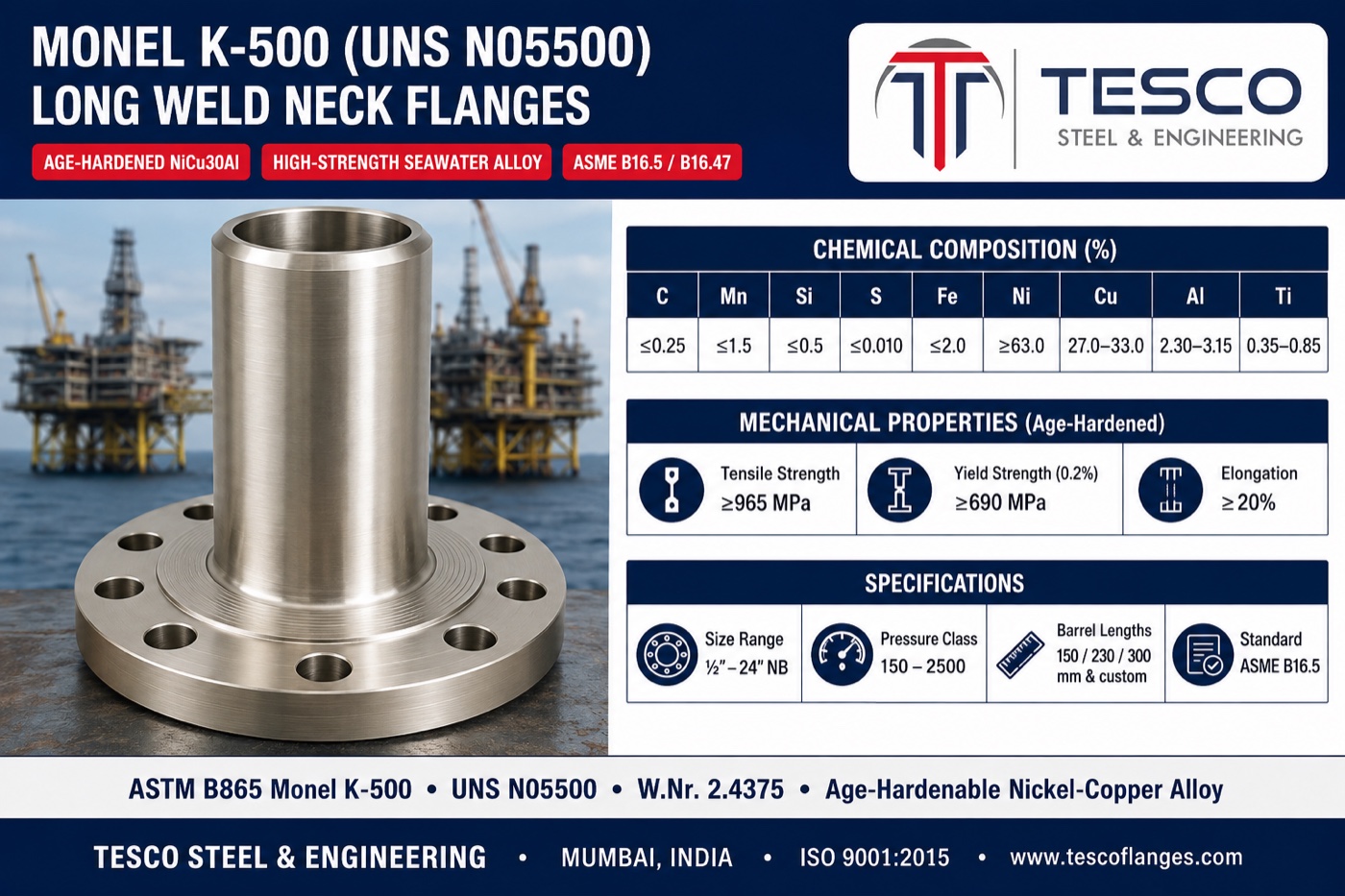
ASTM B865 · UNS N05500 · W.Nr. 2.4375NiCu30Al — The Al/Ti Hardening Pair965 / 690 MPa Age-HardenedStrongest Certificate on the LWN BenchSeawater Credentials Carried OverNon-Magnetic · Cryogenic ToughB16.5 Flange Ends · Class 150–2500EN 10204 3.1 / 3.2 · ISO 9001:2015
Monel K-500 Long Weld Neck Flanges — Specifications at a Glance
What is a Monel K-500 Long Weld Neck Flange?
The strength sibling, in the nozzle pattern. A Monel K-500 flange (UNS N05500, ASTM B865) whose neck continues as a long, heavy-walled straight barrel — the nozzle itself — bevelled for one closing butt weld at the equipment shell. Monel 400's base plus the Al/Ti pair: age-hardened gamma-prime takes the certificate to 965/690/20 — the strongest on this LWN bench — with the family's seawater and HF credentials carried over. Forged where specifications demand K-500: matched-material nozzles, naval (QQ-N-286 heritage), non-magnetic and subsea systems. Flange ends per ASME B16.5, Classes 150–2500; barrel length and bore stated by you. EN 10204 3.1 with ageing furnace records on every lot.
The rule of the sibling: the corrosion character is the family's; the K is bought for strength, and flange strength is class-governed — so the K-500 nozzle is forged where the specification names N05500, and quoted as 400 everywhere else, honestly.
What the Al/Ti Pair Buys
Triple the Yield, Same Sea
Age-hardened gamma-prime takes the certificate to 965/690 MPa — nearly triple the 400's yield and the strongest numbers on this LWN bench — with the matrix's electrochemistry, and so the seawater character, unchanged.
The Jet-Engine Trick, Marinised
The same Al/Ti gamma-prime mechanism that powers nickel superalloys, applied to the seawater bench — fine ordered precipitates pinning dislocations through the nickel-copper base.
Non-Magnetic at Full Strength
Permeability near unity even age-hardened and cold — the minehunter and non-magnetic drill-collar franchise, certificate-backed with permeability data on request.
Tough to Cryogenic
No ductile-brittle transition — strength and toughness rise as temperature falls, serving from liquefied-gas temperatures to the ~480–500°C over-ageing ceiling.
Specification Notes — Getting K-500 Long Weld Necks Right
Three honest notes.Buy the K only where it is demanded: flange strength is class-governed — at an ordinary bolted joint the tripled yield buys nothing that Monel 400 does not already give, so K-500 flanging belongs to matched-material rules and specifications that name N05500. The closing weld disturbs the ageing: the heat-affected zone softens toward solution-treated levels — accept it where class governs, or order annealed and age after welding; what is not legitimate is pretending 690 MPa survives an as-welded joint untouched. And the standard is B865, not B564: the precipitation grade carries its own specification — write ASTM B865 Monel K-500, add the QQ-N-286 reference where naval drawings carry it, and state the required condition (age-hardened, or annealed for age-after-weld).
How Our Monel K-500 LWN Flanges Are Manufactured
1
Forging — each piece individually forged from certified N05500 heats kept segregated on the nickel shelf, with the barrel integral — no welded build-ups.
2
Solution treatment & age-hardening — the K's defining cycle: gamma-prime precipitated under furnace control, records retained against the heat number; annealed condition supplied to order for age-after-weld fabrication.
3
Verification — chemistry per heat with the Al/Ti hardening pair certified; mechanicals per heat at the 965/690 line; permeability and impact data where the drawing asks.
4
Machining — flange end to ASME B16.5; barrel turned to pattern (standard / HB / equal) and bored to the ordered schedule or drawing; RF serrations, flat face or RTJ groove per B16.20; weld end bevelled 37.5°.
5
Testing & marking — PMI reads the aluminium line alongside the nickel-copper signature — the K must never mix with the 400 bins; marked with grade, size, schedule and heat number.
6
Certification & packing — EN 10204 3.1 MTC with ageing furnace records (3.2 witnessed on request); WPS guidance stating the ageing honesty and the ERNiCu-7 consumable; faces and bevels protected, packed sea-worthy.
Where Monel K-500 LWN Flanges Are Used
Where the specification names N05500: naval and defence marine systems — seawater and fire mains on warships and submarines, minehunter hardware where non-magnetic construction is a requirement — offshore and subsea projects with downhole tools, drill collars and riser hardware in K-500, age-hardened Monel equipment in fluoride service under matched-material rules, and the instrument standpipes, level bridles and access nozzles those systems flange to. The flange follows the equipment: small counts, forged to the drawing, certified line by line. Production and supply below:
Long Weld Necks — Machined at Our WorksLong Weld Neck — Heavy Barrel, Bevelled Weld EndDN600 RF Long Weld Neck — Large Diameter, B16.5 Drilling
Monel K-500 LWN Flange Dimensions
Flange-end dimensions are class-governed per ASME B16.5 (ratings per the material group for the alloy); barrel length and bore per order. Full class-by-class charts:
A Monel K-500 long weld neck flange is a forged age-hardenable nickel-copper alloy flange — UNS N05500, W.Nr. 2.4375, NiCu30Al, supplied to ASTM B865 — whose neck continues as a long, heavy-walled straight barrel that is itself the nozzle, bevelled at its far end for one closing butt weld made out at the vessel or equipment shell. K-500 is Monel 400's strength sibling: the same nickel-copper base with aluminium and titanium added, age-hardened so gamma-prime precipitates take the certificate to 965/690 MPa — the strongest numbers on this long weld neck bench — while the family's seawater credentials and chloride-SCC immunity carry over. It is forged for the positions where a specification explicitly demands K-500. Flange ends follow ASME B16.5 in Classes 150 to 2500; the barrel is machined to the ordered length and bore. Supplied age-hardened with furnace records and EN 10204 3.1/3.2 certification.
How does a long weld neck differ from a standard weld neck flange?
Geometry and mission. A standard weld neck's hub tapers quickly down to the pipe's outside diameter and wall, ending in a weld bevel a few centimetres from the flange face — it is built to butt-weld to pipe and continue as a piping run. A long weld neck keeps a full-section straight barrel for its entire length: no taper to pipe dimensions, wall far heavier than the matching schedule, length made to order. The mission follows the shape — the LWN is not a fitting on a pipe run but a nozzle in its own right, projecting through insulation, vessel walls or exchanger channels, with the butt weld relocated to the shell side where the fabricator wants it. In one certified forging it replaces the weld neck flange, the pipe nipple and one whole circumferential weld.
What does the K add — the aluminium-titanium hardening pair?
Everything that separates the sibling from the original. The base is recognisably Monel 400 — two-thirds nickel, a third copper, no chromium — but 2.30-3.15% aluminium and 0.35-0.85% titanium change the alloy's whole mechanism: after solution treatment, an ageing cycle in the furnace precipitates gamma-prime — an ordered nickel-aluminium-titanium phase — in fine particles throughout the structure, and those particles pin dislocations the way the solid solution alone never could. The yield nearly triples with no loss of the family's corrosion character, because the precipitates strengthen the matrix without changing its electrochemistry. The same trick, from the same two elements, powers the nickel superalloys of jet engines; K-500 is the seawater bench's version of it. The one price is fabrication complexity: whatever heats the alloy after ageing — a weld above all — disturbs the precipitates, which is why the closing-weld FAQ on this page is the honest one.
When does a specification demand K-500 flanging — the honest question?
Less often than buyers expect, and this page says so plainly. Flange strength is class-governed: a Class 300 flange is the same geometry in K-500 as in Monel 400, and ASME B16.5 rates the joint by class and material group — so the tripled yield buys nothing at an ordinary bolted connection, while the age-hardened structure adds cost, procurement time and weld-zone complications. K-500's real franchises are shafts, stems, fasteners and downhole tools, where section strength is the mission. K-500 flanging earns its place in one situation: when a specification explicitly demands it — matched-material rules on K-500 equipment and naval or subsea systems, corrosion-pair discipline on age-hardened assemblies, or a project standard that names N05500 for every wetted component. Then the nozzle must match the vessel, and this page forges it. Everywhere else on the Monel bench's duties, the honest quotation reads Monel 400 — as its own LWN page explains.
What is the chemical composition of Monel K-500 (UNS N05500)?
Nickel 63.0% minimum, copper 27.0-33.0%, aluminium 2.30-3.15%, titanium 0.35-0.85%, iron 2.0% maximum, manganese 1.5% maximum, carbon 0.25% maximum, silicon 0.5% maximum and sulphur 0.010% maximum. The base is recognisably Monel 400 — the nickel floor identical, no chromium column, the nobility of the nickel-copper solid solution doing the corrosion work — with the aluminium-titanium pair as the entire difference: they are the precipitation-hardening agents, and without them the K is just a 400. Note the shifted housekeeping against the 400 specification: copper's floor sits a point lower at 27, iron and manganese tighten, and sulphur halves to 0.010% — cleanliness discipline for an alloy whose ageing response depends on a predictable matrix. Chemistry is verified per heat, PMI-confirmed with the aluminium line read alongside the nickel-copper signature, and travels on the EN 10204 3.1 MTC.
What are the mechanical properties of Monel K-500 long weld neck flanges?
Age-hardened to ASTM B865: tensile strength 965 MPa (140 ksi) minimum, yield strength 690 MPa (100 ksi) minimum, elongation 20% minimum — roughly triple Monel 400's yield, and the strongest certificate of any grade on this long weld neck bench, clear of even the super duplex twins. The strength holds from cryogenic temperatures — no ductile-brittle transition, with the alloy famously keeping its toughness and low magnetic permeability in the cold — up to roughly 480-500°C, where over-ageing begins to soften the precipitates. Two honesty notes ride with the numbers: at a bolted flange the class system, not the certificate, still governs the joint's rating; and the heat of a closing weld locally disturbs the ageing, as the welding FAQ explains. Supplied age-hardened with furnace records; annealed condition is available to order for fabrications that will be aged after welding.
What is the ASTM B865 specification?
The third grade on this site's LWN bench to leave A182 behind, and the most specialised standard yet: ASTM B865 (ASME SB-865) covers precipitation-hardenable nickel-copper alloy UNS N05500 — bar, rod, wire, forgings and forging stock — one alloy, one standard, written around the age-hardening metallurgy that general nickel-forging specifications do not administer. That is the practical point for purchasers: Monel 400 forges to B564, the nickel bench's shared forging standard, but the K's ageing cycle, its condition definitions and its mechanical certificates belong to B865, so the K-500 order line reads 'ASTM B865 Monel K-500 (UNS N05500)'. The alloy's naval heritage also survives in specifications: the American federal QQ-N-286 remains the reference on many marine and defence drawings, and dual-referencing B865 with QQ-N-286 is common on naval procurement. Nothing changes at the flange end — dimensions, drilling and facings per ASME B16.5, ratings per its group for the alloy.
How is the closing weld on a K-500 LWN made — the ageing honesty?
This is the FAQ that separates K-500 from every solid-solution grade on the bench, and it deserves plain words. The weld itself is made like Monel's — scrupulous cleanliness, ERNiCu-7 the usual consumable — but the heat-affected zone of an age-hardened forging loses its ageing where the weld cycle exceeds the ageing temperature: the gamma-prime coarsens or dissolves, and strength drops locally toward solution-treated levels. The engineering choices are three, all legitimate when stated: accept the local softening where the joint's rating is class-governed anyway — often true at a nozzle weld; order the forging in the annealed condition, weld, then age the completed fabrication, recovering full properties through the joint — the clean route when the vessel's heat treatment plan allows it; or design the weld away from the load path. What is not legitimate is pretending the certificate's 690 MPa survives untouched through an as-welded joint. Joints must be clean and stress-relieved thinking applies; WPS guidance travels with every supply, and we quote the annealed-then-age route whenever the fabrication plan supports it.
Where do K-500 long weld neck flanges actually appear?
Wherever K-500 equipment needs a matching nozzle. Naval and defence marine systems first — the alloy's original franchise, where QQ-N-286 heritage, seawater immunity and low magnetic permeability meet: seawater and fire-main systems on warships and submarines, minehunter hardware where non-magnetic construction is a requirement, and the pump and valve bodies those systems flange to. Offshore and subsea second: downhole tools and drill collars made of K-500 for the same non-magnetic strength, subsea hardware and riser components, and the instrument and access nozzles on them. Chemical duty third, more narrowly: age-hardened Monel equipment in hydrofluoric and fluoride service whose specifications carry matched-material rules. The common thread is that the flange follows the equipment — K-500 is specified around the vessel or machine, and the nozzle forging obeys the same line of the specification.
Why are low magnetic permeability and cryogenic toughness famous K-500 traits?
Because they come bundled with strength that few non-magnetic materials can offer. K-500 is effectively non-magnetic — its magnetic permeability stays near unity even at high strength and low temperature, where many alloys drift — which made it the classic choice for minehunting ships' hardware, degaussing-sensitive naval systems, and the non-magnetic drill collars that keep measurement-while-drilling instruments honest downhole. The cryogenic side is the same story from the cold end: no ductile-brittle transition anywhere in the range, with strength and toughness actually rising as temperature falls, so the alloy serves from liquefied-gas temperatures upward without a fracture-toughness caveat. For the nozzles this page forges, the traits matter when the surrounding system demands them — a non-magnetic sweep gear housing, a cryogenic marine system — and they are certificate-backed: permeability and impact data are available against the heat on request.
How are the barrel length and bore of a LWN specified?
Two numbers that belong on every enquiry. Length: measured overall from the flange face to the weld end — 150 mm (6"), 230 mm (9") and 300 mm (12") are the common stock lengths, and any length machines to order; state it explicitly, because 'long' is not a dimension. Bore: the barrel is drilled and bored to order — most commonly to match the inside diameter of the connecting pipe schedule, sometimes cylindrical special bores for level bridles, instrument standpipes or restriction work; state the schedule or the finished bore in millimetres. Add the weld-end preparation (standard 37.5° bevel unless told otherwise) and the nozzle is fully defined.
Does K-500 keep Monel 400's seawater and HF credentials?
Essentially yes — the corrosion character is the family's, because the matrix is the same nickel-copper solid solution and the precipitates do not change its electrochemistry. Flowing seawater resistance, immunity to chloride stress corrosion cracking, and the hydrofluoric-acid capability all carry over, which is exactly why the alloy could take the family's strength franchise to shafts and fasteners living in the sea. The honest footnotes carry over too: the stagnant-seawater caveat — biofouling deposits can pit any surface-noble alloy in dead water, so the flowing qualifier applies to the K as to the 400 — and one addition of the K's own: at very high hardness in some sour and hydrogen-charging environments, high-strength K-500 can be more sensitive to hydrogen embrittlement than soft 400, which is why sour-service specifications cap hardness. Where the duty is corrosion alone and strength is ordinary, that is the 400's page; where the specification names N05500, the credentials come built in.
What sizes and pressure classes do Monel K-500 LWN flanges come in?
Flange ends follow ASME B16.5 from ½" to 24" NB in Classes 150, 300, 400, 600, 900, 1500 and 2500 — with the full class-by-class LWN dimension charts on this site — and larger diameters forge to order against B16.47 or drawing dimensions. The K-500 order book is narrower and more specified than the 400's: naval and subsea projects name their classes with the system specification, matched-material nozzles take the class of the vessel they serve, and quantities run small — often single-figure piece counts forged against a drawing rather than stocked. That suits the alloy's economics: each forging is individually made, aged with furnace records, and certified against the specification's line items, permeability and impact data included where the drawing asks. State size, class, barrel length and bore together — and send the specification's material clause with the enquiry, because on this grade the clause decides everything.
What details are needed to get an accurate Monel K-500 LWN flange quotation?
Seven elements plus commercial terms: (1) size and dimensional standard — e.g. 4" NB ASME B16.5; (2) pressure class — 150 to 2500; (3) facing — RF (the default), FF or RTJ with ring number; (4) barrel length overall, face to weld end — 150/230/300 mm stock or any stated length; (5) barrel bore — pipe schedule to be matched or finished bore in millimetres, with pattern (standard, heavy barrel, equal barrel) and weld-end prep if non-standard; (6) the grade line — ASTM B865 Monel K-500, UNS N05500 — with the specification clause that demands K-500 quoted, the required condition stated (age-hardened, or annealed for age-after-weld fabrication), and any permeability or impact requirements named; (7) certification — EN 10204 3.1 with age-hardening furnace records (our standard) or 3.2 witnessed. Add quantity and destination; quotations normally within 24 hours, with the alloy-market lead time quoted honestly.
Who manufactures Monel K-500 long weld neck flanges in India?
Tesco Steel & Engineering is an ISO 9001:2015 certified flange manufacturer based in Mumbai, India, producing Monel K-500 long weld neck flanges to ASTM B865 with B16.5 flange ends from ½" to 24" NB (larger to order) in Classes 150-2500, in standard, heavy-barrel and equal-barrel patterns — each forged individually from certified N05500 heats kept segregated on the nickel shelf, solution-treated and age-hardened with furnace records retained (or supplied annealed for age-after-weld fabrication), machined with the barrel bored to the ordered schedule or drawing, bevelled for the closing weld, PMI-checked with the aluminium line read alongside the nickel-copper signature, and marked with grade, size, schedule and heat number. Supplied with EN 10204 3.1/3.2 certification and WPS guidance stating the ageing honesty — alongside the Monel 400 LWN, the K-500 socketweld and grade-hub siblings, and the complete long weld neck range. Exported to more than 50 countries.