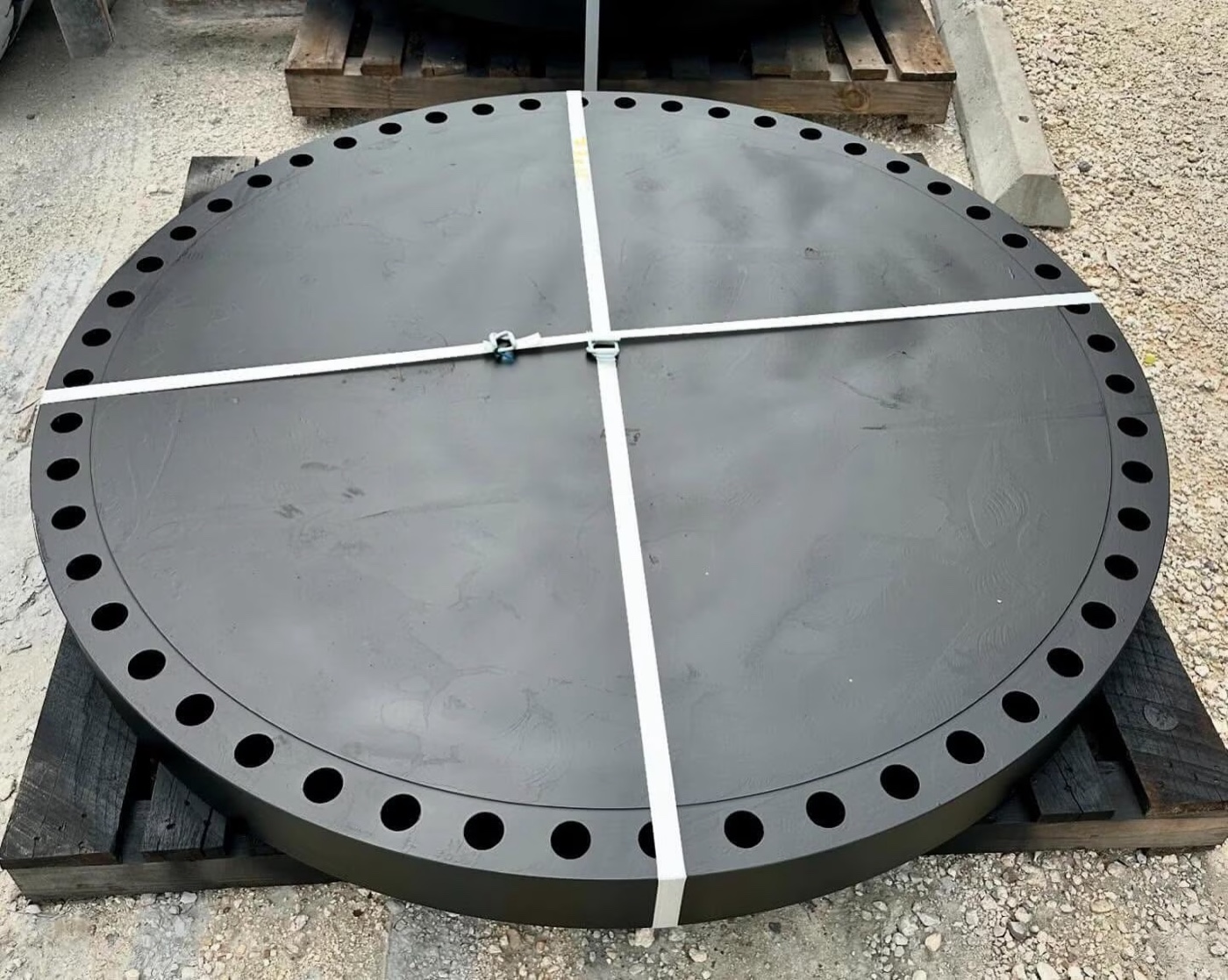
Tesco Steel & Engineering forges ASTM A105 blind flanges — the default closure of plant piping — to ASME B16.5 Class 150–2500 from ½″ to 24″ NB and to ASME B16.47 up to 60″, like the large-diameter blind pictured below. A105 is the grade the standard assumes: a forged medium-carbon steel covering -29 °C to 425 °C — colder duty hands to A350 LF2 blinds, and the facing follows the mating flange: BLRF, BLFF or BLRTJ. Supplied as A105 or normalized A105N, black-coated or galvanized, with NPT-tapped test blinds machined to order. Our fastest-moving stocked blind. Every lot with EN 10204 3.1/3.2 MTC. ISO 9001:2015, made in Mumbai, India — exported to 50+ countries.
ASTM A105 · A105N · ASME SA-105ASME B16.5 ½″–24″ · Class 150–2500ASME B16.47 to 60″ · EN 1092-1 Type 05-29 °C to 425 °C ServiceRF · FF · RTJ FacingsTapped Test Blinds to OrderEN 10204 3.1 / 3.2 · ISO 9001:2015
Large-Diameter A105 Blind Flange — Black-Coated, Ready for Dispatch
What is an ASTM A105 Blind Flange?
The default blind of the piping world. A solid forged carbon steel disc with no bore, drilled to the standard bolt pattern, that closes pipe ends, valves and vessel nozzles. ASTM A105 is the grade every specification assumes for ambient and moderate temperatures: tensile ≥485 MPa, yield ≥250 MPa, service from -29 °C to 425 °C. Dimensions per ASME B16.5 to 24″ and B16.47 to 60″, in RF, FF and RTJ facings — the workhorse closure, stocked by the pallet.
Also searched as: A105 blind flange, A105N blind flange, SA-105 blind (the ASME boiler-code twin), carbon steel blind flange, CS blind — all refer to the product on this page. See also the blind flanges overview, the facing pages BLRF / BLFF / BLRTJ, and the carbon steel hub.
A105 Chemical Composition
Element
C
Mn
Si
P
S
Cu
Ni
Cr
Mo
V
Weight %
≤0.35
0.60–1.05
0.10–0.35
≤0.035
≤0.040
≤0.40
≤0.40
≤0.30
≤0.12
≤0.08
A straightforward medium-carbon steel: enough carbon and manganese for 70 ksi strength, capped residuals so weldability stays predictable. Every heat is spectro-verified before forging, and the analysis prints on the EN 10204 certificate.
Mechanical Properties
Property
ASTM A105 Requirement
Tensile Strength
≥ 485 MPa (70 ksi)
Yield Strength (0.2%)
≥ 250 MPa (36 ksi)
Elongation
≥ 22% (basic, in 2 in.)
Hardness
≤ 187 HB
Comfortable, ductile numbers — exactly what a pressure-bending plate wants. The blind is the one flange with no pipe backing it up: the disc alone carries full line pressure in bending, which is why the B16.5 class tables make blinds the thickest forging per size in the family.
A105 vs A105N — The Normalizing Question
What the N Buys
Normalizing — heating above the transformation range and air-cooling — refines the forged grain: more uniform strength, better toughness, cleaner ultrasonic results. On a thick bending plate, uniformity through the section is worth having.
What the Specification Says
Heat treatment is not mandatory for Class 150/300 flanges; above Class 300 it is — annealed, normalized, N&T or Q&T. Any flange marked A105N has been normalized regardless of class.
What Buyers Actually Do
Most project specifications simply write A105N across the board and stop thinking about it. We forge and certify both; the heat-treatment condition is stated on every EN 10204 certificate.
The Service Window — and the Handoffs
Condition
Limit
What Happens
Hand Off To
Cold
-29 °C
Codes stop assuming carbon-steel toughness without impact tests
Class 900+, wellheads — A105 dominates the RTJ carbon-steel world
The facing always matches the mating flange. The A105 forging underneath is identical — each facing page above tells its own story; this page covers the grade they share.
ASTM A105 Blind Flange Specifications
ASTM A105 Blind Flanges are available in the following specifications:
1/2"NB to 24"NB per ASME B16.5; 26"–60" per ASME B16.47 Series A & B; EN 1092-1 Type 05 to order
Class
150#, 300#, 400#, 600#, 900#, 1500#, 2500#
Facings
Raised Face (BLRF), Flat Face (BLFF), Ring Type Joint (BLRTJ) — 125–250 AARH serrated or smooth finish per gasket
Service Window
-29 °C to 425 °C — below: A350 LF2; sustained above: chrome-moly grades
Surface Protection
Black anti-rust paint / oil standard; yellow zinc-chromate, hot-dip galvanizing, VCI to order
Modifications
NPT-tapped centre (hydrotest / vent / drain / gauge), lifting provisions — to order
Installation
No welding — gasket on facing, star-pattern bolt-up; rated lifting for large sizes
Certification
EN 10204 3.1 (standard) / 3.2 witnessed
Why A105 Blind Flanges Are Specified
The Grade the Standard Assumes
Unless temperature, toughness or chemistry says otherwise, piping specifications default to A105 — it is to carbon steel what F316L is to stainless: the reference grade of the forged-flange world.
Stocked, Fast, Economical
A105 blinds are the fastest-moving product of the blind family — common sizes and classes ship from stock, and the grade carries the lowest cost per kilogram of any forged flange material.
Every Facing, Every Size
RF for steel piping, FF for the cast-iron world, RTJ for Class 900+ — and from ½″ bar-stock blinds to B16.47 giants like the palletised unit pictured above, it is one grade, one certificate format.
The Test-Blind Grade
Most NPT-tapped hydrotest blinds in the world are A105 — economical enough to dedicate to a test, strong enough to hold the pressure, machined and certified with the tap in place.
Three details buyers miss.Mind the -29 °C line: if the minimum design metal temperature is colder — blowdown, depressurisation, cold climate — the blind must be A350 LF2, not A105; the two look identical and only the certificate protects you. Say A105N if you mean it: plain A105 in Class 150/300 may arrive without heat treatment; specifying A105N guarantees a normalized forging. State the facing: "A105 blind" is half a specification — RF, FF or RTJ (with ring number) decides what gets machined, and the mating flange decides which one you need.
How Our A105 Blind Flanges Are Manufactured
1
Forging — cut billet of the spectro-verified A105 heat is hot-forged into the solid disc blank, keeping full heat traceability from melt to marking.
2
Heat treatment — normalized for A105N and all classes above 300; furnace charts retained against the heat number.
3
Machining — faces, OD and bolt holes to ASME B16.5 / B16.47 drilling; thickness verified against the class table that makes the blind the heaviest flange of its size.
4
Facing & modifications — RF serrations, full flat face or RTJ groove gauged per B16.20; NPT centre taps and lifting provisions machined where ordered.
5
Testing & marking — tension test and chemistry against the heat (UT, MPI and hardness where specified), then permanent marking of standard, grade (A105/A105N), size, class and heat number.
6
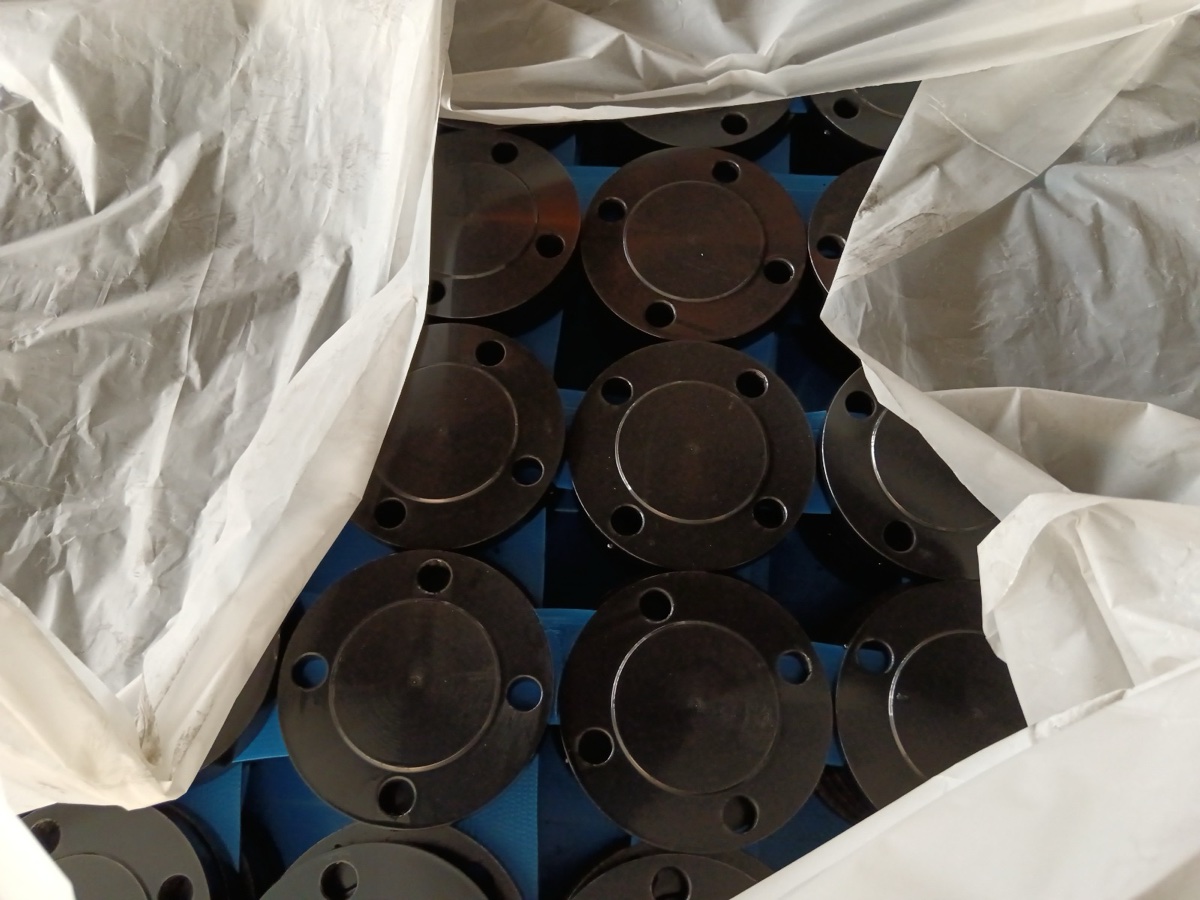
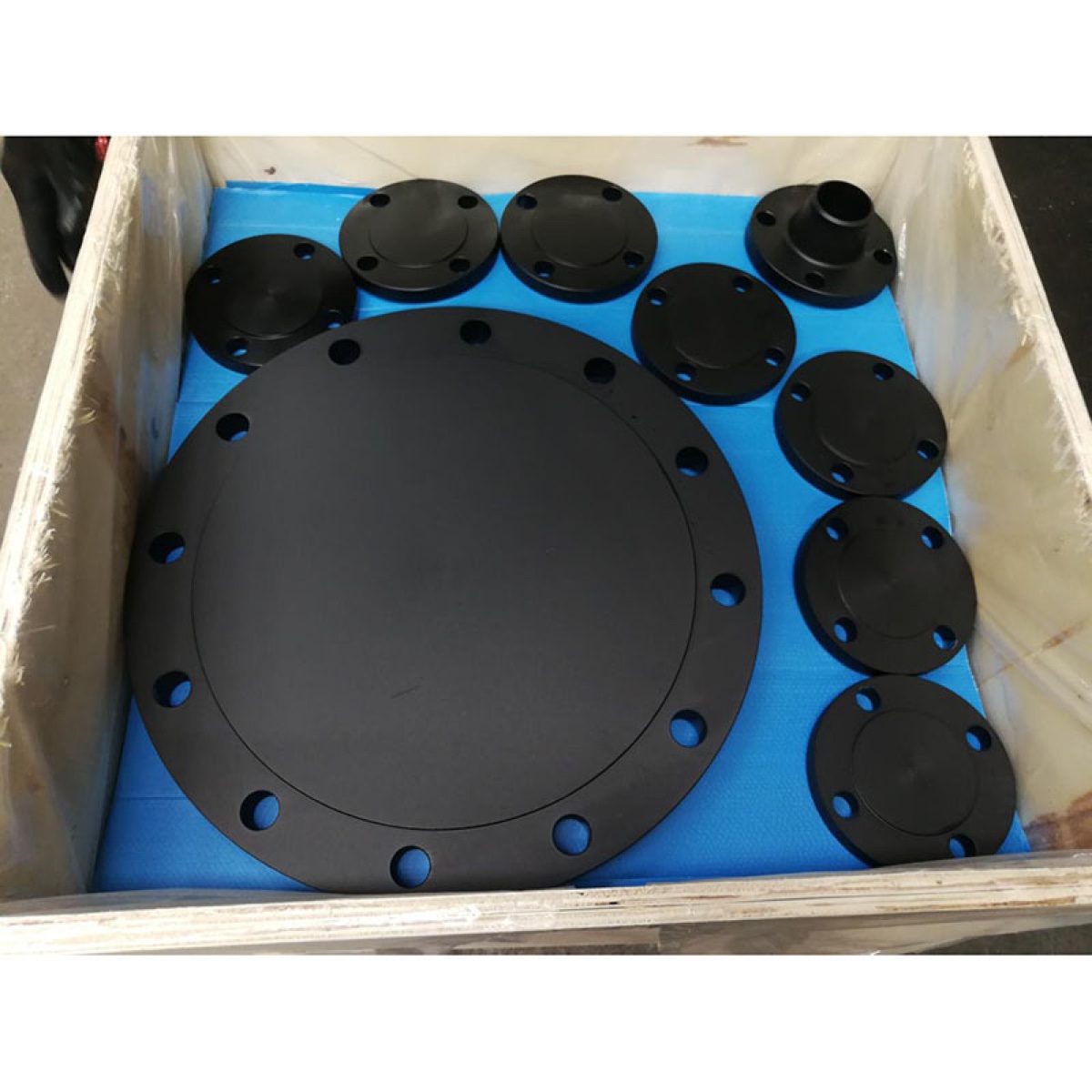
Protection & packing — black anti-rust coating or the ordered finish applied, gasket faces protected, EN 10204 3.1 MTC issued; palletised or crated sea-worthy as pictured on this page.
Where A105 Blind Flanges Are Used
Everywhere carbon steel pipes run: refineries and petrochemical complexes, gas processing and pipelines, power stations, water and utility headers, shipyards and fabrication shops — as permanent line closures, future-connection covers, maintenance isolations and tapped hydrotest blinds. Production and stock below:
A105 RF Blind Flanges — Black-Coated, Packed for Export10″ Class 150 A105 RF Blind — Machined Gasket Face
A105 Blind Flange Dimensions
Blind dimensions are class-governed — the same tables apply to every material grade. Full charts:
Example: “Blind Flange, RF, 10″ NB, ASME B16.5 Class 300, ASTM A105N, black-coated, EN 10204 3.1 — 12 pcs.” Quotations normally within 24 hours with price, unit weight and delivery.
An ASTM A105 blind flange is a solid forged carbon steel disc, drilled to the standard bolt pattern with no bore, used to close the end of a pipe, valve or vessel nozzle. A105 is the default forging grade of the flange world — a medium-carbon steel covering ambient- and moderate-temperature service — and the blind is its heaviest duty: a flat plate carrying full line pressure in bending. Dimensions follow ASME B16.5 from ½ inch to 24 inch and ASME B16.47 beyond, in raised face, flat face and ring joint facings.
What kind of steel is ASTM A105?
A forged medium-carbon steel — the specification covers carbon steel forgings for piping applications at ambient and higher temperatures. Key chemistry limits: carbon 0.35% max, manganese 0.60-1.05%, silicon 0.10-0.35%, with phosphorus, sulphur and residual elements capped. It machines well, welds well with normal precautions and takes the black protective coating seen in the photos on this page. In flange terms, A105 is to carbon steel what F304L or F316L are to stainless: the grade the standard assumes unless the service says otherwise.
What is the difference between A105 and A105N?
The N marks a normalized heat treatment — the forging is heated above its transformation range and air-cooled, refining the grain for more uniform strength and better toughness. Plain A105 flanges in Class 150 and 300 may be supplied without mandatory heat treatment; flanges above Class 300, and any flange specified A105N, are heat treated. Many project specifications simply call for A105N across the board for the tougher, more consistent product — we forge and certify both, with the condition stated on the EN 10204 certificate.
What are the mechanical properties of A105 blind flanges?
Tensile strength 485 MPa (70 ksi) minimum, yield strength 250 MPa (36 ksi) minimum, elongation 22% minimum and hardness capped at 187 HB — comfortable, ductile numbers that let the blind work as a bending plate with the thickness the ASME B16.5 class tables assign. Each heat is tension-tested and chemistry-verified, and the results travel with the flange on the EN 10204 3.1 certificate.
What temperature range does an A105 blind flange cover?
From -29°C to roughly 425°C. The lower bound is where ASME codes stop assuming carbon steel toughness without impact testing — colder duty moves to A350 LF2, tested to -46°C, and our LF2 blind flange page covers that handoff. The upper bound is where prolonged service risks graphitization of carbon steel; sustained hotter duty moves to chrome-moly alloy grades. Between those limits — the vast majority of plant piping — A105 is the specified blind.
When should A350 LF2 be used instead of A105?
When the design temperature falls below -29°C, or the specification demands Charpy impact testing. A350 LF2 is chemically close to A105 but supplied heat-treated and impact-tested at -46°C — the LTCS grade of low-temperature duty: gas processing, cold climates, depressurisation cases. The two look identical; only the certificate and marking distinguish them. If your line list shows a minimum design metal temperature colder than -29°C, order the LF2 blind — see our A350 LF2 blind flange page.
What facings are A105 blind flanges made with?
All three: raised face (BLRF) — the default of steel piping, with a soft or spiral-wound gasket; flat face (BLFF) — full-face gasket service against cast iron, GRP and lined equipment; and ring type joint (BLRTJ) — the machined-groove metal-seal facing of Class 900-and-above and wellhead work. Each facing has its own page on this site. The A105 forging is common to all three; the facing is machined to match the mating flange, which always governs the choice.
What sizes and classes are A105 blind flanges available in?
From ½" to 24" NB per ASME B16.5 in Classes 150 through 2500, and from 26" to 60" per ASME B16.47 Series A and B — like the large-diameter blind pictured at the top of this page. A105 blinds in the common sizes and classes are a stocked item — they are the fastest-moving product of the blind family — and larger or higher-class blinds are forged against the order. EN 1092-1 Type 05 PN-series blinds are produced to order in the same grade.
Are A105 blind flanges heat treated?
Per the specification: heat treatment is not mandatory for Class 150 and 300 flanges, but flanges above Class 300 must be heat treated — annealed, normalized, normalized and tempered, or quenched and tempered. In practice most buyers specify A105N and receive normalized forgings in every class. Blinds have a particular stake here: they are the thickest forging per size in the flange family, and normalizing gives the uniform through-thickness properties a pressure-bending plate deserves. The condition is stated on the certificate.
Can A105 blind flanges be tapped for testing or instruments?
Yes — an NPT-tapped centre hole turns the blind into a hydrotest, vent, drain, gauge or chemical-injection closure, and A105 is the grade most such test blinds are made from. The tap sits in the centre of the pressure-bending plate, so it is machined and certified with the flange rather than drilled in the field. State the NPT size on the enquiry and the tap arrives ready to plug.
How is an A105 blind flange installed?
Bolted, never welded — gasket aligned on the facing, studs inserted, and a star tightening pattern in stages so the gasket loads evenly. Two practical notes for carbon steel blinds: large ones are genuinely heavy (a 24" Class 300 blind approaches 300 kg) and need rated lifting; and the protective black coating or anti-rust oil should stay on the non-gasket surfaces — only the gasket face is cleaned at installation. Torque guidance is supplied with the quotation on request.
What surface finish do A105 blind flanges come with?
Carbon steel rusts, so A105 blinds ship protected: black anti-rust paint or oil as standard — the finish visible in the photos on this page — with yellow zinc-chromate, hot-dip galvanizing or bare-with-VCI options to order. The gasket face itself carries the machined serrated or smooth finish the gasket standard demands, and is protected separately for transit. Specify any coating requirement on the enquiry; export packing is sea-worthy by default.
How much does an A105 blind flange weigh?
More than any other flange of its size and class — the blind is a solid disc, so all the metal stays. Representative figures: a 4" Class 150 blind is about 8 kg, a 10" Class 150 about 24 kg, a 24" Class 150 about 120 kg, and B16.47 large-diameter blinds run to several tonnes. Weight matters twice: for lifting on site and for freight, which on export orders of blinds is a real cost line. Our flange weight chart lists the full tables, and every quotation states exact unit weights.
Which standards cover A105 blind flanges?
Two work together: the material standard — ASTM A105, covering chemistry, mechanicals and heat treatment of the forging, with ASME SA-105 as its boiler-code twin — and the dimensional standard — ASME B16.5 for ½"-24", B16.47 for 26"-60", or EN 1092-1 for PN-series blinds. A flange is only fully specified with both: 'Blind Flange, ASME B16.5 Class 300 RF, ASTM A105N' says everything a manufacturer needs. Our EN 10204 3.1 certificates state the pair together, with heat number, test results and heat-treatment condition.
Who manufactures ASTM A105 blind flanges in India?
Tesco Steel & Engineering is an ISO 9001:2015 certified flange manufacturer based in Mumbai, India, forging ASTM A105 and A105N blind flanges from ½" to 24" NB per ASME B16.5 in Classes 150-2500 and to 60" per ASME B16.47 — in raised face, flat face and ring joint facings, with NPT-tapped test blinds, black-coated or galvanized finishes and EN 10204 3.1/3.2 certification on every lot. A105 blinds are our fastest-moving stocked blind; large-diameter and high-class blinds are forged to order. Exported to more than 50 countries.