BLRF Flanges — Blind Raised Face Flange Manufacturer
Tesco Steel & Engineering forges BLRF flanges — blind flanges with raised face, the solid pressure-holding closures of piping systems — to ASME B16.5 Class 150–2500 from ½″ to 24″ NB and to ASME B16.47 Series A & B up to 60″. The blind is the only flange designed in bending — it carries full line pressure across its own face — which makes it the thickest, heaviest flange in every class, and one of the highest-volume items we forge: in carbon steel A105 by the pallet, and in every stainless, duplex, nickel, titanium and copper-nickel grade on this site to match its piping. NPT-tapped test blinds machined to order. Every lot with EN 10204 3.1/3.2 MTC. ISO 9001:2015, made in Mumbai, India — exported to 50+ countries.
BLRF · Blind RF · Blind Raised FaceASME B16.5 ½″–24″ · Class 150–2500ASME B16.47 A & B · 26″–60″A105 · LF2 · A182 · B564 · Ti · CuNiTapped Test Blinds to OrderBLFF & BLRTJ Facings AvailableEN 10204 3.1 / 3.2 · ISO 9001:2015
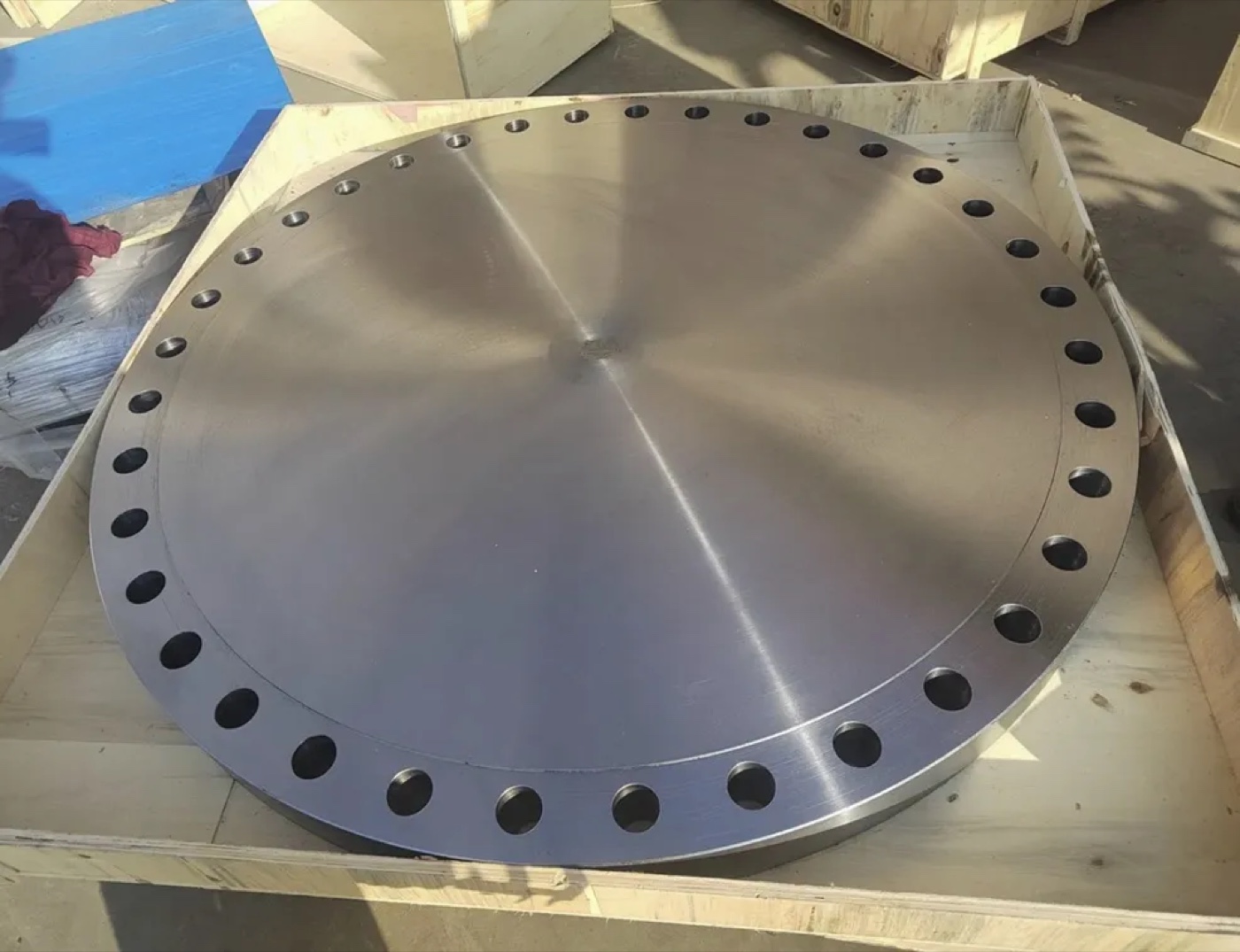
Large-Diameter Blind Raised Face Flange — Crated for Export
What is a BLRF Flange?
BLRF = Blind, Raised Face. A solid forged disc with no bore, drilled to the standard bolt pattern, whose raised face carries the gasket: bolted against any RF flange it closes the line completely and holds full system pressure across its own centre — the only flange that works in bending, and therefore the thickest of every class. The bolted full stop of piping: line ends, nozzle closures, hydrotest blinds, future connections. Dimensions per ASME B16.5 to 24″ and B16.47 to 60″; material per its own grade standard — A105 by default, anything on this site to match the line.
Also searched as: Blind RF flange, BL RF flange, blind flange raised face, RF blind flange — all refer to the product on this page. Facing siblings: BLFF (flat face) and BLRTJ (ring joint); see also the blind flanges overview.
The Blind Family — Facings & Cousins
Designation
Facing / Form
Mates With
Typical Duty
BLRF (this page)
Raised Face
Any RF steel flange
The default closure of steel piping, Class 150–2500
Rule of thumb: permanent closure → BLRF; frequent swing isolation → spectacle blind; the facing always matches the mating flange — mixing facings on one joint is a specification error.
Why the Blind is the Heaviest Flange — The Bending Story
Every other flange passes pressure into the pipe it is joined to. A blind takes the full line pressure across its unsupported centre, like a bolted drumhead — so ASME design treats it as a flat plate in bending, and its thickness grows accordingly. The practical consequences:
Thickest of Every Class
A 10″ Class 150 blind runs ~30 mm and ~24 kg; the same size in Class 1500 passes 90 mm and 100+ kg. Check weights before planning lifts — we state them on every quotation.
The Centre is Sacred
Peak bending stress lives at the centre of the disc — which is why tapping and drilling rules exist, and why centre taps are engineered, not improvised.
Full Material Integrity
A blind is solid certified forging face to face — no bore, no weld, no HAZ. The MTC covers every millimetre that holds the pressure.
The BLRF pattern is identical across every material — only the certificate changes. Each linked grade page carries the full metallurgy; this page is where the type is specified.
BLRF Flange Specifications
BLRF Blind Raised Face Flanges are available in the following specifications:
Type & Facing
Blind flange, Raised Face (BLRF) — solid closure, no bore; BLFF and BLRTJ facings on their own pages
Size
1/2"NB to 24"NB per ASME B16.5; 26"–60" per ASME B16.47 Series A & B; EN 1092-1 Type 05 to order
Serrated stock finish standard; smooth finish where the gasket specification requires
Modifications
NPT-tapped centre (test / vent / drain / instrument blinds), lifting-lug drilling, special face machining — to order
Installation
No welding — gasket on the mating RF, star-pattern bolt-up to gasket torque values
Testing
UT on request for thick sections; PMI on alloy grades
Certification
EN 10204 3.1 (standard) / 3.2 witnessed
Why BLRF Flanges Are Specified
The Bolted Full Stop
Holds full line pressure with no welding — and reopens with hand tools for inspection, cleaning or the extension the plant will eventually build.
Hydrotest Ready
Closing systems for pressure testing is a defining blind duty — NPT-tapped test blinds with fill, vent or gauge connections are machined and certified to order.
One Pattern, Every Metal
From pallet-stock A105 to Hastelloy and titanium — the same B16.5 pattern, matched to whatever the piping is made of, certified accordingly.
Beyond 24 Inch
B16.47 Series A & B take our blinds to 60″ — the giant crated flange pictured above is exactly this class of work.
Three details buyers miss.Facing match: the blind's facing must equal the mating flange's — an RF blind on an FF cast-iron flange can crack the weaker part; that duty is BLFF's. Test pressure vs rating: hydrotest runs at 1.5× design — select the test blind against the test case, not the operating one. Weight: blinds are the heaviest flanges made — a 24″ Class 600 blind is a crane lift, and large B16.47 blinds ship crated like the one pictured. We state unit weights on every quotation.
How Our BLRF Flanges Are Manufactured
1
Forging — cut billet of the certified heat — carbon, stainless or alloy — is hot-forged into the solid disc blank, keeping full heat traceability.
2
Heat treatment — per the material standard: normalised A105, quench-tempered LF2, solution-annealed stainless and nickel grades; furnace record retained.
3
Machining — faces and bolt holes to ASME B16.5 / B16.47; thickness verified against the class table — the dimension that does the bending work.
4
Facing & modifications — raised face with serrated stock finish; NPT centre taps, lifting provisions and special finishes machined where ordered.
5
Testing & marking — mechanical and chemical verification against the heat (UT and PMI where specified), then permanent marking of standard, grade, size, class and heat number.
6
Certification & packing — EN 10204 3.1 MTC (3.2 witnessed on request); faces protected, palletised or crated by size as pictured on this page.
Where BLRF Flanges Are Used
Everywhere piping exists: line terminations and future-expansion stubs, nozzle closures on vessels, columns and exchangers, spare pump and compressor nozzles, manifold ends, hydrotest closures on new construction, and maintenance isolation across refineries, chemical plants, power stations, water works and general industry. Production below:
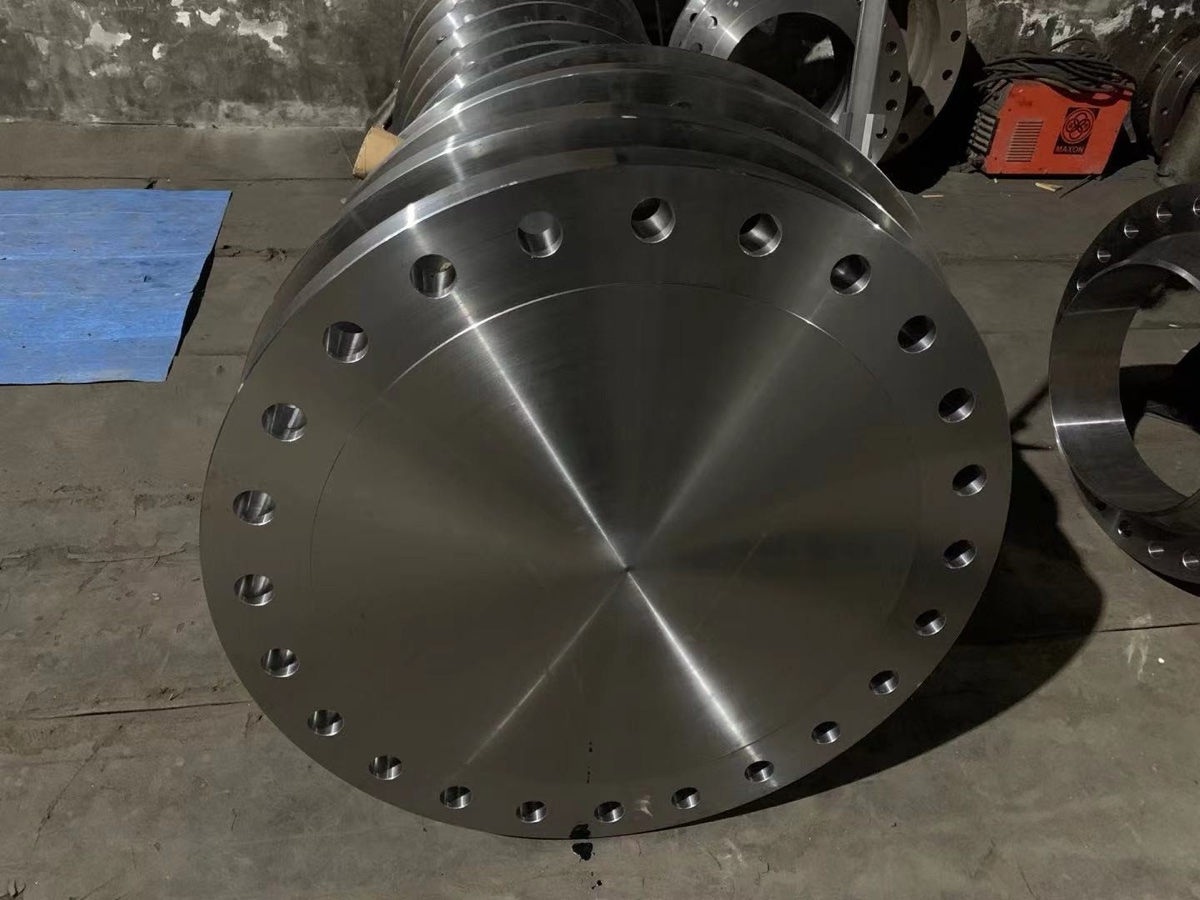
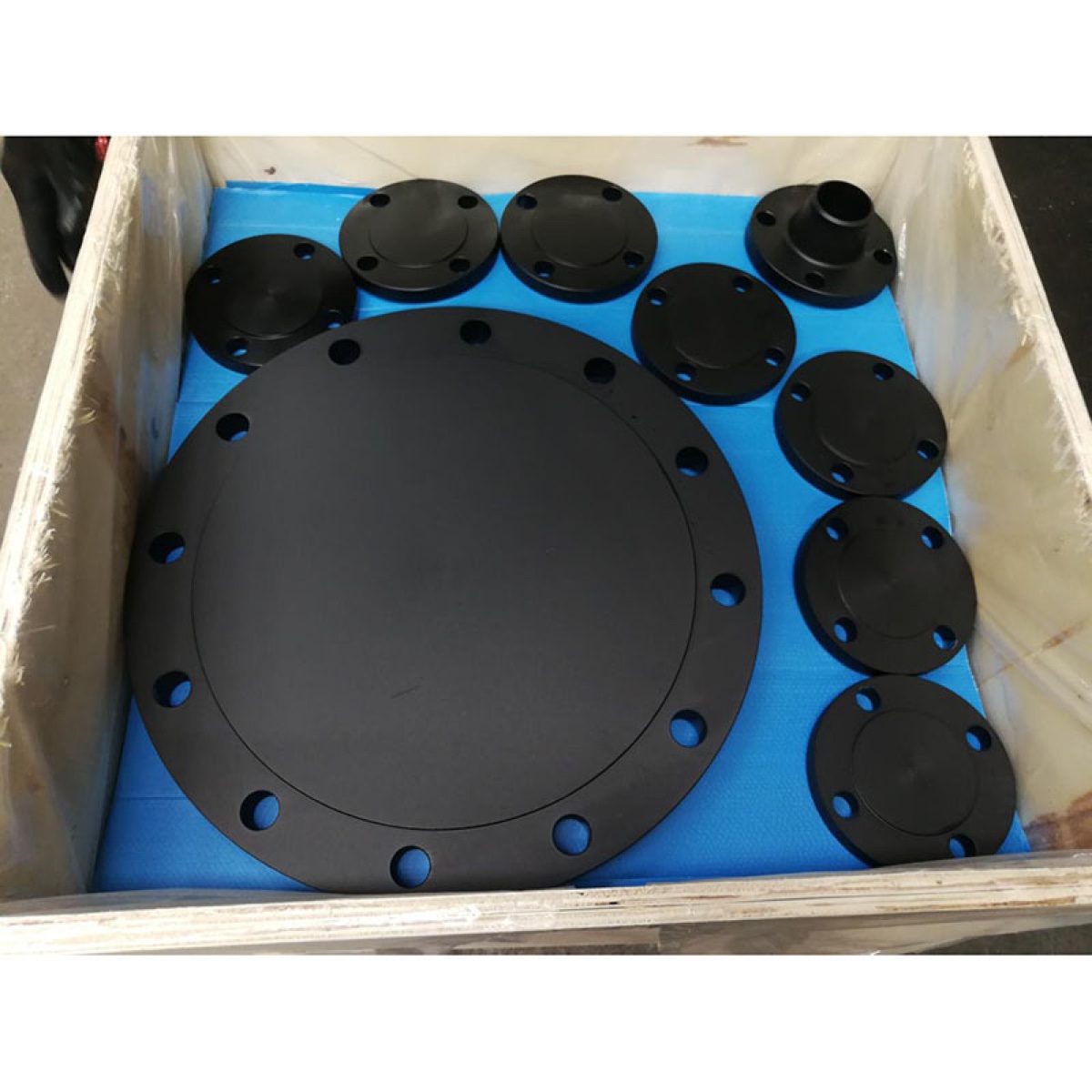
Forged Blind Flanges — Machined & Stacked at Our WorksCoated A105 Blind Flanges — Packed in Lined Export Crate
BLRF Flange Dimensions
Blind dimensions — including the class-governing thickness — come from the ASME tables. Full charts by class:
Example: “Blind Flange, RF, 10″ NB, ASME B16.5 Class 150, ASTM A105, EN 10204 3.1 — 20 pcs.” Quotations normally within 24 hours with price, unit weight and delivery.
BLRF Flanges — Frequently Asked Questions
What is a BLRF flange?
A BLRF flange is a blind flange with a raised face — a solid forged disc, drilled to the standard bolt pattern but with no bore, whose machined raised face carries the gasket. Bolted against a mating flange it closes the line completely and holds full system pressure, which makes it the standard way to terminate piping, blank off vessel nozzles, close future connections and pressure-test systems. Dimensions follow ASME B16.5 to 24 inch and ASME B16.47 beyond.
What does BLRF stand for?
Blind, Raised Face — the piping-list shorthand that combines the flange type with its gasket facing. The family reads the same way: BLFF is a blind with a flat face (for cast iron and GRP mating parts), BLRTJ — sometimes written RTJBL — is a blind with a ring-type-joint groove for high-pressure metal-gasket service. On drawings you may also see it as BL RF or Blind RF; all describe the product on this page.
What is a blind flange used for?
Four jobs above all. Terminating lines: the pressure-tight full stop at the end of a header or future extension. Isolating equipment: blanking nozzles on vessels, exchangers and manifolds during operation or maintenance. Pressure testing: closing a system so it can be hydrotested — often with a tapped test blind. And future access: a bolted closure that opens with hand tools, where a welded cap would need cutting and re-welding. It is the only flange type that holds full line pressure across its own face.
Why is the blind the most heavily loaded flange type?
Because it is the only flange that works in bending. Every other flange passes pressure loads into the pipe it is joined to; a blind takes the full line pressure across its unsupported centre like a bolted drumhead, and its middle deflects under load. ASME design therefore treats the blind as a flat plate in bending, which is why blinds are the thickest, heaviest flanges in every class — and why a Class 2500 blind of large bore is a genuinely massive forging, as the crated example pictured on this page shows.
What materials are BLRF flanges made in?
Every forged grade we produce. Carbon steel ASTM A105 is the default for general service, A350 LF2 for low temperature; stainless A182 F304/F316 families and duplex F51/F53 for corrosion; and the full exotic range — 904L, Alloy 20, Monel, Inconel, Incoloy, Hastelloy, titanium and copper-nickel — for chemistry, each covered by its own material page on this site. The BLRF pattern is identical across all of them; only the material standard and certificate change.
BLRF, BLFF or BLRTJ — which facing should be specified?
Match the mating flange, always. Raised face (BLRF) is the default of steel piping — the raised surface concentrates bolt load on the gasket for reliable sealing, and it mates any RF flange in the system. Flat face (BLFF) is specified against cast iron, GRP and lined equipment, where a raised face would crack the weaker mating part; use full-face gaskets there. Ring type joint (BLRTJ) serves high-pressure, high-temperature metal-gasket classes — common from Class 900 upward and in wellhead service. Mixing facings on one joint is a specification error.
What is the difference between a blind flange, a pipe cap and a plug?
How they close and how they reopen. A welded pipe cap is permanent — cheap and compact, but reopening means cutting and re-welding. A threaded plug closes small-bore threaded connections only. A blind flange is the bolted answer: it holds full pressure, opens with hand tools for inspection, cleaning or extension, and reseals with a new gasket. Wherever a closure might ever need to be opened — which in a process plant is nearly everywhere — the blind flange is the engineered choice.
Can BLRF flanges be used for hydrotesting?
Yes — pressure testing is one of the blind flange's defining duties. Test blinds close the system while it is proven at 1.5 times design pressure, and they are frequently ordered with an NPT-tapped centre hole for the fill, vent or gauge connection — a standard modification we machine to order. Remember the test pressure exceeds the flange's nameplate rating conditions, so test blinds are selected against the hydrotest case; we advise on the correct class at enquiry.
Can a blind flange be drilled or tapped later?
Yes — within engineering limits. Centre-drilled and NPT-tapped blinds serve as instrument, vent, drain and chemical-injection points, and an existing blind can often be machined rather than replaced. The tap removes metal from the most highly stressed zone — the centre of the bending plate — so size limits and reinforcement rules apply, particularly in the higher classes. Ordering the tapping with the new flange, machined and certified together, is the cleaner route, and one we quote routinely.
What sizes and classes are BLRF flanges available in?
From ½" to 24" NB per ASME B16.5 in Classes 150 through 2500 — and, uniquely among flange types on this site, far beyond: ASME B16.47 Series A and Series B cover blinds from 26" to 60", and we forge to both. EN 1092-1 Type 05 blind patterns are available to order. Carbon steel BLRF is stocked deeply; stainless, duplex and nickel-alloy blinds are forged against the order from certified heats with EN 10204 3.1 certification.
How is a BLRF flange installed?
It is the one flange that needs no welding at all: place the gasket on the mating raised face, align the blind, and bolt up — following a star tightening pattern in stages to seat the gasket evenly, with lubricated studs torqued to the gasket manufacturer's values. That bolted simplicity is the point: installation and removal are hand-tool operations. For heavy blinds — and large-class blinds are the heaviest flanges made — plan the lift; a 24" Class 600 blind is a crane job, not a two-man carry.
Where are BLRF flanges typically used?
Everywhere piping exists: line terminations and future-expansion stubs in refineries and chemical plants, nozzle closures on vessels, columns and exchangers, pump and compressor spare nozzles, manifold ends, hydrotest closures on new construction, and maintenance isolation across power, water, oil and gas and general industry. The blind flange is one of the highest-volume items we forge — in carbon steel by the pallet, and in every exotic grade this site covers to match its piping.
Which standards cover BLRF flange dimensions?
ASME B16.5 for ½" through 24" and ASME B16.47 Series A and B for 26" through 60" set the dimensions, thicknesses, facings and bolt patterns; EN 1092-1 Type 05 is the European blind pattern. The material is certified separately to its own standard — A105, A350, A182, B564 and so on — which is why a full BLRF designation reads like: Blind Flange, RF, 10", Class 150, ASME B16.5, ASTM A105. Both halves matter; our certificates state them together.
How thick is a BLRF flange?
Thicker than any other flange of its size and class — the bending design demands it. To take one example, a 10" Class 150 blind is roughly 30 mm thick and about 24 kg; move to Class 1500 and the same nominal size grows past 90 mm and well over 100 kg. Exact thicknesses come from the B16.5 and B16.47 tables, linked below, and we state unit weights on every quotation — worth checking before planning lifts and freight.
Who manufactures BLRF flanges in India?
Tesco Steel & Engineering is an ISO 9001:2015 certified flange manufacturer based in Mumbai, India, forging BLRF blind raised face flanges from ½" to 24" NB per ASME B16.5 and to 60" per ASME B16.47 — in carbon steel A105 and LF2, the full A182 stainless and duplex range, and every nickel, titanium and copper-nickel grade on this site — alongside BLFF and BLRTJ facings, spectacle blinds and spacer-blank sets, with NPT-tapped test blinds machined to order and EN 10204 3.1/3.2 certification on every lot. Exported to more than 50 countries.