Incoloy 825 Slip On Flanges — UNS N08825 Manufacturer
Tesco Steel & Engineering forges Incoloy 825 slip on flanges — the acid and sour-gas member of the Incoloy family (UNS N08825, Werkstoff 2.4858, NiCr21Mo) — to ASTM B564 and ASME B16.5 Class 150–2500 from ½″ to 24″ NB, larger patterns to order. Molybdenum, copper and a titanium stabiliser on a 38–46% nickel base: sulphuric and phosphoric acid capability, chloride SCC immunity, NACE MR0175 sour-service acceptance and welds that enter acid duty as-welded. The wet-side twin of Alloy 800, the sour-service cousin of Alloy 20. Supplied annealed, every lot with EN 10204 3.1/3.2 MTC. ISO 9001:2015, made in Mumbai, India — exported to 50+ countries.
Incoloy 825 · Alloy 825 · N08825ASTM B564 · 2.4858 · NiCr21MoNi 38–46% · Mo 2.5–3.5% · Cu 1.5–3%NACE MR0175 Sour ServiceASME B16.5 Class 150–2500586 MPa TS / 241 MPa YS minEN 10204 3.1 / 3.2 · ISO 9001:2015
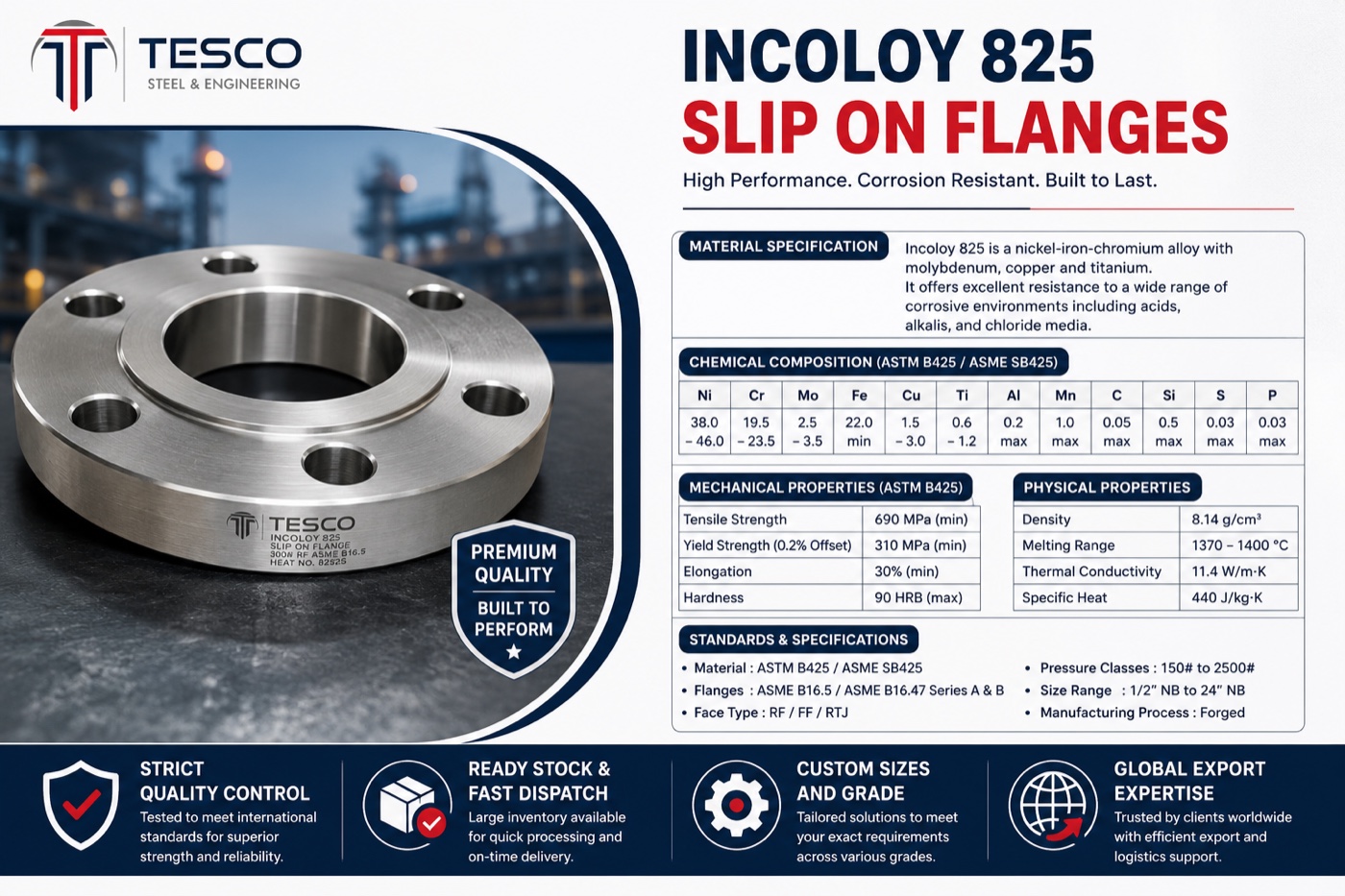
Incoloy 825 Slip On Flange — Specifications at a Glance
What is an Incoloy 825 Slip On Flange?
Incoloy 825 = the Incoloy that fights acid, not heat. Take the Fe-Ni-Cr backbone, raise nickel to 38–46%, add the acid toolkit — 3% Mo (pitting, reducing acids), 2% Cu (sulphuric), Ti stabiliser (as-welded service) — and the result owns sour gas (NACE MR0175), sulphuric and phosphoric duty, with chloride SCC off the table. As a slip-on: two fillet welds with ERNiCrMo-3 filler, no preheat, no PWHT — forged to ASTM B564, not A182.
Also searched as: Alloy 825 slip on flange, Incoloy 825 SORF flange, ASTM B564 N08825 slip on flange, 2.4858 / NiCr21Mo slip on flange, NACE MR0175 slip on flange — all refer to the product on this page. See also our Incoloy 825 weld neck flanges and the heat grades 800/800H/800HT.
Rule of thumb: 825 covers the wide middle of acid and sour duty — below it the stainless economies, above it 625's margins and C-276's extremes, each paid for only when the stream demands it.
Incoloy 825 (UNS N08825) Chemical Composition
Ni
Cr
Mo
Cu
Ti
Fe
C
Mn
Si
Al
S
38.0-46.0
19.5-23.5
2.5-3.5
1.5-3.0
0.6-1.2
22.0 min
0.05 max
1.0 max
0.5 max
0.2 max
0.03 max
Values in weight % for UNS N08825 per ASTM B564. Three additions define it: molybdenum against pitting and reducing acids, copper against sulphuric acid specifically, and titanium to lock up carbon so welds cannot sensitise — the same three jobs Alloy 20 assigns to Mo, Cu and niobium.
Incoloy 825 Mechanical Properties
Tensile Strength, MPa (ksi)
Yield Strength 0.2%, Min, MPa (ksi)
Elongation % min (2")
Density
586 (85) min
241 (35) min
30
8.14 g/cm³
Per ASTM B564, annealed condition. Usefully stronger than both Alloy 800 and Alloy 20, tough from cryogenic temperatures upward, and — being a solid-solution, stabilised alloy — supplied in one simple annealed condition with nothing to age or harden. Values demonstrated per heat on the EN 10204 certificate.
Incoloy 825 Slip On Flange Specifications
Incoloy 825 Slip On Flanges are available in the following specifications:
1/2"NB to 24"NB per ASME B16.5; larger diameters and EN 1092-1 patterns in 2.4858 to order
Class
150#, 300#, 400#, 600#, 900#, 1500#, 2500#
Facing
Raised Face (SORF) — default; Flat Face (SOFF) or RTJ where the piping class specifies
Heat Treatment
Annealed per ASTM B564, thermal record retained
Service
Sulphuric & phosphoric acid, NACE MR0175 sour gas, chloride-contaminated streams & hot brines — chloride SCC immune, to ~540 °C
Installation
Two fillet welds (hub + bore), pipe set back 1/8"; ERNiCrMo-3 filler (or ERNiFeCr-1), no preheat, no PWHT
Testing
PMI verification and NACE MR0175 documentation where specified
Certification
EN 10204 3.1 (standard) / 3.2 witnessed
Equivalent Grades of Incoloy 825
Trade Names
ASTM Forging
UNS
Werkstoff Nr.
EN
Fittings
Incoloy 825 / Alloy 825 / Nicrofer 4221
B564
N08825
2.4858
NiCr21Mo
B366 WPNICMC
ASME SB-564 is the boiler-code twin. System partners: ASTM B423 seamless pipe & tube, ASTM B424 plate, sheet & strip and ASTM B425 rod & bar. Not an A182 grade — and note the forging callout is B564, not B425 (the bar spec for the same alloy), a common paperwork slip.
Why Incoloy 825 Slip Ons Are Specified
The Sour-Service Workhorse
NACE MR0175 / ISO 15156-3 listed — H₂S, chlorides, CO₂ and heat together are its home ground, at a fraction of 625 or C-276 money. Wellheads worldwide standardised on it.
The Acid Toolkit, Complete
Mo for pitting and reducing acids, Cu for sulphuric, Ti for as-welded service — sulphuric and phosphoric plants get the whole kit in one certified forging.
Chloride SCC Off the Table
At 38–46% nickel the cracking mechanism that retires stainless — and worries even 904L — simply does not operate.
One Condition, No Surprises
Solid-solution, Ti-stabilised, supplied annealed — no grades to confuse, no ageing windows to manage, welds enter service as-welded.
Three lines define the edges.Heat: no creep ratings, and structure coarsens above ~540 °C — furnace and reformer duty belongs to siblings 800H/800HT. The worst acids: hot HCl, wet chlorine and severe crevice chemistry escalate to 625 or C-276. The budget line: where 904L or Alloy 20 genuinely covers a clean sulphuric duty, 825's premium buys unneeded margin — we quote the honest alternative when the enquiry allows.
How Our Incoloy 825 Slip On Flanges Are Manufactured
1
Forging — cut billet of certified N08825 heat is hot-forged into the flange blank, keeping full heat traceability from raw material to despatch.
2
Annealing — per ASTM B564, setting the stabilised solid-solution structure; furnace record retained.
3
Machining — hub, faces and bolt holes to ASME B16.5; the bore machined slightly over pipe OD per the slip-on tolerance.
4
Facing & finish — SORF raised face with serrated stock finish, flat face or RTJ groove.
5
Testing & marking — mechanical and chemical verification against the heat (PMI and NACE documentation where the order specifies), then permanent marking of standard, grade, size, class and heat number.
6
Certification & packing — EN 10204 3.1 MTC (3.2 witnessed on request), export-packed for sea or air freight.
Where Incoloy 825 Slip On Flanges Are Used
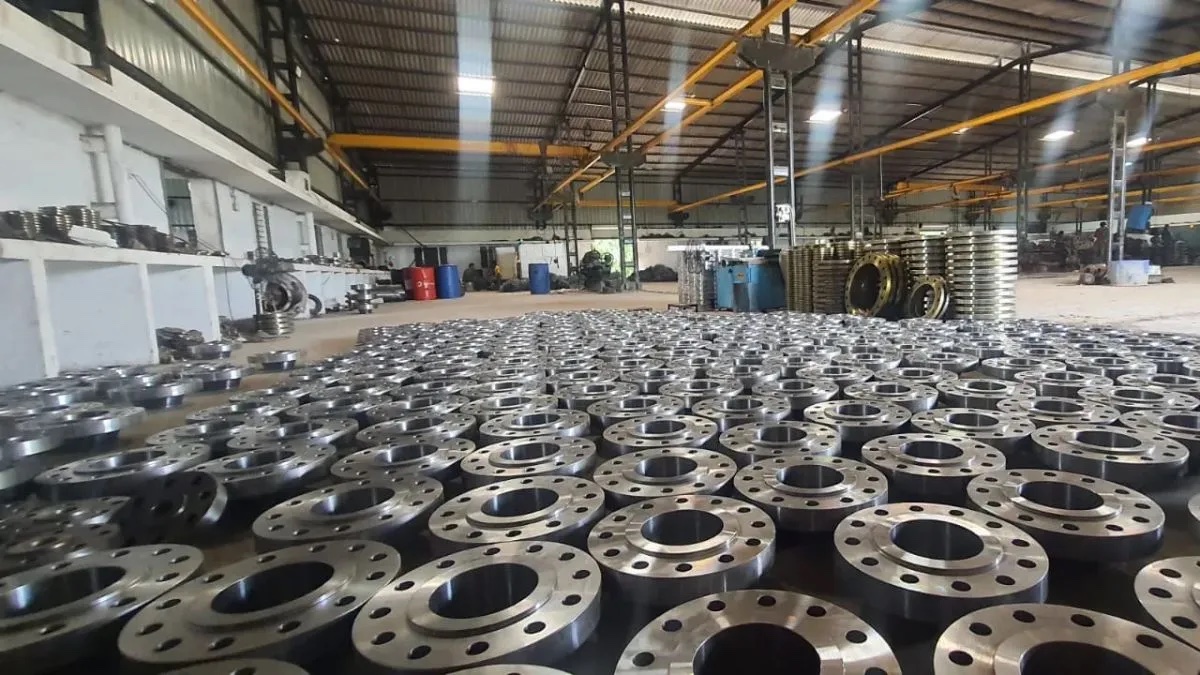
Sour gas production first — wellhead and christmas-tree connections, piping and flanges matching 825 tubing — then sulphuric and phosphoric acid plants, pickling and chemical processing, refinery units handling acid and chloride streams, offshore injection systems, nuclear fuel reprocessing and flue-gas desulphurisation. Slip-ons serve the utility, transfer and lower-pressure connections; weld necks take the critical lines. Production scale below:
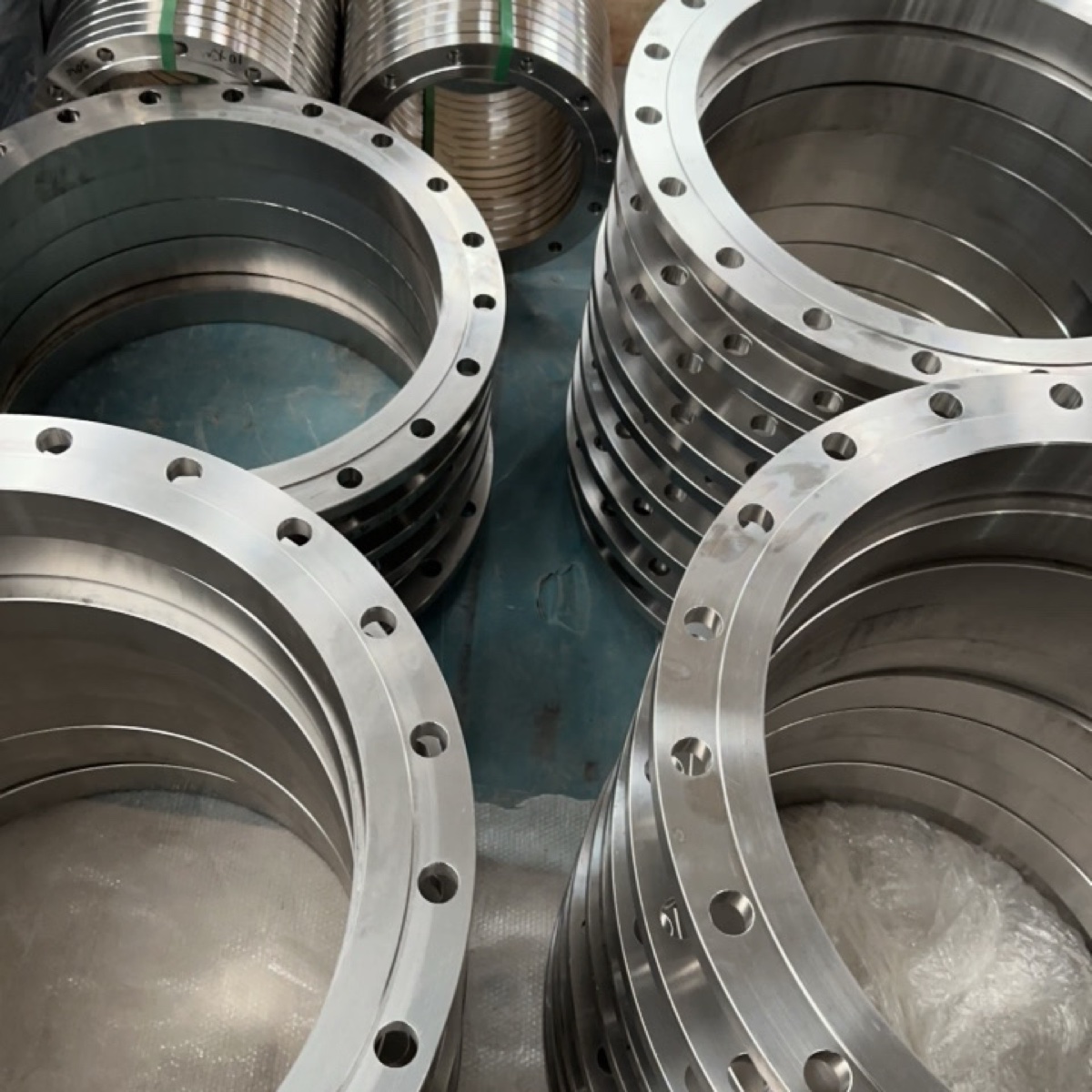
Large-Diameter Slip On Flanges — EN 1092-1 Patterns to OrderSlip On Production Hall — Volume Capability
Incoloy 825 Slip On Flange Dimensions
Incoloy 825 slip-on dimensions follow the ASME B16.5 slip-on tables — identical for every material. Full charts by class:
How to Specify & Order an Incoloy 825 Slip On Flange
Five elements — no bore schedule, since the slip-on bore suits the pipe OD:
1
Size & standard — e.g. 4″ NB ASME B16.5.
2
Pressure class & facing — Class 150–2500, SORF (default), flat face or RTJ where specified.
3
Grade & service flags — Incoloy 825 / UNS N08825 — ASTM B564 (2.4858); state NACE MR0175 where sour, and the acid stream so we can confirm against Alloy 20, 904L or 625.
4
Certification & testing — EN 10204 3.1 (standard) or 3.2 witnessed; PMI where the project specifies.
Example: “Slip On Flange, 4″ NB, ASME B16.5 Class 300, RF, Incoloy 825 / ASTM B564 (N08825), NACE MR0175, EN 10204 3.1 — 10 pcs.” Quotations normally within 24 hours with price, unit weight and delivery.
Incoloy 825 Slip On Flanges — Frequently Asked Questions
What is an Incoloy 825 slip on flange?
It is a slip-on flange forged from Incoloy 825 — the acid and sour-gas member of the Incoloy family (UNS N08825, ASTM B564, Werkstoff 2.4858) — dimensioned to ASME B16.5. The flange slides over the pipe end and is secured with two fillet welds. Molybdenum, copper and a titanium stabiliser on a 38-46% nickel base give it sulphuric and phosphoric acid capability, immunity to chloride stress corrosion cracking, NACE MR0175 sour-service acceptance and corrosion resistance that survives welding untouched.
What is Incoloy 825?
The wet-corrosion specialist of the Incoloy line. Take the Fe-Ni-Cr backbone of Alloy 800, raise nickel to 38-46%, then add the acid toolkit — 3% molybdenum for pitting and reducing acids, 2% copper for sulphuric duty, titanium to stabilise the welds. The result serves acid plants, sour gas fields and chemical duty that would consume both stainless and its own heat-serving siblings. Designations: UNS N08825, Werkstoff 2.4858, EN NiCr21Mo, often simply Alloy 825; forged flanges are governed by ASTM B564.
What is the chemical composition of Incoloy 825?
For UNS N08825: nickel 38.0-46.0%, chromium 19.5-23.5%, molybdenum 2.5-3.5%, copper 1.5-3.0%, titanium 0.6-1.2%, iron 22.0% minimum, carbon 0.05% max, manganese 1.0% max, silicon 0.5% max, aluminium 0.2% max and sulphur 0.03% max. Three additions define it: molybdenum against pitting and reducing acids, copper against sulphuric acid specifically, and titanium to lock up carbon so welds cannot sensitise — the same trio of jobs Alloy 20 assigns to Mo, Cu and niobium.
What are the mechanical properties of Incoloy 825 slip on flanges?
Per ASTM B564 in the annealed condition: tensile strength 586 MPa (85 ksi) minimum, 0.2% yield strength 241 MPa (35 ksi) minimum and elongation 30% minimum. Density is 8.14 g/cm³. Usefully stronger than both Alloy 800 and Alloy 20, tough from cryogenic temperatures upward, and — being a solid-solution, stabilised alloy — supplied in one simple annealed condition with nothing to age or harden. Values are demonstrated per heat on the EN 10204 certificate.
Why is Incoloy 825 the sour gas alloy?
Because it sits at the sweet spot of NACE MR0175 / ISO 15156-3 economics. Sour wells combine H₂S, chlorides, CO₂ and heat — chemistry that cracks carbon steel and pits stainless — and N08825 resists all four mechanisms at a markedly lower cost than Alloy 625 or C-276. It became the default corrosion-resistant alloy of sour-service tubing, wellhead components and downhole hardware worldwide, and flanges to match that equipment are one of this page's defining duties. State the NACE requirement on the enquiry and the certification documents compliance.
What is the difference between Incoloy 825 and Alloy 20?
They are two schools solving the same acid problem. Both carry molybdenum plus copper on a nickel-iron-chromium base with a stabiliser — titanium in 825, niobium in Alloy 20. 825 brings more nickel (38-46 vs 32-38%), slightly more molybdenum, and its NACE sour-gas pedigree; Alloy 20 counters with more copper (3-4 vs 1.5-3%) and its dedicated sulphuric-acid tradition. In dedicated H₂SO₄ plants the two quote head-to-head; once H₂S enters the stream, 825's sour-service listing usually decides it. We forge both.
What is the difference between Incoloy 825 and Incoloy 800?
Same family, perpendicular duties. Alloy 800 and its H/HT grades are the heat side: creep-rated furnace and reformer service, with no molybdenum or copper and no pretension to acid duty. 825 is the wet side: acids, sour gas and chloride chemistry, with no creep ratings and no business in a reformer. The shared Fe-Ni-Cr backbone is where the resemblance ends — specify by the enemy, heat or acid, and the family covers both from one forge.
How does Incoloy 825 compare with Inconel 625?
625 is the step above on every axis — three times the molybdenum (9 vs 3%), double the strength, better crevice and seawater performance — at a distinctly higher price. 825's role is to cover the wide middle of acid and sour duty where 625's margins are not needed: sulphuric and phosphoric streams, standard sour wells, chemical plant piping. The honest escalation points are hot concentrated chlorides, severe crevice conditions and the strength-critical joints — there the enquiry moves to 625. Both come from our forge with the same certification.
How does Incoloy 825 compare with 904L stainless?
904L is the stainless approximation of the same idea — copper-bearing, high-nickel (23-28%), aimed at sulphuric acid. 825 carries roughly fifteen points more nickel, a titanium stabiliser and the NACE sour listing, giving firmer SCC immunity, as-welded acid service and access to oil-and-gas duty that 904L rarely sees. 904L counters on price and availability for tanks, exchangers and general acid piping. The classic split: chemical-plant economy favours 904L, wellhead and sour paperwork favours 825.
Does Incoloy 825 resist chloride stress corrosion cracking?
Yes — effectively immune in practical service. Chloride SCC susceptibility peaks at stainless nickel levels and vanishes as nickel rises; at 38-46%, 825 sits comfortably beyond the cracking range, which is precisely why chloride-contaminated acid streams and hot brines that retire 316L and even 904L are routine 825 duty. Combined with its pitting resistance from molybdenum, this immunity is the backbone of its sour-service career.
What temperature range can Incoloy 825 slip on flanges handle?
825 is a wet-corrosion alloy, not a heat grade: its working world runs from cryogenic temperatures to roughly 540 °C, and ASME ratings follow the B16.5 tables within that span. Above about 540 °C, long exposure can coarsen its titanium-stabilised structure, and the family hands over to Alloy 800H/HT — which is exactly how the Incoloy line divides its labour. For hot acid within its range — boiling sulphuric fractions, hot brines — it remains one of the most dependable materials available.
Which ASTM standard covers Incoloy 825 slip on flanges?
ASTM B564 (ASME SB-564), the nickel-alloy forging specification — not A182, which covers stainless and alloy steels, and not B425, which is the rod and bar specification for the same alloy. System partners follow the B-series logic: seamless pipe and tube to ASTM B423, plate, sheet and strip to ASTM B424, rod and bar to ASTM B425, and welding fittings to ASTM B366 (WPNICMC). Certificates state UNS N08825, the standard, the annealed condition and the heat number together.
Where are Incoloy 825 slip on flanges typically used?
Sour gas production first — wellhead and christmas-tree connections, downhole-adjacent piping and flanges matching 825 tubing — then sulphuric and phosphoric acid plants, pickling and chemical processing, oil refinery units handling acid and chloride streams, offshore hydraulic and injection systems, nuclear fuel reprocessing, and flue-gas desulphurisation. Slip-ons serve the utility, transfer and lower-pressure connections; weld necks take the critical lines — both forged from the same certified heats.
Where does Incoloy 825 not belong?
Three honest lines. Heat: no creep ratings and structural coarsening above ~540 °C — furnace and reformer duty belongs to its siblings 800H/800HT. The worst acids: hot hydrochloric, wet chlorine and severe crevice chemistry escalate to Inconel 625 or Hastelloy C-276. And the budget line: where 904L or Alloy 20 genuinely covers a clean sulphuric duty, 825's premium buys margin the project may not need — we quote the honest alternative when the enquiry allows it.
Who manufactures Incoloy 825 slip on flanges in India?
Tesco Steel & Engineering is an ISO 9001:2015 certified flange manufacturer based in Mumbai, India, forging Incoloy 825 / UNS N08825 slip on flanges from ½" to 24" NB per ASTM B564 and ASME B16.5 — alongside Incoloy 825 weld neck, blind and socketweld flanges, the heat grades 800/800H/800HT, and the neighbouring acid alloys 904L, Alloy 20 and Inconel 625 — with full heat traceability, NACE MR0175 documentation where specified, PMI on request, and EN 10204 3.1/3.2 certification on every lot. Exported to more than 50 countries.