Incoloy 800 Slip On Flanges — UNS N08800 Manufacturer
Tesco Steel & Engineering forges Incoloy 800 slip on flanges — the iron-nickel-chromium alloy (UNS N08800, Werkstoff 1.4876) — to ASTM B564 and ASME B16.5 Class 150–2500 from ½″ to 24″ NB, larger patterns to order. The bridge between stainless and the nickel alloys: 30–35% nickel resists the chloride SCC and carburisation that retire stainless in hot service, 19–23% chromium carries the heat, and the iron base keeps the economics honest. The workhorse of heat exchangers, hot pressure parts and thermal-process piping — with creep grades 800H and 800HT from the same forge for duty beyond 593 °C, and Inconel 600 above it when chemistry demands full nickel. Supplied annealed, every lot with EN 10204 3.1/3.2 MTC. ISO 9001:2015, made in Mumbai, India — exported to 50+ countries.
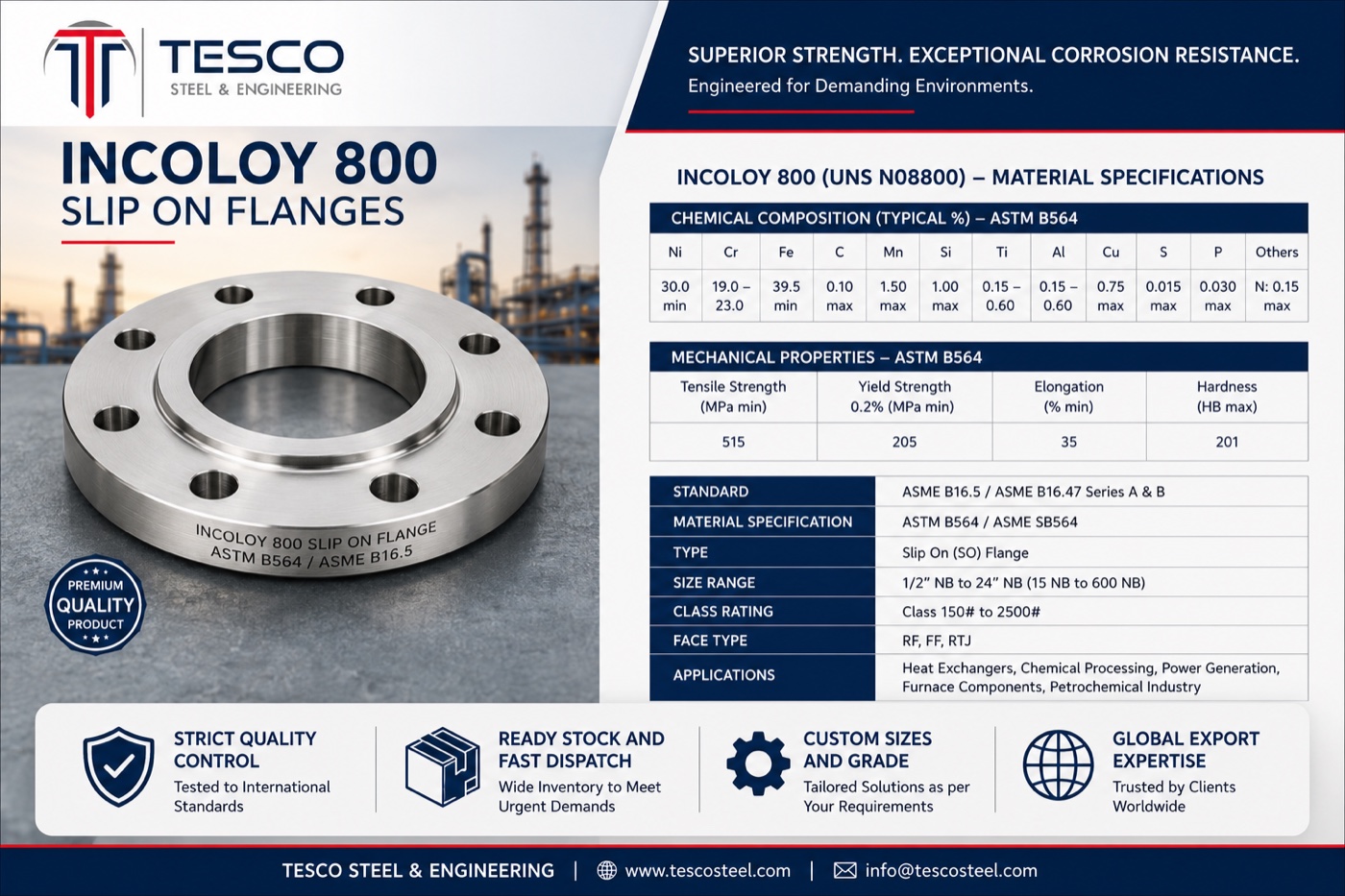
Incoloy 800 · Alloy 800 · N08800ASTM B564 · 1.4876Fe 39.5% min · Ni 30–35% · Cr 19–23%ASME B16.5 Class 150–2500½″ – 24″ NB · SORF517 MPa TS / 207 MPa YS minEN 10204 3.1 / 3.2 · ISO 9001:2015
Incoloy 800 Slip On Flange — Material Specifications at a Glance
What is an Incoloy 800 Slip On Flange?
Incoloy 800 = nickel-alloy behaviour at iron-alloy economics.Fe-32Ni-21Cr (1.4876): a third nickel is enough to escape the chloride SCC that cracks 304/316 and to resist carburisation, the chromium holds heat to ~1100 °C oxidation, and the 39.5% minimum iron keeps the price near stainless. The thermal-process workhorse — with 800H/HT creep grades above 593 °C. As a slip-on: two fillet welds with ERNiCr-3 filler, no preheat, no PWHT — forged to ASTM B564, not A182.
Also searched as: Alloy 800 slip on flange, Incoloy 800 SORF flange, ASTM B564 N08800 slip on flange, 1.4876 slip on flange, Fe-Ni-Cr slip on flange — all refer to the product on this page. See also our Incoloy 800 weld neck flanges and the creep grades 800H / 800HT.
Rule of thumb: 800 is where hot plants land when stainless stops being honest — and the family answer stays iron-based until halogens, caustic or the worst chlorides force the step to full nickel.
Incoloy 800 (UNS N08800) Chemical Composition
Fe
Ni
Cr
Al
Ti
C
Mn
Si
Cu
S
39.5 min
30.0-35.0
19.0-23.0
0.15-0.60
0.15-0.60
0.10 max
1.5 max
1.0 max
0.75 max
0.015 max
Values in weight % for UNS N08800 per ASTM B564. The deliberate iron majority is the commercial idea — nickel-alloy behaviour at iron-alloy economics — while the small Al and Ti additions strengthen and stabilise the structure. The creep grades tighten carbon and grain size, not this basic chemistry.
Incoloy 800 Mechanical Properties
Tensile Strength, MPa (ksi)
Yield Strength 0.2%, Min, MPa (ksi)
Elongation % min (2")
Density
517 (75) min
207 (30) min
30
7.94 g/cm³
Per ASTM B564, annealed condition. Density sits closer to steel than to the nickel alloys — another gift of the iron base. Useful strength persists well beyond stainless territory; for code-calculated stress above 593 °C the creep grades 800H/800HT take over. Values demonstrated per heat on the EN 10204 certificate.
Incoloy 800 Slip On Flange Specifications
Incoloy 800 Slip On Flanges are available in the following specifications:
Material
Incoloy 800 / Alloy 800 — ASTM B564 / ASME SB-564 (UNS N08800, Werkstoff 1.4876); 800H (N08810) & 800HT (N08811) from the same forge
Size
1/2"NB to 24"NB per ASME B16.5; larger diameters and EN 1092-1 patterns in 1.4876 to order
Class
150#, 300#, 400#, 600#, 900#, 1500#, 2500#
Facing
Raised Face (SORF) — default; Flat Face (SOFF) or RTJ where the piping class specifies
Heat Treatment
Annealed per ASTM B564, thermal record retained
Service
Hot pressure parts, heat exchangers & thermal-process piping to ~593 °C (800H/HT beyond) — chloride SCC & carburisation resistant
Installation
Two fillet welds (hub + bore), pipe set back 1/8"; ERNiCr-3 filler, sulphur-clean joints, no preheat, no PWHT
Testing
PMI verification and dye-penetrant examination on request
Certification
EN 10204 3.1 (standard) / 3.2 witnessed
The Alloy 800 Family — 800 vs 800H vs 800HT
Grade
UNS
Carbon
Condition / Grain
Correct Duty
Incoloy 800 (this page)
N08800
0.10 max
Annealed, fine grain
General hot duty up to ~593 °C — strongest at ordinary temperature
Highest creep ratings, reformers & manifolds to ~900 °C
Ordering plain 800 for a reformer manifold is the classic slip in this family — specify by peak metal temperature, and note that dual-certified 800H/800HT heats are common. Werkstoff equivalents: 1.4876 (800), 1.4958/1.4959 (800H/HT). System partners: ASTM B407 pipe, B409 plate, B408 bar, B366 WPNIC fittings. Not an A182 grade.
Why Incoloy 800 Slip Ons Are Specified
Escapes the Stainless Traps
Chloride SCC peaks at stainless nickel levels and falls steeply by 30% — 800 shrugs off the hot-chloride conditions that crack 304/316, and its Al-Ti-stabilised structure resists sigma-phase embrittlement.
The Economics of Iron
39.5% minimum iron keeps price and density near stainless while delivering most of the nickel-alloy benefit — the reason hot plants standardised on this family.
Twin Atmosphere Tolerance
Enough nickel to resist carburisation, enough iron to tolerate sulphur-bearing flue gas that attacks high-nickel Inconel — the balance thermal processing actually needs.
A Family, Not Just a Grade
800 for general hot duty, 800H/HT for code-rated creep to ~900 °C, 825 for acids — one chemistry backbone, certified to the duty, all from our forge.
Three lines define the edges.The 593 °C code line: above it, design shifts to creep allowables and plain 800 must give way to 800H/800HT — the classic specification slip in this family. Wet acids & sour chemistry: no molybdenum or copper — that duty belongs to sister 825 or 625. Halogens & strong caustic: hot Cl₂, HCl and concentrated hydroxides want the full nickel of Inconel 600 or Nickel 201. And SCC resistance at 30% Ni is strong but not the immunity of 72% — the severest chloride cases still escalate.
How Our Incoloy 800 Slip On Flanges Are Manufactured
1
Forging — cut billet of certified N08800 heat is hot-forged into the flange blank, keeping full heat traceability from raw material to despatch.
2
Annealing — per ASTM B564 (solution annealing with grain-size verification for 800H/HT orders); furnace record retained.
3
Machining — hub, faces and bolt holes to ASME B16.5; the bore machined slightly over pipe OD per the slip-on tolerance.
4
Facing & finish — SORF raised face with serrated stock finish, flat face or RTJ groove.
5
Testing & marking — mechanical and chemical verification against the heat (PMI where the order specifies), then permanent marking of standard, grade, size, class and heat number.
6
Certification & packing — EN 10204 3.1 MTC (3.2 witnessed on request), export-packed for sea or air freight.
Where Incoloy 800 Slip On Flanges Are Used
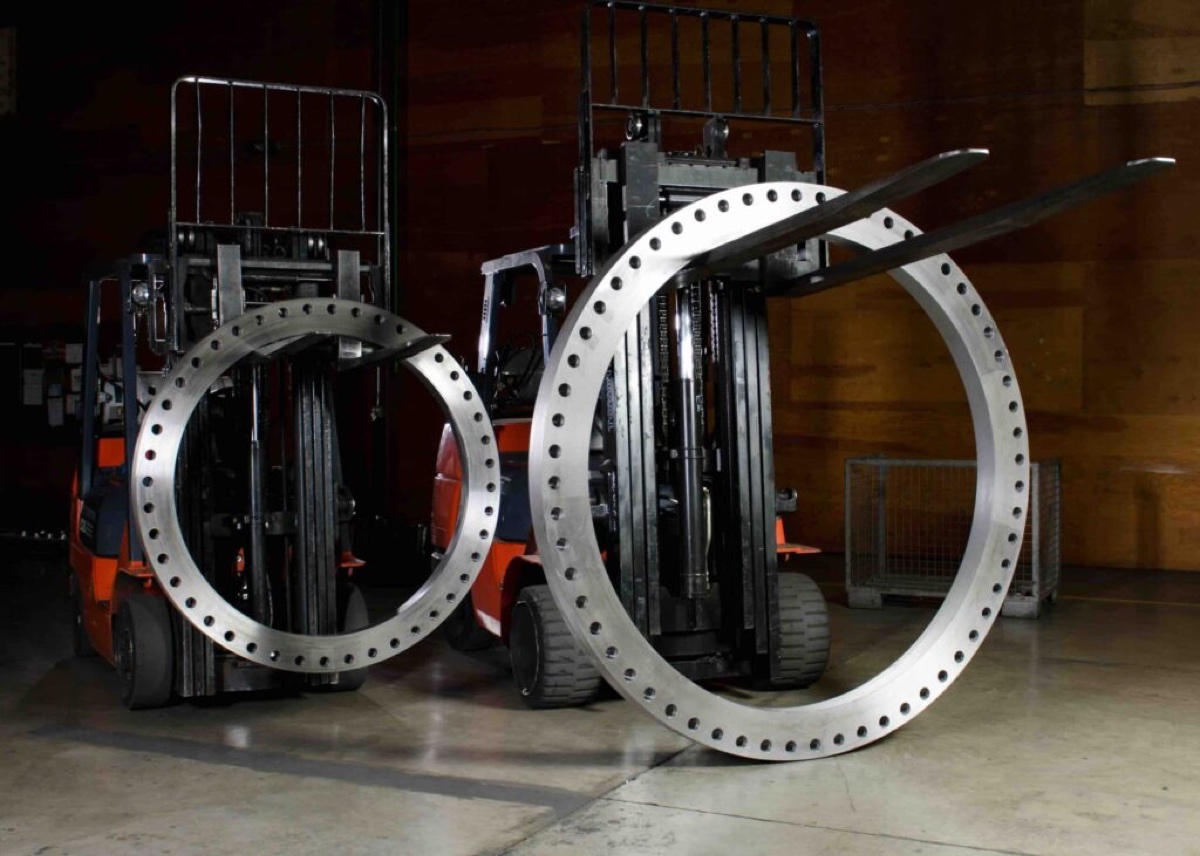
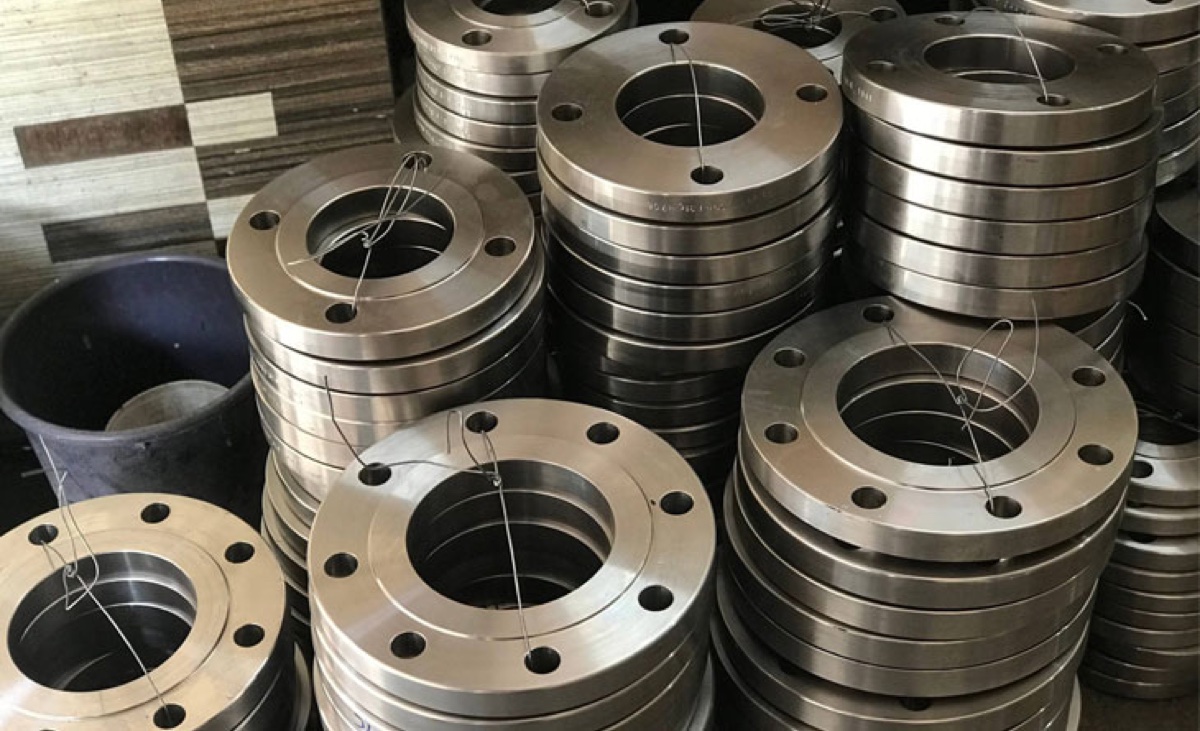
The hot side of process industry: heat-exchanger and superheater systems, hot chemical and petrochemical piping, ethylene and reformer plants (800H/HT on the creep-rated sections), power generation and heat-recovery steam systems, furnace components and hot gas ducting, and legacy nuclear steam-generator programmes. Slip-ons serve the moderate-pressure utility, vent and transfer connections; weld necks take pressure and cycling. Production scale below:
Giant-Diameter Flanges — Forklift-Scale ProductionSlip On Flanges — Wired Bundles Ready for Despatch
Incoloy 800 Slip On Flange Dimensions
Incoloy 800 slip-on dimensions follow the ASME B16.5 slip-on tables — identical for every material. Full charts by class:
How to Specify & Order an Incoloy 800 Slip On Flange
Five elements — no bore schedule, since the slip-on bore suits the pipe OD:
1
Size & standard — e.g. 4″ NB ASME B16.5.
2
Pressure class & facing — Class 150–2500, SORF (default), flat face or RTJ where specified.
3
Grade & peak temperature — Incoloy 800 / UNS N08800 — ASTM B564 (1.4876); state the peak metal temperature so we can flag 800H/800HT where creep governs.
4
Certification & testing — EN 10204 3.1 (standard) or 3.2 witnessed; PMI where the project specifies.
Example: “Slip On Flange, 4″ NB, ASME B16.5 Class 150, RF, Incoloy 800 / ASTM B564 (N08800), EN 10204 3.1 — 10 pcs.” Quotations normally within 24 hours with price, unit weight and delivery.
Incoloy 800 Slip On Flanges — Frequently Asked Questions
What is an Incoloy 800 slip on flange?
It is a slip-on flange forged from Incoloy 800 — the iron-nickel-chromium alloy (UNS N08800, ASTM B564, Werkstoff 1.4876) — dimensioned to ASME B16.5. The flange slides over the pipe end and is secured with two fillet welds. With 30-35% nickel, 19-23% chromium and an iron base, the alloy bridges stainless steel and the nickel alloys: it resists the chloride stress corrosion cracking and carburisation that retire stainless in hot service, keeps useful strength at heat, and costs far less than nickel-base grades.
What is Incoloy 800?
The founding Incoloy — the alloy family built on iron rather than nickel. Raising nickel to about a third of the analysis buys most of what hot plants need from nickel alloys — chloride SCC resistance, carburisation tolerance, structural stability — while the 39.5% minimum iron keeps the price closer to stainless than to Inconel. It has been the workhorse of heat exchangers, hot pressure parts and thermal-process piping for over half a century. Designations: UNS N08800, Werkstoff 1.4876, EN X10NiCrAlTi32-20, often simply Alloy 800; forged flanges are governed by ASTM B564.
What is the chemical composition of Incoloy 800?
For UNS N08800: iron 39.5% minimum, nickel 30.0-35.0%, chromium 19.0-23.0%, aluminium 0.15-0.60%, titanium 0.15-0.60%, carbon 0.10% max, manganese 1.5% max, silicon 1.0% max, copper 0.75% max and sulphur 0.015% max. The small aluminium and titanium additions strengthen and stabilise the structure, and the deliberate iron majority is the whole commercial idea — nickel-alloy behaviour at iron-alloy economics.
What are the mechanical properties of Incoloy 800 slip on flanges?
Per ASTM B564 in the annealed condition: tensile strength 517 MPa (75 ksi) minimum, 0.2% yield strength 207 MPa (30 ksi) minimum and elongation 30% minimum. Density is 7.94 g/cm³ — closer to steel than to the nickel alloys, another gift of the iron base. The alloy holds useful strength well beyond stainless territory, and its creep-rated siblings 800H and 800HT extend that to genuinely hot code service. Values are demonstrated per heat on the EN 10204 certificate.
What is the difference between Incoloy 800, 800H and 800HT?
Carbon, grain size and heat treatment — the creep ladder. Standard 800 (N08800, C 0.10 max, fine grain, annealed) is the general-purpose grade, strongest at ordinary temperatures and correct below about 593 °C. 800H (N08810) controls carbon to 0.05-0.10% and is solution annealed to a coarse grain, buying code-recognised creep strength above 593 °C. 800HT (N08811) further tightens carbon plus aluminium-titanium (0.85-1.20% combined) for the highest creep ratings to about 900 °C. Specify by service temperature; we forge all three, and dual-certified 800H/800HT heats are common.
Why choose Incoloy 800 over 310S or other heat-resistant stainless?
Two failure modes decide it. Chloride stress corrosion cracking: austenitic stainless at 8-20% nickel sits in the most susceptible range, and hot chlorides crack it; at 30-35% nickel, 800 largely escapes the mechanism. Carburisation and structural stability: stainless embrittles by sigma phase and carbon pickup in long hot service, while 800's nickel level and Al-Ti stabilisation keep the structure ductile. 310S remains the honest budget answer for clean, dry oxidation; once chlorides, carbon or decades-long creep enter the brief, 800 earns its modest premium.
How does Incoloy 800 compare with Inconel 600?
They are the two sides of the iron-nickel bridge. Inconel 600's 72%+ nickel buys near-immunity to chloride SCC, serious caustic and halogen chemistry and better carburisation behaviour — at nickel-alloy cost. Incoloy 800's 30-35% nickel delivers most of the practical benefit for hot pressure parts at a fraction of the price, and its iron base actually outperforms high-nickel alloys in sulphur-bearing atmospheres. The working rule: 800 for hot structural and exchanger duty, 600 when the chemistry — halogens, caustic, the worst chlorides — demands full nickel.
What is the difference between Incoloy 800 and Incoloy 825?
Molybdenum and copper — 825 is the wet-corrosion member of the family. It adds about 3% Mo, 2% Cu and a titanium stabiliser to the same Fe-Ni-Cr base, transforming it into an acid alloy: sulphuric and phosphoric duty, sour gas, and chloride pitting resistance. 800 keeps the simpler chemistry and the high-temperature role — 825 is not a heat alloy, and 800 is not an acid alloy. Same family, perpendicular duties; we forge both.
Does Incoloy 800 resist chloride stress corrosion cracking?
It resists it strongly, though honesty requires the distinction: resistance, not immunity. Susceptibility to chloride SCC peaks around 8-20% nickel — exactly where the 300-series stainless steels live — and falls steeply as nickel rises; at 30-35%, Alloy 800 shrugs off conditions that crack 304 and 316 in weeks. Under the most severe combinations of chloride, tension and temperature it can still crack where a 72%-nickel alloy would not — which is precisely when the enquiry steps up to Inconel 600 or 625.
What temperature can Incoloy 800 slip on flanges handle?
Standard Alloy 800 is the right grade up to roughly 593 °C (1100 °F) — below that line its fine grain and higher room-temperature strength are advantages. Above 593 °C, ASME code design shifts to creep-based allowables, and the coarse-grain creep grades 800H and 800HT take over, serving to roughly 900 °C in reformers and hot manifolds. Oxidation resistance itself extends to about 1100 °C. As always, bolted-joint ratings follow the ASME B16.5 pressure-temperature tables.
How does Incoloy 800 behave in carburising and sulphur-bearing atmospheres?
Better than either of its neighbours in one direction each. Against carburisation, its 30%+ nickel slows carbon diffusion far better than stainless — hence its long service in ethylene and heat-treatment plants. Against sulphur, its iron base is the advantage over nickel alloys: sulphidising flue gases that rapidly attack 72%-nickel Inconel are tolerated far better by the Fe-Ni-Cr balance. This twin tolerance — carbon from one side, sulphur from the other — is much of why Alloy 800 became the default thermal-process alloy.
Which ASTM standard covers Incoloy 800 slip on flanges?
ASTM B564 (ASME SB-564), the nickel-alloy forging specification — not A182, which covers stainless and alloy steels. System partners follow the same B-series logic: seamless pipe and tube to ASTM B407, plate, sheet and strip to ASTM B409, rod and bar to ASTM B408, and welding fittings to ASTM B366 (WPNIC; the 800H and 800HT versions are WPNIC10 and WPNIC11). Certificates state UNS N08800, the standard, the annealed condition and the heat number together.
Where are Incoloy 800 slip on flanges typically used?
Heat-exchanger and superheater systems, hot process piping in chemical and petrochemical plants, ethylene and reformer plant hardware (with 800H/HT on the hottest creep-rated sections), power generation including heat-recovery steam systems, furnace components and hot gas ducting, and nuclear steam-generator programmes to legacy 800-family designs. Slip-ons serve the moderate-pressure utility, vent and transfer connections; weld necks take pressure and cycling — both forged from the same certified heats.
Where does Incoloy 800 not belong?
Three honest lines. Wet acids and sour chemistry: no molybdenum or copper — that duty belongs to sister alloy 825 or to Inconel 625. Halogens and strong caustic: hot chlorine, HCl and concentrated hydroxides want the high nickel of Inconel 600 or pure nickel. And above ~593 °C under code-calculated stress, standard 800 must give way to its own creep grades 800H/800HT — ordering plain 800 for a reformer manifold is the classic specification slip in this family.
Who manufactures Incoloy 800 slip on flanges in India?
Tesco Steel & Engineering is an ISO 9001:2015 certified flange manufacturer based in Mumbai, India, forging Incoloy 800 / UNS N08800 slip on flanges from ½" to 24" NB per ASTM B564 and ASME B16.5 — alongside Incoloy 800 weld neck, blind and socketweld flanges, the creep grades 800H and 800HT, and sister alloy 825 — with full heat traceability, PMI on request, and EN 10204 3.1/3.2 certification on every lot. Exported to more than 50 countries.