UNS N02201 Slip On Flanges — Nickel 201 Manufacturer
Tesco Steel & Engineering forges Nickel 201 slip on flanges — low-carbon commercially pure nickel (99.0% min, C 0.02% max; UNS N02201, Werkstoff 2.4068) — to ASTM B564 and ASME B16.5 Class 150–2500 from ½″ to 24″ NB, larger patterns to order. It is Nickel 200 with the carbon — and therefore the 315 °C graphitisation limit — removed: the same caustic soda inertness, dry chlorine and fluorine capability and certified purity, extended to roughly 600 °C. The grade hot caustic evaporators, fusion pots and molten-salt systems specify. Supplied annealed, carbon reported on every certificate, every lot with EN 10204 3.1/3.2 MTC. ISO 9001:2015, made in Mumbai, India — exported to 50+ countries.
Nickel 201 · LC-Ni 99 · N02201ASTM B564 · 2.4068Ni 99.0% min · C 0.02% maxService to ~600 °CASME B16.5 Class 150–2500½″ – 24″ NB · SORFEN 10204 3.1 / 3.2 · ISO 9001:2015
Nickel 201 = Nickel 200 with the clock removed. Same 99% pure nickel, one change: carbon capped at 0.02% (vs 0.15). No carbon → no grain-boundary graphite → no 315 °C embrittlement limit — pure nickel's caustic, chlorine and fluorine chemistry extended to ~600 °C. The grade of hot caustic evaporators and molten-salt duty. As a slip-on: two fillet welds with ERNi-1 filler, no preheat, no PWHT — forged to ASTM B564, not A182.
Also searched as: Nickel 201 slip on flange, Ni 201 SORF flange, low-carbon nickel slip on flange, LC-Ni 99 flange, ASTM B564 N02201 slip on flange, 2.4068 slip on flange — all refer to the product on this page. For duty below 315 °C see Nickel 200 slip on flanges.
Rule of thumb: specify the pure-nickel pair by peak metal temperature — 200 below 315 °C, 201 above — and move to Inconel only when the hot environment turns oxidising.
Nickel 201 (UNS N02201) Chemical Composition
Ni (+Co)
C
Cu
Fe
Mn
Si
S
99.0 min
0.02 max
0.25 max
0.40 max
0.35 max
0.35 max
0.01 max
Values in weight % for UNS N02201 per ASTM B564. Every line reads identically to Nickel 200 except the carbon — 0.02 vs 0.15 max — and that one number is the entire story: it is what removes the 315 °C graphitisation limit. Our certificates report the measured carbon on every heat.
Nickel 201 Mechanical Properties
Grade
Tensile Strength, MPa (ksi)
Yield Strength 0.2%, Min, MPa (ksi)
Elongation % min (2")
Nickel 201 (this page)
345 (50) min
80 (12) min
40
Nickel 200 — for comparison
380 (55) min
105 (15) min
40
Per ASTM B564, annealed condition. Slightly softer than 200 — the interstitial carbon that strengthened it is exactly what was removed — and it work-hardens more slowly, which fabricators appreciate. Density 8.89 g/cm³; tough from cryogenic temperatures with no ductile-brittle transition. Values demonstrated per heat on the EN 10204 certificate.
UNS N02201 Slip On Flange Specifications
Nickel 201 Slip On Flanges are available in the following specifications:
Material
Nickel 201 / LC-Ni 99 — ASTM B564 / ASME SB-564 (UNS N02201, Werkstoff 2.4068); dual-certified 200/201 where available
Size
1/2"NB to 24"NB per ASME B16.5; larger diameters and EN 1092-1 patterns in 2.4068 to order
Class
150#, 300#, 400#, 600#, 900#, 1500#, 2500#
Facing
Raised Face (SORF) — default; Flat Face (SOFF) or RTJ where the piping class specifies
Heat Treatment
Annealed per ASTM B564, thermal record retained
Service
Hot caustic soda & potash to ~600 °C, molten salts, hot dry chlorine & fluorine — beyond Nickel 200's 315 °C limit
Installation
Two fillet welds (hub + bore), pipe set back 1/8"; ERNi-1 / ENi-1 filler, sulphur-clean joints, low heat input, no preheat, no PWHT
Testing
Carbon reported per heat; PMI verification and dye-penetrant examination on request
ASME SB-564 is the boiler-code twin. System partners: ASTM B161 seamless pipe, ASTM B162 plate and ASTM B366 welding fittings (WPNL; Nickel 200's is WPN). Not an A182 grade — nickel-alloy flanges are governed by the B-series standards.
Why Nickel 201 Slip Ons Are Specified
Pure Nickel Without the Clock
All of Nickel 200's caustic and halogen chemistry with the graphitisation wear-out mechanism deleted — ASME ratings extend to roughly 600 °C.
The Hot Caustic Grade
Final-effect evaporators, fusion pots and molten caustic run exactly where 200 embrittles — 201 is the grade those plants are built from.
Hot Halogen Capable
Dry chlorine, hydrogen chloride and fluorine at temperature — chromium-free nickel forms the protective halide films that keep chlorination and fluorination plants running.
Fabrication-Friendly
Lower work-hardening than 200, nothing to sensitise, ERNi-1 welds with no preheat or PWHT — and dual-certified 200/201 heats satisfy either callout from one stock.
The carbon fix buys temperature, not universality.Strength: 201 is the softest grade on this site (80 MPa yield) and pure nickel's strength fades further with heat — above its practical range, structural duty passes to Inconel. Oxidising media: nitric acid, ferric and cupric salts and wet chlorine attack chromium-free nickel at any temperature. Sulphur: sulphur-bearing atmospheres embrittle nickel above ~370 °C — the one hot-service enemy the low carbon does not fix — so combustion gases need chromium and welding demands sulphur-clean joints. State the full service chemistry on the enquiry and we confirm the grade.
How Our Nickel 201 Slip On Flanges Are Manufactured
1
Forging — cut billet of certified N02201 heat is hot-forged into the flange blank, keeping full heat traceability from raw material to despatch.
2
Annealing — softened and homogenised per ASTM B564; furnace record retained.
3
Machining — hub, faces and bolt holes to ASME B16.5; the bore machined slightly over pipe OD per the slip-on tolerance.
4
Facing & finish — SORF raised face with serrated stock finish, flat face or RTJ groove.
5
Testing & marking — mechanical and chemical verification against the heat, carbon reported (PMI where the order specifies), then permanent marking of standard, grade, size, class and heat number.
6
Certification & packing — EN 10204 3.1 MTC (3.2 witnessed on request), export-packed for sea or air freight.
Where UNS N02201 Slip On Flanges Are Used
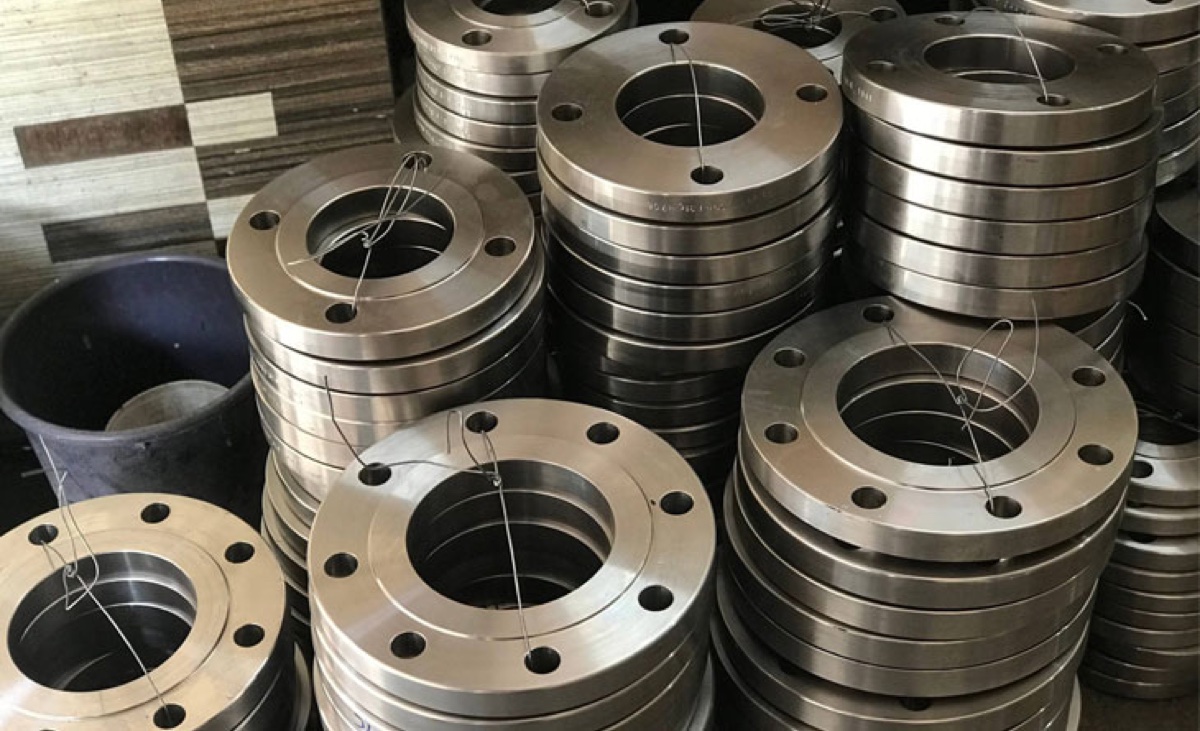
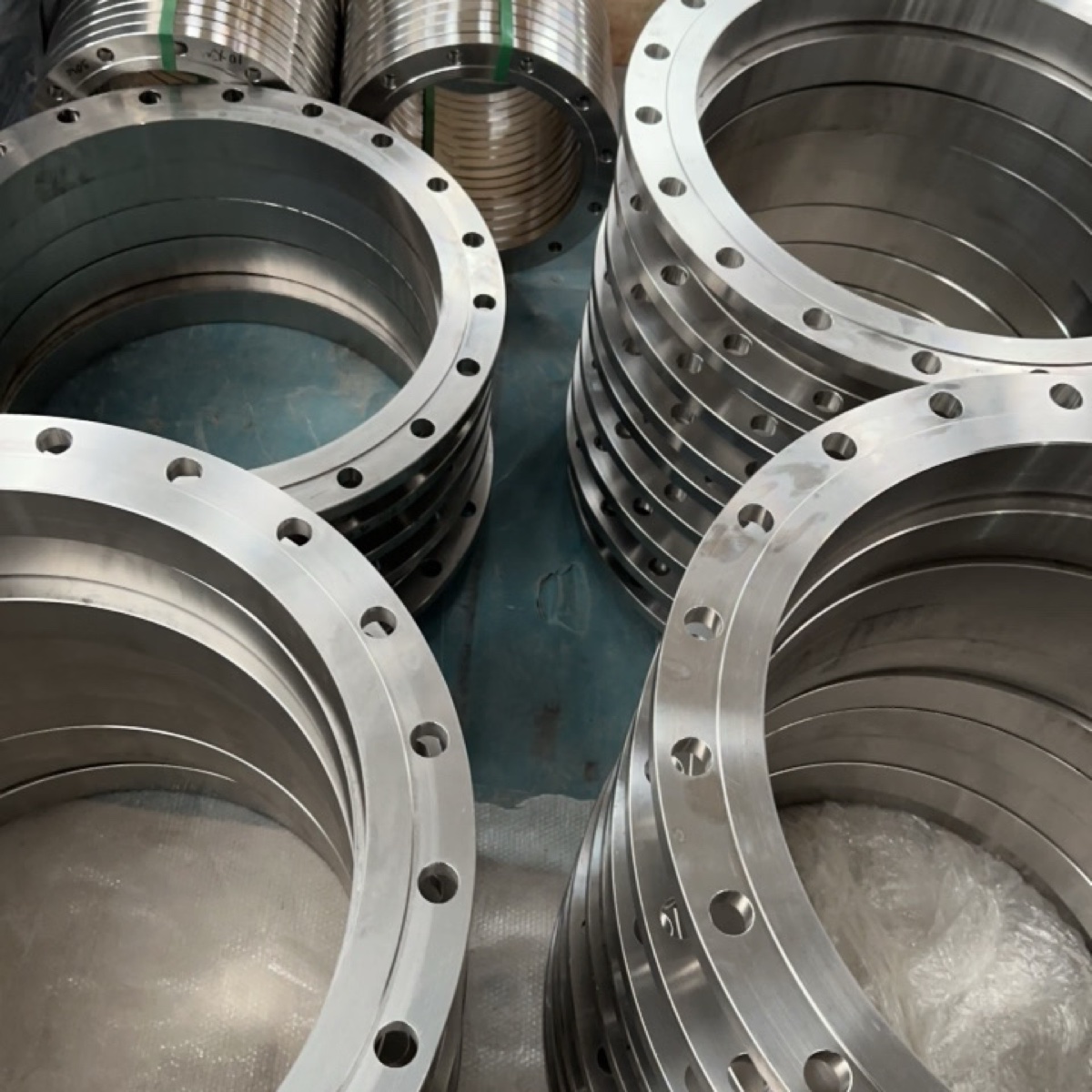
Caustic concentration above 315 °C first — final-effect evaporators, fusion pots and molten caustic handling — then molten-salt systems, hot dry chlorine, hydrogen chloride and fluorine lines in chlorination and fluorination plants, furnace fixtures in reducing atmospheres, and purity-critical hot chemistry in pharmaceutical and fine-chemical synthesis. Below 315 °C, Nickel 200 does the same chemistry. Slip-on production below:
Slip On Flanges — Wired Bundles Ready for DespatchLarge-Diameter Slip On Flanges — EN 1092-1 Patterns to Order
UNS N02201 Slip On Flange Dimensions
Nickel 201 slip-on dimensions follow the ASME B16.5 slip-on tables — identical for every material. Full charts by class:
Example: “Slip On Flange, 4″ NB, ASME B16.5 Class 150, RF, Nickel 201 / ASTM B564 (N02201), EN 10204 3.1 — 10 pcs.” Quotations normally within 24 hours with price, unit weight and delivery.
UNS N02201 Slip On Flanges — Frequently Asked Questions
What is a UNS N02201 slip on flange?
It is a slip-on flange forged from Nickel 201 — low-carbon commercially pure wrought nickel, 99.0% minimum with carbon capped at 0.02% (UNS N02201, ASTM B564, Werkstoff 2.4068) — dimensioned to ASME B16.5. The flange slides over the pipe end and is secured with two fillet welds. Nickel 201 keeps everything that makes pure nickel the caustic soda metal — inertness in hydroxides, dry halogen capability, chloride SCC immunity, certified purity — and extends it to roughly 600 °C, far past the 315 °C limit of standard Nickel 200.
What is Nickel 201?
The low-carbon version of commercially pure nickel. The analysis is Nickel 200's in every respect except one number: carbon is capped at 0.02% instead of 0.15%. That single change removes the graphitisation mechanism that embrittles standard nickel above 315 °C, making 201 the pure-nickel grade for genuinely hot duty. Designations: UNS N02201, Werkstoff 2.4068, EN LC-Ni 99; forged flanges are governed by ASTM B564, and many mills dual-certify heats as Nickel 200/201.
What is the chemical composition of Nickel 201?
For UNS N02201: nickel (plus cobalt) 99.0% minimum, carbon 0.02% maximum — the defining limit — with copper 0.25% max, iron 0.40% max, manganese 0.35% max, silicon 0.35% max and sulphur 0.01% max. Everything except the carbon line reads identically to Nickel 200; that one number is the entire specification story, and it is why the grade exists.
What are the mechanical properties of Nickel 201 slip on flanges?
Per ASTM B564 in the annealed condition: tensile strength 345 MPa (50 ksi) minimum, 0.2% yield strength 80 MPa (12 ksi) minimum and elongation 40% minimum — slightly softer than Nickel 200, because the interstitial carbon that strengthened 200 is exactly what was removed. The alloy also work-hardens more slowly, which fabricators appreciate. Tough from cryogenic temperatures upward; values demonstrated per heat on the EN 10204 certificate.
Why does removing carbon allow 600 °C service?
Because the failure mechanism of hot pure nickel is its own carbon. Above roughly 315 °C, carbon dissolved in Nickel 200 migrates to grain boundaries and precipitates as graphite films, embrittling the metal over time — a wear-out mechanism, not corrosion. Cap the carbon at 0.02%, as N02201 does, and there is simply not enough of it to form damaging graphite: the intergranular embrittlement disappears and the ASME ratings extend to roughly 600 °C (1,200 °F).
What is the difference between Nickel 201 and Nickel 200?
One number: carbon, 0.02% max in 201 against 0.15% max in 200. The consequences: 200 is slightly stronger and is the standard grade below 315 °C; 201 gives up a little strength to gain service to roughly 600 °C, where 200 would embrittle by graphitisation. Corrosion behaviour — caustic, halogens, purity, chloride SCC immunity — is identical. The clean rule: specify by peak metal temperature, and when a system straddles both regimes, dual-certified Nickel 200/201 material satisfies either callout.
Why do hot caustic evaporators specify Nickel 201?
Caustic concentration is a temperature story. Turning 50% liquor into anhydrous caustic means final evaporators and fusion equipment running far above 315 °C — molten caustic itself sits near 320 °C and processes hotter. Pure nickel is the only practical metal that shrugs off these hydroxides, but standard 200 would graphitise at exactly the temperatures involved; low-carbon 201 delivers the same caustic inertness without the embrittlement clock. High-temperature chlorination and fluorination duty follows the same logic.
How does Nickel 201 compare with Inconel 600?
Both serve hot duty; the chemistry decides which. Inconel 600 adds 15% chromium for oxidation resistance and keeps useful strength to furnace temperatures — the choice for hot air, steam and oxidising atmospheres. Nickel 201 remains better where chromium is a liability: the strongest hot hydroxides and molten caustic, and hot dry chlorine, hydrogen chloride and fluorine, where chromium-free nickel forms the protective halide films. Above nickel's own strength limits in inert or reducing heat, 600 also takes over structurally.
Can a heat be dual-certified as Nickel 200 and 201?
Yes — and it is common good practice. A melt with carbon at or below 0.02% meets both UNS N02200 and N02201 chemistry simultaneously, so the mill certificate can state both designations, and one flange stock then satisfies either specification callout. We offer dual-certified Nickel 200/201 material where available; for orders destined for service above 315 °C we certify N02201 explicitly, with the carbon value stated on the EN 10204 certificate.
Is Nickel 201 magnetic?
Yes — like Nickel 200, it is essentially pure nickel, one of only three elements ferromagnetic at room temperature, holding its magnetism to the Curie point of about 355 °C. A magnet sticking firmly to a flange distinguishes the pure-nickel grades from stainless and from most nickel alloys in seconds — a handy warehouse check, with PMI available on every lot as the formal verification. Note that magnetism says 200-family; only the certificate's carbon value separates 200 from 201.
How is a UNS N02201 slip on flange welded to pipe?
With two fillet welds — hub outside, bore inside, pipe set back 1/8" (3 mm) — using pure-nickel filler ERNi-1 (Nickel 61) or ENi-1 electrodes, exactly as for Nickel 200; the filler's carbon is already low. No preheat and no post-weld heat treatment. The discipline is sulphur exclusion: joints free of oil, grease, paint and crayon marks, low heat input and interpass control — nickel forgives almost everything except sulphur contamination at temperature.
Which ASTM standard covers Nickel 201 slip on flanges?
ASTM B564 (ASME SB-564), the nickel-alloy forging specification — not A182, which covers stainless and alloy steels. System partners follow the same B-series logic: seamless pipe to ASTM B161, plate to ASTM B162 and welding fittings to ASTM B366, where the low-carbon designation is WPNL (Nickel 200's is WPN). Certificates state UNS N02201, the standard, the annealed condition, the measured carbon and the heat number together.
Where are UNS N02201 slip on flanges typically used?
Caustic soda and potash concentration above 315 °C — final-effect evaporators, fusion pots and molten caustic handling — plus molten-salt systems, hot dry chlorine, hydrogen chloride and fluorine lines in chlorination and fluorination plants, heat-treatment and furnace fixtures in reducing atmospheres, and purity-critical hot chemistry in pharmaceutical and fine-chemical synthesis. Below 315 °C its twin Nickel 200 does the same chemistry at slightly higher strength and usually better availability.
What sizes and classes are Nickel 201 slip on flanges available in?
From ½" to 24" NB per ASME B16.5 in Classes 150 through 2500, with larger diameters and EN 1092-1 patterns in 2.4068 forged to order — the large-diameter slip-on production pictured on this page shows the scale we machine. Nickel 201 is project material forged against the order from certified N02201 heats, normally dispatching within a few weeks with EN 10204 3.1 certification; state the required delivery on the enquiry and we confirm the schedule with the quotation.
Who manufactures UNS N02201 slip on flanges in India?
Tesco Steel & Engineering is an ISO 9001:2015 certified flange manufacturer based in Mumbai, India, forging Nickel 201 / UNS N02201 slip on flanges from ½" to 24" NB per ASTM B564 and ASME B16.5 — alongside the full N02201 range of weld neck, blind, socketweld, threaded, lapped joint and spectacle blind flanges, and the standard-carbon Nickel 200 programme — with full heat traceability, carbon reported on every certificate, PMI on request, and EN 10204 3.1/3.2 certification on every lot. Exported to more than 50 countries.