Nickel 201 Long Weld Neck Flanges — UNS N02201 Low-Carbon Pure Nickel LWN Manufacturer
Tesco Steel & Engineering manufactures Nickel 201 long weld neck flanges — the hot sibling of the pure-nickel pair: ASTM B564, UNS N02201, W.Nr. 2.4068 — with ASME B16.5 flange ends in Classes 150–2500 and the barrel made to order. Set beside Nickel 200, the specification differs by exactly one line: carbon capped seven times tighter, at 0.02% — and that line is the entire difference between a 315 °C metal and a 600 °C one, because above 315 °C trace carbon graphitises at the grain boundaries and there is no stabiliser to add: in a pure metal, the only fix is less carbon. The reward is the caustic crown carried into the fusion range — molten anhydrous alkali, specified by name — with the hot ends of the dry chlorine, HCl gas and fluorine duties alongside. Dual-certified 200/201 resolves the sibling choice on one certificate. Welds with ERNi-1, no PWHT — and the joint keeps the full 600 °C envelope. One forging, one closing weld. Facings: RF / FF / RTJ; small bore on the Nickel 201 socketweld. Every lot with EN 10204 3.1/3.2 MTC. ISO 9001:2015, made in Mumbai, India — exported to 50+ countries.
ASTM B564 · UNS N02201 · W.Nr. 2.4068C ≤0.02% — Seven Times TighterHot Caustic & Fusion — to ~600 °CThe Caustic Crown, HotterDual-Certified 200/201 Available345 / 83 MPa AnnealedB16.5 Flange Ends · Class 150–2500EN 10204 3.1 / 3.2 · ISO 9001:2015
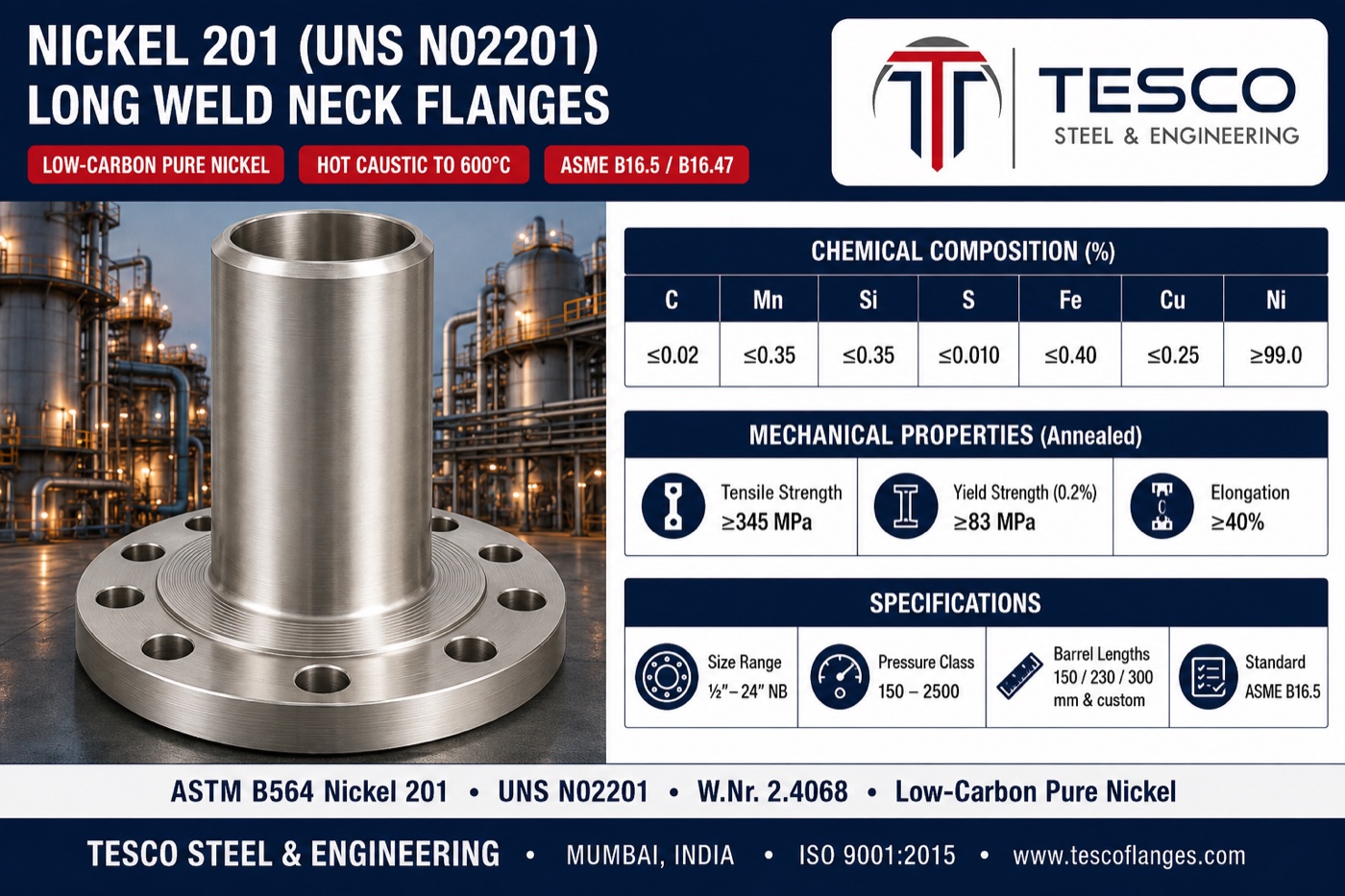
Nickel 201 Long Weld Neck Flanges — Specifications at a Glance
What is a Nickel 201 Long Weld Neck Flange?
The hot sibling, in the nozzle pattern. A Nickel 201 flange (UNS N02201, ASTM B564) whose neck continues as a long, heavy-walled straight barrel — the nozzle itself — bevelled for one closing butt weld at the caustic fusion pot, evaporator or vessel shell. The same 99.0% minimum nickel as Nickel 200, with carbon capped seven times tighter at 0.02% — one line of the specification, and the entire difference between 315 °C and ~600 °C. The franchise: molten anhydrous caustic and the hot halogen duties. Welds with ERNi-1, no PWHT; the joint keeps the full envelope. Supplied annealed — 345/83/40, the softest certificate on the bench, honestly. Flange ends per ASME B16.5, Classes 150–2500; barrel length and bore stated by you. EN 10204 3.1 on every lot.
The same crown into the fusion range — molten anhydrous alkali
This page
Dual-certified 200/201
≤0.02%
Both chapters
One stock, either specification line — the warehouse answer
Quoted on request
The rule of the pair: same chemistry map, same franchises — read the temperature column, and above 315 °C the name changes to 201; dual certification removes the question from the warehouse entirely.
What the Tighter Cap Buys
The Fusion Range, Unlocked
With almost no carbon to graphitise, the caustic franchise runs to ~600 °C — fusion pots, final-concentration evaporators and molten-alkali piping, specified by name.
No Graphitisation Clock
Above 315 °C, 200's trace carbon precipitates as grain-boundary graphite — no stabiliser exists and no PWHT cures it; in a pure metal the only fix is less carbon, and 201 is that fix.
Welds Keep the Envelope
ERNi-1 joints carry the full 600 °C rating through filler and HAZ alike — no ageing, no re-treatment, no local exception at the closing weld.
One Certificate, Both Grades
Dual-certified 200/201 — melted to the tight cap, certified to both chapters — serves either specification line and ends the 315 °C question at the warehouse.
Specification Notes — Getting Nickel 201 Long Weld Necks Right
Three honest notes.The certificate is the softest on this bench: 345/83 MPa — gentler even than Nickel 200's 380/103, because the removed carbon was also the strengthener; the class system carries the ratings, and at 201's temperatures the B16.5 derating curves bite hard — choose the class from the tables at temperature, not at ambient. Below 315 °C, 200 is the standard answer: buying 201 for cold duty pays the low-carbon premium for a ceiling the service never approaches — unless one dual-certified stock is the goal, which we quote gladly. And wet chlorine is still not dry: the halogen franchise reads dry gas at every temperature — moist chlorine chemistry belongs to titanium and the Hastelloy bench, hot or cold.
How Our Nickel 201 LWN Flanges Are Manufactured
1
Forging — each piece individually forged from certified N02201 heats (dual-certified 200/201 where available) kept segregated on the nickel shelf, with the barrel integral — no welded build-ups.
2
Annealing — the pure metal's one heat treatment: softened and homogenised, nothing to precipitate, nothing to age; records retained against the heat number.
3
Verification — chemistry per heat with the carbon certified against the 0.02% cap — the number the grade exists for; mechanicals per heat at the 345/83 line.
4
Machining — flange end to ASME B16.5; barrel turned to pattern (standard / HB / equal) and bored to the ordered schedule or drawing; RF serrations, flat face or RTJ groove per B16.20; weld end bevelled 37.5°.
5
Testing & marking — PMI reads the pure-nickel signature on every piece — and the paperwork, not the spectrometer, separates 201 from 200: heat-number traceability is the guarantee; marked with grade, size, schedule and heat number.
6
Certification & packing — EN 10204 3.1 MTC (3.2 witnessed on request); WPS guidance naming the ERNi-1 filler and the cleanliness rule; faces and bevels protected, packed sea-worthy.
Where Nickel 201 LWN Flanges Are Used
Where the process sheet says molten or hot: caustic fusion plants — fusion pots, final-concentration evaporator bodies, molten anhydrous caustic and potash piping — the hot ends of chlor-alkali and fluorochemical systems where dry chlorine and hydrogen chloride run above the 315 °C line, fused-salt heat-treatment and electrochemical equipment, the drying and calcining hot spots of food and fibre chemistry, and the fusion-pot nozzles, instrument standpipes and transfer connections that ride on all of them. The chemistry and the temperature are the load, one forging, one closing weld. Production and supply below:
Long Weld Necks — Machined at Our WorksLong Weld Neck — Heavy Barrel, Bevelled Weld EndDN600 RF Long Weld Neck — Large Diameter, B16.5 Drilling
Nickel 201 LWN Flange Dimensions
Flange-end dimensions are class-governed per ASME B16.5 (ratings per the nickel material group — checked at the service temperature); barrel length and bore per order. Full class-by-class charts:
Seven elements — the temperature column names the grade:
1
Size & standard — e.g. 6″ NB ASME B16.5.
2
Pressure class & facing — 150#–2500#, checked against the derating tables at the service temperature; RF, FF or RTJ with ring number.
3
Barrel length — overall, face to weld end: 150 / 230 / 300 mm stock or any stated length.
4
Barrel bore & pattern — pipe schedule to match or finished bore in mm; standard, heavy barrel or equal barrel; weld-end prep if non-standard.
5
Grade line & temperature — ASTM B564 Nickel 201 (UNS N02201) with the service temperature and its excursions named; Nickel 200 quoted below 315 °C, dual-certified 200/201 where one stock should serve both duties.
6
Certification — EN 10204 3.1 with the carbon certified against the 0.02% cap (our standard) / 3.2 witnessed.
Example: “LWN Flange RF, 4″ NB, ASME B16.5 Class 300, barrel 230 mm, Sch 80 bore, heavy-barrel pattern, ASTM B564 Nickel 201 UNS N02201, caustic fusion pot nozzles — anhydrous NaOH at 480 °C, EN 10204 3.1 — 4 pcs.” Quotations normally within 24 hours with price, unit weight and delivery.
A Nickel 201 long weld neck flange is a forged low-carbon commercially pure nickel flange — UNS N02201, W.Nr. 2.4068, supplied to ASTM B564 — whose neck continues as a long, heavy-walled straight barrel that is itself the nozzle, bevelled at its far end for one closing butt weld made out at the caustic fusion pot, evaporator or vessel shell. Nickel 201 is the hot sibling of the pure-nickel pair: the same 99.0% minimum nickel as Nickel 200, with carbon capped seven times tighter at 0.02% — and that one line of the specification is the entire difference between a 315°C metal and a 600°C one. It carries the caustic crown into the fusion range — molten anhydrous alkali — along with the hot ends of the halogen duties. Flange ends follow ASME B16.5 in Classes 150 to 2500; the barrel is machined to the ordered length and bore. Supplied annealed at 345/83 MPa with EN 10204 3.1/3.2 certification.
How does a long weld neck differ from a standard weld neck flange?
Geometry and mission. A standard weld neck's hub tapers quickly down to the pipe's outside diameter and wall, ending in a weld bevel a few centimetres from the flange face — it is built to butt-weld to pipe and continue as a piping run. A long weld neck keeps a full-section straight barrel for its entire length: no taper to pipe dimensions, wall far heavier than the matching schedule, length made to order. The mission follows the shape — the LWN is not a fitting on a pipe run but a nozzle in its own right, projecting through insulation, vessel walls or exchanger channels, with the butt weld relocated to the shell side where the fabricator wants it. In one certified forging it replaces the weld neck flange, the pipe nipple and one whole circumferential weld.
What changes from Nickel 200 — one line of the specification?
Exactly one number. Set the two specifications side by side and every line matches — nickel 99.0% minimum, the same trace ceilings on copper, iron, manganese, silicon and sulphur — except carbon: Nickel 200 allows 0.15%, Nickel 201 caps it at 0.02%. A factor of seven, in an element present only as an impurity, and it rewrites the service envelope: 200 stops at 315°C, 201 carries the same chemistry to roughly 600°C. Nothing else is gained and one small thing is paid — the removed carbon was also the pure metal's modest strengthener, so 201's certificate reads gentler — but the corrosion behaviour, the weldability and the fabrication character are the sibling's, unchanged. It is the purest expression of the carbon story this site has told across its whole bench: from the stainless L-grades' 0.030% to the H-grades' guaranteed floors, ending here, where even a pure metal keeps a low-carbon sibling for the heat.
Why does carbon matter in a pure metal above 315°C?
Because dissolved carbon does not stay dissolved forever. At ordinary temperatures the trace carbon in Nickel 200 sits harmlessly in solution — but hold the metal above roughly 315°C for extended service and that carbon migrates to the grain boundaries and precipitates as graphite films, embrittling the structure from within. The mechanism is intergranular graphitisation — a cousin of the sensitisation stories the stainless bench tells, but with graphite in place of chromium carbide, and with no chromium depletion needed to do the damage: the graphite itself is the defect. There is no stabiliser to add and no post-weld cure — in a metal whose whole identity is purity, the only fix is less carbon, which is precisely what Nickel 201 is: a melt discipline, not an alloy. With the cap at 0.02% there is almost nothing left to precipitate, and the graphitisation clock effectively never runs — which is why every specification for hot caustic equipment above 315°C writes 201 by name.
What is the chemical composition of Nickel 201 (UNS N02201)?
Nickel 99.0% minimum, carbon ≤0.02% — and the rest are the same trace ceilings as Nickel 200: copper ≤0.25%, iron ≤0.40%, manganese ≤0.35%, silicon ≤0.35%, sulphur ≤0.010%. The certificate reads like its sibling's — proof of absence, with the nickel floor the only minimum — but the line that buys the page is the carbon cap, seven times tighter than 200's 0.15%. The sulphur ceiling matters as much here as anywhere in the nickel family, guarding the hot workability and weldability that sulphur destroys. Chemistry is verified per heat with the carbon certified against the 0.02% cap — the number the whole grade exists for — PMI-confirmed on the pure-nickel signature, and travels on the EN 10204 3.1 MTC. Dual-certified 200/201 material, melted to the tight cap and certified to both chapters, is available and often the practical answer, as the decision FAQ explains.
What are the mechanical properties of Nickel 201 long weld neck flanges?
Annealed to ASTM B564: tensile strength 345 MPa (50 ksi) minimum, yield strength 83 MPa (12 ksi) minimum, elongation 40% minimum — gentler even than Nickel 200's 380/103, because the removed carbon was also the pure metal's modest strengthener. This is the softest certificate on our entire long weld neck bench, and the honest framing is the sibling's: pure nickel is bought for chemistry, not muscle, and the class system carries the engineering — B16.5's tables assign the nickel group's ratings against the soft numbers, a properly classed flange carries its rated duty with full margins, and the heavy LWN barrel adds stiffness where nozzle loads bear. At temperature the trade reverses into the grade's favour: above 315°C, where 200 is excluded outright, 201's retained strength is not a compromise but the only pure-nickel option on the table — and 40% elongation absorbs every fabrication step from forging to the closing weld.
What is the caustic-fusion franchise — the crown, hotter?
The finishing end of the caustic ladder the Nickel 200 page climbs. Caustic soda and potash concentrate through evaporation toward the anhydrous product, and the final stage — fusion — runs molten: anhydrous caustic at temperatures far beyond the 315°C line, held in equipment that only low-carbon pure nickel serves without embrittling or dissolving. That is Nickel 201's home ground: fusion pots and their nozzles, final-concentration evaporator bodies, molten-alkali piping and the transfer systems between them, specified by name in every caustic plant whose flowsheet reaches the anhydrous product. The rest of the pure metal's franchise map carries over at its hot end too — dry chlorine and hydrogen chloride gas duties running above the 315°C line, fluorine service, and the fused-salt electrochemistry where nickel's alkali immunity does the work. Where the process sheet says molten alkali, the materials column says Nickel 201 — there is no second candidate to argue with.
What is the ASTM B564 specification for Nickel 201 flanges — and what is dual certification?
The same shared nickel forging standard as the sibling's, one chapter over: ASTM B564 (ASME SB-564) carries N02201's forged flanges, with B160 bar, B161 seamless pipe and B162 plate around it to the same chemistry. The purchasing subtlety worth knowing is dual certification: because 201's requirements sit inside 200's — the same floors and ceilings with only the carbon cap tighter — a heat melted to 0.02% carbon can be certified as both N02200 and N02201 on one document. Mills do exactly that, and dual-certified 200/201 material resolves the sibling choice on the certificate itself: one stock serves cold duty and hot, specifications reading either grade are satisfied, and the 315°C question never needs to be answered at the warehouse. We quote dual-certified material wherever availability allows. Nothing changes at the flange end — dimensions, drilling and facings per ASME B16.5, ratings per the nickel group's tables, order line 'ASTM B564 Nickel 201 (UNS N02201)' or the dual form.
Beyond molten caustic — what else does Nickel 201 serve?
Everything its sibling serves, with the thermometer as the tiebreaker. The halogen duties run hotter than they look: dry chlorine and hydrogen chloride gas systems operate well above 315°C at their reaction ends, and there 201 takes over the franchise the 200 page describes — the same stable chloride and fluoride films, without the graphitisation clock. Fluorine and fluorochemical service follows the same rule. The product-purity duties — food evaporation, rayon chemistry, fine chemicals — mostly live below the line and stay with 200, but their hot spots (drying, calcining, fused-salt steps) specify 201. And one franchise is the hot sibling's alone: fused-salt and molten-metal work, from heat-treatment salt pots to electrochemical cells, where the combination of alkali immunity and structural stability at red heat has no pure-metal rival. The rule of thumb for purchasers is simple: same chemistry map as Nickel 200 — read the temperature column, and above 315°C the name changes to 201.
How is the closing weld on a Nickel 201 LWN made?
Exactly as on Nickel 200, with one anxiety removed. The consumable is the same ERNi-1 — pure nickel filler, titanium-deoxidised — and the same iron rule of cleanliness applies: nickel punishes sulphur, so paint, crayon, oil and grime must be gone before the arc strikes; the pool runs sluggish, favouring modest heat input and the good access the LWN's straight barrel provides. No preheat beyond dryness, no PWHT, nothing to sensitise. The removed anxiety is the weld zone's future: on a 200 fabrication destined for hot service, every weld region is metal that will spend its life above the graphitisation line, and only the 0.02% cap protects it — welded 201 carries its full 600°C envelope through the joint, filler and HAZ alike, with no ageing, no re-treatment and no local exception to the service ceiling. The closing weld at the fusion pot or shell inherits the plant's own qualified procedure, and WPS guidance travels with every supply, filler class stated.
How are the barrel length and bore of a LWN specified?
Two numbers that belong on every enquiry. Length: measured overall from the flange face to the weld end — 150 mm (6"), 230 mm (9") and 300 mm (12") are the common stock lengths, and any length machines to order; state it explicitly, because 'long' is not a dimension. Bore: the barrel is drilled and bored to order — most commonly to match the inside diameter of the connecting pipe schedule, sometimes cylindrical special bores for level bridles, instrument standpipes or restriction work; state the schedule or the finished bore in millimetres. Add the weld-end preparation (standard 37.5° bevel unless told otherwise) and the nozzle is fully defined.
Nickel 200 or Nickel 201 — how is the choice actually made?
By the service temperature, with dual certification as the practical escape from choosing at all. Below 315°C either grade serves, and 200 is the standard answer — marginally stronger, marginally more available, the default of the two chapters. Above 315°C there is no choice: 201 by name, because the graphitisation mechanism excludes its sibling outright. The interesting band is the uncertain middle — a process that mostly runs warm but excursions hot, a plant standard that wants one nickel stock for both duties, a fabrication whose weld zones will see the hot end even if the run pipe does not. There the clean answer is dual-certified 200/201: one melt to the tight carbon cap, certified to both, satisfying either specification line and removing the 315°C question from the warehouse forever. State the service temperature and its excursions on the enquiry — the quotation names the grade, or the dual form, accordingly, and both pages of the pure-nickel pair link each other for the full story.
What sizes and pressure classes do Nickel 201 LWN flanges come in?
Flange ends follow ASME B16.5 from ½" to 24" NB in Classes 150, 300, 400, 600, 900, 1500 and 2500 — with the full class-by-class LWN dimension charts on this site — and larger diameters forge to order against B16.47 or drawing dimensions. The order book mirrors the hot franchise: caustic fusion and final-concentration systems concentrate in Classes 150 and 300 — the chemistry and the temperature, not the pressure, are the load — while hot halogen-gas systems and fused-salt equipment specify their classes per the unit's piping specification. Note that at 201's service temperatures the B16.5 derating curves bite hard, so the class for a 500°C nozzle is chosen from the tables at temperature, not at ambient — a check our quotation runs as standard. State size, class, barrel length and bore together — the four numbers define the forging — with the service temperature named, and our quotation returns price, unit weight and delivery per class.
What details are needed to get an accurate Nickel 201 LWN flange quotation?
Seven elements plus commercial terms: (1) size and dimensional standard — e.g. 6" NB ASME B16.5; (2) pressure class — 150 to 2500, checked against the derating tables at the service temperature; (3) facing — RF (the default), FF or RTJ with ring number; (4) barrel length overall, face to weld end — 150/230/300 mm stock or any stated length; (5) barrel bore — pipe schedule to be matched or finished bore in millimetres, with pattern (standard, heavy barrel, equal barrel) and weld-end prep if non-standard; (6) the grade line — ASTM B564 Nickel 201, UNS N02201 — with the service temperature and its excursions named, and dual-certified 200/201 requested where one stock should serve both duties; (7) certification — EN 10204 3.1 with the carbon certified against the 0.02% cap (our standard) or 3.2 witnessed. Add quantity and destination; quotations normally within 24 hours, with the alloy-market lead time quoted honestly.
Who manufactures Nickel 201 long weld neck flanges in India?
Tesco Steel & Engineering is an ISO 9001:2015 certified flange manufacturer based in Mumbai, India, producing Nickel 201 long weld neck flanges to ASTM B564 with B16.5 flange ends from ½" to 24" NB (larger to order) in Classes 150-2500, in standard, heavy-barrel and equal-barrel patterns — each forged individually from certified N02201 heats (dual-certified 200/201 where available) kept segregated on the nickel shelf, annealed, machined with the barrel bored to the ordered schedule or drawing, bevelled for the closing weld, PMI-checked on the pure-nickel signature with the carbon certified against the 0.02% cap, and marked with grade, size, schedule and heat number. Supplied with EN 10204 3.1/3.2 certification and WPS guidance naming the ERNi-1 filler — alongside the Nickel 200 LWN sibling, the Nickel 201 socketweld, weld neck and blind siblings, and the complete long weld neck range. Exported to more than 50 countries.