Nickel 200 Long Weld Neck Flanges — UNS N02200 Pure Nickel LWN Manufacturer
Tesco Steel & Engineering manufactures Nickel 200 long weld neck flanges — the pure metal on the alloy bench: ASTM B564, UNS N02200, W.Nr. 2.4066, commercially pure nickel at 99.0% minimum — with ASME B16.5 flange ends in Classes 150–2500 and the barrel made to order. The specification is written in reverse: everything except the nickel is a ceiling, and the certificate proves absence rather than presence — because in hot concentrated caustic soda, the crown franchise this page serves, everything added to nickel makes it worse. The caustic ladder climbs toward what this metal simply is: stainless holds the dilute duty, Monel the middle, Nickel 200 the crown — with dry chlorine, HCl gas, fluorine and the product-purity duties alongside. One honest number rules it: 315 °C, where the low-carbon Nickel 201 sibling takes over by name. A single-phase pure metal: welds with ERNi-1, no PWHT, nothing to sensitise. One forging, one closing weld. Facings: RF / FF / RTJ; small bore on the Nickel 200 socketweld. Every lot with EN 10204 3.1/3.2 MTC. ISO 9001:2015, made in Mumbai, India — exported to 50+ countries.
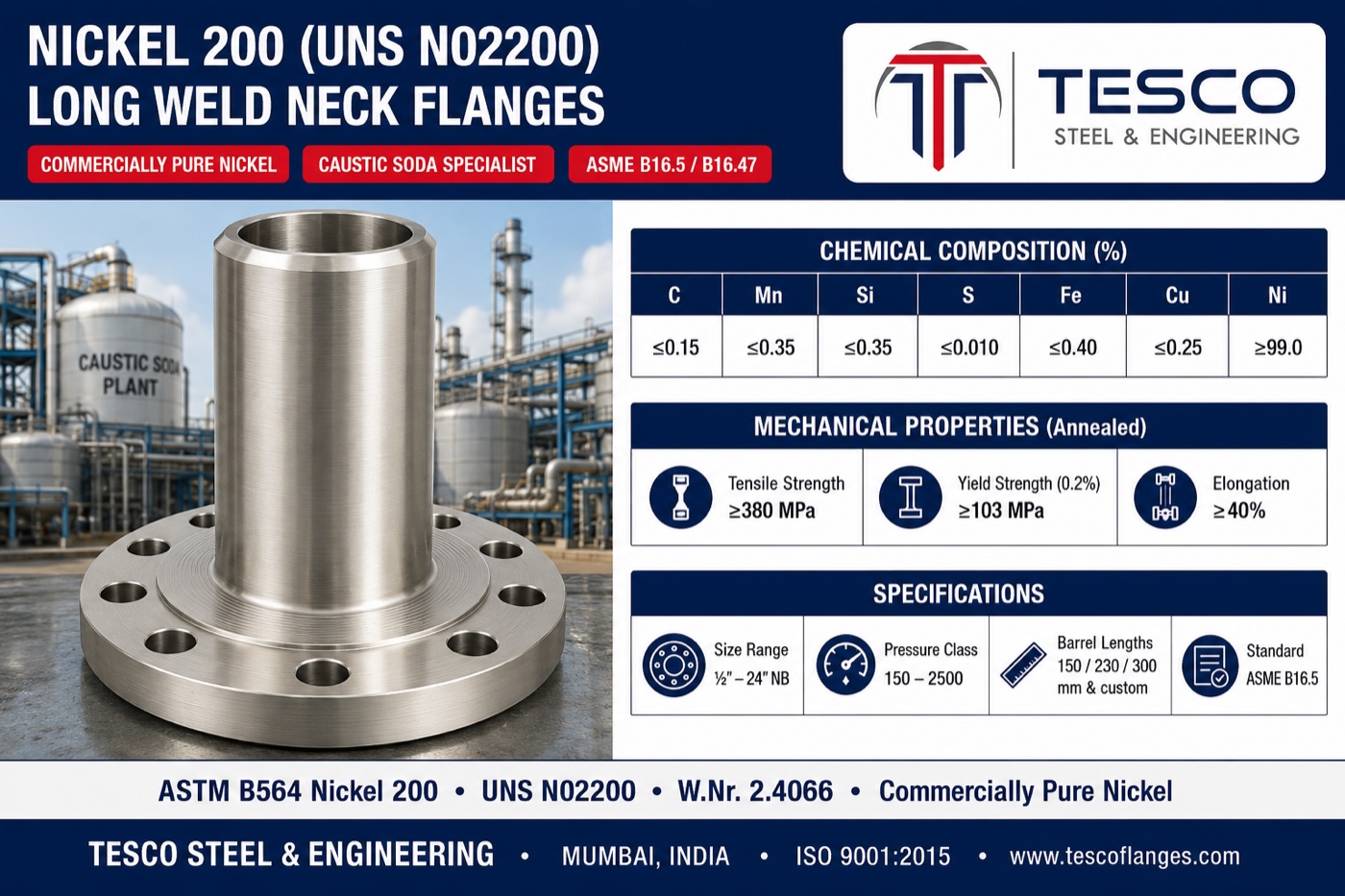
ASTM B564 · UNS N02200 · W.Nr. 2.4066Commercially Pure — Ni ≥99.0%The Caustic Crown — Hot Concentrated AlkaliDry Chlorine · HCl Gas · Fluorine315 °C Ceiling — 201 Above380 / 103 MPa AnnealedB16.5 Flange Ends · Class 150–2500EN 10204 3.1 / 3.2 · ISO 9001:2015
Nickel 200 Long Weld Neck Flanges — Specifications at a Glance
What is a Nickel 200 Long Weld Neck Flange?
The pure metal, in the nozzle pattern. A Nickel 200 flange (UNS N02200, ASTM B564) whose neck continues as a long, heavy-walled straight barrel — the nozzle itself — bevelled for one closing butt weld at the caustic evaporator, chlor-alkali vessel or storage shell. 99.0% nickel minimum; every other certificate line a ceiling on impurities — because in hot concentrated caustic, the crown franchise, alloying only gives the alkali something to attack. Serves to 315 °C — Nickel 201 above, by name. Welds with ERNi-1, no PWHT. Supplied annealed — 380/103/40, soft and honest: bought for chemistry, not muscle. Flange ends per ASME B16.5, Classes 150–2500; barrel length and bore stated by you. EN 10204 3.1 on every lot.
The rule of the crown: the whole nickel family exists to extend this metal's nobility into other enemies' territory — in hot concentrated caustic the ladder runs backwards, and the unalloyed element wins.
What Purity Buys
The Caustic Crown
From ~50% concentration hot to molten anhydrous fusion, pure nickel stands effectively alone — corrosion rates a fraction of every alternative, and no chromium for the alkali to leach.
The Halogen Franchise
Dry chlorine, hydrogen chloride gas and fluorine — nickel forms one of metallurgy's few stable fluoride films, serving chlor-alkali and fluorochemical plants at both ends of the process.
Colourless Ions — The Purity Duty
Nickel's corrosion products neither stain nor flavour — food processing, rayon and fine chemicals specify the pure metal to protect the product, not the plant.
Nothing to Sensitise, Nothing to Manage
A single-phase pure metal — ERNi-1 filler, no preheat, no PWHT, no precipitates, and 40% elongation absorbing every fabrication step.
Specification Notes — Getting Nickel 200 Long Weld Necks Right
Three honest notes.The 315 °C ceiling is real: above it Nickel 200's trace carbon graphitises at the grain boundaries — hot caustic duty in the fusion range belongs to Nickel 201 by name, or to dual-certified 200/201 material; state the service temperature on every enquiry. The certificate is soft and honestly so: 380/103 MPa is the gentlest on this bench — the B16.5 tables already reflect it in the nickel group's ratings, so trust the class system, not intuition, when selecting. And wet chlorine is not dry: the halogen franchise reads dry gas — moist chlorine and hypochlorite chemistry attack nickel and belong to titanium and the Hastelloy bench; name the moisture state when the duty is halogen.
How Our Nickel 200 LWN Flanges Are Manufactured
1
Forging — each piece individually forged from certified N02200 heats kept segregated on the nickel shelf, with the barrel integral — no welded build-ups.
2
Annealing — the pure metal's one heat treatment: softened and homogenised, nothing to precipitate, nothing to age; records retained against the heat number.
3
Verification — chemistry per heat with the 99.0% floor and every impurity ceiling certified — the certificate of absence; mechanicals per heat at the 380/103 line.
4
Machining — flange end to ASME B16.5; barrel turned to pattern (standard / HB / equal) and bored to the ordered schedule or drawing; RF serrations, flat face or RTJ groove per B16.20; weld end bevelled 37.5°.
5
Testing & marking — PMI reads the pure-nickel signature on every piece — 200 must mix with neither the Monel bins nor the 201 shelf; marked with grade, size, schedule and heat number.
6
Certification & packing — EN 10204 3.1 MTC (3.2 witnessed on request); WPS guidance naming the ERNi-1 filler and the cleanliness rule; faces and bevels protected, packed sea-worthy.
Where Nickel 200 LWN Flanges Are Used
Where the pure metal is the specification: caustic soda and caustic potash evaporation plants — evaporator bodies, high-concentration piping, fusion equipment — chlor-alkali cell rooms and their dry chlorine and hydrogen chloride gas systems, fluorine and fluorochemical production, salt works and food-grade evaporation, rayon and viscose fibre chemistry, electroplating and battery hardware, and the evaporator nozzles, instrument standpipes and level-bridle connections that ride on all of them. Modest pressures, unforgiving chemistry, one forging, one closing weld. Production and supply below:
Long Weld Necks — Machined at Our WorksLong Weld Neck — Heavy Barrel, Bevelled Weld EndDN600 RF Long Weld Neck — Large Diameter, B16.5 Drilling
Nickel 200 LWN Flange Dimensions
Flange-end dimensions are class-governed per ASME B16.5 (ratings per the nickel material group); barrel length and bore per order. Full class-by-class charts:
Seven elements — the service temperature decides between 200 and its hot sibling:
1
Size & standard — e.g. 6″ NB ASME B16.5.
2
Pressure class & facing — 150#–2500#; RF, FF or RTJ with ring number.
3
Barrel length — overall, face to weld end: 150 / 230 / 300 mm stock or any stated length.
4
Barrel bore & pattern — pipe schedule to match or finished bore in mm; standard, heavy barrel or equal barrel; weld-end prep if non-standard.
5
Grade line & temperature — ASTM B564 Nickel 200 (UNS N02200) with the service and its temperature named — the 315 °C ceiling checked, and Nickel 201 or dual-certified 200/201 quoted where the duty runs hot.
6
Certification — EN 10204 3.1 (our standard) / 3.2 witnessed.
Example: “LWN Flange RF, 8″ NB, ASME B16.5 Class 150, barrel 300 mm, Sch 40 bore, standard pattern, ASTM B564 Nickel 200 UNS N02200, caustic evaporator nozzles — 73% NaOH at 120 °C, EN 10204 3.1 — 6 pcs.” Quotations normally within 24 hours with price, unit weight and delivery.
A Nickel 200 long weld neck flange is a forged commercially pure nickel flange — UNS N02200, W.Nr. 2.4066, supplied to ASTM B564 — whose neck continues as a long, heavy-walled straight barrel that is itself the nozzle, bevelled at its far end for one closing butt weld made out at the caustic evaporator, chlor-alkali vessel or storage shell. Nickel 200 is the pure metal on the alloy bench: 99.0% nickel minimum, with every other line of the certificate a ceiling on impurities, holding the crown franchise of hot concentrated caustic soda along with dry chlorine, hydrogen chloride gas, fluorine and the product-purity duties of food and rayon chemistry. It serves to 315°C, where the low-carbon Nickel 201 sibling takes over by name. Flange ends follow ASME B16.5 in Classes 150 to 2500; the barrel is machined to the ordered length and bore. Supplied annealed at 380/103 MPa with EN 10204 3.1/3.2 certification.
How does a long weld neck differ from a standard weld neck flange?
Geometry and mission. A standard weld neck's hub tapers quickly down to the pipe's outside diameter and wall, ending in a weld bevel a few centimetres from the flange face — it is built to butt-weld to pipe and continue as a piping run. A long weld neck keeps a full-section straight barrel for its entire length: no taper to pipe dimensions, wall far heavier than the matching schedule, length made to order. The mission follows the shape — the LWN is not a fitting on a pipe run but a nozzle in its own right, projecting through insulation, vessel walls or exchanger channels, with the butt weld relocated to the shell side where the fabricator wants it. In one certified forging it replaces the weld neck flange, the pipe nipple and one whole circumferential weld.
Why is a pure metal on the alloy bench at all?
Because for a handful of chemistries, everything added to nickel makes it worse. The whole nickel bench — Monel's copper, Inconel's chromium, Hastelloy's molybdenum — exists to extend nickel's natural nobility into environments the pure metal cannot hold. Hot concentrated caustic runs the logic backwards: nickel itself is the most resistant common metal to molten and concentrated alkalis, and alloying additions only give the caustic something else to attack — chromium in particular dissolves selectively in the hottest caustic service. So the specification is written in reverse: nickel 99.0% minimum, and every other element a ceiling. The certificate's job is to prove absence rather than presence — the mirror image of every alloy datasheet on this site, where the value lives in what was added. On the caustic ladder the family climbs toward what Nickel 200 simply is: stainless holds the dilute and cool duty, Monel the middle, and the pure metal wears the crown.
What is the caustic franchise — the crown metal of hot alkali?
The service this page is really about. Caustic soda and caustic potash concentrate through evaporator trains toward the anhydrous product, and as concentration and temperature climb, the materials ladder shortens: stainless steels exit on stress corrosion and general attack, Monel serves the middle concentrations honourably, and from roughly 50% concentration hot up to molten anhydrous fusion, commercially pure nickel stands effectively alone — corrosion rates a fraction of every alternative, and no chromium for the alkali to leach. That is why chlor-alkali and caustic evaporation plants specify Nickel 200 by name for evaporator bodies, high-concentration piping, fusion equipment and the nozzles they flange with. The franchise extends to the halogens the same plants handle — dry chlorine and hydrogen chloride gas, and fluorine, where nickel's fluoride film protects — making the grade the chlor-alkali industry's house metal at both ends of the process.
What is the chemical composition of Nickel 200 (UNS N02200)?
Nickel 99.0% minimum — and that is the specification. Everything else is a ceiling on impurities: copper ≤0.25%, iron ≤0.40%, manganese ≤0.35%, carbon ≤0.15%, silicon ≤0.35%, sulphur ≤0.010%. Note there are no ranges anywhere except the nickel floor: nothing is added on purpose, and the certificate's job is to prove absence rather than presence. Two ceilings deserve attention: the sulphur limit of 0.010% guards the weldability and hot workability that sulphur destroys in nickel, and the carbon ceiling of 0.15% is the number that separates 200 from its hot sibling — above 315°C even that trace carbon matters, as the Nickel 201 FAQ explains. Chemistry is verified per heat, PMI-confirmed on the pure-nickel signature, and travels on the EN 10204 3.1 MTC.
What are the mechanical properties of Nickel 200 long weld neck flanges?
Annealed to ASTM B564: tensile strength 380 MPa (55 ksi) minimum, yield strength 103 MPa (15 ksi) minimum, elongation 40% minimum — the gentlest, most ductile certificate on this long weld neck bench, and honestly so: pure metals are soft, and Nickel 200 is bought for its chemistry, not its muscle. The engineering consequences are managed by the class system, exactly as everywhere else on the bench: B16.5's pressure-temperature tables for the nickel group already reflect the modest strength, so a properly classed Nickel 200 flange carries its rated duty with the same margins as any other grade — the tables simply assign lower ratings per class, and the heavy LWN barrel adds its own stiffness where nozzle loads bear. What the softness gives back is fabrication grace: 40% elongation absorbs forging, machining, cold springing of mating pipe and the closing weld without complaint, and there is no hardness limit to manage because nothing in the metal hardens.
What is the 315°C ceiling — and when does Nickel 201 take over?
The one number every Nickel 200 purchaser must know, and the site's carbon story told one last time — in a pure metal. Nickel 200's carbon ceiling of 0.15% is harmless at ordinary temperatures, but in extended service above 315°C the dissolved carbon migrates to the grain boundaries and precipitates as graphite, embrittling the metal from within — so the specifications cap Nickel 200 service at 315°C. Nickel 201 (UNS N02201) is the identical metal with carbon capped at 0.02%: nothing else changes, but with almost no carbon to graphitise, 201 carries the same caustic franchise up to roughly 600°C — which matters precisely because hot caustic duty often lives exactly there, in the fusion range. The practical rules: below 315°C either grade serves and 200 is standard; above it, 201 by name; and dual-certified 200/201 material — pure nickel melted to the 0.02% carbon cap and certified to both — resolves the choice on the certificate. Our Nickel 201 LWN page carries the hot sibling's own story.
What is the ASTM B564 specification for Nickel 200 flanges?
The return to the nickel bench's shared forging standard. After the one-alloy specifications of the previous rungs, Nickel 200 forges to ASTM B564 (ASME SB-564) — the nickel-alloy forging standard whose chapters span the whole family, from this page's pure metal through Monel, the Inconel grades and the Incoloy grades — one standard, many UNS numbers, N02200's chapter carrying the flanges this page describes. Around it sit the product-form siblings: B160 for bar and rod, B161 for seamless pipe and tube, B162 for plate, sheet and strip, all to the same N02200 chemistry. Nothing changes at the flange end: dimensions, drilling and facings follow ASME B16.5, with pressure-temperature ratings from B16.5's own tables for the nickel group. The order line reads 'ASTM B564 Nickel 200 (UNS N02200)' — and where service runs hot, the same line with Nickel 201 or dual-certified 200/201, as the ceiling FAQ explains.
Beyond caustic — what else does Nickel 200 serve?
Three families of duty follow the pure metal's chemistry. The halogens first: dry chlorine and dry hydrogen chloride gas to several hundred degrees, and fluorine, where nickel forms one of the few stable fluoride films in metallurgy — the reason the grade appears throughout chlor-alkali, fluorochemical and refrigerant plants. Product purity second, and less obvious: nickel's corrosion products are colourless and non-staining, so food processing (fatty acids, salt evaporation), synthetic fibre chemistry (the rayon and viscose tradition) and fine chemicals specify Nickel 200 not because the process would destroy another metal, but because another metal's ions would destroy the product. Electrochemistry third: nickel's own electrode behaviour serves electroplating anode systems and battery hardware. The common thread is the element's identity — where the duty wants nickel's own surface, unmodified, the pure metal is not one option among several: it is the specification.
How is the closing weld on a Nickel 200 LWN made?
Simply, with the nickel family's one iron rule: cleanliness. The metallurgy is as benign as it gets — a single-phase pure metal with nothing to precipitate, no preheat beyond dryness, no PWHT ever, and no sensitisation possible because there is nothing to sensitise. The consumable of record is ERNi-1, pure nickel filler with a touch of titanium to deoxidise the pool, keeping the joint's chemistry — and its caustic and halogen credentials — identical to the forging's. The care points are practical: nickel punishes sulphur above all, so paint, marking crayon, cutting oil and shop grime must be cleaned off before the arc strikes or the weld will crack; the weld pool runs sluggish, favouring modest heat input and good access — which the LWN's straight barrel provides by design; and penetration control matters more than on steel because the pool does not wet as far. The closing weld at the evaporator or shell inherits the plant's own qualified procedure, and WPS guidance travels with every supply, filler class stated.
How are the barrel length and bore of a LWN specified?
Two numbers that belong on every enquiry. Length: measured overall from the flange face to the weld end — 150 mm (6"), 230 mm (9") and 300 mm (12") are the common stock lengths, and any length machines to order; state it explicitly, because 'long' is not a dimension. Bore: the barrel is drilled and bored to order — most commonly to match the inside diameter of the connecting pipe schedule, sometimes cylindrical special bores for level bridles, instrument standpipes or restriction work; state the schedule or the finished bore in millimetres. Add the weld-end preparation (standard 37.5° bevel unless told otherwise) and the nozzle is fully defined.
Nickel 200 or Monel 400 — when does the pure metal beat the alloy?
By chemistry, cleanly. Monel 400 — nickel with a third copper — is the stronger, cheaper-per-duty generalist of the bench's lower rungs, and for seawater and hydrofluoric acid its copper is exactly what the service wants: those franchises are Monel's, and its own LWN page argues them. Nickel 200 wins where the copper would lose: hot concentrated caustic above Monel's comfortable middle concentrations, where the pure metal's rates stay low as the alloy's climb; dry chlorine, HCl gas and fluorine, where the unalloyed fluoride and chloride films protect best; and every product-purity duty, because copper ions stain and flavour precisely the way nickel's colourless ions do not. The decision usually writes itself from the process sheet: the caustic ladder's top, the halogens and the purity duties read Nickel 200; the seawater and HF pages read Monel; and where a plant runs both chemistries, both benches are stocked at our works and quoted side by side.
What sizes and pressure classes do Nickel 200 LWN flanges come in?
Flange ends follow ASME B16.5 from ½" to 24" NB in Classes 150, 300, 400, 600, 900, 1500 and 2500 — with the full class-by-class LWN dimension charts on this site — and larger diameters forge to order against B16.47 or drawing dimensions. The order book mirrors the habitat: caustic evaporation and chlor-alkali plants concentrate in Classes 150 and 300 — large evaporator and storage nozzles, modest pressures, the chemistry as the load — with the halogen-gas systems and pressure-bearing fine-chemical duty specifying higher classes where their piping specifications demand. The B16.5 tables assign the nickel group's ratings honestly against the soft certificate, so class selection follows the tables, not intuition. State size, class, barrel length and bore together — the four numbers define the forging — with the service temperature named so the 315°C ceiling is checked, and our quotation returns price, unit weight and delivery per class.
What details are needed to get an accurate Nickel 200 LWN flange quotation?
Seven elements plus commercial terms: (1) size and dimensional standard — e.g. 6" NB ASME B16.5; (2) pressure class — 150 to 2500; (3) facing — RF (the default), FF or RTJ with ring number; (4) barrel length overall, face to weld end — 150/230/300 mm stock or any stated length; (5) barrel bore — pipe schedule to be matched or finished bore in millimetres, with pattern (standard, heavy barrel, equal barrel) and weld-end prep if non-standard; (6) the grade line — ASTM B564 Nickel 200, UNS N02200 — with the service and its temperature named, so the 315°C ceiling is checked and Nickel 201 or dual-certified 200/201 material is quoted where the duty runs hot; (7) certification — EN 10204 3.1 (our standard) or 3.2 witnessed. Add quantity and destination; quotations normally within 24 hours, with the alloy-market lead time quoted honestly.
Who manufactures Nickel 200 long weld neck flanges in India?
Tesco Steel & Engineering is an ISO 9001:2015 certified flange manufacturer based in Mumbai, India, producing Nickel 200 long weld neck flanges to ASTM B564 with B16.5 flange ends from ½" to 24" NB (larger to order) in Classes 150-2500, in standard, heavy-barrel and equal-barrel patterns — each forged individually from certified N02200 heats kept segregated on the nickel shelf, annealed, machined with the barrel bored to the ordered schedule or drawing, bevelled for the closing weld, PMI-checked on the pure-nickel signature on every piece, and marked with grade, size, schedule and heat number. Supplied with EN 10204 3.1/3.2 certification and WPS guidance naming the ERNi-1 filler — alongside the Nickel 200 socketweld, weld neck and blind siblings, the Nickel 201 hot sibling, the Monel bench and the complete long weld neck range. Exported to more than 50 countries.