UNS N02200 Slip On Flanges — Nickel 200 Manufacturer
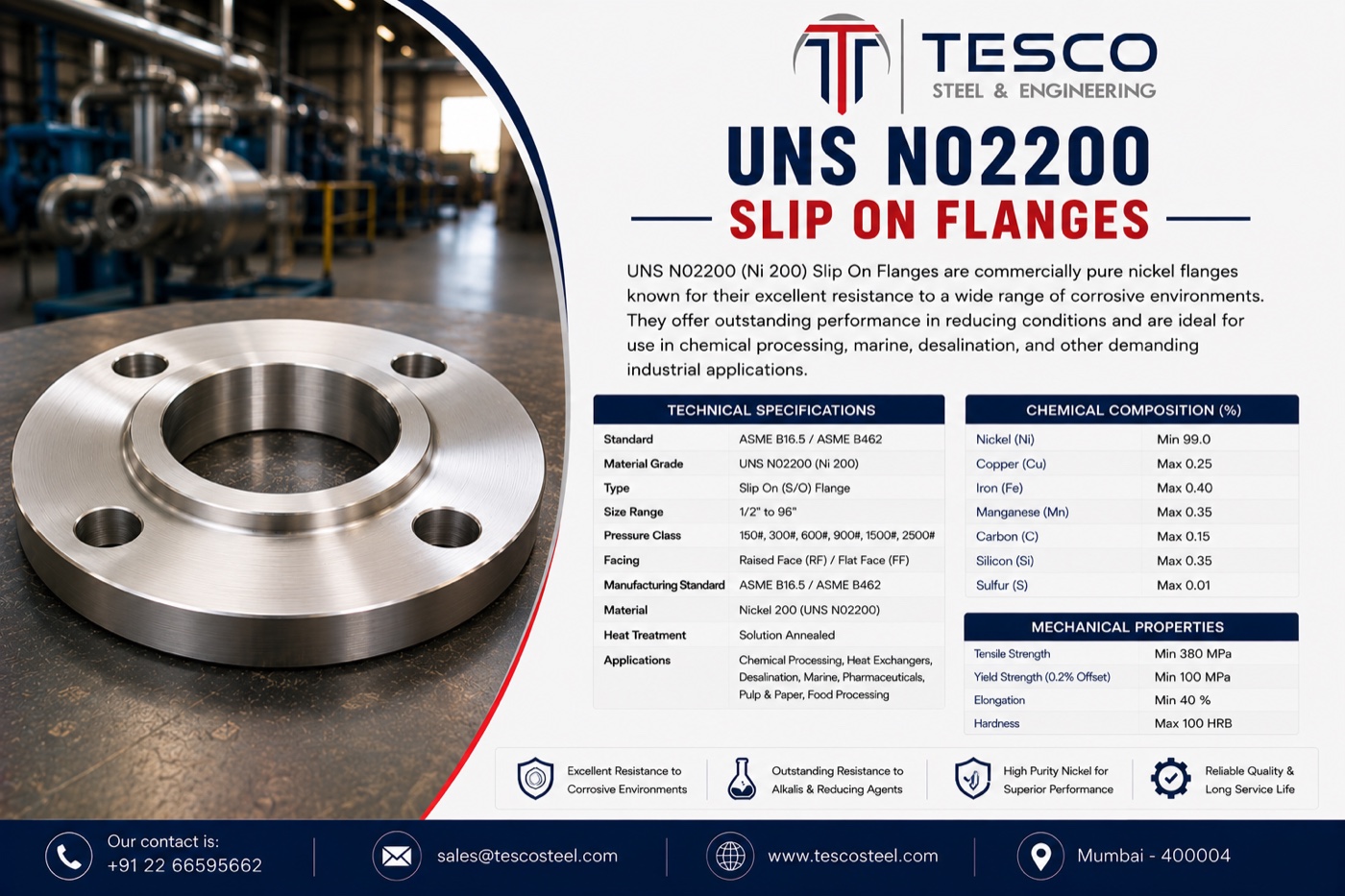
Tesco Steel & Engineering forges Nickel 200 slip on flanges — commercially pure wrought nickel, 99.0% minimum (UNS N02200, Werkstoff 2.4060) — to ASTM B564 and ASME B16.5 Class 150–2500 from ½″ to 24″ NB, larger patterns to order. The definitive caustic soda metal: essentially inert in NaOH and KOH at every concentration where stainless cracks, at home in dry chlorine and fluorine, immune to chloride SCC, and carrying the purity credentials food and fine-chemical plants specify. One honest line in its book: above 315 °C the duty passes to low-carbon Nickel 201 — we forge both. Supplied annealed, every lot with EN 10204 3.1/3.2 MTC. ISO 9001:2015, made in Mumbai, India — exported to 50+ countries.
Nickel 200 Slip On Flange — Specifications at a Glance
What is a UNS N02200 Slip On Flange?
Nickel 200 = the element itself, doing the work.99.0% minimum pure nickel (UNS N02200 / 2.4060) — the simplest chemistry on this site and the definitive caustic soda metal: inert in NaOH/KOH at every concentration, sound in dry chlorine and fluorine, food-grade clean, chloride-SCC immune — and, uniquely here, magnetic. One rule: above 315 °C its carbon graphitises — hotter duty belongs to Nickel 201. As a slip-on: two fillet welds with ERNi-1 filler, no preheat, no PWHT — forged to ASTM B564, not A182.
Also searched as: Nickel 200 slip on flange, Ni 200 SORF flange, pure nickel slip on flange, commercially pure nickel flange, ASTM B564 N02200 slip on flange, 2.4060 slip on flange — all refer to the product on this page. For the low-carbon twin see Nickel 201 slip on flanges.
Rule of thumb: every alloying addition trades away some of pure nickel's caustic serenity to buy strength, price or heat. When the duty is hydroxides and halogens at honest temperatures, the undiluted element remains the answer.
Nickel 200 (UNS N02200) Chemical Composition
Ni (+Co)
Cu
Fe
Mn
C
Si
S
99.0 min
0.25 max
0.40 max
0.35 max
0.15 max
0.35 max
0.01 max
Values in weight % for UNS N02200 per ASTM B564. The number to watch is the carbon: harmless below 315 °C, but above it the permitted 0.15% precipitates as grain-boundary graphite and embrittles the metal — the entire reason Nickel 201 (C 0.02 max) exists.
Nickel 200 Mechanical Properties
Tensile Strength, MPa (ksi)
Yield Strength 0.2%, Min, MPa (ksi)
Elongation % min (2")
Density
380 (55) min
105 (15) min
40
8.89 g/cm³
Per ASTM B564, annealed condition. Pure nickel is deliberately soft and exceptionally ductile — gasket faces seat beautifully — and tough from cryogenic temperatures upward with no ductile-brittle transition. Values demonstrated per heat on the EN 10204 certificate.
UNS N02200 Slip On Flange Specifications
Nickel 200 Slip On Flanges are available in the following specifications:
ASME SB-564 is the boiler-code twin. System partners follow the same B-series logic: ASTM B161 seamless pipe, ASTM B162 plate and ASTM B366 welding fittings (WPN; WPNL for 201). Not an A182 grade — nickel-alloy flanges are governed by the B-series standards.
Why Nickel 200 Slip Ons Are Specified
The Caustic Soda Metal
Essentially inert in NaOH and KOH from dilute to molten anhydrous — the concentrations and temperatures where stainless steels crack. Chlor-alkali plants are built around it.
Halogen-Gas Capable
Dry chlorine and fluorine at ambient and warm conditions — the chemistry that retires most other metals on contact.
Purity You Can Certify
99% of a single element: no chromium, no copper, nothing to leach — the clean choice for food, pharmaceutical and electronic chemistry, PMI-verifiable on every lot.
Ductile, Tough, Honest
40% elongation, cryogenic toughness, no ductile-brittle transition, nothing to sensitise in welding — the metallurgy is as simple as the analysis.
Three lines define where pure nickel stops.Temperature: above 315 °C the permitted 0.15% carbon precipitates as grain-boundary graphite and embrittles the metal — hot caustic evaporators and molten-salt duty specify Nickel 201 (C 0.02 max, good to ~600 °C). Oxidising media: nitric acid, ferric and cupric salts and wet chlorine attack chromium-free nickel. Sulphur: sulphur-bearing atmospheres embrittle nickel above ~370 °C, and welding demands sulphur-clean joints. State the service temperature on the enquiry and we confirm 200 or 201 with the quotation.
How Our Nickel 200 Slip On Flanges Are Manufactured
1
Forging — cut billet of certified N02200 heat is hot-forged into the flange blank, keeping full heat traceability from raw material to despatch.
2
Annealing — softened and homogenised per ASTM B564; furnace record retained.
3
Machining — hub, faces and bolt holes to ASME B16.5; the bore machined slightly over pipe OD per the slip-on tolerance.
4
Facing & finish — SORF raised face with serrated stock finish, flat face or RTJ groove.
5
Testing & marking — mechanical and chemical verification against the heat (PMI where the order specifies), then permanent marking of standard, grade, size, class and heat number.
6
Certification & packing — EN 10204 3.1 MTC (3.2 witnessed on request), export-packed for sea or air freight.
Where UNS N02200 Slip On Flanges Are Used
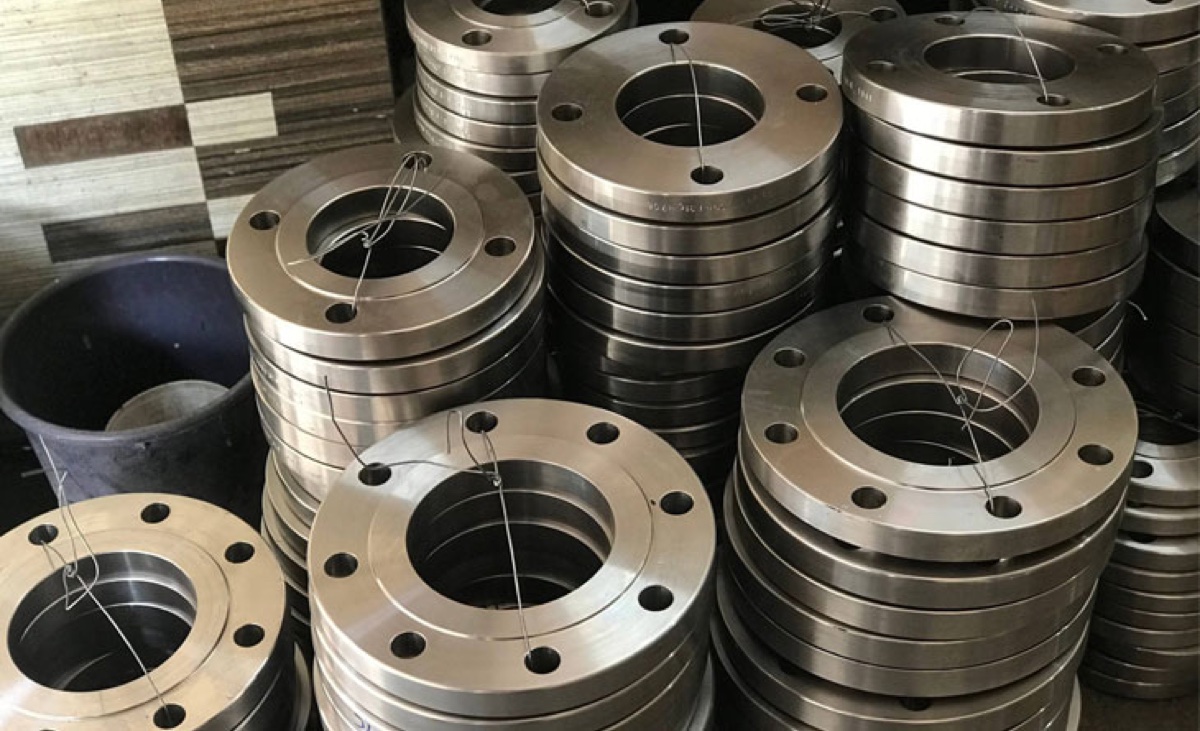
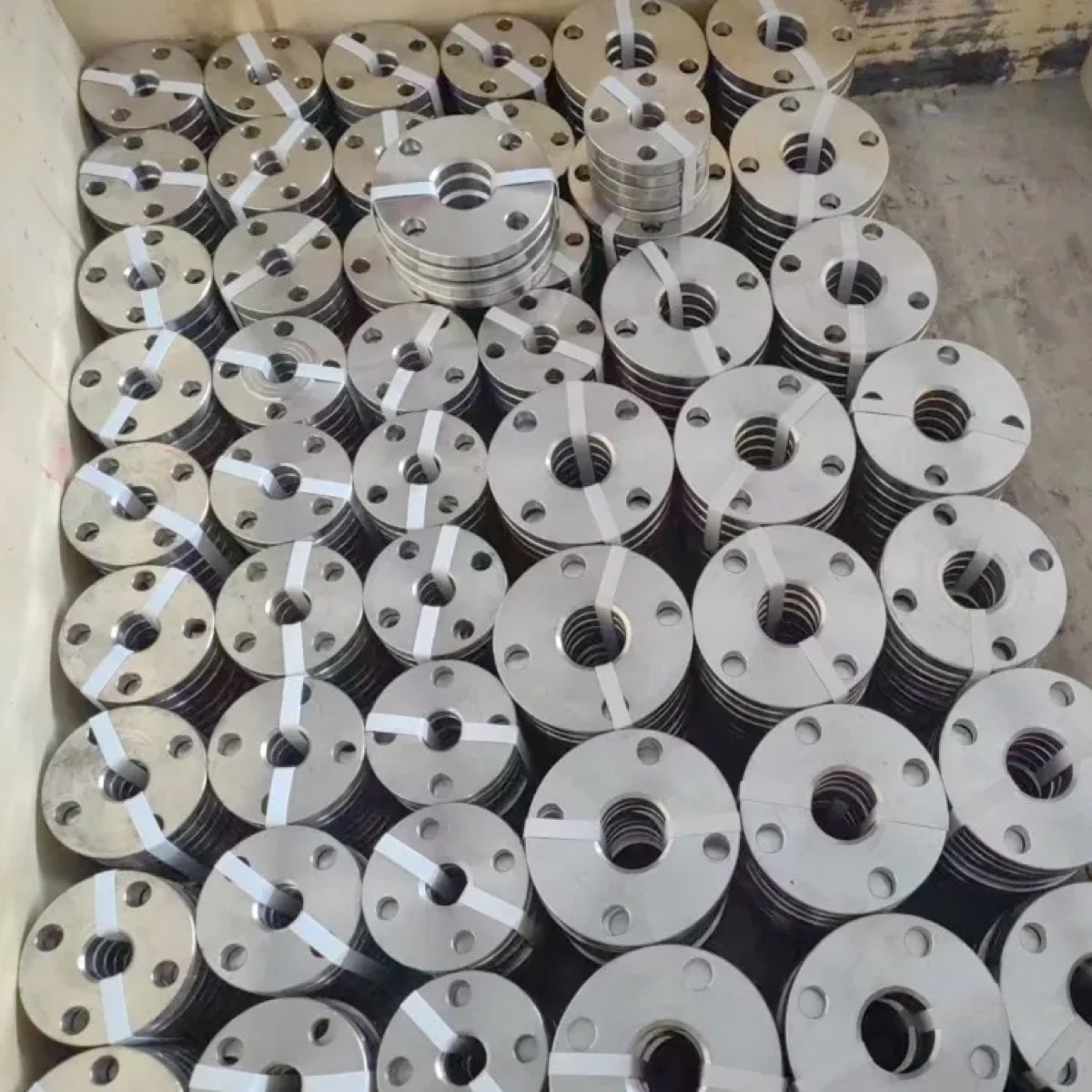
Chlor-alkali and caustic plants first — evaporators, storage, transfer and dilution systems — then dry chlorine and fluorine gas lines, food processing where product purity rules, pharmaceutical and fine-chemical synthesis, viscose rayon production, and electroplating chemistry. Slip-ons serve the utility, transfer, tank and vent connections; weld necks take the critical lines. Slip-on production below:
Slip On Flanges — Wired Bundles Ready for DespatchEN 1092-1 Type 01 Plate / Slip On Flanges — Strapped Bundles
UNS N02200 Slip On Flange Dimensions
Nickel 200 slip-on dimensions follow the ASME B16.5 slip-on tables — identical for every material. Full charts by class:
Example: “Slip On Flange, 4″ NB, ASME B16.5 Class 150, RF, Nickel 200 / ASTM B564 (N02200), EN 10204 3.1 — 10 pcs.” Quotations normally within 24 hours with price, unit weight and delivery.
UNS N02200 Slip On Flanges — Frequently Asked Questions
What is a UNS N02200 slip on flange?
It is a slip-on flange forged from Nickel 200 — commercially pure wrought nickel, 99.0% minimum (UNS N02200, ASTM B564, Werkstoff 2.4060) — dimensioned to ASME B16.5. The flange slides over the pipe end and is secured with two fillet welds. Pure nickel is the definitive material for caustic soda and caustic potash at every concentration, handles dry chlorine and fluorine, is immune to chloride stress corrosion cracking, and carries the purity credentials that food and fine-chemical plants specify.
What is Nickel 200?
The simplest alloy on this site — because it is barely an alloy at all. Nickel 200 is commercially pure wrought nickel: at least 99.0% of the single element, with only traces of copper, iron, manganese, silicon and carbon permitted. Everything the nickel-alloy family does ultimately traces back to this metal's own nobility in reducing environments, and Nickel 200 delivers that nobility undiluted. Designations: UNS N02200, Werkstoff 2.4060, often written Ni 200 or CP nickel; forged flanges are governed by ASTM B564.
What is the chemical composition of Nickel 200?
For UNS N02200: nickel (plus cobalt) 99.0% minimum, copper 0.25% max, iron 0.40% max, manganese 0.35% max, carbon 0.15% max, silicon 0.35% max and sulphur 0.01% max. The one limit that matters most in service is the carbon: up to 0.15% is permitted, which is fine below 315 °C but embrittles by graphitisation above it — the entire reason the low-carbon twin Nickel 201 (C 0.02% max) exists.
What are the mechanical properties of Nickel 200 slip on flanges?
Per ASTM B564 in the annealed condition: tensile strength 380 MPa (55 ksi) minimum, 0.2% yield strength 105 MPa (15 ksi) minimum and elongation 40% minimum. Pure nickel is deliberately soft and exceptionally ductile — gasket faces seat beautifully — and it is tough from cryogenic temperatures upward with no ductile-brittle transition. Density is 8.89 g/cm³. Values are demonstrated per heat on the EN 10204 certificate.
Why is Nickel 200 the caustic soda metal?
Because no engineering metal resists sodium and potassium hydroxide better. Stainless steels suffer caustic stress corrosion cracking as concentration and temperature rise; pure nickel remains essentially inert across the full range — dilute solutions, 50% and 73% evaporator liquor, even anhydrous molten caustic. Chlor-alkali and caustic evaporation plants are built around it, with the one caveat that above 315 °C the low-carbon Nickel 201 version takes over. Oxidisable impurities such as chlorates accelerate attack and are controlled by the process, not the metal.
What is the difference between Nickel 200 and Nickel 201?
One number in the analysis: carbon. Nickel 200 permits up to 0.15% carbon, and above roughly 315 °C (600 °F) that carbon precipitates as graphite along grain boundaries, embrittling the metal — so 200 is limited to 315 °C. Nickel 201 (UNS N02201) caps carbon at 0.02%, removing the mechanism and extending service to about 600 °C, which is why hot caustic evaporators and molten-salt duty specify 201. Corrosion behaviour is otherwise identical. Below 315 °C, 200 is the standard and slightly stronger grade; we forge both.
What is the difference between Nickel 200 and Monel 400?
Monel 400 is nickel diluted with a third copper — cheaper per unit of corrosion duty, roughly twice as strong, and better against flowing seawater. Nickel 200 answers where purity of performance matters: it is measurably better in hot concentrated caustic (the copper in Monel can leach into strong hydroxides), it is the cleaner choice for food-grade and fine-chemical service, and it handles dry chlorine and fluorine gas. Typical split: Monel for marine and HF-acid systems, pure nickel for caustic and chlor-alkali chemistry.
How does Nickel 200 compare with Inconel 600?
Inconel 600 is nickel with 15% chromium and some iron — the chromium adds oxidation resistance and high-temperature strength, making 600 the step up for hot, oxidising or mixed environments up to furnace temperatures. Nickel 200 counters with the best caustic resistance of all (chromium is a liability in the strongest hydroxides), lower cost, and its unmatched purity story. The practical border: wet reducing chemistry and caustic stay with pure nickel; add heat, oxygen or sulphur-free furnace atmospheres and the enquiry moves to Inconel.
Is Nickel 200 magnetic?
Yes — a genuine curiosity among corrosion alloys. Pure nickel is one of only three elements ferromagnetic at room temperature (with iron and cobalt), and Nickel 200 keeps that magnetism up to its Curie point of about 355 °C. A magnet therefore sticks to a pure-nickel flange while sliding off most stainless and nickel-alloy neighbours — a useful quick identity check in the warehouse, though PMI remains the formal verification we offer on every lot.
Where does Nickel 200 not belong?
Three honest limits. First, temperature: above 315 °C its carbon graphitises and embrittles the metal — hand the duty to Nickel 201. Second, oxidising media: nitric acid, ferric and cupric salts and wet chlorine attack it, as they do all chromium-free nickel alloys. Third, sulphur: sulphur-bearing atmospheres embrittle nickel above roughly 370 °C, and sulphur contamination must be excluded during welding. Strong mineral acids generally belong to Monel (HF), Alloy 20 (sulphuric) or Hastelloy (hydrochloric) rather than pure nickel.
How is a UNS N02200 slip on flange welded to pipe?
With two fillet welds — hub outside, bore inside, pipe set back 1/8" (3 mm) — using matching pure-nickel filler: ERNi-1 (Nickel 61) for TIG/MIG or ENi-1 electrodes. No preheat and no post-weld heat treatment; there is nothing in the metallurgy to sensitise. The discipline is cleanliness: nickel is intolerant of sulphur, so joints must be free of oil, grease, paint and marking-crayon residues, welded with low heat input and controlled interpass temperature.
Which ASTM standard covers Nickel 200 slip on flanges?
ASTM B564 (ASME SB-564), the nickel-alloy forging specification — not A182, which covers stainless and alloy steels. System partners follow the same B-series logic: seamless pipe to ASTM B161, plate to ASTM B162 and welding fittings to ASTM B366 (WPN; the Nickel 201 version is WPNL). Certificates state UNS N02200, the standard, the annealed condition and the heat number together.
Where are UNS N02200 slip on flanges typically used?
Chlor-alkali plants and caustic soda concentration and handling first — evaporators, storage, transfer and dilution systems — then dry chlorine and fluorine gas lines, food processing where product purity rules (nickel adds no colour, taste or contamination), pharmaceutical and fine-chemical synthesis, viscose rayon production, and electronic and electroplating chemistry. On these plants the slip-on pattern serves utility, transfer, tank and vent connections, with weld necks specified on the critical lines.
What sizes and classes are Nickel 200 slip on flanges available in?
From ½" to 24" NB per ASME B16.5 in Classes 150 through 2500, with larger diameters and EN 1092-1 patterns in 2.4060 forged to order — including plate-type Type 01 flanges, as pictured on this page. Nickel 200 is project material forged against the order from certified N02200 heats, normally dispatching within a few weeks with EN 10204 3.1 certification; state the required delivery on the enquiry and we confirm the schedule with the quotation.
Who manufactures UNS N02200 slip on flanges in India?
Tesco Steel & Engineering is an ISO 9001:2015 certified flange manufacturer based in Mumbai, India, forging Nickel 200 / UNS N02200 slip on flanges from ½" to 24" NB per ASTM B564 and ASME B16.5 — alongside the full N02200 range of weld neck, blind, socketweld, threaded, lapped joint and spectacle blind flanges, and the complete low-carbon Nickel 201 programme for hotter duty — with full heat traceability, PMI on request, and EN 10204 3.1/3.2 certification on every lot. Exported to more than 50 countries.