Alloy 20 Slip On Flanges — Carpenter 20 / UNS N08020 Manufacturer
Tesco Steel & Engineering forges Alloy 20 slip on flanges — the copper-bearing, niobium-stabilised nickel-iron-chromium alloy (UNS N08020, Werkstoff 2.4660), known as Carpenter 20 and 20Cb-3 — to ASTM B462 and ASME B16.5 Class 150–2500 from ½″ to 24″ NB, larger patterns to order. Purpose-built for sulphuric acid across 10–98% concentration: 3–4% copper holds the passive film where stainless dissolves, 32–38% nickel makes chloride SCC a non-issue, and the Nb stabiliser lets joints enter acid service as-welded, no PWHT. The economic step between 904L and Hastelloy on the acid ladder. Supplied solution annealed, every lot with EN 10204 3.1/3.2 MTC. ISO 9001:2015, made in Mumbai, India — exported to 50+ countries.
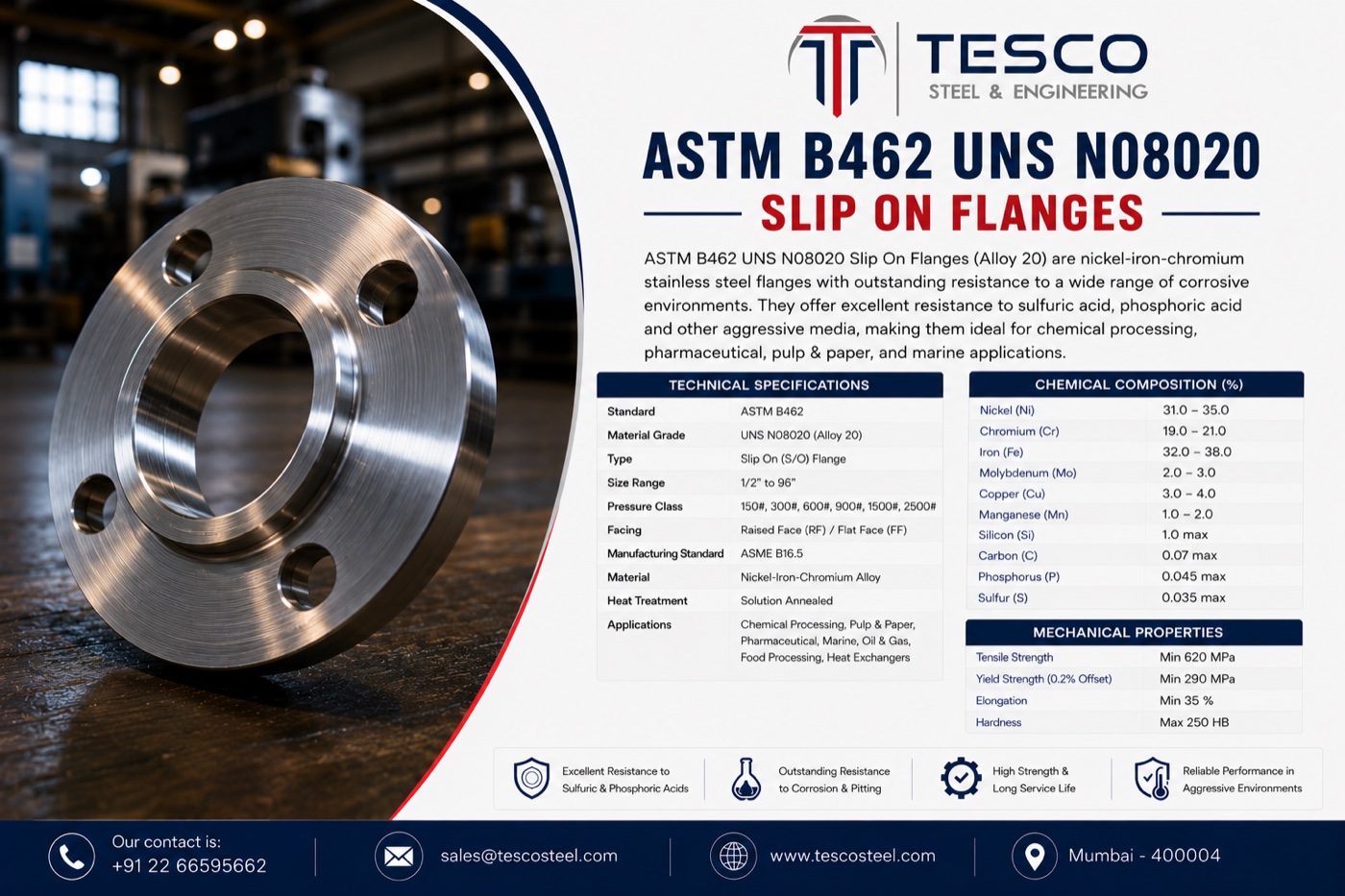
Alloy 20 · Carpenter 20 · 20Cb-3ASTM B462 · UNS N08020 · 2.4660Cu 3–4% · Ni 32–38% · Nb-stabilisedASME B16.5 Class 150–2500½″ – 24″ NB · SORF551 MPa TS / 241 MPa YS minEN 10204 3.1 / 3.2 · ISO 9001:2015
Alloy 20 Slip On Flange — Specifications at a Glance
What is an Alloy 20 Slip On Flange?
Alloy 20 = the sulphuric acid alloy. A 35Ni-20Cr-3.5Cu-2.5Mo nickel-iron-chromium alloy (UNS N08020 / Carpenter 20 / 20Cb-3) designed in the 1950s for one chemical: 3–4% copper holds the passive film across 10–98% H₂SO₄, 32–38% nickel gives chloride SCC immunity, niobium locks the carbon so welds never sensitise. As a slip-on: two fillet welds with ER320LR filler, no preheat, no PWHT — forged to ASTM B462, not A182.
Also searched as: Carpenter 20 slip on flange, 20Cb-3 SORF flange, UNS N08020 slip on flange, ASTM B462 slip on flange, 2.4660 slip on flange, Incoloy 20 / Nicrofer 3620Nb flange — all refer to the product on this page. See also our Alloy 20 weld neck flanges.
Rule of thumb: Alloy 20 exists so plants don't pay Hastelloy money for sulphuric-acid problems. Within 10–98% H₂SO₄ and moderate temperature it is the economic specification; hydrochloric and hot chlorides escalate the enquiry up the ladder.
Alloy 20 (UNS N08020) Chemical Composition
Ni
Cr
Cu
Mo
Nb (Cb)
C
Mn
Si
P
S
Fe
32.0-38.0
19.0-21.0
3.0-4.0
2.0-3.0
8×C-1.00
0.07 max
2.00 max
1.00 max
0.045 max
0.035 max
Bal
Values in weight % for UNS N08020 per ASTM B462. The copper is the signature element — it changes the electrochemistry in reducing sulphuric acid — and the niobium (the “Cb” in 20Cb-3) ties up carbon as NbC so the heat-affected zone cannot sensitise.
Alloy 20 Mechanical Properties
Tensile Strength, MPa (ksi)
Yield Strength 0.2%, Min, MPa (ksi)
Elongation % min (2")
Hardness, HB
551 (80) min
241 (35) min
30
≤ 217 (typical)
Per ASTM B462, supplied solution annealed (925–955 °C, rapid quench) — the condition that keeps the corrosion resistance intact. Fully austenitic: no low-temperature brittleness, full ductility retained. Values demonstrated per heat on the EN 10204 certificate.
Alloy 20 Slip On Flange Specifications
Alloy 20 Slip On Flanges are available in the following specifications:
ASME SB-462 is the boiler-code twin. System partners follow the same B-series logic: ASTM B729 seamless pipe and ASTM B366 welding fittings (WP20CB). Not an A182 grade — enquiries citing “A182 Alloy 20” are quoted, correctly, to B462.
Why Alloy 20 Slip Ons Are Specified
Purpose-Built for Sulphuric
3–4% copper holds the passive film across the 10–98% H₂SO₄ range that dissolves stainless — the specific gap the alloy was designed in the 1950s to fill.
Chloride SCC Off the Table
At 32–38% nickel, stress corrosion cracking is a non-issue — real-world acid with chloride contamination holds no cracking anxiety.
As-Welded Into Acid Service
Niobium locks the carbon so the heat-affected zone cannot sensitise — two fillet welds with ER320LR and the joint is done. No preheat, no PWHT.
The Border Alloy Economics
Nickel-alloy acid performance at near-stainless fabrication cost — the deliberate step between 904L and Hastelloy, so sulphuric problems never pay Hastelloy prices.
Slip On vs Weld Neck in Acid Service — An Honest Note
Where the slip-on pattern belongs on an acid plant: a slip-on inherently leaves a small crevice between pipe OD and flange bore, and severe acid immersion is exactly where crevices matter. Critical, continuously-wetted process lines are therefore usually specified with Alloy 20 weld necks — while slip-ons earn their place on utility, transfer, tank-top and vent connections and lower-pressure services, where their easier fit-up and lower cost count on an alloy this expensive. A continuous internal fillet weld closes the bore-side path. We quote both patterns from the same N08020 heats.
How Our Alloy 20 Slip On Flanges Are Manufactured
1
Forging — cut billet of certified N08020 heat is hot-forged into the flange blank, keeping full heat traceability from raw material to despatch.
2
Solution annealing — 925–955 °C with rapid quench per ASTM B462, dissolving any damaging phases and setting the acid resistance; furnace record retained.
3
Machining — hub, faces and bolt holes to ASME B16.5; the bore machined slightly over pipe OD per the slip-on tolerance.
4
Facing & finish — SORF raised face with serrated stock finish, flat face or RTJ groove; pickled and passivated on request.
5
Testing & marking — mechanical and chemical verification against the heat (ASTM A262 intergranular testing and PMI where the order specifies), then permanent marking of grade, size, class and heat number.
6
Certification & packing — EN 10204 3.1 MTC (3.2 witnessed on request), export-packed as pictured on this page.
Where Alloy 20 Slip On Flanges Are Used
Anywhere sulphuric acid is made, stored or consumed: acid plants and dilution stations, pickling lines, fertiliser plants (phosphoric and mixed acids), chemical processing, pharmaceutical synthesis, pulp-and-paper bleaching chemistry and food-industry acid handling — slip-ons on the utility, transfer, tank and vent connections, weld necks on the critical immersed lines. Our production and packing below:
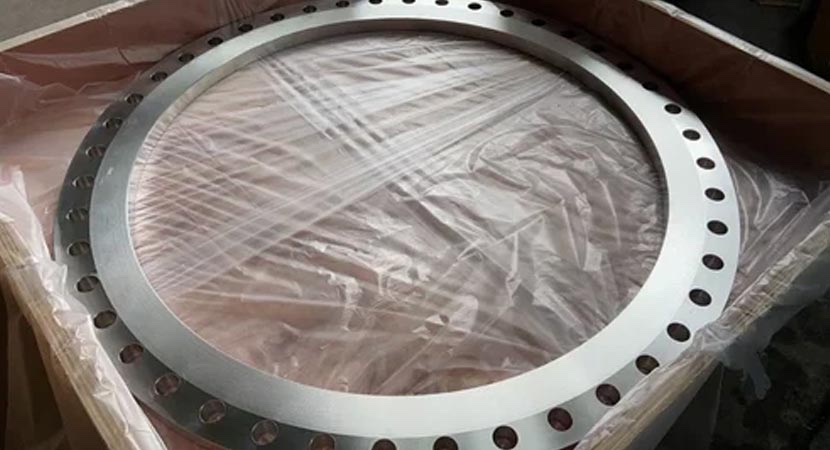
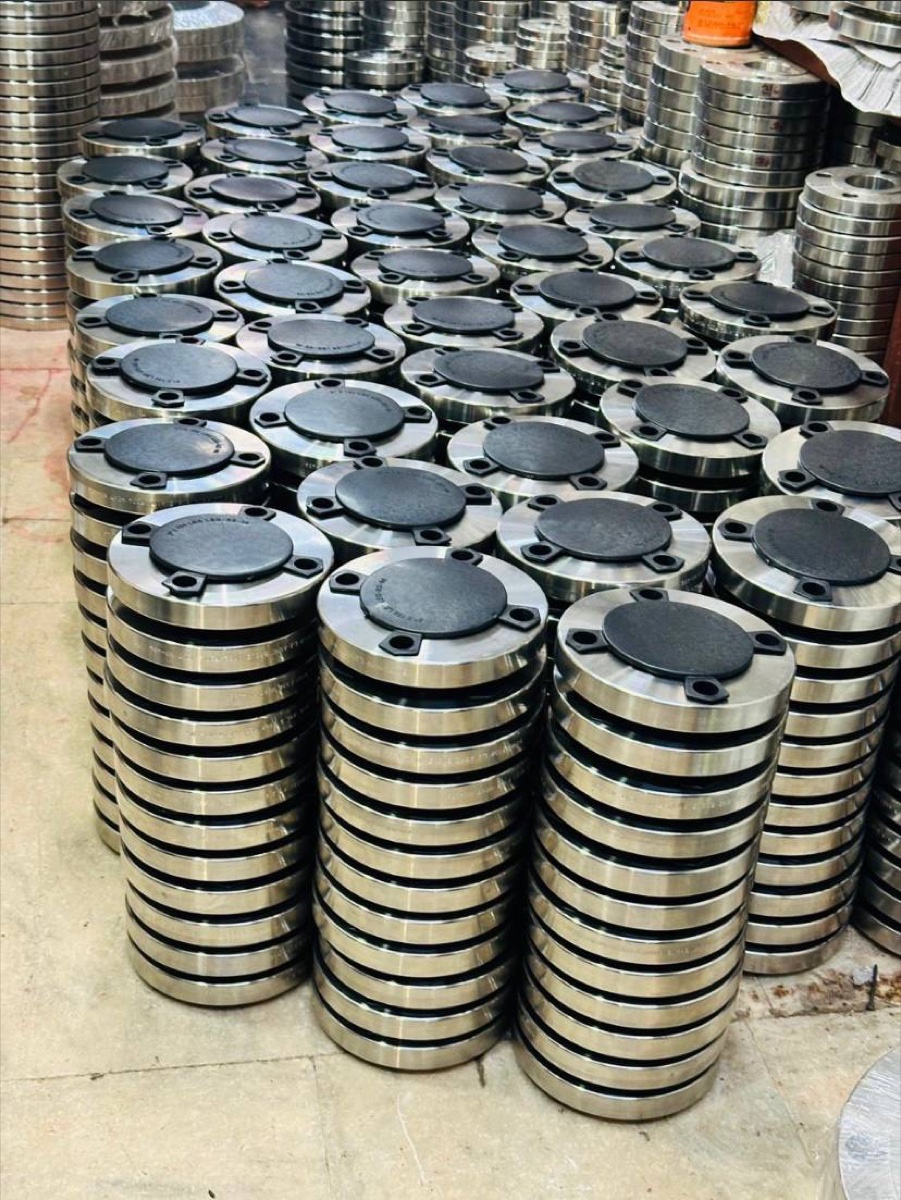
Large-Diameter Slip On Flange — Crated for ExportAlloy Flanges — Face-Protected Stacks at Our Works
Alloy 20 Slip On Flange Dimensions
Alloy 20 slip-on dimensions follow the ASME B16.5 slip-on tables — identical for every material. Full charts by class:
Example: “Slip On Flange, 4″ NB, ASME B16.5 Class 150, RF, Alloy 20 / ASTM B462 (N08020), EN 10204 3.1 — 10 pcs.” Quotations normally within 24 hours with price, unit weight and delivery.
Alloy 20 Slip On Flanges — Frequently Asked Questions
What is an Alloy 20 slip on flange?
It is a slip-on flange forged from Alloy 20 — the copper-bearing, niobium-stabilised nickel-iron-chromium alloy (UNS N08020, ASTM B462, Werkstoff 2.4660) — dimensioned to ASME B16.5. The flange slides over the pipe end and is secured with two fillet welds, and the 35Ni-20Cr-3.5Cu-2.5Mo chemistry makes it the industry's purpose-built answer to sulphuric acid: reliable across the 10-98% concentration range that dissolves ordinary stainless steel, and immune to chloride stress corrosion cracking.
What do Carpenter 20 and 20Cb-3 mean?
They are trade names for the same alloy. Carpenter Technology developed the grade — hence Carpenter 20 — and 20Cb-3 records its defining refinement: Cb is the older American symbol for columbium (niobium), the stabiliser added to lock up carbon and stop weld sensitisation. Other mill names include Incoloy 20 and Nicrofer 3620Nb. Universally it is UNS N08020, Werkstoff 2.4660, forged to ASTM B462 — certificates state the designations together.
What is the chemical composition of Alloy 20?
For UNS N08020: nickel 32.0-38.0%, chromium 19.0-21.0%, copper 3.0-4.0%, molybdenum 2.0-3.0%, niobium 8×C to 1.00%, carbon 0.07% max, manganese 2.00% max, silicon 1.00% max, phosphorus 0.045% max, sulphur 0.035% max, iron balance. The copper is the signature element — it holds the passive film in reducing sulphuric acid — while the niobium stabilises the carbon so welds cannot sensitise.
What are the mechanical properties of Alloy 20 slip on flanges?
Per ASTM B462: tensile strength 551 MPa (80 ksi) minimum, 0.2% yield strength 241 MPa (35 ksi) minimum and elongation 30% minimum, with hardness typically 217 HB or below — supplied solution annealed at 925-955 °C with rapid quench, the condition that keeps the alloy's corrosion resistance intact. Values are demonstrated per heat on the EN 10204 certificate.
Is Alloy 20 a stainless steel or a nickel alloy?
It sits exactly on the border — which is its commercial point. At 32-38% nickel with an iron balance, it is classified among the nickel-iron-chromium alloys (hence the B-series ASTM standard and N-series UNS number), yet it fabricates much like a super austenitic stainless steel. The result: genuine nickel-alloy acid performance at near-stainless fabrication cost — the economic step between 904L below it and Hastelloy above it.
Why is Alloy 20 called the sulphuric acid alloy?
Because it was designed in the 1950s specifically for that one chemical. Sulphuric acid is reducing at most concentrations, which strips the passive film off chromium stainless steels; Alloy 20's 3-4% copper changes the electrochemistry so the film survives across roughly the 10-98% concentration range, with the high nickel adding chloride SCC immunity for real-world contaminated acid. Phosphoric acid and many mixed-acid streams fall within reach for the same reason.
What is the difference between Alloy 20 and 904L?
They are neighbours on the acid ladder, both copper-bearing and both aimed at sulphuric duty. Alloy 20 carries roughly ten points more nickel (32-38 vs 23-28%), giving firmer SCC immunity and better performance in hotter, stronger acid, plus its niobium stabiliser for as-welded acid service; 904L counters with higher molybdenum (4-5 vs 2-3%) and better chloride pitting resistance. The working split: dedicated sulphuric and mixed-acid plants favour Alloy 20; chloride-plus-acid chemistry favours 904L. We forge both.
How does Alloy 20 compare with Hastelloy C-276?
Hastelloy C-276 is two rungs higher — 16% molybdenum in a full nickel base handles hot hydrochloric, wet chlorine and aggressive mixed acids that would consume Alloy 20 — at several times the price. Alloy 20 exists precisely so plants do not pay Hastelloy money for sulphuric-acid problems: within its 10-98% H₂SO₄ envelope and moderate temperatures it is the economical specification, and the enquiry escalates to C-276 only when hydrochloric, hot chlorides or oxidising-reducing swings enter the stream.
Are slip-on flanges suitable for acid service?
With judgement. A slip-on inherently leaves a small crevice between pipe OD and flange bore, and severe acid immersion is exactly where crevices matter — so critical, continuously-wetted acid process lines are usually specified with Alloy 20 weld neck flanges instead. Slip-ons earn their place on moderate duty: acid-plant utility and transfer lines, tank-top and vent connections, and lower-pressure services where their easier fit-up and lower cost count. Sealing the internal fillet weld continuously closes the bore-side path.
How is an Alloy 20 slip on flange welded to pipe?
With two fillet welds — hub outside, bore inside, pipe set back 1/8" (3 mm) — using matching-composition filler ER320LR, the low-residual variant developed to prevent hot cracking in this alloy family. Because niobium locks up the carbon, the heat-affected zone cannot sensitise: joints go into acid service exactly as welded, with no post-weld heat treatment and no preheat. Standard nickel-alloy discipline applies — clean joint preparation, low heat input and interpass temperature control.
Is Alloy 20 covered by ASTM A182?
No — that is a frequent specification slip. ASTM A182 covers forged stainless and alloy steel flanges; Alloy 20 is a nickel-iron-chromium alloy, so its forged flanges are governed by ASTM B462 (ASME SB-462). System partners follow the same B-series logic: seamless pipe to ASTM B729 and welding fittings to ASTM B366 (designation WP20CB). Enquiries citing A182 Alloy 20 are quoted, correctly, to B462.
What temperature range can Alloy 20 slip on flanges handle?
ASME B16.5 rates the alloy through its pressure-temperature tables, but real Alloy 20 duty is defined by chemistry, not heat: the alloy lives in wet corrosive service, typically from ambient up to a few hundred degrees Celsius of hot acid. The niobium stabiliser keeps welds and heat-affected zones safe through fabrication and service excursions, and the fully austenitic structure has no low-temperature brittleness. For genuinely hot dry oxidation duty, the heat-resistant grades — 310, Incoloy 800 series — are the correct family instead.
Where are Alloy 20 slip on flanges typically used?
Anywhere sulphuric acid is made, stored or consumed: acid plants and dilution stations, pickling lines, fertiliser plants (phosphoric and mixed acids), chemical processing, pharmaceutical synthesis where chloride SCC immunity protects clean acid streams, pulp and paper bleaching chemistry, and food-industry acid handling. On these plants the slip-on pattern serves utility, transfer, tank and vent connections, with weld necks reserved for the critical immersed lines.
What sizes and classes are Alloy 20 slip on flanges available in?
From ½" to 24" NB per ASME B16.5 in Classes 150 through 2500, with larger diameters and EN 1092-1 patterns in 2.4660 forged to order — the crated large-diameter flange pictured on this page shows the upper end of the range. Alloy 20 is project material forged against the order from certified N08020 heats, normally dispatching within a few weeks with EN 10204 3.1 certification; state the required delivery on the enquiry and we confirm the schedule with the quotation.
Who manufactures Alloy 20 slip on flanges in India?
Tesco Steel & Engineering is an ISO 9001:2015 certified flange manufacturer based in Mumbai, India, forging Alloy 20 / Carpenter 20 (UNS N08020, 2.4660) slip on flanges from ½" to 24" NB per ASTM B462 and ASME B16.5 — alongside the full Alloy 20 range of weld neck, blind, socketweld, threaded, lapped joint and spectacle blind flanges — in solution-annealed condition with full heat traceability, ASTM A262 intergranular corrosion testing on request, and EN 10204 3.1/3.2 certification on every lot. Exported to more than 50 countries.