Inconel 601 Slip On Flanges — UNS N06601 Manufacturer
Tesco Steel & Engineering forges Inconel 601 slip on flanges — the aluminium-bearing nickel-chromium alloy (UNS N06601, Werkstoff 2.4851, NiCr23Fe) — to ASTM B564 and ASME B16.5 Class 150–2500 from ½″ to 24″ NB, larger patterns to order. 58–63% nickel, 21–25% chromium and 1.0–1.7% aluminium build an oxide scale that stays adherent through thermal cycling, carrying oxidation service to roughly 1250 °C — a step beyond Inconel 600's 1093 °C — with strong carburisation resistance for heat-treatment atmospheres. The hottest grade in our slip-on programme. Supplied solution annealed, every lot with EN 10204 3.1/3.2 MTC. ISO 9001:2015, made in Mumbai, India — exported to 50+ countries.
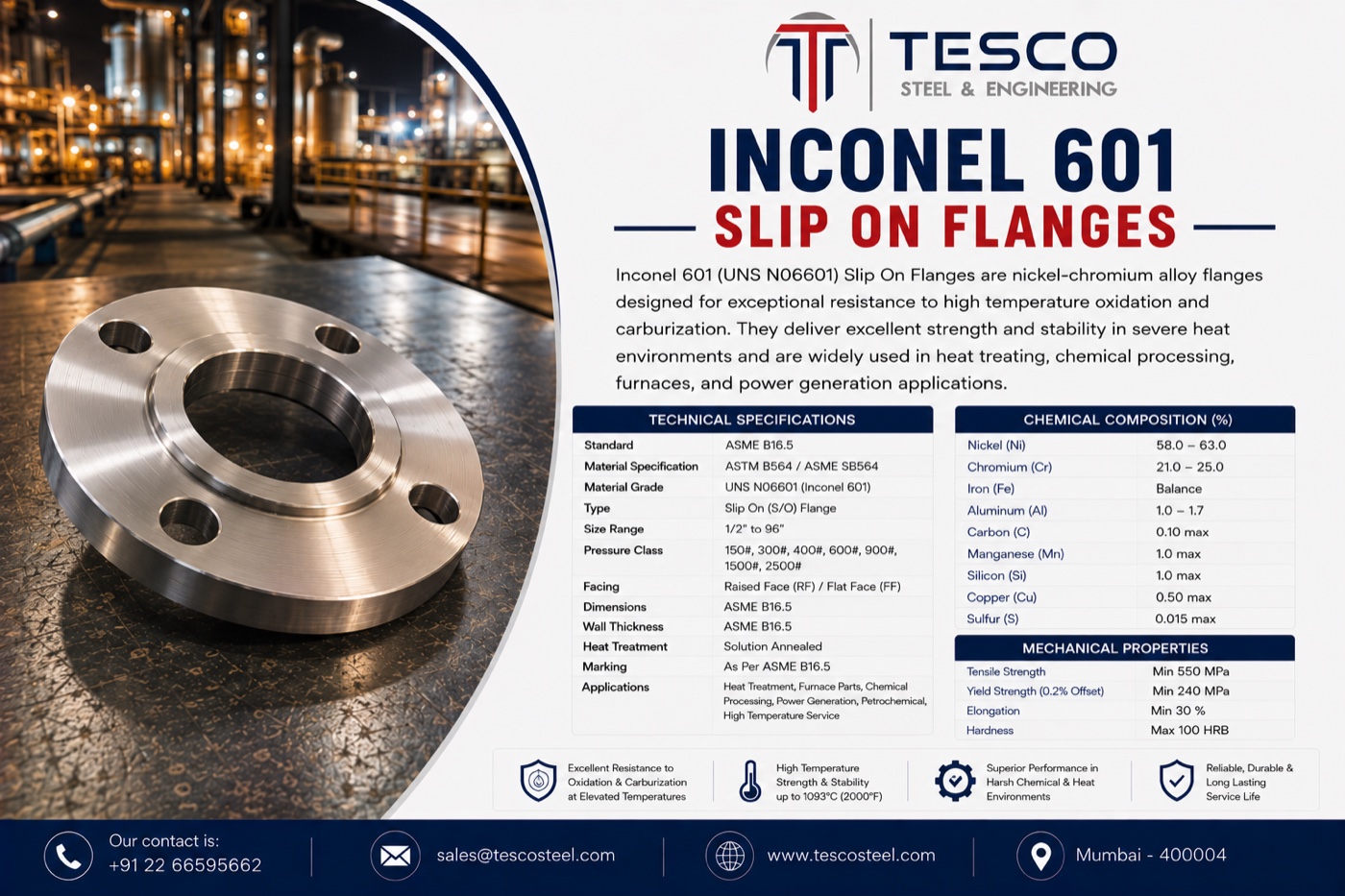
Inconel 601 · Alloy 601 · N06601ASTM B564 · 2.4851 · NiCr23FeCr 21–25% · Al 1.0–1.7%Cyclic Oxidation to ~1250 °CASME B16.5 Class 150–2500550 MPa TS / 205 MPa YS minEN 10204 3.1 / 3.2 · ISO 9001:2015
Inconel 601 Slip On Flange — Specifications at a Glance
What is an Inconel 601 Slip On Flange?
Inconel 601 = the alloy whose scale stays put. Thermal cycling flakes the protective oxide off ordinary heat alloys; 601's 1.0–1.7% aluminium (with 21–25% Cr) bonds an aluminium-enriched scale to the metal that survives the cycles — extending oxidation duty to ~1250 °C, the highest in our slip-on range, with carburisation resistance the heat-treatment trade relies on. As a slip-on: two fillet welds, ERNiCr-3 or matching ERNiCrFe-11 filler, no preheat, no PWHT — forged to ASTM B564, not A182.
Also searched as: Alloy 601 slip on flange, Inconel 601 SORF flange, ASTM B564 N06601 slip on flange, 2.4851 / NiCr23Fe slip on flange, high-temperature slip on flange — all refer to the product on this page. See also our Inconel 601 flanges overview and Inconel hub.
Rule of thumb: when the duty is heat alone — especially heat that cycles — 601 tops the ladder; chemistry running hot stays with 600, wet and strong goes to 625.
Inconel 601 (UNS N06601) Chemical Composition
Ni (+Co)
Cr
Al
Fe
C
Mn
Si
Cu
S
58.0-63.0
21.0-25.0
1.0-1.7
Balance
0.10 max
1.0 max
0.5 max
1.0 max
0.015 max
Values in weight % for UNS N06601 per ASTM B564. The aluminium is the defining addition — small enough not to harden the alloy, large enough to transform the oxide scale — and the raised chromium deepens the reservoir the scale rebuilds from. Iron balances for economy.
Inconel 601 Mechanical Properties
Tensile Strength, MPa (ksi)
Yield Strength 0.2%, Min, MPa (ksi)
Elongation % min (2")
Density
550 (80) min
205 (30) min
30
8.11 g/cm³
Per ASTM B564, solution annealed condition. Useful creep-rupture strength persists to furnace temperatures and the alloy stays ductile after long exposure — the property furnace engineers quietly prize. Values demonstrated per heat on the EN 10204 certificate.
Inconel 601 Slip On Flange Specifications
Inconel 601 Slip On Flanges are available in the following specifications:
1/2"NB to 24"NB per ASME B16.5; larger diameters and EN 1092-1 patterns in 2.4851 to order
Class
150#, 300#, 400#, 600#, 900#, 1500#, 2500#
Facing
Raised Face (SORF) — default; Flat Face (SOFF) or RTJ where the piping class specifies
Heat Treatment
Solution annealed per ASTM B564, thermal record retained
Service
Cyclic oxidation to ~1250 °C, carburising heat-treatment atmospheres, thermal-process plant — the hottest grade in our range
Installation
Two fillet welds (hub + bore), pipe set back 1/8"; ERNiCr-3 or matching ERNiCrFe-11 filler, sulphur-clean joints, no preheat, no PWHT
Testing
PMI verification and dye-penetrant examination on request
Certification
EN 10204 3.1 (standard) / 3.2 witnessed
Equivalent Grades of Inconel 601
Trade Names
ASTM Forging
UNS
Werkstoff Nr.
EN
Inconel 601 / Alloy 601 / Nicrofer 6023
B564
N06601
2.4851
NiCr23Fe
ASME SB-564 is the boiler-code twin. System partners follow the same B-series logic: ASTM B167 seamless pipe & tube, ASTM B168 plate, sheet & strip and ASTM B366 welding fittings. Not an A182 grade — nickel-alloy flanges are governed by the B-series standards. Family neighbours: Inconel 600 and 625.
Why Inconel 601 Slip Ons Are Specified
The Scale That Stays Put
Aluminium bonds the oxide to the metal through heating-cooling cycles — the failure mode that consumes ordinary heat alloys simply doesn't run.
~1250 °C Ceiling
The highest continuous-oxidation rating in our slip-on programme — 200 °C beyond 310S, a step past 600 and 800H, at the top of wrought flange practice.
Carburisation Fighter
High nickel slows carbon diffusion, the Al-bearing scale blocks its entry — carburising furnace fixtures, retorts and radiant tubes are classic 601 duty.
Ductile After the Years
601 keeps its toughness after long furnace exposure — hardware comes down at turnaround still weldable and still safe to handle.
601 is a heat specialist, not a universal.Wet corrosion: no molybdenum means pitting chemistry, acids and marine duty belong to 625 or Hastelloy. Halogens & strong caustic:600's higher nickel serves hot Cl₂/HCl and hydroxides better. Reducing sulphur: hot sulphidising reducing atmospheres attack nickel alloys — though in oxidising sulphur-bearing gas 601's high chromium performs well. State the atmosphere on the enquiry and we confirm the grade.
How Our Inconel 601 Slip On Flanges Are Manufactured
1
Forging — cut billet of certified N06601 heat is hot-forged into the flange blank, keeping full heat traceability from raw material to despatch.
2
Solution annealing — homogenised per ASTM B564; furnace record retained.
3
Machining — hub, faces and bolt holes to ASME B16.5; the bore machined slightly over pipe OD per the slip-on tolerance.
4
Facing & finish — SORF raised face with serrated stock finish, flat face or RTJ groove.
5
Testing & marking — mechanical and chemical verification against the heat (PMI where the order specifies), then permanent marking of standard, grade, size, class and heat number.
6
Certification & packing — EN 10204 3.1 MTC (3.2 witnessed on request), export-packed for sea or air freight.
Where Inconel 601 Slip On Flanges Are Used
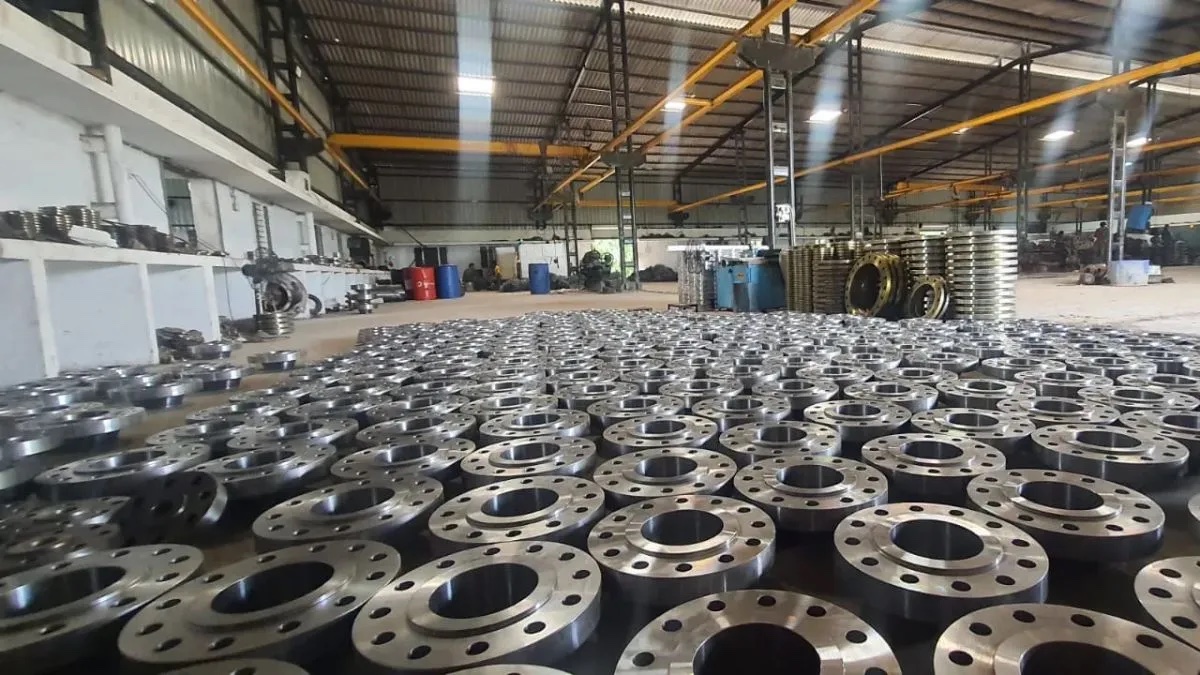
The hottest hardware of thermal processing: heat-treatment furnace fixtures, baskets, retorts and muffles, radiant tubes and burner components, strand- and wire-annealing lines, thermal oxidisers and incinerator internals, combustion cans and afterburners, thermocouple protection tubes — and the flanged utility, vent and duct connections that serve them. Wherever the plant cycles between hot and cold, 601 earns its premium. Production scale below:
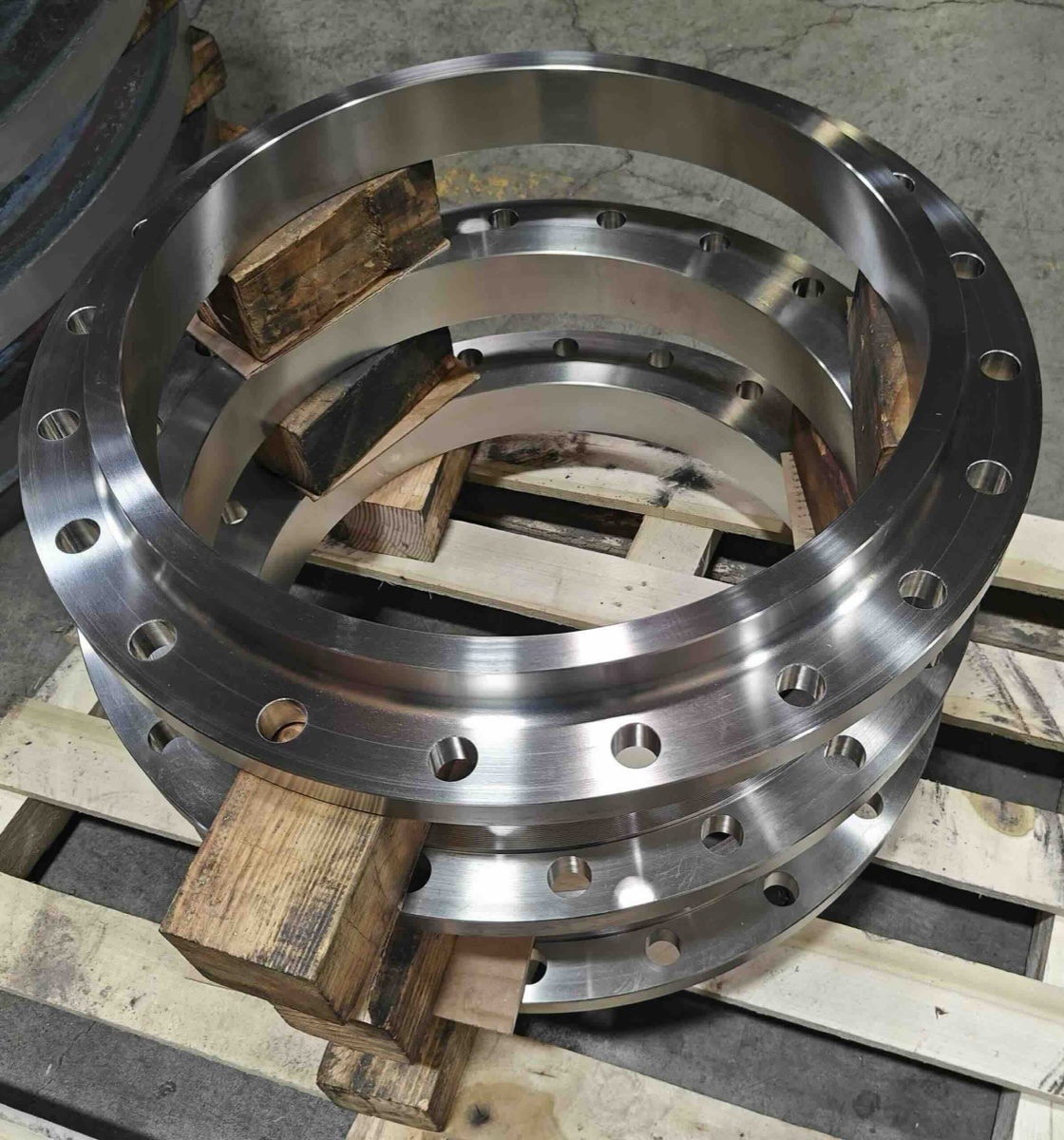
Large-Diameter Slip On Flanges — Palletised for DespatchSlip On Production Hall — Volume Capability
Inconel 601 Slip On Flange Dimensions
Inconel 601 slip-on dimensions follow the ASME B16.5 slip-on tables — identical for every material. Full charts by class:
How to Specify & Order an Inconel 601 Slip On Flange
Five elements — no bore schedule, since the slip-on bore suits the pipe OD:
1
Size & standard — e.g. 4″ NB ASME B16.5.
2
Pressure class & facing — Class 150–2500, SORF (default), flat face or RTJ where specified.
3
Grade & atmosphere — Inconel 601 / UNS N06601 — ASTM B564 (2.4851); state peak temperature, cycling and atmosphere so we can confirm 601 against 600 or 625.
4
Certification & testing — EN 10204 3.1 (standard) or 3.2 witnessed; PMI where the project specifies.
Example: “Slip On Flange, 4″ NB, ASME B16.5 Class 150, RF, Inconel 601 / ASTM B564 (N06601), EN 10204 3.1 — 10 pcs.” Quotations normally within 24 hours with price, unit weight and delivery.
Inconel 601 Slip On Flanges — Frequently Asked Questions
What is an Inconel 601 slip on flange?
It is a slip-on flange forged from Inconel 601 — the aluminium-bearing nickel-chromium alloy (UNS N06601, ASTM B564, Werkstoff 2.4851) — dimensioned to ASME B16.5. The flange slides over the pipe end and is secured with two fillet welds. With 58-63% nickel, 21-25% chromium and the crucial 1.0-1.7% aluminium, the alloy builds an oxide scale that stays adherent through heating and cooling cycles, extending oxidation service to roughly 1250 °C — the highest-temperature grade in our slip-on programme.
What is Inconel 601?
The high-temperature oxidation specialist of the Inconel family. Alloy 600's chromia scale protects superbly — until repeated thermal cycling cracks and spalls it. 601 answers with more chromium and an aluminium addition that together form a tighter, aluminium-enriched spinel scale that clings through the cycles, taking continuous oxidation duty to about 1250 °C. Designations: UNS N06601, Werkstoff 2.4851, EN NiCr23Fe, often simply Alloy 601; forged flanges are governed by ASTM B564.
What is the chemical composition of Inconel 601?
For UNS N06601: nickel (plus cobalt) 58.0-63.0%, chromium 21.0-25.0%, aluminium 1.0-1.7%, iron balance (roughly 13-17%), carbon 0.10% max, manganese 1.0% max, silicon 0.5% max, copper 1.0% max and sulphur 0.015% max. The aluminium is the defining addition — small enough not to harden the alloy, large enough to transform the oxide scale — while the raised chromium deepens the reservoir the scale rebuilds from.
What are the mechanical properties of Inconel 601 slip on flanges?
Per ASTM B564 in the annealed condition: tensile strength 550 MPa (80 ksi) minimum, 0.2% yield strength 205 MPa (30 ksi) minimum and elongation 30% minimum. Density is 8.11 g/cm³ — the higher iron and chromium make it slightly lighter than most nickel alloys. Useful creep-rupture strength persists to furnace temperatures, and the alloy remains ductile after long exposure. Values are demonstrated per heat on the EN 10204 certificate.
What temperature can Inconel 601 slip on flanges handle?
In oxidising atmospheres, up to roughly 1250 °C (2280 °F) — and, more importantly, it keeps that protection under thermal cycling, where scale spalling normally undoes high-temperature alloys. Two honest qualifications: bolted-joint ratings follow the ASME B16.5 pressure-temperature tables, which fade long before the metallurgy, and at these temperatures gasketed joints themselves need careful engineering. For furnace-adjacent flanged connections, though, 601 is the top of our standard programme.
Why does aluminium stop the oxide scale from spalling?
Every heat cycle strains a protective scale, because oxide and metal expand at different rates — plain chromia scales crack and flake off, exposing fresh metal that oxidises again, and the part slowly consumes itself. Aluminium changes the scale chemistry: it concentrates at the metal-oxide interface and forms an aluminium-rich layer that bonds the scale to the alloy, so the protection stays put cycle after cycle. It is the same principle that carries alumina-forming superalloys — applied in a forgeable, weldable flange material.
What is the difference between Inconel 601 and Inconel 600?
Aluminium and chromium. 601 adds 1.0-1.7% Al and raises Cr to 21-25%, buying spall-resistant oxidation to ~1250 °C where 600 stops near 1093 °C — the difference shows most under thermal cycling. 600 counters with higher nickel (72%+ vs 58-63%), which makes it the better alloy for halogen and caustic chemistry and gives it wider availability. Rule of thumb: chemical duty that runs hot favours 600; pure high-temperature oxidation duty, especially cyclic, favours 601. We forge both.
How does Inconel 601 compare with Incoloy 800H/800HT?
Incoloy 800H/HT are iron-base economy: 30-35% nickel with creep-rated coarse grain, the standard for hot pressure parts like reformer and pigtail systems to roughly 1000-1100 °C. Inconel 601's nickel-base chemistry and aluminium-bearing scale go two steps further in oxidation ceiling and cycling tolerance, and resist carburisation better. The practical split: continuous, code-calculated hot pressure service favours 800H/HT economics; the hottest, cycling, atmosphere-exposed hardware favours 601.
How does Inconel 601 compare with 310S stainless?
310S (25Cr-20Ni stainless) is the budget entry to heat: clean oxidation to ~1050 °C at stainless prices, but its scale spalls under cycling, it creeps at temperature, and chlorides crack it. 601 costs several times more and answers every one of those weaknesses — 200 °C more ceiling, cycling tolerance, better creep strength and chloride SCC resistance from its nickel base. Many furnaces run 310S for the mild zones and 601 where the burners live; the honest split is duty, not brand.
Does Inconel 601 resist carburisation?
Yes — among the best of the wrought heat alloys. Carburising atmospheres in heat-treatment furnaces inject carbon into hot metal, embrittling stainless grades ('green rot' in alternating carburising-oxidising conditions). 601's high nickel slows carbon diffusion and its aluminium-bearing scale blocks carbon entry, which is why carburising-furnace fixtures, baskets, retorts and radiant tubes are classic 601 territory. For the most aggressive carburising plus sulphur-free reducing service, the enquiry can continue to alloys like 602CA or 617.
Where does Inconel 601 not belong?
Three honest limits. Wet corrosion: 601 has no molybdenum, so pitting chemistry, acids and marine duty belong to Inconel 625 or Hastelloy. Halogens and strong caustic: 600's higher nickel serves hot chlorine, HCl and hydroxides better. And reducing sulphur: hot sulphidising atmospheres attack nickel alloys — in sulphur-bearing reducing flue gas, iron-base alloys can outlast it; in oxidising sulphur-bearing gas 601's high chromium actually performs well. State the atmosphere on the enquiry and we confirm the grade.
How is an Inconel 601 slip on flange welded to pipe?
With two fillet welds — hub outside, bore inside, pipe set back 1/8" (3 mm). Filler choice follows service temperature: ERNiCr-3 (Inconel 82) for general fabrication, or matching-type ERNiCrFe-11 where the weld itself must carry full 601 oxidation duty; nickel-alloy discipline applies — sulphur-clean joints, low heat input, interpass control. No preheat and no post-weld heat treatment are required.
Which ASTM standard covers Inconel 601 slip on flanges?
ASTM B564 (ASME SB-564), the nickel-alloy forging specification — not A182, which covers stainless and alloy steels. System partners follow the same B-series logic: seamless pipe and tube to ASTM B167, plate, sheet and strip to ASTM B168, and welding fittings to ASTM B366. Certificates state UNS N06601, the standard, the annealed condition and the heat number together.
Where are Inconel 601 slip on flanges typically used?
The hottest hardware of thermal processing: heat-treatment furnace fixtures, baskets, retorts and muffles, radiant tubes and burner components, strand-annealing and wire-annealing lines, thermal-oxidiser and incinerator internals, combustion cans and afterburners, thermocouple protection tubes, and the flanged utility, vent and duct connections that serve them. Wherever the plant cycles between hot and cold — exactly where plain chromia alloys shed their scale — 601 earns its premium.
Who manufactures Inconel 601 slip on flanges in India?
Tesco Steel & Engineering is an ISO 9001:2015 certified flange manufacturer based in Mumbai, India, forging Inconel 601 / UNS N06601 slip on flanges from ½" to 24" NB per ASTM B564 and ASME B16.5 — alongside the full Inconel 601 range of weld neck, blind, socketweld, threaded, lapped joint and spectacle blind flanges, plus Inconel 600 and 625 — with full heat traceability, PMI on request, and EN 10204 3.1/3.2 certification on every lot. Exported to more than 50 countries.