Incoloy 800HT Slip On Flanges — UNS N08811 Manufacturer
Tesco Steel & Engineering forges Incoloy 800HT slip on flanges — the top creep grade of the Alloy 800 family (UNS N08811, Werkstoff 1.4959) — to ASTM B564 and ASME B16.5 Class 150–2500 from ½″ to 24″ NB, larger patterns to order. Carbon at 0.06–0.10% and the defining Al+Ti window of 0.85–1.20% raise creep-rupture allowables above even 800H — the grade whose datasheets govern reformer outlet manifolds, pigtails and the hottest code-rated headers to ~900 °C. Solution annealed, coarse grain verified, dual-certified 800H/800HT heats available. Every lot with EN 10204 3.1/3.2 MTC. ISO 9001:2015, made in Mumbai, India — exported to 50+ countries.
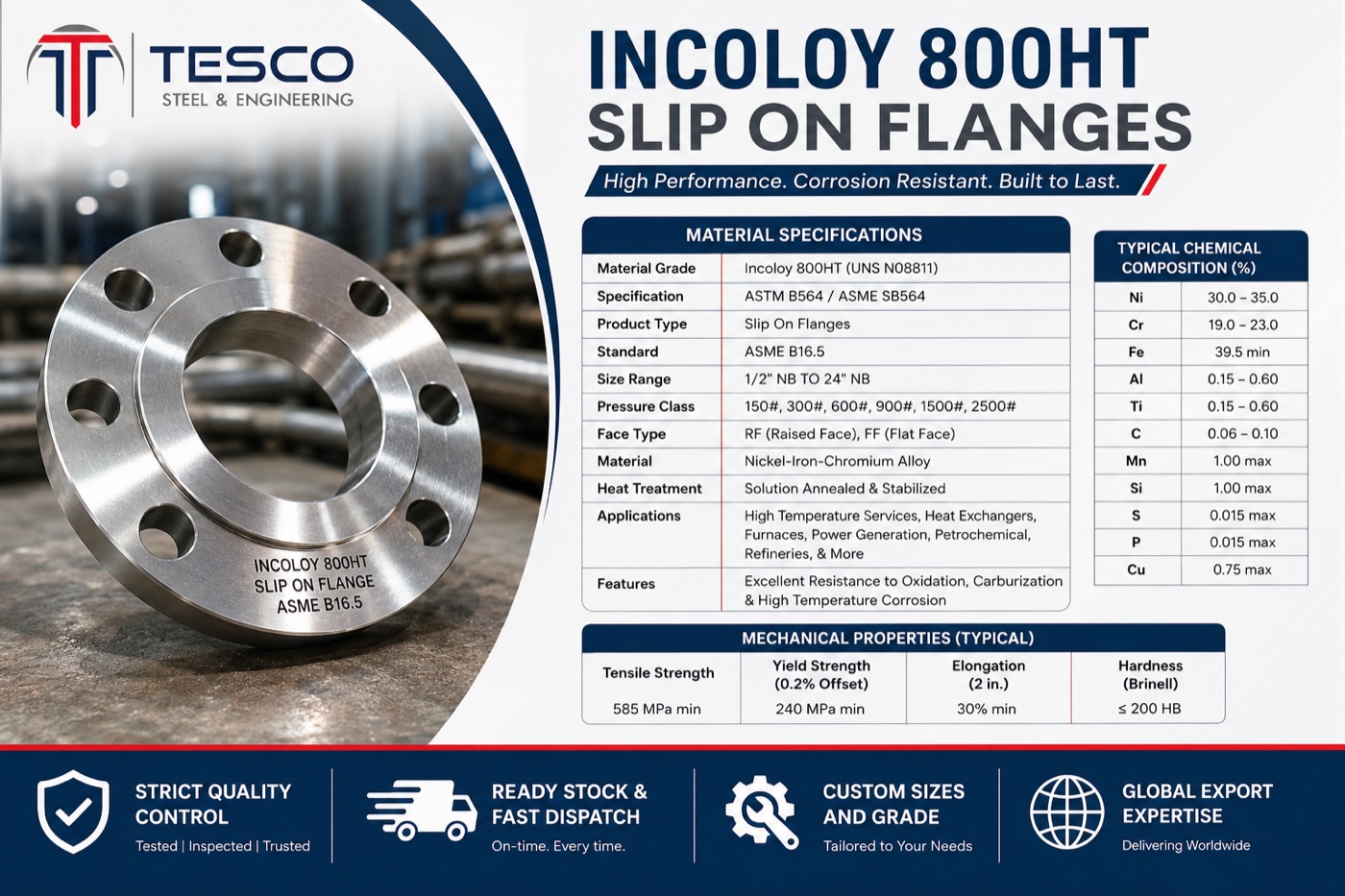
Incoloy 800HT Slip On Flange — Specifications at a Glance
What is an Incoloy 800HT Slip On Flange?
Incoloy 800HT = the 800 family with the chemistry locked into its best window. Decades of creep data showed heats with C 0.06–0.10% and Al+Ti 0.85–1.20% consistently outlasting the rest — so those windows became a grade. Same Fe-32Ni-21Cr backbone and coarse solution-annealed grain as 800H, but with the family's highest creep-rupture allowables — the reformer-manifold and pigtail grade to ~900 °C. As a slip-on: two fillet welds, ERNiCr-3 filler, no preheat, no PWHT — forged to ASTM B564, not A182.
Also searched as: Alloy 800HT slip on flange, Incoloy 800HT SORF flange, ASTM B564 N08811 slip on flange, 1.4959 slip on flange, reformer manifold flange — all refer to the product on this page. See also Incoloy 800H and Incoloy 800 (below 593 °C).
Rule of thumb: the three heat grades differ only in chemistry windows and grain — specify by peak metal temperature and what the datasheet names; dual-certified 800H/800HT stock covers both hot callouts.
Incoloy 800HT (UNS N08811) Chemical Composition
Fe
Ni
Cr
C
Al
Ti
Al+Ti
Mn
Si
Cu
S
39.5 min
30.0-35.0
19.0-23.0
0.06-0.10
0.15-0.60
0.15-0.60
0.85-1.20
1.5 max
1.0 max
0.75 max
0.015 max
Values in weight % for UNS N08811 per ASTM B564. The combined Al+Ti window of 0.85–1.20% is the grade's signature — individually the elements read like 800/800H, but the required total puts every heat inside the high-creep envelope. That one line on the certificate separates 800HT from 800H.
Incoloy 800HT Mechanical Properties
Grade
Tensile Strength, MPa (ksi)
Yield Strength 0.2%, Min, MPa (ksi)
Elongation % min
Incoloy 800HT (this page, solution annealed)
450 (65) min
170 (25) min
30
Incoloy 800H — identical RT minimums
450 (65) min
170 (25) min
30
The advantage is invisible in a tensile test — room-temperature minimums match 800H exactly (typical values run well above). Where 800HT earns its name is creep-rupture life at 700–900 °C, where its tightened chemistry carries the family's highest time-dependent allowables. Density 7.94 g/cm³; values and grain size demonstrated per heat on the EN 10204 certificate.
Incoloy 800HT Slip On Flange Specifications
Incoloy 800HT Slip On Flanges are available in the following specifications:
Material
Incoloy 800HT / Alloy 800HT — ASTM B564 / ASME SB-564 (UNS N08811, Werkstoff 1.4959); dual-certified 800H/800HT where available
Size
1/2"NB to 24"NB per ASME B16.5; larger diameters and EN 1092-1 patterns to order
Class
150#, 300#, 400#, 600#, 900#, 1500#, 2500#
Facing
Raised Face (SORF) — default; Flat Face (SOFF) or RTJ where the piping class specifies
Heat Treatment
Solution annealed per ASTM B564, coarse grain verified; thermal record retained
Service
The 800 family's highest creep-rupture ratings — reformer manifolds, pigtails & hot headers 593–~900 °C; oxidation to ~1100 °C
Installation
Two fillet welds (hub + bore), pipe set back 1/8"; ERNiCr-3 filler (creep-qualified fillers per project spec), no preheat, no PWHT
Testing
Grain size and Al+Ti total reported per heat; PMI verification on request
Certification
EN 10204 3.1 (standard) / 3.2 witnessed
Equivalent Grades of Incoloy 800HT
Trade Names
ASTM Forging
UNS
Werkstoff Nr.
Fittings
Pipe / Plate / Bar
Incoloy 800HT / Alloy 800HT
B564
N08811
1.4959
B366 WPNIC11
B407 / B409 / B408
ASME SB-564 is the boiler-code twin — and the point: the code's hottest 800-family creep allowables belong to this grade. Not an A182 grade — nickel-alloy flanges are governed by the B-series standards. Family neighbours: 800H, 800, 825.
Why Incoloy 800HT Slip Ons Are Specified
The Family's Hottest Numbers
Creep-rupture allowables above even 800H in the 700–900 °C band — the margin modern reformer and ethylene datasheets are calculated on.
Chemistry Locked, Not Hoped For
The Al+Ti 0.85–1.20% window guarantees every heat sits in the high-performance envelope that older 800H populations only sometimes reached.
Reformer-Manifold Pedigree
Outlet manifolds and pigtails run 800+ °C for decades between turnarounds — the service record that made 800HT the named grade of the hydrogen economy.
Still Iron-Base Economics
The hottest code-rated duty of the family, still on a 39.5% iron base — nickel-base 617 money stays unspent until ~900 °C is genuinely exceeded.
The top rung is still an iron-base rung.Below 593 °C: the creep chemistry and coarse grain buy nothing — plain 800 is stronger and cheaper. Beyond ~900 °C code service or severe cycling: nickel-base 601 and Alloy 617 take over. Wet acids & sour:825 or 625. Halogens & strong caustic:Inconel 600 or Nickel 201. State peak temperature and the named grade on the enquiry — we confirm 800 vs 800H vs 800HT honestly.
How Our Incoloy 800HT Slip On Flanges Are Manufactured
1
Forging — cut billet of certified N08811 heat (Al+Ti total verified in the window) is hot-forged into the flange blank, keeping full heat traceability.
2
Solution annealing — high-temperature anneal develops the coarse creep-resistant grain; furnace record retained.
3
Machining — hub, faces and bolt holes to ASME B16.5; the bore machined slightly over pipe OD per the slip-on tolerance.
4
Facing & finish — SORF raised face with serrated stock finish, flat face or RTJ groove.
5
Testing & marking — mechanical and chemical verification against the heat, grain size and Al+Ti total reported (PMI where the order specifies), then permanent marking of standard, grade, size, class and heat number.
6
Certification & packing — EN 10204 3.1 MTC (3.2 witnessed on request), export-packed for sea or air freight.
Where Incoloy 800HT Slip On Flanges Are Used
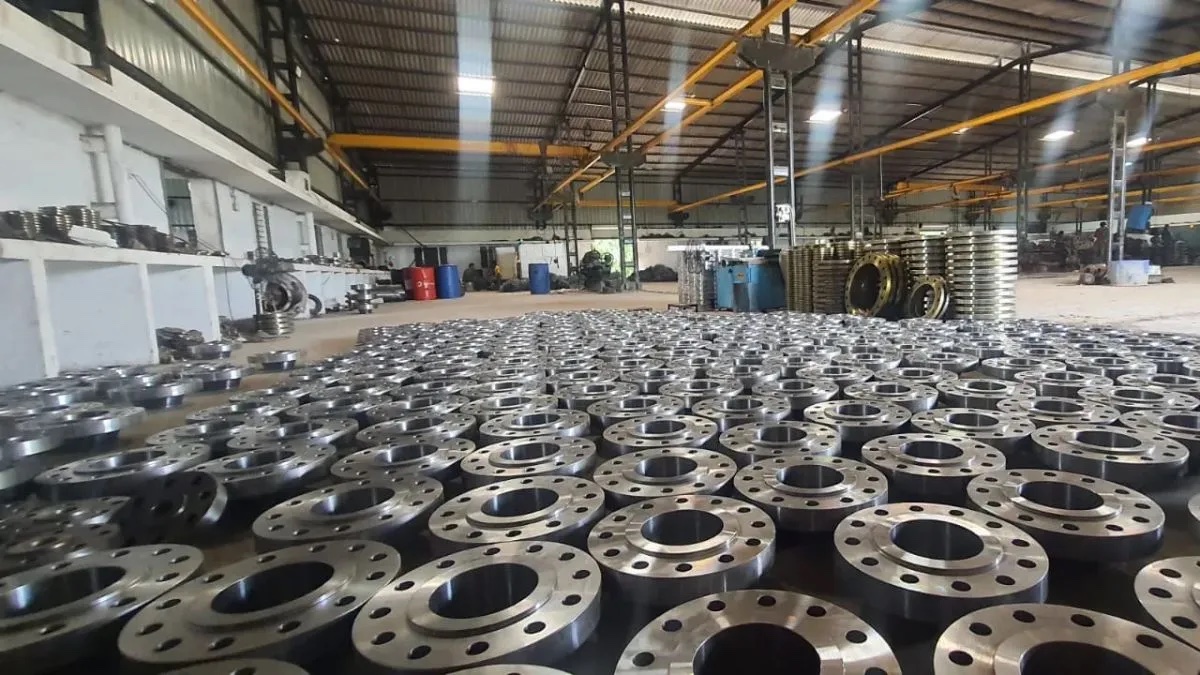
The hottest code-calculated hardware of the hydrogen economy and petrochemistry: steam-methane reformer outlet manifolds and pigtails, ethylene cracker components, ammonia and methanol plant hot systems, high-temperature heat exchangers, superheaters and headers — the applications whose datasheets increasingly name 800HT outright. Slip-ons serve the utility, vent and transfer connections; weld necks take the pressure-critical lines. Production scale below:
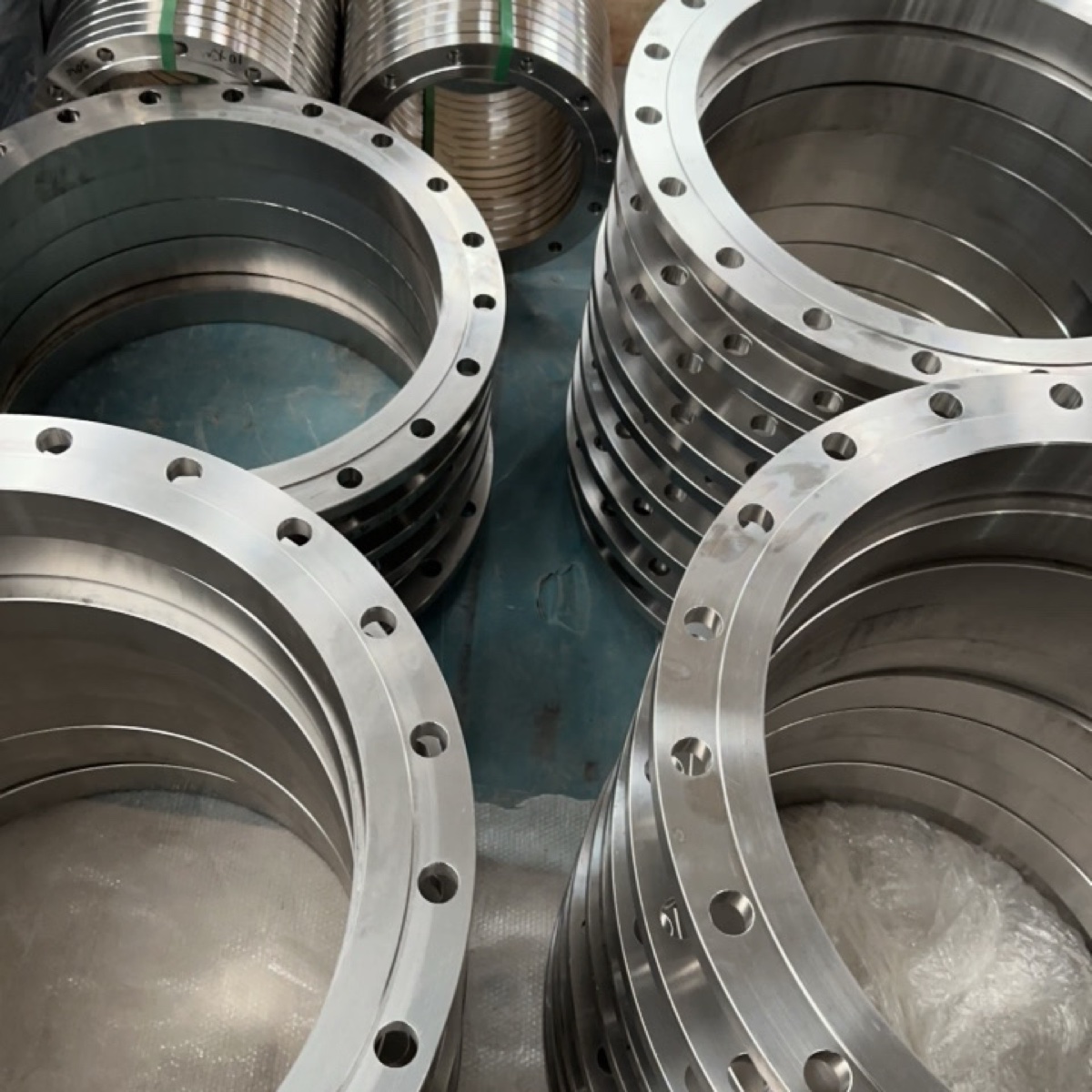
Large-Diameter Slip On Flanges — EN 1092-1 Patterns to OrderSlip On Production Hall — Volume Capability
Incoloy 800HT Slip On Flange Dimensions
Incoloy 800HT slip-on dimensions follow the ASME B16.5 slip-on tables — identical for every material. Full charts by class:
Example: “Slip On Flange, 4″ NB, ASME B16.5 Class 300, RF, Incoloy 800HT / ASTM B564 (N08811), EN 10204 3.1 — 10 pcs.” Quotations normally within 24 hours with price, unit weight and delivery.
Incoloy 800HT Slip On Flanges — Frequently Asked Questions
What is an Incoloy 800HT slip on flange?
It is a slip-on flange forged from Incoloy 800HT — the top creep grade of the Alloy 800 family (UNS N08811, ASTM B564, Werkstoff 1.4959) — dimensioned to ASME B16.5. The flange slides over the pipe end and is secured with two fillet welds. Its carbon held at 0.06-0.10% and a tightened aluminium-plus-titanium window of 0.85-1.20% combined raise the long-term creep-rupture strength above even 800H, making it the grade of the family's hottest code-rated hardware — reformer manifolds, pigtails and headers to roughly 900 °C.
What is Incoloy 800HT?
The final refinement of the Alloy 800 line. As decades of creep data accumulated, metallurgists found that heats with carbon and aluminium-plus-titanium in specific upper windows consistently outperformed the rest of the 800H population — so those windows were written into a new grade. 800HT is that grade: same Fe-32Ni-21Cr backbone, same coarse-grain solution anneal, but chemistry guaranteed inside the high-performance envelope. Designations: UNS N08811, Werkstoff 1.4959; forged flanges are governed by ASTM B564.
What is the chemical composition of Incoloy 800HT?
For UNS N08811: iron 39.5% minimum, nickel 30.0-35.0%, chromium 19.0-23.0%, carbon 0.06-0.10%, aluminium 0.15-0.60% and titanium 0.15-0.60% individually — but with the defining requirement that aluminium plus titanium together total 0.85-1.20% — plus manganese 1.5% max, silicon 1.0% max, copper 0.75% max and sulphur 0.015% max. That combined Al+Ti window is what separates 800HT from 800H on a certificate.
What are the mechanical properties of Incoloy 800HT slip on flanges?
Per ASTM B564, solution annealed: tensile strength 450 MPa (65 ksi) minimum, 0.2% yield strength 170 MPa (25 ksi) minimum and elongation 30% minimum — identical room-temperature minimums to 800H, with typical values running well above. The grade's advantage is invisible in a tensile test: it appears in creep-rupture life at 700-900 °C, where the tightened chemistry earns the family's highest time-dependent allowables. Values and grain size are demonstrated per heat on the EN 10204 certificate.
What is the difference between Incoloy 800HT and 800H?
Chemistry windows, not concept. Both are solution-annealed, coarse-grain creep grades of Alloy 800. 800H requires carbon 0.05-0.10%; 800HT tightens it to 0.06-0.10% and adds the requirement that aluminium plus titanium total 0.85-1.20% — the extra Al+Ti forms fine strengthening precipitates that nudge creep-rupture allowables above 800H's in the hottest range. Room-temperature properties are identical. Because a heat can satisfy both, dual-certified 800H/800HT material is common and satisfies either callout; where a specification names one exclusively, that is what the certificate states.
What is the difference between Incoloy 800HT and Incoloy 800?
Two steps apart on the same ladder. Standard 800 (N08800) is fine-grained, annealed, stronger at room temperature, and correct below 593 °C — but it has no code creep allowables above that line. 800HT is the family's opposite pole: coarse-grained, solution annealed, chemistry locked into the high-creep window, correct for the hottest code-calculated service and a deliberate waste below 593 °C. The middle grade 800H sits between them. Specify by peak metal temperature — the certificate should match the duty, not the habit.
Why does the Al+Ti window raise creep strength?
Aluminium and titanium combine with nickel to form fine, stable intermetallic precipitates — the same gamma-prime family that strengthens superalloys, present here in dilute form. At creep temperatures these particles obstruct the slow dislocation motion that constitutes creep, and together with the carbides from the controlled carbon they pin the coarse-grained structure against time. Below about 0.85% combined Al+Ti the effect is inconsistent; above 1.20% fabricability suffers — hence the window written into N08811.
Should I order 800H, 800HT, or dual-certified?
Follow the design code and the project specification. If the datasheet names 800HT — common in modern reformer and ethylene designs where the extra creep margin was used in the calculation — order 800HT and the certificate states N08811. If it names 800H, either 800H or dual-certified material satisfies it. Where the specification is silent but service is above 593 °C, dual-certified 800H/800HT stock is the flexible answer: one inventory, both callouts covered. We supply all three routes, with the measured chemistry, grain size and both UNS numbers (where earned) on the EN 10204 certificate.
What temperature can Incoloy 800HT slip on flanges handle?
Its design home is the top of the family's range — code-rated creep service from 593 °C to roughly 900 °C, with oxidation resistance to about 1100 °C. Reformer outlet manifolds and pigtails, the grade's signature applications, run exactly in that band for decades at a time. Below 593 °C standard Alloy 800 is stronger and cheaper; and bolted-joint design follows the ASME B16.5 pressure-temperature tables, with gasket and bolting engineering governing the hottest flanged connections.
How does Incoloy 800HT compare with Inconel 601 or Alloy 617?
They are the nickel-base step above. Inconel 601 buys spall-proof cyclic oxidation to ~1250 °C and better carburisation resistance; Alloy 617 (NiCrCoMo) carries code creep allowables beyond 900 °C where the 800 family fades. Both cost substantially more per kilogram. 800HT's role is to hold the code-rated hot envelope on an iron base for as long as the duty allows — which, for most reformer and ethylene hardware, is exactly its 593-900 °C band. The enquiry steps to nickel-base only when temperature, cycling or atmosphere genuinely exceed it.
How does Incoloy 800HT behave in carburising and sulphur-bearing atmospheres?
It inherits the family's twin tolerance: 30%+ nickel slows carbon pickup in the ethylene and reformer atmospheres it lives in, and the iron base tolerates sulphur-bearing flue gas that attacks high-nickel alloys. For the most aggressive carburising duty, nickel-base 601 or 602CA go further. This balance — carbon resistance from the nickel, sulphur tolerance from the iron, creep strength from the chemistry windows — is why 800HT owns the hottest honest work of the iron-nickel family.
Which ASTM standard covers Incoloy 800HT slip on flanges?
ASTM B564 (ASME SB-564), the nickel-alloy forging specification — not A182, which covers stainless and alloy steels. System partners follow the same B-series logic: seamless pipe and tube to ASTM B407, plate, sheet and strip to ASTM B409, rod and bar to ASTM B408, and welding fittings to ASTM B366 (WPNIC11; 800H's is WPNIC10). Certificates state UNS N08811, the standard, the solution-annealed condition, the measured grain size and the heat number together.
Where are Incoloy 800HT slip on flanges typically used?
The hottest code-calculated hardware of the hydrogen economy and petrochemistry: steam-methane reformer outlet manifolds and pigtails, ethylene cracker components, ammonia and methanol plant hot systems, high-temperature heat exchangers, superheaters and headers — the applications whose datasheets increasingly name 800HT outright. Slip-ons serve the utility, vent and transfer connections around these systems; weld necks take the pressure-critical lines, both forged from the same certified heats.
Where does Incoloy 800HT not belong?
Three honest lines. Below 593 °C: the coarse grain and creep chemistry buy nothing — standard Alloy 800 is stronger and cheaper. Wet acids and sour chemistry: no molybdenum or copper — that duty belongs to sister alloy 825 or Inconel 625. Halogens and strong caustic: hot chlorine, HCl and concentrated hydroxides want the full nickel of Inconel 600 or pure nickel. And beyond roughly 900 °C code service or severe thermal cycling, the nickel-base grades — 601, 617 — take over.
Who manufactures Incoloy 800HT slip on flanges in India?
Tesco Steel & Engineering is an ISO 9001:2015 certified flange manufacturer based in Mumbai, India, forging Incoloy 800HT / UNS N08811 slip on flanges from ½" to 24" NB per ASTM B564 and ASME B16.5 — alongside the full 800-family programme of Incoloy 800, 800H and 825 in weld neck, blind, socketweld and slip-on patterns — with grain size verified and reported, dual-certified 800H/800HT heats where available, PMI on request, and EN 10204 3.1/3.2 certification on every lot. Exported to more than 50 countries.