Incoloy 800H Slip On Flanges — UNS N08810 Manufacturer
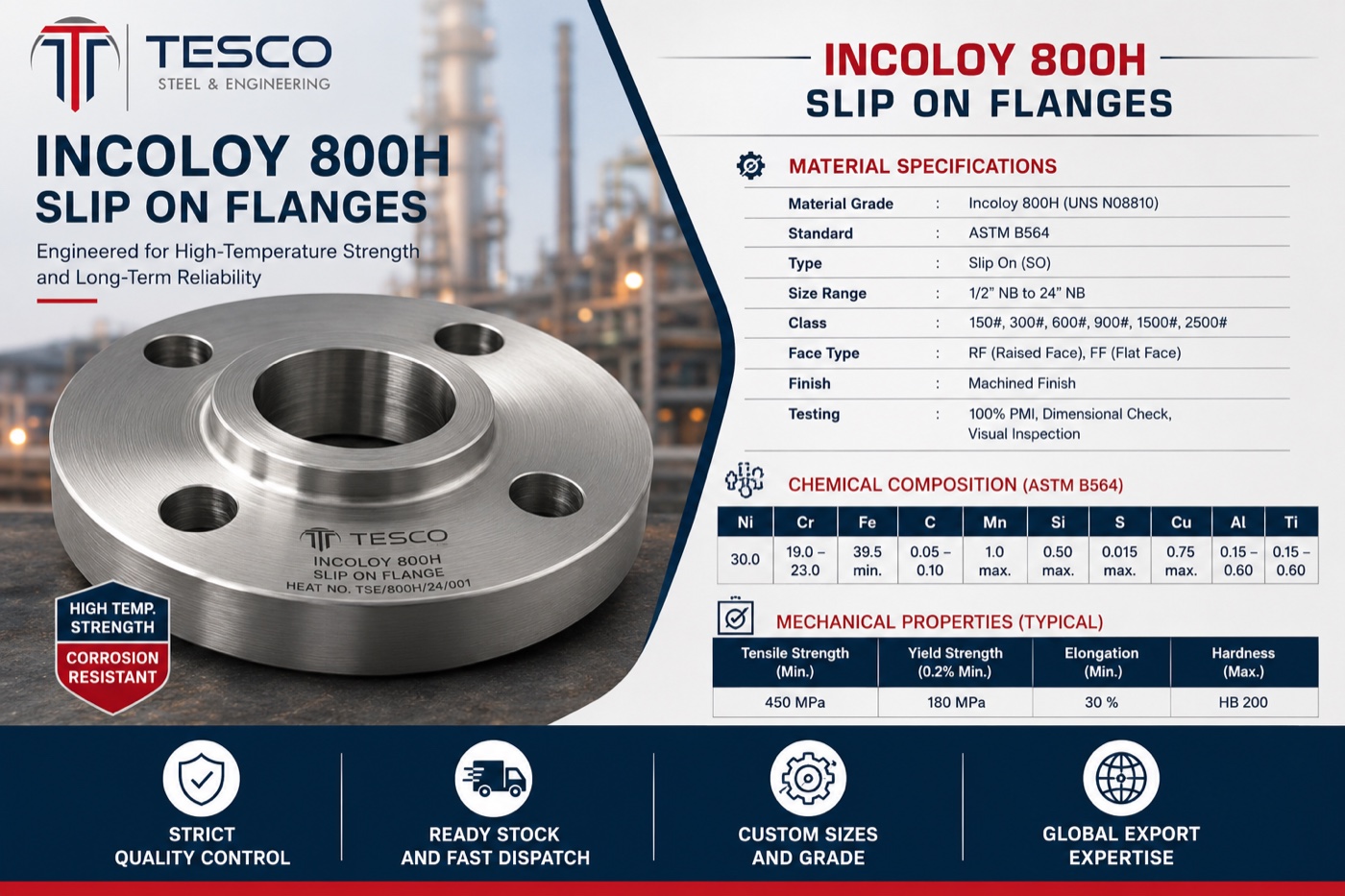
Tesco Steel & Engineering forges Incoloy 800H slip on flanges — the creep-rated iron-nickel-chromium alloy (UNS N08810, Werkstoff 1.4958) — to ASTM B564 and ASME B16.5 Class 150–2500 from ½″ to 24″ NB, larger patterns to order. It is Alloy 800 re-engineered for time: carbon controlled to 0.05–0.10% and a solution-annealed coarse grain earn the code-recognised creep allowables above 593 °C that plain 800 lacks — the grade of reformer outlets, pigtails, ethylene crackers and hot manifolds to ~900 °C. Grain size verified and reported on every certificate; dual-certified 800H/800HT heats available. Every lot with EN 10204 3.1/3.2 MTC. ISO 9001:2015, made in Mumbai, India — exported to 50+ countries.
Incoloy 800H Slip On Flange — Specifications at a Glance
What is an Incoloy 800H Slip On Flange?
Incoloy 800H = Alloy 800 re-engineered for time. Above 593 °C, metal under load stretches slowly and permanently — creep — and code design switches to time-based allowables published only for proven grades. 800H qualifies by two changes: carbon held at 0.05–0.10% (carbides pin the structure) and a coarse solution-annealed grain (less boundary area to slide) — buying code service to ~900 °C at the cost of some room-temperature strength. As a slip-on: two fillet welds, ERNiCr-3 filler, no preheat, no PWHT — forged to ASTM B564, not A182.
Also searched as: Alloy 800H slip on flange, Incoloy 800H SORF flange, ASTM B564 N08810 slip on flange, 1.4958 slip on flange, creep-rated slip on flange — all refer to the product on this page. See also Incoloy 800 (below 593 °C) and 800HT (highest creep ratings).
Rule of thumb: specify the family by peak metal temperature and code path — 800 below 593 °C, 800H/HT above it, 825 when the enemy is acid rather than heat.
Incoloy 800H (UNS N08810) Chemical Composition
Fe
Ni
Cr
C
Al
Ti
Al+Ti
Mn
Si
Cu
S
39.5 min
30.0-35.0
19.0-23.0
0.05-0.10
0.15-0.60
0.15-0.60
0.30-1.20
1.5 max
1.0 max
0.75 max
0.015 max
Values in weight % for UNS N08810 per ASTM B564. Note the carbon: a required range, not a maximum — the carbon is deliberately kept in, because its carbides do the creep-pinning work. Everything else reads as standard Alloy 800.
Incoloy 800H Mechanical Properties
Grade
Tensile Strength, MPa (ksi)
Yield Strength 0.2%, Min, MPa (ksi)
Elongation % min
Incoloy 800H (this page, solution annealed)
450 (65) min
170 (25) min
30
Incoloy 800, annealed — for comparison
517 (75) min
207 (30) min
30
Deliberately lower than plain 800 — the coarse grain that wins the creep battle costs room-temperature strength. That trade is the whole point: below 593 °C plain 800 is stronger and correct; above it, 800H's creep-rupture allowables govern. Density 7.94 g/cm³. Values and measured grain size demonstrated per heat on the EN 10204 certificate.
Incoloy 800H Slip On Flange Specifications
Incoloy 800H Slip On Flanges are available in the following specifications:
Material
Incoloy 800H / Alloy 800H — ASTM B564 / ASME SB-564 (UNS N08810, Werkstoff 1.4958); dual-certified 800H/800HT where available
Size
1/2"NB to 24"NB per ASME B16.5; larger diameters and EN 1092-1 patterns to order
Class
150#, 300#, 400#, 600#, 900#, 1500#, 2500#
Facing
Raised Face (SORF) — default; Flat Face (SOFF) or RTJ where the piping class specifies
Heat Treatment
Solution annealed per ASTM B564, coarse grain (ASTM 5 or coarser) verified; thermal record retained
Service
Code-rated creep service 593–~900 °C — reformers, pigtails, ethylene & hot manifolds; oxidation to ~1100 °C
Installation
Two fillet welds (hub + bore), pipe set back 1/8"; ERNiCr-3 filler (creep-qualified fillers per project spec), no preheat, no PWHT
Testing
Grain size reported per heat; PMI verification on request
Certification
EN 10204 3.1 (standard) / 3.2 witnessed
Equivalent Grades of Incoloy 800H
Trade Names
ASTM Forging
UNS
Werkstoff Nr.
Fittings
Pipe / Plate / Bar
Incoloy 800H / Alloy 800H
B564
N08810
1.4958
B366 WPNIC10
B407 / B409 / B408
ASME SB-564 is the boiler-code twin — and for this grade the code connection is the point: ASME creep allowables above 593 °C exist for 800H/HT, not plain 800. Not an A182 grade — nickel-alloy flanges are governed by the B-series standards.
Why Incoloy 800H Slip Ons Are Specified
The Code Stamp Above 593 °C
ASME time-dependent allowables are published for 800H — plain 800 legally disappears from hot code design, and this grade takes over.
Carbides That Pin, Grain That Holds
Required 0.05–0.10% carbon forms stable carbides; coarse grain minimises boundary sliding — the two levers of creep resistance, both certified on our MTCs.
Reformer Pedigree
Steam-methane reformer outlets, pigtails and ethylene hardware standardised on 800H decades ago — the service record at 800+ °C is measured in plant-lifetimes.
Iron-Base Economics, Still
All the creep engineering rides on the same 39.5% iron base — code-rated hot pressure parts at a fraction of nickel-base cost.
The creep engineering cuts both ways.Below 593 °C: the coarse grain is pure liability — plain 800 is stronger, tougher and cheaper there; 800H buys nothing. Wet acids & sour: no molybdenum or copper — that duty belongs to 825 or 625. Halogens & strong caustic:Inconel 600 or Nickel 201. State the peak metal temperature on the enquiry and we confirm 800 vs 800H vs 800HT — the family's classic slips run in both directions.
How Our Incoloy 800H Slip On Flanges Are Manufactured
1
Forging — cut billet of certified N08810 heat is hot-forged into the flange blank, keeping full heat traceability from raw material to despatch.
2
Solution annealing — the defining step: high-temperature anneal develops the coarse creep-resistant grain, verified against ASTM 5 or coarser; furnace record retained.
3
Machining — hub, faces and bolt holes to ASME B16.5; the bore machined slightly over pipe OD per the slip-on tolerance.
4
Facing & finish — SORF raised face with serrated stock finish, flat face or RTJ groove.
5
Testing & marking — mechanical and chemical verification against the heat, grain size reported (PMI where the order specifies), then permanent marking of standard, grade, size, class and heat number.
6
Certification & packing — EN 10204 3.1 MTC (3.2 witnessed on request), export-packed for sea or air freight.
Where Incoloy 800H Slip On Flanges Are Used
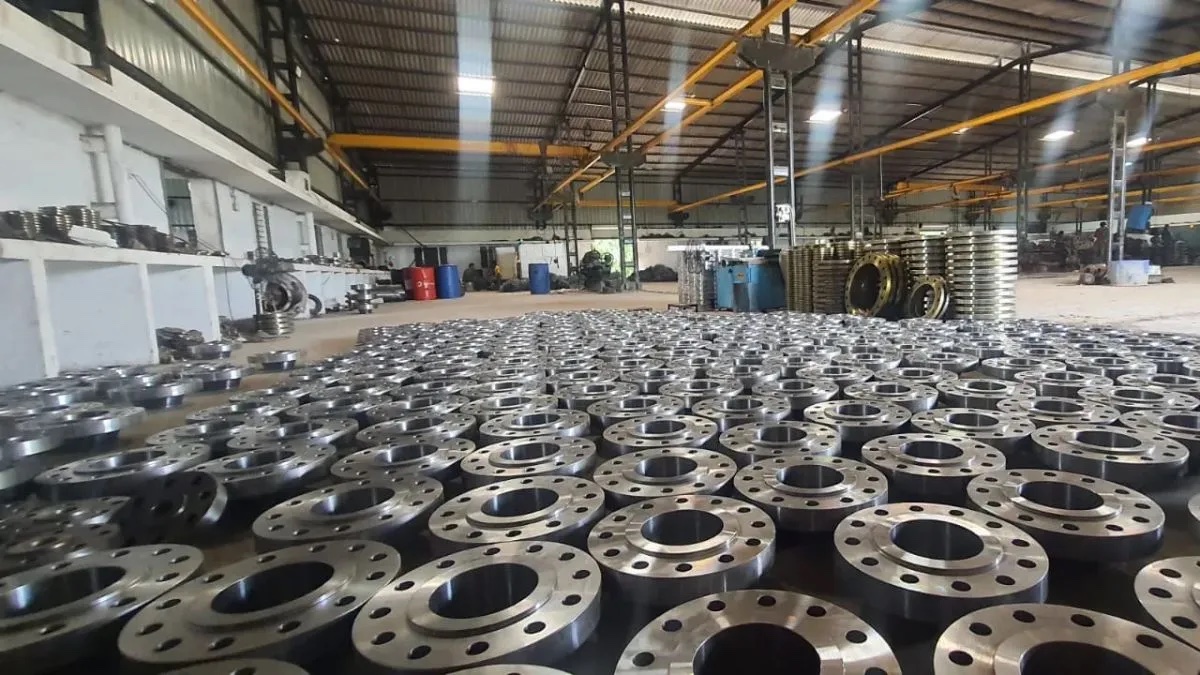
The code-calculated hot core of process industry: steam-methane reformer outlet systems and pigtails, ethylene cracker hardware, hydrogen and ammonia plant hot piping, high-temperature heat exchangers and superheaters, hot manifolds and headers, and heat-recovery systems above 593 °C. Slip-ons serve the utility, vent and transfer connections around these systems; weld necks take the pressure-critical lines. Production scale below:
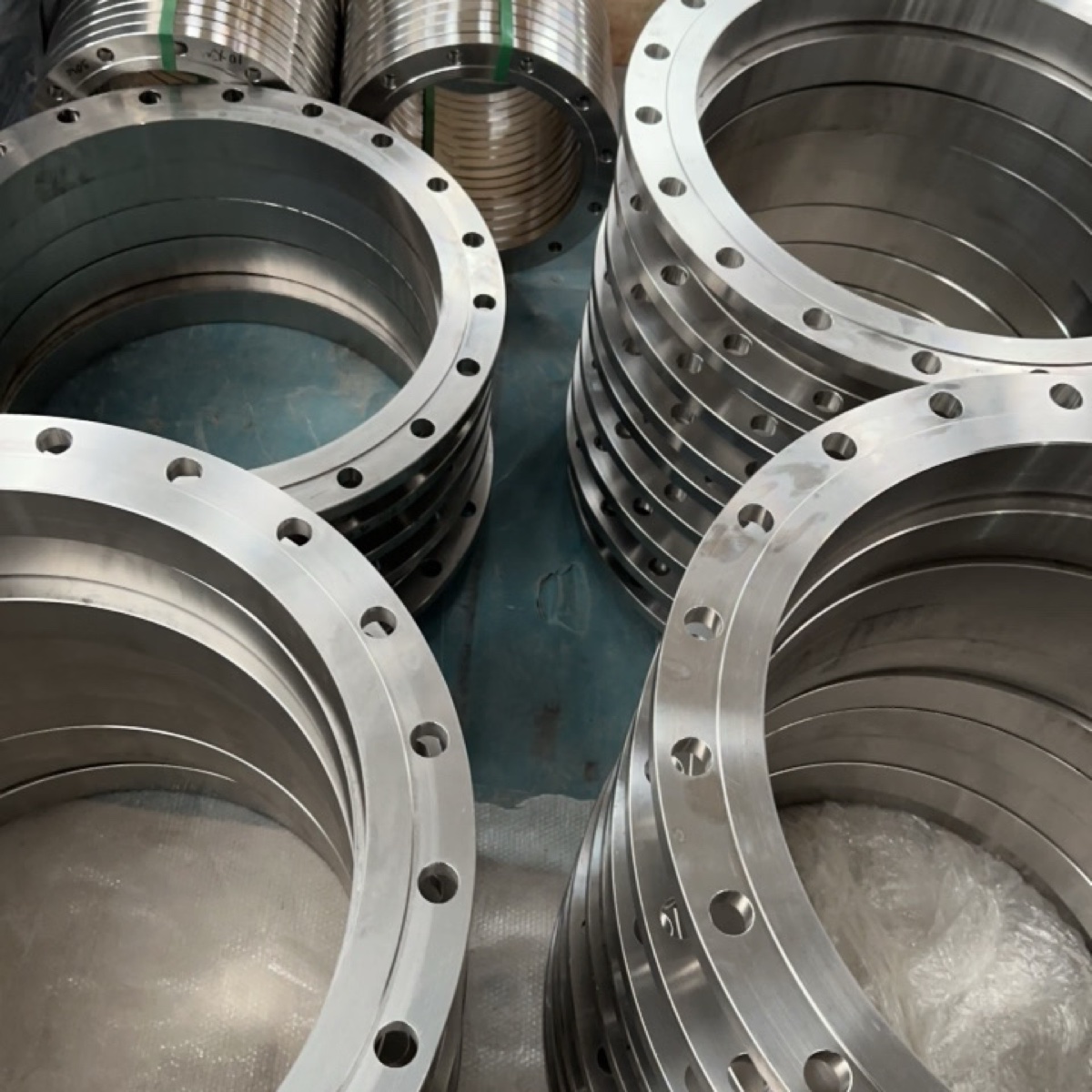
Large-Diameter Slip On Flanges — EN 1092-1 Patterns to OrderSlip On Production Hall — Volume Capability
Incoloy 800H Slip On Flange Dimensions
Incoloy 800H slip-on dimensions follow the ASME B16.5 slip-on tables — identical for every material. Full charts by class:
How to Specify & Order an Incoloy 800H Slip On Flange
Five elements — no bore schedule, since the slip-on bore suits the pipe OD:
1
Size & standard — e.g. 4″ NB ASME B16.5.
2
Pressure class & facing — Class 150–2500, SORF (default), flat face or RTJ where specified.
3
Grade & peak temperature — Incoloy 800H / UNS N08810 — ASTM B564 (1.4958); state the peak metal temperature, and whether dual-certified 800H/800HT suits the project.
4
Certification & testing — EN 10204 3.1 (standard) or 3.2 witnessed; grain size is reported as standard, PMI where the project specifies.
Example: “Slip On Flange, 4″ NB, ASME B16.5 Class 300, RF, Incoloy 800H / ASTM B564 (N08810), grain size ≤ ASTM 5 reported, EN 10204 3.1 — 10 pcs.” Quotations normally within 24 hours with price, unit weight and delivery.
Incoloy 800H Slip On Flanges — Frequently Asked Questions
What is an Incoloy 800H slip on flange?
It is a slip-on flange forged from Incoloy 800H — the creep-rated version of Alloy 800 (UNS N08810, ASTM B564, Werkstoff 1.4958) — dimensioned to ASME B16.5. The flange slides over the pipe end and is secured with two fillet welds. Its controlled 0.05-0.10% carbon and solution-annealed coarse grain earn the code-recognised creep allowables that standard Alloy 800 lacks, making it the correct grade of the family for pressure service above 593 °C, up to roughly 900 °C.
What is Incoloy 800H?
Alloy 800 re-engineered for time. Above roughly 593 °C, metal under load slowly and permanently stretches — creep — and design shifts from strength-based to time-based allowables. 800H takes the same Fe-32Ni-21Cr chemistry and makes two changes that resist creep: carbon is held in a deliberate 0.05-0.10% range so stable carbides pin the structure, and a high-temperature solution anneal coarsens the grain so there is less grain-boundary area to slide. Designations: UNS N08810, Werkstoff 1.4958; forged flanges are governed by ASTM B564.
What is the chemical composition of Incoloy 800H?
For UNS N08810: iron 39.5% minimum, nickel 30.0-35.0%, chromium 19.0-23.0%, carbon 0.05-0.10% — a required range, not a maximum: the carbon is deliberately kept in, because its carbides do the creep-pinning work — aluminium and titanium 0.15-0.60% each (0.30-1.20% combined), manganese 1.5% max, silicon 1.0% max, copper 0.75% max and sulphur 0.015% max. Everything except the carbon control reads as standard Alloy 800.
What are the mechanical properties of Incoloy 800H slip on flanges?
Per ASTM B564, solution annealed: tensile strength 450 MPa (65 ksi) minimum, 0.2% yield strength 170 MPa (25 ksi) minimum and elongation 30% minimum — deliberately lower than standard Alloy 800's 517/207 MPa, because the coarse grain that wins the creep battle costs room-temperature strength. That trade is the whole point: below 593 °C, plain 800 is the stronger and correct grade; above it, 800H's creep-rupture allowables govern and win. Values and grain size are demonstrated per heat on the EN 10204 certificate.
What is creep, and why does it change flange design above 593 °C?
Below about 593 °C, metal under a steady load holds its shape indefinitely if the stress stays under yield. Above that line, atoms become mobile enough that the metal stretches slowly and permanently under even modest load — creep — and failure becomes a question of time, not just stress. ASME code design therefore switches from yield-based to creep-rupture-based allowables, published only for grades with proven long-term data: in this family, 800H and 800HT. That is why plain Alloy 800 legally disappears from hot code design and 800H takes over.
Why is coarse grain specified for creep service?
Because at creep temperatures, grain boundaries are the weakness — deformation proceeds by grains sliding past one another and cavities forming along the boundaries. A coarse-grained structure (ASTM grain size 5 or coarser, the 800H requirement) has far less boundary area per unit volume, so it creeps slower and lives longer. The same coarse grain is a modest liability at room temperature, in fatigue and in toughness — which is exactly why 800H is a hot-service specification, not a universal upgrade. Our certificates report the measured grain size on every heat.
What is the difference between Incoloy 800H and Incoloy 800?
Carbon and grain, not chemistry class. Standard 800 (N08800) caps carbon at 0.10% with no minimum, is annealed fine-grained, and is the stronger, correct grade below 593 °C. 800H (N08810) requires carbon between 0.05 and 0.10%, is solution annealed to coarse grain, and carries the code creep allowables above 593 °C. Corrosion behaviour is essentially identical. Specify by peak metal temperature — ordering plain 800 for a reformer manifold, or 800H for a warm heat exchanger, are the two classic slips in this family.
What is the difference between Incoloy 800H and 800HT?
One further refinement. 800HT (N08811) tightens carbon to 0.06-0.10% and raises the combined aluminium-plus-titanium to 0.85-1.20%, which nudges the creep-rupture allowables above 800H's in the hottest range. In practice the two grades overlap so closely that mills commonly dual-certify heats as 800H/800HT, satisfying either callout from one stock — we offer the same. Where a specification names one exclusively, that is what the certificate states.
How does Incoloy 800H compare with Inconel 600 or 601?
Different jobs at the hot end. 800H is the code-pressure-parts economist: iron-based, creep-certified, the standard for reformer and ethylene hardware where stress and time are calculated. Inconel 600 and 601 are nickel-base atmosphere specialists — halogens and caustic for 600, spall-proof cyclic oxidation to 1250 °C for 601 — with better carburisation resistance but no cost advantage. Many hot plants run 800H for the code-calculated pressure envelope and Inconel for the atmosphere-exposed internals; the split is duty, not loyalty.
What temperature can Incoloy 800H slip on flanges handle?
Its design home is 593 to roughly 900 °C, where its code creep allowables govern — reformer outlet systems and pigtails run exactly there. Oxidation resistance extends to about 1100 °C. Two honest notes: below 593 °C, standard Alloy 800 is stronger and the correct economic grade; and bolted-joint ratings follow the ASME B16.5 pressure-temperature tables, with gasket and bolting selection becoming the real engineering at the hottest flanged joints.
How does Incoloy 800H behave in carburising and sulphur-bearing atmospheres?
It inherits the family's twin tolerance. The 30%+ nickel slows carbon diffusion, giving good carburisation resistance in ethylene and heat-treatment service — where its creep rating is needed anyway — and the iron base tolerates the sulphur-bearing flue gases that attack high-nickel Inconel. For the most aggressive carburising, nickel-base 601 or 602CA go further; for heavily sulphidising reducing gas, chromium-rich iron alloys hold the line. 800H's virtue is doing well on both fronts while carrying the code stamp.
Which ASTM standard covers Incoloy 800H slip on flanges?
ASTM B564 (ASME SB-564), the nickel-alloy forging specification — not A182, which covers stainless and alloy steels. System partners follow the same B-series logic: seamless pipe and tube to ASTM B407, plate, sheet and strip to ASTM B409, rod and bar to ASTM B408, and welding fittings to ASTM B366 (WPNIC10; 800HT's is WPNIC11). Certificates state UNS N08810, the standard, the solution-annealed condition, the measured grain size and the heat number together.
Where are Incoloy 800H slip on flanges typically used?
The code-calculated hot core of process industry: steam-methane reformer outlet systems and pigtails, ethylene cracker hardware, hydrogen and ammonia plant hot piping, high-temperature heat exchangers and superheaters, hot manifolds and headers, and heat-recovery systems running above 593 °C. Slip-ons serve the moderate-pressure utility, vent and transfer connections around these systems; weld necks take the pressure-critical lines — both forged from the same certified, grain-size-verified heats.
Where does Incoloy 800H not belong?
Three honest lines. Below 593 °C: standard Alloy 800 is stronger, finer-grained and cheaper — 800H buys nothing there. Wet acids and sour chemistry: no molybdenum or copper — that duty belongs to sister alloy 825 or Inconel 625. Halogens and strong caustic: hot chlorine, HCl and concentrated hydroxides want the full nickel of Inconel 600 or pure nickel. And in heavily sulphidising reducing flue gas, chromium-rich iron alloys can outlast the whole nickel-bearing family.
Who manufactures Incoloy 800H slip on flanges in India?
Tesco Steel & Engineering is an ISO 9001:2015 certified flange manufacturer based in Mumbai, India, forging Incoloy 800H / UNS N08810 slip on flanges from ½" to 24" NB per ASTM B564 and ASME B16.5 — alongside the full 800-family programme of Incoloy 800, 800HT and 825 in weld neck, blind, socketweld and slip-on patterns — with grain size verified and reported, dual-certified 800H/800HT heats where available, PMI on request, and EN 10204 3.1/3.2 certification on every lot. Exported to more than 50 countries.