Incoloy 925 Slip On Flanges — UNS N09925 Manufacturer
Tesco Steel & Engineering forges Incoloy 925 slip on flanges — the age-hardenable member of the Incoloy family (UNS N09925) — to ASTM B637 with ASME B16.5 dimensions, Class 150–2500, from ½″ to 24″ NB, larger patterns to order. It is Alloy 825 given the K-500 treatment: the same Mo + Cu sour-and-acid recipe, plus titanium and aluminium so ageing triples the yield — 965/724 MPa minimum against 825's 586/241 — with NACE MR0175 acceptance retained. The wellhead and downhole-hardware grade: sub-surface safety valves, hangers and christmas-tree connections specify it by name. Supplied solution annealed and aged with thermal records, every lot with EN 10204 3.1/3.2 MTC. ISO 9001:2015, made in Mumbai, India — exported to 50+ countries.
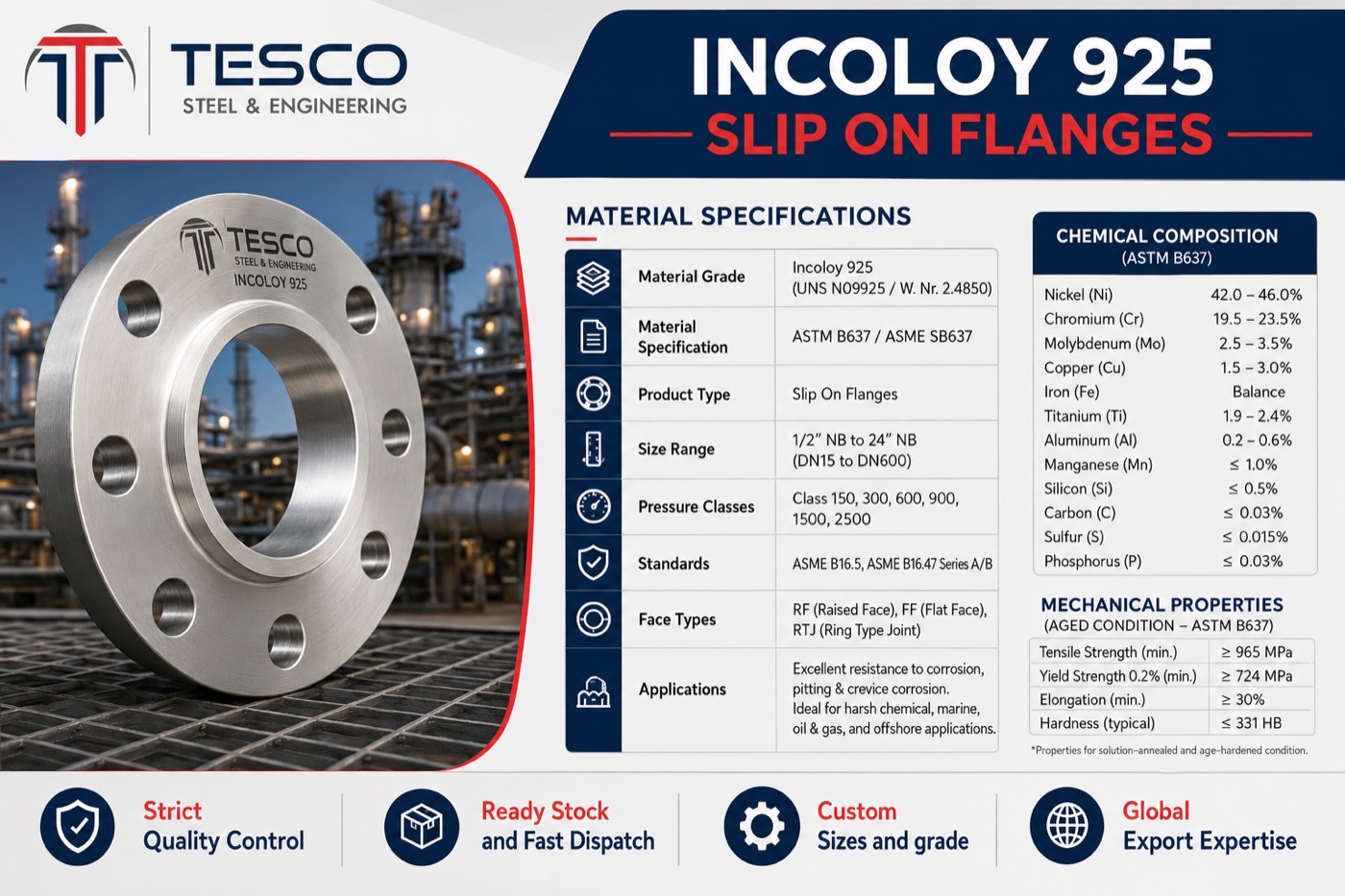
Incoloy 925 · Alloy 925 · N09925ASTM B637 · API 6A CRA PracticeNi 42–46% · Mo + Cu · Ti 1.9–2.4%NACE MR0175 Sour ServiceASME B16.5 Class 150–2500965 MPa TS / 724 MPa YS min (aged)EN 10204 3.1 / 3.2 · ISO 9001:2015
Incoloy 925 Slip On Flange — Specifications at a Glance
What is an Incoloy 925 Slip On Flange?
Incoloy 925 = Alloy 825 with the superalloy trick. Keep the Mo + Cu sour-and-acid chemistry on a 42–46% nickel base, add ~2% Ti + Al, age at ~700 °C, and γ′ precipitates triple the yield to 724 MPa min — while NACE MR0175 sour acceptance stays. The mechanism of Monel K-500 and Inconel 718, applied to the 825 base — the wellhead-hardware grade. Forged to ASTM B637 (not B564, not A182); welding needs planning — see the honest note below.
Also searched as: Alloy 925 slip on flange, Incoloy 925 SORF flange, ASTM B637 N09925 slip on flange, age-hardened Incoloy slip on flange, API 6A CRA flange — all refer to the product on this page. See also Incoloy 825 (the weldable parent) and Inconel 718 flanges (the strength ceiling).
Rule of thumb: 825 for the joints, 925 where sour-service metal must carry serious load, 718 when load governs everything — the same 400 → K-500 logic, played on the Incoloy base.
Incoloy 925 (UNS N09925) Chemical Composition
Ni
Cr
Mo
Cu
Ti
Al
Fe
C
Mn
Si
S
42.0-46.0
19.5-22.5
2.5-3.5
1.5-3.0
1.9-2.4
0.10-0.50
22.0 min
0.03 max
1.0 max
0.5 max
0.03 max
Values in weight % for UNS N09925. Read it as 825 plus the hardening pair: Mo and Cu do the same acid and sour work, while the titanium and aluminium form the γ′ precipitates that triple the strength on ageing.
Per ASTM B637; typical aged values run higher still. Roughly three times 825's yield — and API 6A CRA practice classifies wellhead material by yield grade (the familiar 110K callout). The heat-treatment condition is part of the specification; our certificates state it with the thermal record. Values demonstrated per heat on the EN 10204 certificate.
Incoloy 925 Slip On Flange Specifications
Incoloy 925 Slip On Flanges are available in the following specifications:
Material
Incoloy 925 / Alloy 925 — ASTM B637 (UNS N09925); API 6A CRA practice where the project governs
Size
1/2"NB to 24"NB to ASME B16.5 dimensions; larger diameters and custom patterns to order
Class
150#, 300#, 400#, 600#, 900#, 1500#, 2500#
Facing
Raised Face (SORF) — default; Flat Face (SOFF) or RTJ where the piping class specifies
Heat Treatment
Solution annealed + age-hardened (~700 °C cycle) per ASTM B637 — standard; solution annealed for weld-then-age fabrication
Service
NACE MR0175 sour wellhead & downhole duty — 825's corrosion resistance at three times the strength
Installation
Welding needs planning — weld annealed (ERNiFeCr-1 / ERNiCrMo-3) then age; see the honest note below
Testing
Hardness survey per NACE where specified; PMI verification on request
Not B564 — that covers the solid-solution relatives like 825; age-hardenable N09925 belongs to ASTM B637, the precipitation-hardening nickel alloy specification, and citing B564 for it is a common paperwork slip. Not an A182 grade either — nickel-alloy flanges are governed by the B-series standards.
Why Incoloy 925 Slip Ons Are Specified
Sour Strength, Certified
NACE MR0175 / ISO 15156-3 listed in the aged condition — 724+ MPa yield with H₂S acceptance is the combination the alloy exists to deliver.
Three Times 825's Yield
965/724 MPa against 586/241 — the γ′ mechanism of K-500 and 718, running on the sour-proven 825 chemistry.
The Corrosion Recipe Survives Ageing
Nickel, chromium, molybdenum and copper stay in solution doing their normal work — sour brines, CO₂-chloride streams and acidising fluids see essentially an 825 surface.
Wellhead Pedigree
Sub-surface safety valves, tubing hangers, packers and christmas-tree hardware specify N09925 by name — our flanges match that equipment from the same certified heats.
925's strength does not survive an arc untouched. The alloy welds in the solution annealed condition (ERNiFeCr-1 or ERNiCrMo-3 filler) and is then aged — weld-then-age fabrication works where the sequence can be arranged — but welding already-aged material softens the joint zone, and weld metal does not reach base-metal strength. Be deliberate: for a routine welded slip-on, 825 is usually the honest specification; where 925's strength is essential at the connection, plan the heat-treatment sequence with us at enquiry, or use bolted and integral connections. NACE hardness limits apply throughout — we survey and certify where specified.
How Our Incoloy 925 Slip On Flanges Are Manufactured
1
Forging — cut billet of certified N09925 heat is hot-forged into the flange blank, keeping full heat traceability from raw material to despatch.
2
Solution treatment — homogenised per ASTM B637, preparing the matrix for ageing.
3
Age-hardening — the defining step: held on a controlled ~700 °C cycle while γ′ precipitates form and the yield triples; full thermal record retained.
4
Machining — hub, faces and bolt holes to ASME B16.5; the bore machined slightly over pipe OD per the slip-on tolerance.
5
Testing & marking — tensile, hardness (NACE survey where specified) and chemical verification against the heat, then permanent marking of standard, grade, size, class and heat number.
6
Certification & packing — EN 10204 3.1 MTC stating the aged condition (3.2 witnessed on request), export-packed for sea or air freight.
Where Incoloy 925 Slip On Flanges Are Used
Sour oil and gas hardware where strength and corrosion meet: wellhead and christmas-tree connections, tubing hangers and spools, sub-surface safety valve and packer systems, downhole tool assemblies, high-pressure sour piping and flanges matching 925 equipment — plus marine and acid-service components needing more strength than 825. Slip-ons serve the moderate-pressure connections; weld necks and integral connections take the extreme-pressure envelope. Packing and despatch below:
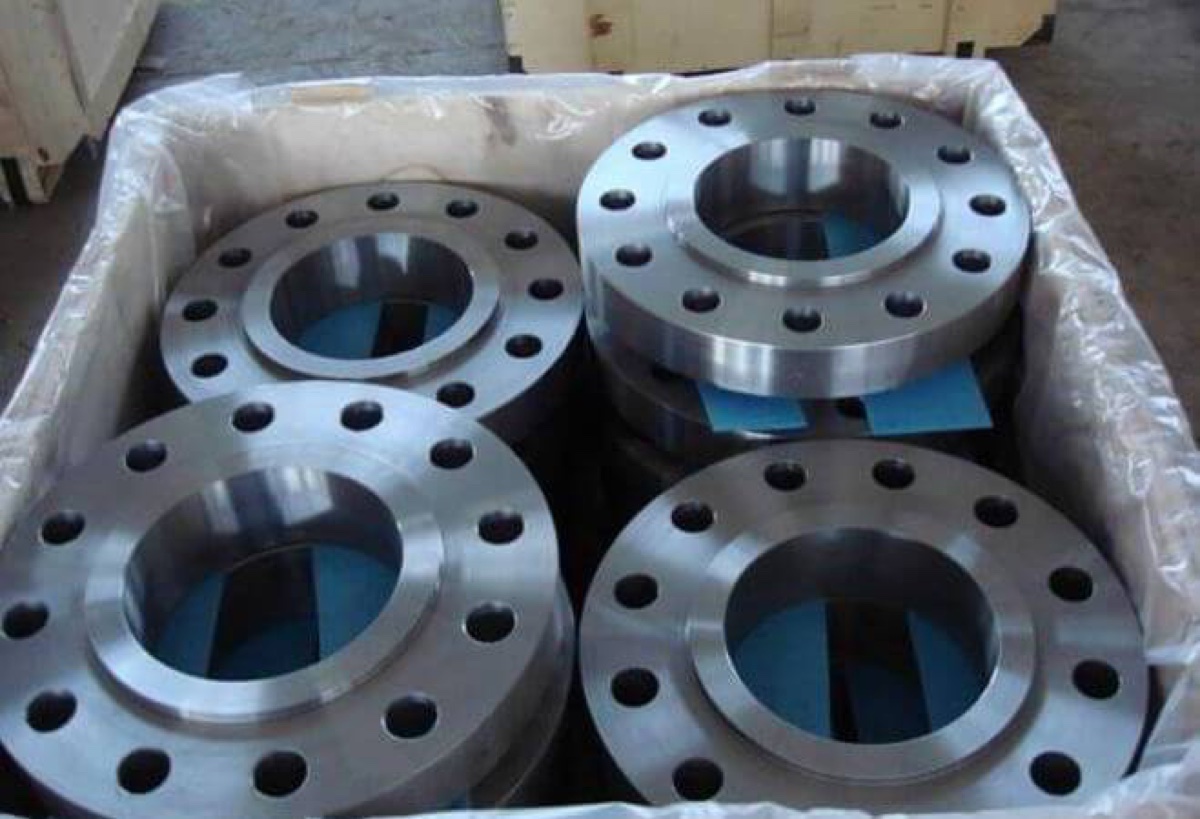
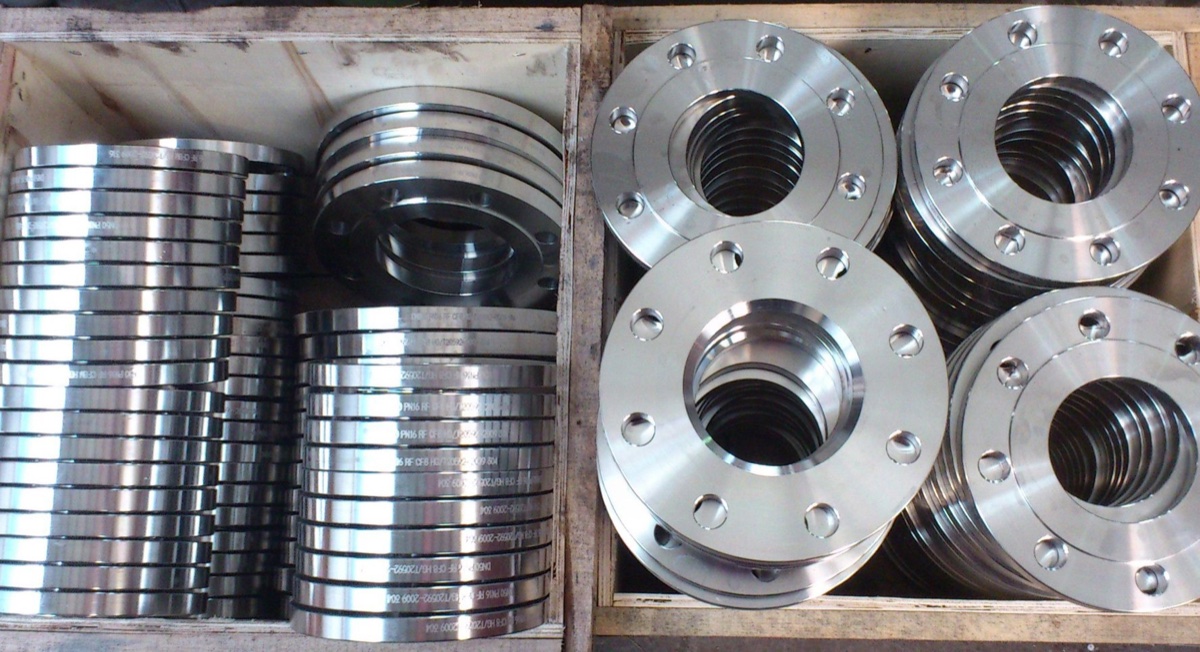
SORF Slip On Flanges — Packed in Lined Export CrateMarked Slip On Flanges — Crated by Size for Despatch
Incoloy 925 Slip On Flange Dimensions
Incoloy 925 slip-on dimensions follow the ASME B16.5 slip-on tables — identical for every material. Full charts by class:
Example: “Slip On Flange, 4″ NB, ASME B16.5 Class 900, RTJ, Incoloy 925 / ASTM B637 (N09925), aged, NACE MR0175, EN 10204 3.1 — 6 pcs.” Quotations normally within 24 hours with price, unit weight and delivery.
Incoloy 925 Slip On Flanges — Frequently Asked Questions
What is an Incoloy 925 slip on flange?
It is a slip-on flange forged from Incoloy 925 — the age-hardenable member of the Incoloy family (UNS N09925, ASTM B637) — with ASME B16.5 dimensions. The flange slides over the pipe end and is secured with two fillet welds. 925 keeps Alloy 825's corrosion recipe — molybdenum and copper on a high-nickel iron-chromium base — and adds titanium and aluminium so heat treatment can precipitation-harden it to roughly three times 825's yield strength, with NACE MR0175 sour-service acceptance retained. It is the wellhead and downhole-hardware alloy of the family.
What is Incoloy 925?
Alloy 825 given the K-500 treatment. Sour gas fields needed 825's corrosion immunity in components that also carry serious load — hangers, stems, valve internals, wellhead hardware — so metallurgists added about 2% titanium and a little aluminium to the 825 base, creating an alloy that age-hardens by gamma-prime precipitation, the same mechanism as Monel K-500 and Inconel 718. Designations: UNS N09925, often Alloy 925; forgings are governed by ASTM B637, with API 6A CRA practice common in oil-and-gas procurement.
What is the chemical composition of Incoloy 925?
For UNS N09925: nickel 42.0-46.0%, chromium 19.5-22.5%, molybdenum 2.5-3.5%, copper 1.5-3.0%, titanium 1.9-2.4%, aluminium 0.10-0.50%, iron 22.0% minimum, carbon 0.03% max, manganese 1.0% max, silicon 0.5% max and sulphur 0.03% max. Read it as 825 plus the hardening pair: the Mo and Cu do the same acid and sour work, while the titanium and aluminium form the gamma-prime precipitates that triple the strength on ageing.
What are the mechanical properties of Incoloy 925 slip on flanges?
In the solution annealed and age-hardened condition per ASTM B637: tensile strength 965 MPa (140 ksi) minimum, 0.2% yield strength 724 MPa (105 ksi) minimum and elongation 18% minimum — against Alloy 825's 586/241 MPa, roughly three times the yield. Typical aged values run higher still. API 6A CRA practice classifies wellhead material by yield grade (the familiar 110K callout); state the governing specification and the certificate documents the heat treatment and properties against it.
How does age-hardening give Incoloy 925 its strength?
By gamma-prime precipitation — the superalloy mechanism. After solution treatment, the alloy is aged in the 700 °C region, during which the titanium and aluminium form fine Ni₃(Al,Ti) particles coherently locked into the matrix. Dislocations must cut or bypass them, so yield strength roughly triples while the corrosion-bearing chemistry — nickel, chromium, molybdenum, copper — stays in solution doing its normal work. The same mechanism powers Monel K-500 and Inconel 718; 925 applies it to the sour-service 825 base.
What is the difference between Incoloy 925 and Incoloy 825?
Strength mechanism, not corrosion philosophy. 825 is solid-solution: one simple annealed condition, freely weldable, 586/241 MPa — the piping and flange workhorse. 925 adds titanium and aluminium and is age-hardened to 965/724 MPa minimum — three times the yield — for the components where the metal itself carries the load. Corrosion behaviour is closely similar, and both carry NACE MR0175 acceptance. The practical split mirrors Monel 400 versus K-500: 825 for the joints and piping, 925 where strength is the specification.
How does Incoloy 925 compare with Inconel 718?
718 is the strength ceiling of the age-hardened nickel world — around 1035 MPa minimum yield from its niobium-based gamma-double-prime — and the choice where load governs everything. 925 answers with better economics (lower nickel, no niobium), easier processing, and corrosion chemistry inherited from 825 that suits sour and acid environments particularly well. Oil-and-gas practice uses both: 718 for the highest-stressed components, 925 for the wide band of wellhead and downhole hardware where its 724 MPa minimum is ample. We quote to the specification the project names.
Is Incoloy 925 acceptable for NACE MR0175 sour service?
Yes — UNS N09925 is listed in NACE MR0175 / ISO 15156-3 for sour service in the solution annealed and aged condition, within the hardness limits the standard sets. That combination — sour-gas acceptance at 724+ MPa yield — is the alloy's entire reason for existing, and why sub-surface safety valves, tubing hangers, packers and wellhead components specify it by name. State the NACE requirement on the enquiry and the certification documents compliance, including hardness survey where required.
Does Incoloy 925 keep 825's corrosion resistance?
Substantially, yes. The elements that do 825's corrosion work — 40%+ nickel for chloride SCC immunity, molybdenum for pitting and reducing acids, copper for sulphuric duty — are all present and remain in solution after ageing. In sour brines, CO₂-chloride streams and acidising fluids, 925 performs essentially as its parent. The honest nuance: for the most severe crevice and hot-chloride extremes, solid-solution 625 or C-276 still rank higher — which is why 925's home is sour strength, not worst-case acid.
Can Incoloy 925 slip on flanges be welded?
With planning — the age-hardenable caveat applies. 925 is weldable in the solution annealed condition (typically with ERNiFeCr-1 or ERNiCrMo-3 filler) and then age-hardened, so weld-then-age fabrication works where the sequence can be arranged. Welding already-aged material softens the joint zone and is generally avoided; the weld metal itself does not reach base-metal strength. Where a routine welded slip-on joint is the design, 825 is often the honest specification; where 925's strength is essential, plan the heat-treatment sequence with us at enquiry.
Which condition should Incoloy 925 flanges be ordered in?
Solution annealed and age-hardened is the standard supply — it is the condition NACE lists and the one that delivers the 965/724 MPa properties. Solution annealed (unaged) material is ordered where the fabricator intends to weld first and age after. The heat-treatment condition, cycle records and resulting properties appear on the EN 10204 certificate either way; state the intended fabrication route on the enquiry and we supply the matching condition.
Which ASTM standard covers Incoloy 925 slip on flanges?
ASTM B637 — the specification for precipitation-hardening nickel alloy bars, forgings and forging stock — with flange dimensions from ASME B16.5. Note the difference from its solid-solution relatives: 825 forgings are B564, but age-hardenable N09925 belongs to B637, and citing B564 for it is a common paperwork slip. Oil-and-gas procurement frequently governs through API 6A CRA requirements instead; certificates state UNS N09925, the standard, the heat-treatment condition and the heat number together.
Where are Incoloy 925 slip on flanges typically used?
Sour oil and gas hardware where strength and corrosion meet: wellhead and christmas-tree connections, tubing hangers and spools, sub-surface safety valve and packer systems, downhole tool assemblies, high-pressure sour piping and the flanges matching 925 equipment — plus marine and acid-service components that need more strength than 825 offers. Slip-ons serve the moderate-pressure connections around this hardware; weld necks and integral connections take the extreme-pressure envelope.
Where does Incoloy 925 not belong?
Three honest lines. Routine welded piping: the age-hardening complicates fabrication — solid-solution 825 does the same corrosion job weldably and cheaper. Heat: gamma-prime coarsens with long exposure above roughly 540 °C — furnace duty belongs to 800H/800HT, and hot strength beyond 925 to Inconel 718. Worst-case acids: hot HCl, wet chlorine and severe crevice chemistry still escalate to 625 or Hastelloy C-276. Its lane — sour strength at wellhead temperatures — it owns outright.
Who manufactures Incoloy 925 slip on flanges in India?
Tesco Steel & Engineering is an ISO 9001:2015 certified flange manufacturer based in Mumbai, India, forging Incoloy 925 / UNS N09925 slip on flanges from ½" to 24" NB per ASTM B637 with ASME B16.5 dimensions — alongside the full Incoloy programme of 800, 800H, 800HT and 825, and the age-hardened neighbours Monel K-500 and Inconel 718 — supplied solution annealed and aged with full thermal records, NACE MR0175 documentation and hardness surveys where specified, PMI on request, and EN 10204 3.1/3.2 certification on every lot. Exported to more than 50 countries.