Incoloy 825 Long Weld Neck Flanges — UNS N08825 Acid & Sour Service LWN Manufacturer
Tesco Steel & Engineering manufactures Incoloy 825 long weld neck flanges — the Incoloy family's wet-chemistry child: ASTM B564, UNS N08825, W.Nr. 2.4858, NiCr21Mo — with ASME B16.5 flange ends in Classes 150–2500 and the barrel made to order. Read against parent 800, every change points at acid: molybdenum in at 2.5–3.5% for chlorides and reducing media, copper in at 1.5–3.0% for the sulphuric electrochemistry the acid ladder describes, titanium raised to a true stabilising dose — the 321-style lock on a nickel-iron base, as-welded safe where acid finds sensitised boundaries fastest — carbon halved, nickel up to 38–46%. The modern franchise is the oil patch's: sour gas under NACE MR0175/ISO 15156 — solid forgings and the 825-clad economy alike. The neighbours are one trade away each — Alloy 20 deeper in named sulphuric, 904L leaner for breadth, 625 stronger for stacked severity — and 825 holds the working middle: mixed acid, sour and chloride duty on one certificate. One forging, one closing weld — matching ERNiFeCr-1 or the borrowed ERNiCrMo-3. Facings: RF / FF / RTJ; small bore on the Incoloy 825 socketweld. Every lot with EN 10204 3.1/3.2 MTC. ISO 9001:2015, made in Mumbai, India — exported to 50+ countries.
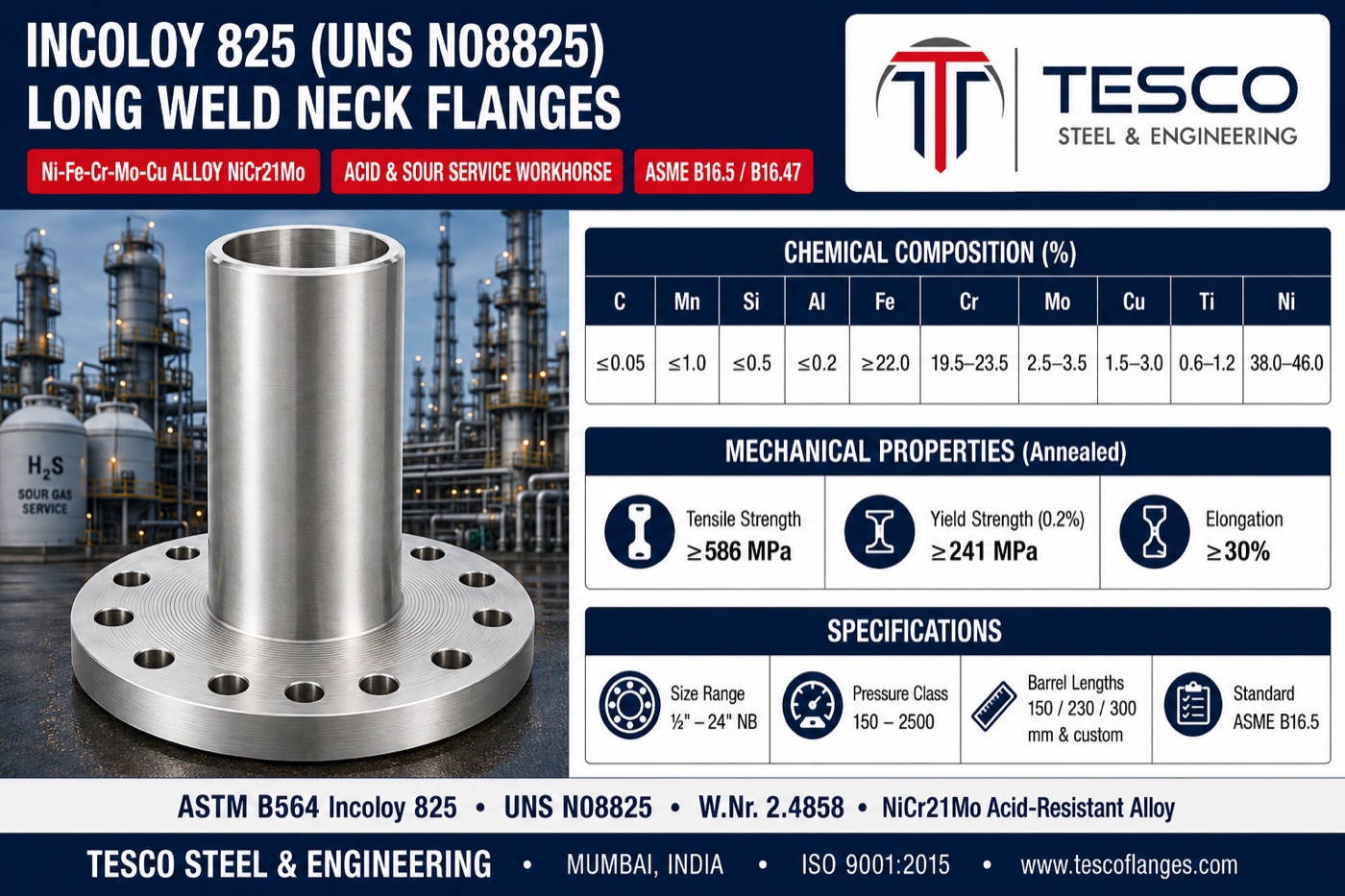
ASTM B564 · UNS N08825 · W.Nr. 2.4858NiCr21Mo — Every Change Points at AcidMo + Cu + Ti Lock on the Incoloy BaseNACE MR0175 Sour-Service StandingChloride-SCC Immune · As-Welded Safe586 / 241 MPa AnnealedB16.5 Flange Ends · Class 150–2500EN 10204 3.1 / 3.2 · ISO 9001:2015
Incoloy 825 Long Weld Neck Flanges — Specifications at a Glance
What is an Incoloy 825 Long Weld Neck Flange?
The wet-chemistry Incoloy, in the nozzle pattern. An Incoloy 825 flange (UNS N08825, ASTM B564) whose neck continues as a long, heavy-walled straight barrel — the nozzle itself — bevelled for one closing butt weld at the vessel, column or wellhead system. Against parent 800: Mo in for chlorides, Cu in for sulphuric, Ti raised to the stabilising lock, carbon halved, nickel up to 38–46% — every change pointing at acid. The modern franchise: sour gas under NACE MR0175. Welds with ERNiFeCr-1 or ERNiCrMo-3, no PWHT — as-welded safe. Supplied annealed — 586/241/30. Flange ends per ASME B16.5, Classes 150–2500; barrel length and bore stated by you. EN 10204 3.1 on every lot.
The industry's split in one line:named sulphuric reads Alloy 20, breadth reads 904L, sour and mixed oil-field chemistry read 825, stacked severity reads 625 — all four benches stocked at our works.
What the Wet Redesign Buys
The Sour-Service Standing
NACE MR0175/ISO 15156 practice in the annealed condition — H2S, CO2-brine and chloride duty on one certificate: the oil patch's most-specified nickel-iron alloy.
Both Acids of the Ladder
Copper for sulphuric and phosphoric, molybdenum for chlorides and reducing media — the acid ladder's two electrochemistries carried together on the Incoloy base.
The Titanium Lock
Ti at 0.6–1.2% against carbon halved to 0.05% — the 321-style stabilisation on a nickel-iron base: heavy fabrication and closing welds stay intergranular-safe as-welded.
SCC Beyond Reach
At 38–46% nickel the chloride cracking mechanism has no grip — deeper immunity than the parent's, carried into hot brines and evaporator duty.
Specification Notes — Getting Incoloy 825 Long Weld Necks Right
Three honest notes.Not the heat branch of the family: 825's stabilisation is tuned for aqueous service — sustained duty above ~540 °C belongs to parent 800 and its H grades, whose creep certificates 825 does not carry. The PREN is modest: 2.5–3.5% molybdenum serves process chlorides honourably, but seawater and severe pitting duty read the super duplex twins or 625 — and hot concentrated reducing acids read the Hastelloy bench. And name the sour duty fully: H2S partial pressure and chloride level decide the MR0175 conversation — put them on the enquiry.
How Our Incoloy 825 LWN Flanges Are Manufactured
1
Forging — each piece individually forged from certified N08825 heats kept segregated on the nickel shelf, with the barrel integral — no welded build-ups.
2
Stabilise-annealing — the cycle that sets the titanium lock to work; records retained against the heat number.
3
Verification — chemistry per heat with the molybdenum, copper and titanium windows certified; mechanicals per heat at the 586/241 line.
4
Machining — flange end to ASME B16.5; barrel turned to pattern (standard / HB / equal) and bored to the ordered schedule or drawing; RF serrations, flat face or RTJ groove per B16.20 for the wellhead habitat; weld end bevelled 37.5°.
5
Testing & marking — PMI reads the Mo, Cu and Ti lines on every piece — the signature separating 825 from parent 800, from Alloy 20 and from 625 on the shelf; marked with grade, size, schedule and heat number.
6
Certification & packing — EN 10204 3.1 MTC (3.2 witnessed on request); WPS guidance naming the ERNiFeCr-1 and ERNiCrMo-3 filler options; faces and bevels protected, packed sea-worthy.
Where Incoloy 825 LWN Flanges Are Used
Where acid and sour duty meet: sour-gas processing plants and wellhead-adjacent systems under NACE MR0175 — adapter spools, manifold nozzles, vessel connections, alongside the 825-clad economy of lined pipe and vessels — sulphuric and phosphoric acid plants, pickling circuits, chemical-process columns running mixed and chloride-bearing streams, hot-brine evaporators where the SCC immunity governs, and the instrument standpipes and level bridles riding on all of them — from Class 150 acid work to Class 2500 ring-joint wellhead duty. One forging, one closing weld. Production and supply below:
Long Weld Necks — Machined at Our WorksLong Weld Neck — Heavy Barrel, Bevelled Weld EndDN600 RF Long Weld Neck — Large Diameter, B16.5 Drilling
Incoloy 825 LWN Flange Dimensions
Flange-end dimensions are class-governed per ASME B16.5 (ratings per the alloy's tables); barrel length and bore per order. Full class-by-class charts:
Seven elements — the acid named and the sour numbers decide the rung:
1
Size & standard — e.g. 4″ NB ASME B16.5.
2
Pressure class & facing — 150#–2500#; RF, FF or RTJ with ring number for the wellhead habitat.
3
Barrel length — overall, face to weld end: 150 / 230 / 300 mm stock or any stated length.
4
Barrel bore & pattern — pipe schedule to match or finished bore in mm; standard, heavy barrel or equal barrel; weld-end prep if non-standard.
5
Grade line & duty — ASTM B564 Incoloy 825 (UNS N08825) — with the acid named (type, concentration, temperature) and the sour numbers stated (H2S partial pressure, chloride level) where MR0175 applies — checking 904L, Alloy 20 and 625 honestly.
6
Certification — EN 10204 3.1 (our standard) / 3.2 witnessed.
An Incoloy 825 long weld neck flange is a forged nickel-iron-chromium-molybdenum-copper alloy flange — UNS N08825, W.Nr. 2.4858, NiCr21Mo, supplied to ASTM B564 — whose neck continues as a long, heavy-walled straight barrel that is itself the nozzle, bevelled at its far end for one closing butt weld made out at the vessel, column or wellhead system. 825 is the Incoloy family's wet-chemistry child: against parent 800, molybdenum enters for chlorides and reducing media, copper for sulphuric, titanium rises to a true stabilising dose for as-welded safety, and nickel climbs to 38-46% — every change pointing at acid. It is the oil patch's sour-service workhorse under NACE MR0175 practice. Flange ends follow ASME B16.5 in Classes 150 to 2500; the barrel is machined to the ordered length and bore. Supplied annealed at 586/241 MPa with EN 10204 3.1/3.2 certification.
How does a long weld neck differ from a standard weld neck flange?
Geometry and mission. A standard weld neck's hub tapers quickly down to the pipe's outside diameter and wall, ending in a weld bevel a few centimetres from the flange face — it is built to butt-weld to pipe and continue as a piping run. A long weld neck keeps a full-section straight barrel for its entire length: no taper to pipe dimensions, wall far heavier than the matching schedule, length made to order. The mission follows the shape — the LWN is not a fitting on a pipe run but a nozzle in its own right, projecting through insulation, vessel walls or exchanger channels, with the butt weld relocated to the shell side where the fabricator wants it. In one certified forging it replaces the weld neck flange, the pipe nipple and one whole circumferential weld.
How does 825 read against its parent 800 — every change pointing at acid?
As a systematic redesign of the bridge alloy for wet chemistry. Set the two specifications side by side: molybdenum, absent in 800, enters at 2.5-3.5% — the pitting, crevice and reducing-acid element; copper, negligible in 800, enters at 1.5-3.0% — the sulphuric-acid electrochemistry the acid ladder's pages describe; titanium rises from 800's small housekeeping dose to a true stabilising 0.6-1.2% — the 321-style carbon lock on a nickel-iron base; carbon halves to ≤0.05%, tightening the same protection; nickel climbs from 30-35% to 38-46%, deepening the SCC immunity and acid nobility; and the iron floor lightens from 39.5% to 22.0% to make room — still a floor, still the Incoloy signature, but the economics shift a step toward the nickel bench. Nothing in the redesign chases heat: 825 trades the parent's creep-family franchise for the wet one, and the two alloys divide the family's territory cleanly — 800 where heat governs, 825 where acid does.
Where does 825 sit among the acid-ladder neighbours — Alloy 20, 904L, 625?
In the working middle, with each neighbour one deliberate trade away. Against 904L — the acid ladder's working rung — 825 carries more nickel (38-46 against 23-28), the titanium stabiliser 904L lacks, and sour-service standing; 904L answers with more molybdenum and leaner economics for pure wet-chemistry duty. Against Alloy 20 — the sulphuric specialist — 825 runs more nickel and less copper with titanium in place of niobium: 20 goes deeper in named sulphuric service, 825 broader across mixed duty and sour gas. Against 625 — the strong descendant — 825 concedes molybdenum (2.5-3.5 against 8-10) and strength, but at a markedly friendlier price: where PREN past 50 and 827 MPa are not needed, 825 does the general severe-service work. The practical split the industry actually uses: named sulphuric reads Alloy 20, wet-chemistry breadth reads 904L, sour gas and mixed oil-field chemistry read 825, and stacked severity reads 625 — with all four benches stocked at our works.
What is the sour-service franchise — the oil patch's 825?
The chapter that made N08825 one of the most-specified nickel alloys of the last four decades. Sour hydrocarbons — H2S-bearing oil and gas — crack ordinary steels by sulphide stress mechanisms, and NACE MR0175/ISO 15156, the oil field's own materials law, names the alloys allowed near them: annealed 825 carries that standing, combining H2S resistance, chloride-SCC immunity from the big nickel, and CO2-brine corrosion performance on one certificate. The field uses it exactly as the seabed uses 625: solid forgings — the wellhead adapter spools, manifold nozzles and vessel connections this page forges — and 825-clad economy, where line pipe and vessels are carbon steel for strength with a metallurgically bonded 825 layer wetting the sour stream. Downhole tubing hangers, side-pocket mandrels and injection systems fill out the franchise. Name the H2S partial pressure and chloride level on the enquiry, and the MR0175 conversation is short.
What does the titanium lock do on this page?
Exactly what it does on the 321 page, translated to a nickel-iron base — and doubled in importance by the habitat. Titanium at 0.6-1.2%, against a carbon cap of 0.05%, claims the carbon as harmless titanium carbide before any weld cycle can drag it to the grain boundaries as chromium carbide: the joint and its heat-affected zone stay intergranular-safe as-welded, with no post-weld anneal and no sensitisation anxiety. On an alloy whose working life is acid — where sensitised boundaries are found fastest — the lock is not a convenience but a design pillar, the same logic the Alloy 20 page assigns to its niobium. It is also why 825, alone in the Incoloy family, is trusted for heavy as-welded fabrication in wet service: clad vessels, field-welded spools and the closing welds of this page's nozzles all lean on the stabilisation. The one discipline it asks is the mill's: the stabilising anneal that sets the titanium chemistry to work, recorded on every certificate we issue.
What is the chemical composition of Incoloy 825 (UNS N08825)?
Nickel 38.0-46.0%, chromium 19.5-23.5%, iron ≥22.0% — still a deliberate floor, the Incoloy signature, though lighter than 800's 39.5% — molybdenum 2.5-3.5%, copper 1.5-3.0%, titanium 0.6-1.2%, carbon ≤0.05%, manganese ≤1.0%, silicon ≤0.5%, aluminium ≤0.2%. Read it against the parent: 800 has no molybdenum, negligible copper, a small titanium dose and twice the allowed carbon — every change in 825 points at wet chemistry. Read it against the neighbours: Alloy 20 runs less nickel and more copper with a niobium stabiliser; 625 runs far more molybdenum with no copper at all. Chemistry is verified per heat, PMI-confirmed with the molybdenum, copper and titanium lines read on every piece — the signature separating 825 from every neighbour on the shelf — and travels on the EN 10204 3.1 MTC.
What are the mechanical properties of Incoloy 825 long weld neck flanges?
Annealed to ASTM B564: tensile strength 586 MPa (85 ksi) minimum, yield strength 241 MPa (35 ksi) minimum, elongation 30% minimum — usefully stronger than parent 800's 520/205, courtesy of the heavier alloying, and fully austenitic and tough from cryogenic temperatures up with no ductile-brittle transition. The frame is the wet bench's rather than the heat bench's: 825's service ceiling is set by its corrosion franchises, not by creep — sustained duty above roughly 540°C belongs to the parent family's H grades, and the stabilising chemistry is tuned for aqueous service, not red heat. At the flange the class system governs as everywhere: B16.5's tables assign the ratings, the certificate provides its margin through the heavy LWN barrel where nozzle loads bear, and the 30% elongation absorbs forging, machining and the closing weld. Sour-service standing under MR0175 applies in this annealed condition — one more reason the condition line belongs on the certificate.
What is the ASTM B564 specification for Incoloy 825 flanges?
The nickel bench's shared forging standard, in the chapter the oil field reads most. ASTM B564 (ASME SB-564) spans the family from pure nickel through Monel, the Inconels and the Incoloys — one standard, many UNS numbers — and its N08825 chapter covers the forged flanges this page describes. Around it sit the product-form siblings: B425 for bar and rod, B423 for seamless pipe and tube, B424 for plate, sheet and strip, all to the same chemistry. Nothing changes at the flange end: dimensions, drilling and facings follow ASME B16.5 — ring-joint grooves per B16.20 for the wellhead habitat — with pressure-temperature ratings from the alloy's tables. The order line reads 'ASTM B564 Incoloy 825 (UNS N08825)', with the EN designation NiCr21Mo / 2.4858 on the same certificate for European drawings, and the sour-service clause referenced where MR0175 applies.
When does 825 hand off — the wet bench's economics?
Along the same honest lines as every rung on the site. Down the acid ladder where the duty is leaner: 904L serves wet-chemistry breadth at friendlier economics, and the stainless wing below it carries dilute and incidental duty. Sideways to the specialists where the acid is named: Alloy 20 for sulphuric plants, the duplex twins for chloride strength without sour or acid clauses. Up to 625 where severity stacks — more molybdenum, more strength, PREN past 50 — and to C-276 and the Hastelloy bench where hot reducing acids push past everything nickel-iron. Back to parent 800 and its H grades where the duty is heat rather than acid: 825's stabilisation is tuned for aqueous service, and the creep franchise belongs to the family's other branch. The enquiry lines that decide it in one pass: the acid named with concentration and temperature, the H2S partial pressure where sour, and the chloride level — the quotation places the rung honestly.
How is the closing weld on an Incoloy 825 LWN made?
With a choice of two fillers, both honest. The matching consumable is ERNiFeCr-1 — 825's own chemistry in wire form, keeping the joint identical to the forging, copper and all: the choice where the weld must share the parent's sulphuric-side behaviour. Just as common in practice is ERNiCrMo-3, the 625 filler the whole industry borrows: over-alloyed against the 825 base in molybdenum and free of copper, it over-matches the joint in most sour and chloride service and simplifies procedures on projects already stocking it — the standard route on clad and oil-field work. Both weld without preheat beyond dryness and without PWHT; the titanium lock keeps the HAZ intergranular-safe as-welded, as its FAQ explains. The care points are the family's: scrupulous cleanliness, modest heat input, the good access the LWN's straight barrel provides. The closing weld inherits the project's qualified procedure — sour-service work under its MR0175-aligned welding specification — and WPS guidance travels with every supply, filler class stated.
How are the barrel length and bore of a LWN specified?
Two numbers that belong on every enquiry. Length: measured overall from the flange face to the weld end — 150 mm (6"), 230 mm (9") and 300 mm (12") are the common stock lengths, and any length machines to order; state it explicitly, because 'long' is not a dimension. Bore: the barrel is drilled and bored to order — most commonly to match the inside diameter of the connecting pipe schedule, sometimes cylindrical special bores for level bridles, instrument standpipes or restriction work; state the schedule or the finished bore in millimetres. Add the weld-end preparation (standard 37.5° bevel unless told otherwise) and the nozzle is fully defined.
What sizes and pressure classes do Incoloy 825 LWN flanges come in?
Flange ends follow ASME B16.5 from ½" to 24" NB in Classes 150, 300, 400, 600, 900, 1500 and 2500 — with the full class-by-class LWN dimension charts on this site — and larger diameters forge to order against B16.47 or drawing dimensions. The order book spans the alloy's two worlds: chemical and acid-plant nozzles concentrate in Classes 150 and 300 — large connections, modest pressures, the chemistry as the load — while the sour-gas and wellhead-adjacent habitat reaches Classes 900, 1500 and 2500, usually with ring-joint facings per B16.20, exactly as on the 625 page one bench over. State size, class, facing (RTJ with ring number for the high-pressure habitat), barrel length and bore together — the four numbers define the forging — and our quotation returns price, unit weight and delivery per class, with the alloy-market lead time quoted honestly.
What details are needed to get an accurate Incoloy 825 LWN flange quotation?
Seven elements plus commercial terms: (1) size and dimensional standard — e.g. 4" NB ASME B16.5; (2) pressure class — 150 to 2500; (3) facing — RF (the default), FF or RTJ with ring number for the wellhead habitat; (4) barrel length overall, face to weld end — 150/230/300 mm stock or any stated length; (5) barrel bore — pipe schedule to be matched or finished bore in millimetres, with pattern (standard, heavy barrel, equal barrel) and weld-end prep if non-standard; (6) the grade line — ASTM B564 Incoloy 825, UNS N08825 — with the duty stated fully: the acid named with concentration and temperature, the H2S partial pressure and chloride level where sour standing under NACE MR0175 is claimed — so the 904L, Alloy 20, 625 and parent-800 questions are all checked honestly; (7) certification — EN 10204 3.1 (our standard) or 3.2 witnessed. Add quantity and destination; quotations normally within 24 hours, with the alloy-market lead time quoted honestly.
Who manufactures Incoloy 825 long weld neck flanges in India?
Tesco Steel & Engineering is an ISO 9001:2015 certified flange manufacturer based in Mumbai, India, producing Incoloy 825 long weld neck flanges to ASTM B564 with B16.5 flange ends from ½" to 24" NB (larger to order) in Classes 150-2500, in standard, heavy-barrel and equal-barrel patterns — each forged individually from certified N08825 heats kept segregated on the nickel shelf, stabilise-annealed with records retained, machined with the barrel bored to the ordered schedule or drawing, ring-joint grooves per B16.20 where specified, bevelled for the closing weld, PMI-checked with the molybdenum, copper and titanium lines read on every piece, and marked with grade, size, schedule and heat number. Supplied with EN 10204 3.1/3.2 certification and WPS guidance naming the ERNiFeCr-1 and ERNiCrMo-3 filler options — alongside the Incoloy 825 socketweld, weld neck and blind siblings, the parent 800 family, the acid ladder and the complete long weld neck range. Exported to more than 50 countries.