BLRTJ Flanges — Blind Ring Type Joint Flange Manufacturer
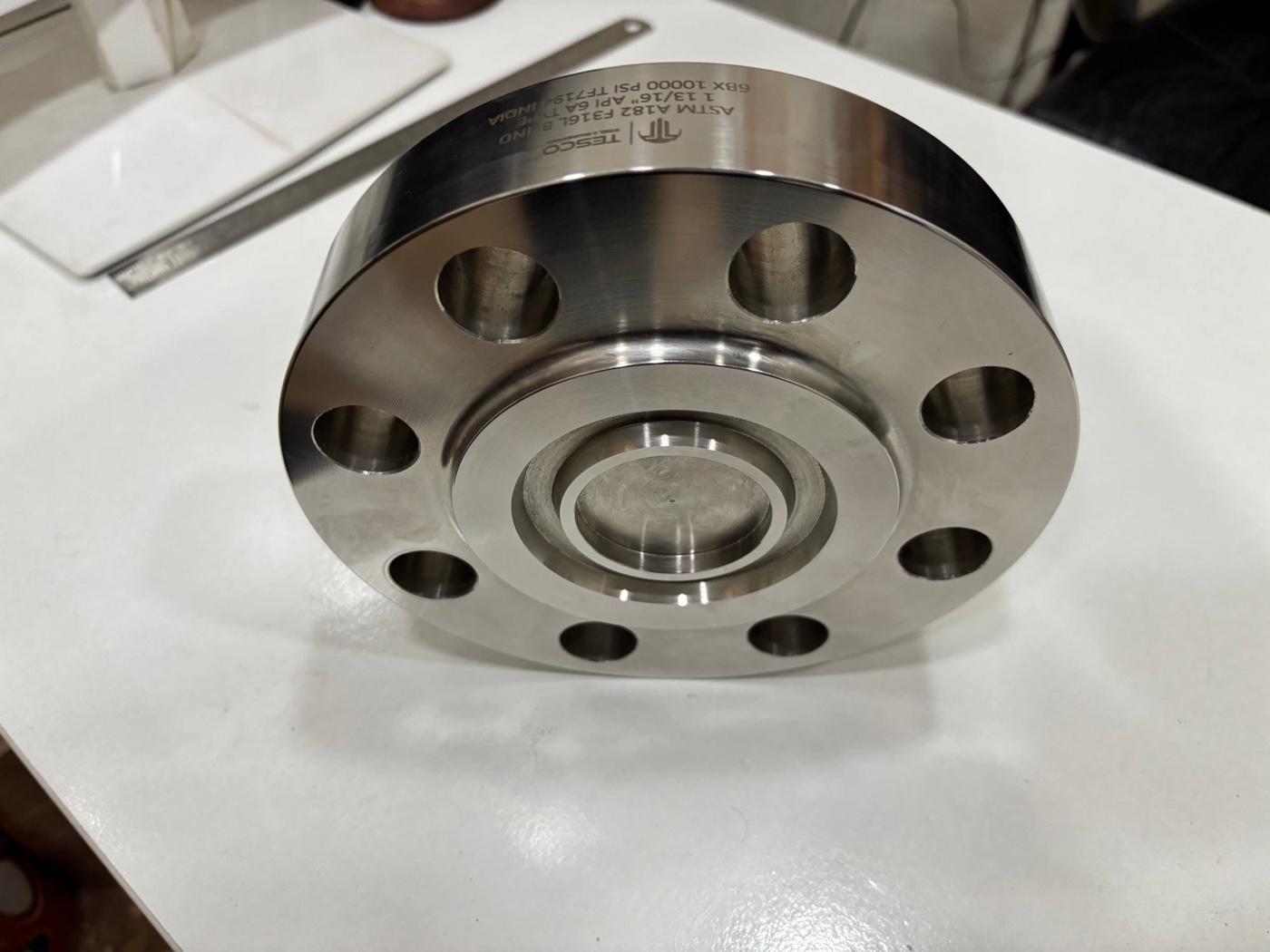
Tesco Steel & Engineering forges BLRTJ flanges — blind flanges with ring type joint facing, the metal-gasket closures of the high-pressure world — to ASME B16.5 Class 150–2500 from ½″ to 24″ NB, with grooves gauged per ASME B16.20 for R, RX and BX rings, and API 6A Type 6B/6BX blinds to 20,000 psi. Where soft gaskets give way — Class 900+ piping, wellheads, refinery hydrogen and hot-oil units — the joint seals by yielding a solid metal ring into machined grooves, and the blind that closes it must carry that groove. Pictured: a Tesco-marked F316L API 6A Type 6BX 10,000 psi blind from our works. Sibling facings BLRF and BLFF on their own pages. Every lot with EN 10204 3.1/3.2 MTC. ISO 9001:2015, made in Mumbai, India — exported to 50+ countries.
BLRTJ · RTJ Blind · RTJBLASME B16.5 ½″–24″ · Class 150–2500Rings R · RX · BX per ASME B16.20API 6A 6B / 6BX to 20,000 psiClass 900+ & Wellhead ServiceA105 · LF2 · A182 · B564EN 10204 3.1 / 3.2 · ISO 9001:2015
ASTM A182 F316L Blind, API 6A Type 6BX 10,000 psi — Machined & Marked at Our Works
What is a BLRTJ Flange?
BLRTJ = Blind, Ring Type Joint. A solid forged disc with no bore, its face carrying a precision-machined groove for a solid metal ring gasket — no raised face, no soft gasket. Bolt-up yields the softer ring into the harder grooves of both flanges, and with RX/BX profiles line pressure energises the seal further. The closure of the Class 900-and-above, wellhead and API 6A world, where spiral-wound and sheet gaskets give way to metal-to-metal sealing. Dimensions per ASME B16.5; grooves and rings per ASME B16.20; every forged grade on this site.
Rule of thumb: the facing always matches the mating flange — and in RTJ systems that is not negotiable: a raised-face blind physically cannot close a grooved joint. If the line flanges carry ring grooves, the blind is a BLRTJ, with a new ring in the joint.
How a Ring Joint Seals — The Pressure-Energised Story
A ring joint is the only common flange facing where the gasket is harder-working than the flange face: a solid metal ring, machined to profile, is deliberately yielded into the grooves of both flanges. Three things follow:
Plastic Deformation, Not Compression
Bolt-up drives the ring into both grooves until its contact faces yield against the groove flanks — line-contact metal seals on both sides, immune to the blow-out and creep that limit soft gaskets at high pressure and temperature.
Pressure Energisation
RX and BX profiles are shaped so internal pressure pushes the ring harder against the outer groove flank — the joint seals more tightly as pressure rises, the property that makes RTJ the facing of 10,000 and 15,000 psi wellheads.
All-Metal Temperature Range
With no elastomer or filler in the joint, the sealing system is limited by the metals alone — which is why RTJ survives hot hydrogen, hot-oil and high-pressure steam circuits that destroy softer gaskets.
Ring Gaskets — R, RX & BX per ASME B16.20
Ring Style
Profile
Fits
Notes
R — Oval
Oval cross-section
B16.5 RTJ grooves, all classes
The original profile; seats in round-bottom and flat-bottom grooves
R — Octagonal
Octagonal cross-section
B16.5 RTJ grooves (flat-bottom)
Preferred modern profile — flank contact seals; same R-numbers as oval
RX
Asymmetric, pressure-energised
Same groove as R
Interchangeable with octagonal R in most sizes; higher seal integrity
BX
Square with pressure-balance hole
API 6A Type 6BX flanges only
Not interchangeable with R/RX — a separate system for 5,000–20,000 psi
Every B16.5 size-and-class combination maps to one ring number (R-11 through R-105) — the groove in the blind is machined and gauged to that number, and the RTJ gasket size chart on this site lists them all. State the ring number on the enquiry if the joint is non-standard; otherwise size + class fixes it.
The Hardness Rule — Ring Softer Than Groove
The ring is the sacrificial member: it must yield so the groove survives. ASME B16.20 caps ring hardness for exactly this reason — and matching ring material below flange hardness is part of correct specification:
Ring Material
Max Hardness (approx.)
Typical Flange Pairing
Soft Iron
90 HB
Carbon steel A105 / LF2 — the workhorse pairing
Low-Carbon Steel
120 HB
Carbon & chrome-moly flanges
F5 (5Cr-½Mo)
130 HB
Chrome-moly hot-service flanges
SS 304 / 316 (annealed)
160 HB
Stainless, duplex & nickel-alloy flanges
And never reuse a ring. The first bolt-up work-hardens the ring's contact faces and imprints the old groove geometry onto them — a refitted ring seats unpredictably and usually leaks at hydrotest. Every reassembly takes a new ring and a cleaned, inspected groove. Rings are cheap; breaking a wellhead joint apart twice is not.
Sour wellheads & aggressive chemistry — NACE MR0175 on request
The groove is machined into whichever grade the system demands — the ring is then chosen softer than the flange. The hero flange above is the pattern in practice: an F316L body carrying a 6BX groove for sour offshore duty.
BLRTJ Flange Specifications
BLRTJ Blind Ring Type Joint Flanges are available in the following specifications:
Type & Facing
Blind flange, Ring Type Joint (BLRTJ / RTJBL) — machined ring groove, no bore; BLRF and BLFF facings on their own pages
Size
1/2"NB to 24"NB per ASME B16.5; large-diameter ring-joint blinds per ASME B16.47 Series A; API 6A sizes to order
Class
150#, 300#, 400#, 600#, 900#, 1500#, 2500# — RTJ service concentrates in 600# and above; API 6A ratings to 20,000 psi
Groove & Rings
Groove per ASME B16.5 / B16.20, gauged to the ring number (R-11–R-105); rings R oval/octagonal, RX, BX — ring always softer than groove
NACE MR0175 / ISO 15156 compliance on request for wellhead and sour-gas duty
Modifications
NPT-tapped centre (hydrotest / vent / gauge / injection), lifting provisions — to order
Installation
No welding — new ring in cleaned groove, star-pattern controlled bolt-up; small face stand-off normally remains
Certification
EN 10204 3.1 (standard) / 3.2 witnessed
Why BLRTJ Flanges Are Specified
The Only Blind for a Grooved Joint
Once a system runs RTJ, every closure in it must carry the groove — a raised-face blind physically cannot make the joint. The BLRTJ is not an upgrade choice; it is the matching part.
The Hydrotest Closure of the High-Pressure World
Tapped BLRTJ blinds are the standard fill-vent-and-gauge closures for testing Class 900–2500 spools and wellhead assemblies — pressures at which soft-gasket closures cannot be trusted.
Wellhead & API 6A Capability
Type 6B and 6BX blinds to 20,000 psi, BX-grooved and gauged, with sour-service compliance on request — the hero photo on this page is one of ours, marked and shipped.
Seals Where Gaskets Retire
Hot hydrogen, hydrocracker and hot-oil circuits, high-pressure steam — all-metal sealing carries on where spiral-wound fillers oxidise and creep.
Four details buyers miss.BX is its own world: BX rings fit only API 6A Type 6BX flanges — never mix them with R/RX grooves, and never mate a 6BX flange to a B16.5 one. New ring, every time: reused rings are the classic RTJ leak; budget rings as consumables. Inspect the groove: a scored or corroded groove flank will not seal against a fresh ring — grooves can be re-machined within B16.5 limits, and we advise at enquiry. Expect the stand-off: R and RX joints make up with a visible gap between flange faces; pulling the faces metal-to-metal over-compresses the ring. Torque guidance is supplied with the quotation on request.
How Our BLRTJ Flanges Are Manufactured
1
Forging — cut billet of the certified heat — carbon, chrome-moly, stainless or nickel alloy — is hot-forged into the solid disc blank, keeping full heat traceability.
2
Heat treatment — per the material standard: normalised A105, quench-tempered LF2, solution-annealed stainless and nickel grades; furnace record retained.
3
Machining — faces, OD and bolt holes to ASME B16.5 / B16.47 / API 6A; thickness verified against the class table.
4
Groove machining & gauging — the ring groove cut to the B16.20 ring number with controlled flank angle, depth and width, fine-finished flanks, and verified with ring gauges — the step that makes an RTJ flange an RTJ flange.
5
Testing & marking — mechanical and chemical verification against the heat (UT, PMI and hardness where specified), then permanent marking of standard, grade, size, class or pressure rating and heat number — as laser-marked on the 6BX blind pictured above.
6
Certification & packing — EN 10204 3.1 MTC (3.2 witnessed on request); grooves protected, palletised or crated by size.
Where BLRTJ Flanges Are Used
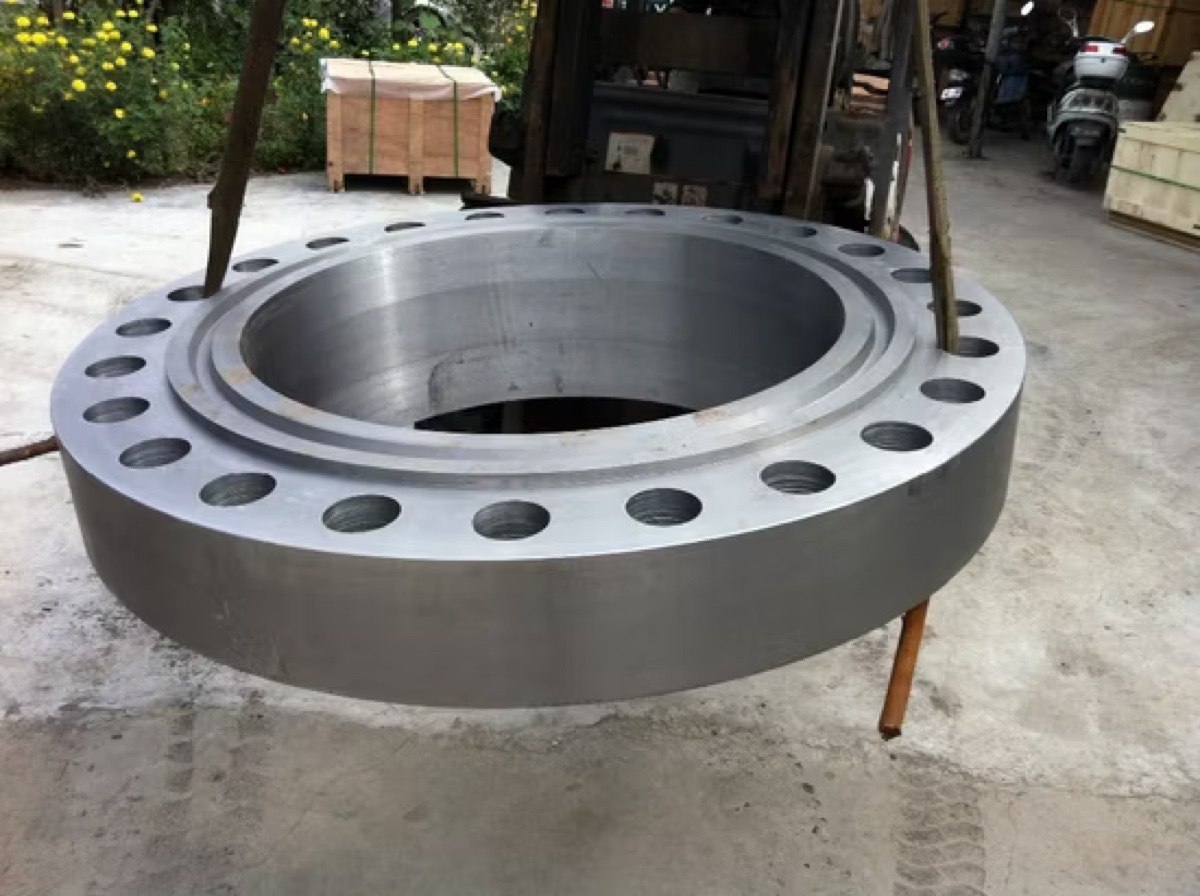
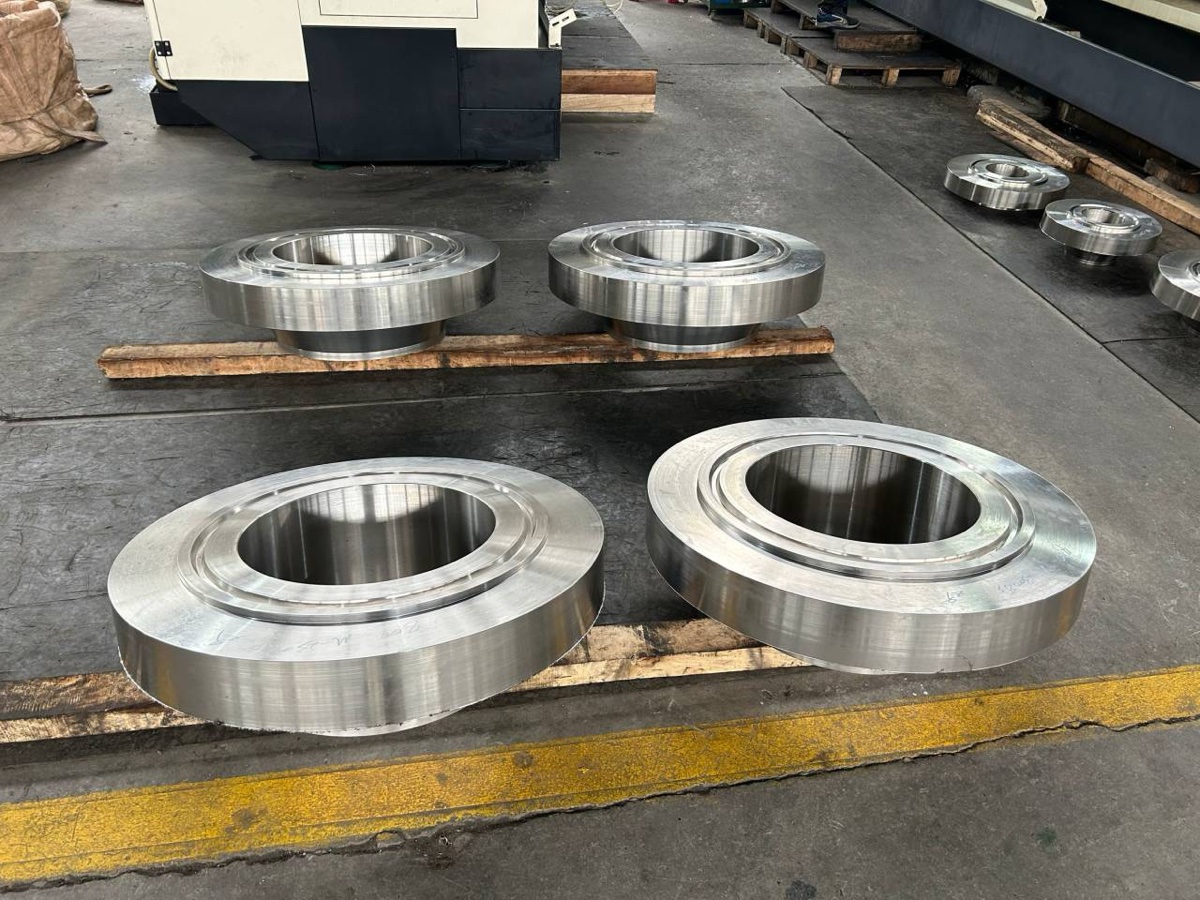
The high-pressure end of industry: wellheads, christmas trees and API 6A equipment onshore and offshore, hydrogen units, hydrocrackers and hot-oil circuits in refineries, gas processing and compression stations, high-pressure steam, and Class 900–2500 piping generally — as permanent closures, maintenance isolations and tapped hydrotest blinds. Production below:
Large-Diameter Class 600 RTJ Flange — Ring Groove MachinedRTJ-Grooved Flanges — Off the CNC Line at Our Works
BLRTJ Flange Dimensions
Ring-joint blind dimensions share the B16.5 / B16.47 blind tables — same OD and drilling, with the groove per the ring number and a slightly greater overall thickness through the facing. Full charts by class, plus the ring chart:
Example: “Blind Flange, RTJ, 6″ NB, ASME B16.5 Class 900, ASTM A105, groove for R-45 octagonal ring per B16.20, EN 10204 3.1 — 4 pcs.” Quotations normally within 24 hours with price, unit weight and delivery.
BLRTJ Flanges — Frequently Asked Questions
What is a BLRTJ flange?
A BLRTJ flange is a blind flange with a ring type joint facing — a solid forged disc, drilled to the standard bolt pattern with no bore, whose face carries a precision-machined groove for a solid metal ring gasket instead of a raised face. Bolted against a mating RTJ flange with an R, RX or BX ring between them, it closes lines and equipment nozzles in the high-pressure, high-temperature classes — Class 900 and above, wellheads and API 6A equipment — where soft gaskets give way to metal-to-metal sealing. Dimensions follow ASME B16.5, with grooves and rings per ASME B16.20.
What does BLRTJ stand for?
Blind, Ring Type Joint — the piping-list shorthand combining the flange type with its facing. On drawings the same product also appears as RTJBL, BL RTJ, RTJ blind or blind ring joint flange; our RTJBL page covers the reversed abbreviation. The family reads consistently: BLRF is the raised-face blind of general steel piping, BLFF the flat-face blind of the cast-iron and GRP world, and BLRTJ the metal-gasket blind of the high-pressure classes.
How does a ring type joint seal?
By plastic deformation and pressure energisation. Tightening the bolts drives the solid metal ring into the grooves of both flanges until the softer ring yields against the harder groove flanks, creating line-contact seals on both sides. With RX and BX profiles, internal pressure then pushes the ring harder against the outer groove flank — the joint seals more tightly as pressure rises. That is why RTJ dominates where soft gaskets blow out: the seal is machined metal yielded into machined metal, not a compressed sheet.
Which ring gaskets fit a BLRTJ flange?
Rings per ASME B16.20. Style R — oval or octagonal cross-section — fits the standard B16.5 grooves in every class, identified by a ring number (R-11 through R-105) fixed by the flange size and class. Style RX is a pressure-energised profile that fits the same R groove and interchanges with the octagonal R in most sizes. Style BX is a different system entirely: it fits only API 6A Type 6BX flanges and is not interchangeable with R or RX. Our RTJ gasket size chart lists the ring number for every size and class.
When is BLRTJ specified instead of BLRF?
When class, temperature or consequence push past what soft and spiral-wound gaskets handle reliably: Class 900, 1500 and 2500 piping, hydrogen and hot-oil refinery units, wellheads and christmas trees under API 6A, gas processing and offshore systems. Many refinery specifications switch from raised face to RTJ at Class 900; upstream wellhead equipment is RTJ territory outright. The blind that closes those joints must carry the same groove — that blind is BLRTJ. In ordinary Class 150/300 plant piping, BLRF remains the default.
Why must the ring be softer than the groove?
Because the ring is the sacrificial member. The joint seals by yielding the ring's contact faces against the groove flanks; a harder ring would coin and damage the flange grooves — and the flange, not the gasket, is the expensive, bolted-in part. ASME B16.20 caps ring hardness accordingly: soft iron 90 HB, low-carbon steel 120 HB, alloy and stainless rings annealed to fixed maxima. A fresh, softer ring deforms while the groove survives repeated make-and-break; pairing ring material below flange hardness is part of correct RTJ specification.
Can a ring joint gasket be reused?
No. Sealing depends on plastic deformation — the first bolt-up work-hardens the ring's contact faces and imprints the old groove geometry onto them. Refitted, a used ring seats unpredictably and usually leaks at hydrotest. Every reassembly of a BLRTJ joint takes a new ring, and the grooves should be cleaned and inspected for scoring at the same time. Rings are cheap against the cost of breaking a wellhead or offshore joint apart twice — treat them as one-use items, as every operator's specification does.
What materials are BLRTJ flanges made in?
Carbon steel ASTM A105 and low-temperature A350 LF2 dominate — the high-pressure carbon-steel world of wellheads and gas plants — with A182 F5, F11 and F22 chrome-moly for hot refinery circuits, F304L/F316L stainless, duplex F51/F53, and nickel alloys Incoloy 825 and Inconel 625 for sour and corrosive high-pressure service, with NACE MR0175 compliance available on request. The groove is machined into whichever grade the system demands; the ring is then chosen softer than the flange.
BLRTJ vs BLRF vs BLFF — how do the three blinds differ?
Same blind, three facings — matched always to the mating flange. BLRF carries the raised face and a soft or spiral-wound gasket: the default of steel piping. BLFF is machined flat for full-face gaskets against cast iron, GRP and lined equipment. BLRTJ carries a machined groove for a solid metal ring: the closure of Class 900-and-above piping and API 6A equipment. The pressure-retaining thickness is class-governed and essentially common; what changes is the sealing system — and the three are not interchangeable on a joint.
What sizes and classes are BLRTJ flanges available in?
From ½" to 24" NB per ASME B16.5 — the ring-joint facing is standardised in every class from 150 to 2500, though real-world RTJ service concentrates in Class 600 and above — with large-diameter ring-joint blinds available per ASME B16.47 Series A. API 6A Type 6B (to 5,000 psi) and Type 6BX (to 20,000 psi) blinds for wellhead equipment are produced against the API specification, like the 6BX 10,000 psi blind pictured on this page. Carbon steel BLRTJ in the common classes is a stocked item; alloy grades are forged to order with EN 10204 3.1 certification.
How is a BLRTJ flange installed?
Bolted, never welded. The groove is cleaned and inspected, a new ring seated in it, and the blind drawn up with a star tightening pattern in stages so the ring yields evenly into both grooves. Two disciplines specific to RTJ: the joint makes up metal-to-metal, so controlled torque — or bolt tensioning on large high-class joints — matters more than on soft gaskets; and a small stand-off between the flange faces normally remains after make-up, because the ring, not the faces, carries the seal. We supply torque guidance with the quotation on request.
Can BLRTJ flanges be tapped for testing?
Yes — the NPT-tapped centre modification is common on RTJ blinds precisely because they live in the hydrotest world: a tapped BLRTJ becomes the fill, vent, gauge or injection closure for testing Class 900-2500 spools and wellhead assemblies at pressures soft-gasket closures cannot hold. The tap sits in the centre of the pressure-bending plate, the engineering limits are identical to any tapped blind, and ordering the tap machined and certified with the flange is the clean route. State the NPT size on the enquiry.
Where are BLRTJ flanges typically used?
The high-pressure end of industry: wellheads, christmas trees and API 6A equipment onshore and offshore, hydrogen units, hydrocrackers and hot-oil circuits in refineries, gas processing and compression stations, high-pressure steam, and Class 900-2500 piping generally. They serve as permanent closures on future connections, as isolation blinds during maintenance and — tapped — as the standard hydrotest closures of the RTJ world. Wherever the line flanges carry ring grooves, the blind that closes them is a BLRTJ.
Which standards cover BLRTJ flanges?
Three standards work together. ASME B16.5 governs the blind flange dimensions and its ring-joint facing — groove location, depth, width and flank finish — for ½"-24", with ASME B16.47 Series A carrying large diameters. ASME B16.20 governs the metal rings themselves: R, RX and BX profiles, dimensions and hardness limits. For wellhead equipment, API 6A replaces both with its own Type 6B and 6BX flanges and BX gaskets. The material certifies separately — A105, A182, B564 — and our EN 10204 certificates state dimension standard and grade together.
Who manufactures BLRTJ flanges in India?
Tesco Steel & Engineering is an ISO 9001:2015 certified flange manufacturer based in Mumbai, India, forging BLRTJ blind ring type joint flanges from ½" to 24" NB per ASME B16.5 in Classes 150-2500, large-diameter ring-joint blinds per ASME B16.47 Series A, and API 6A Type 6B/6BX blinds to order — in carbon steel A105 and LF2, A182 chrome-moly, stainless and duplex grades, and B564 nickel alloys — with grooves gauged against ASME B16.20, NPT-tapped test blinds machined to order and EN 10204 3.1/3.2 certification on every lot. Exported to more than 50 countries.