Hastelloy C-22 Long Weld Neck Flanges — UNS N06022 Versatile Acid LWN Manufacturer
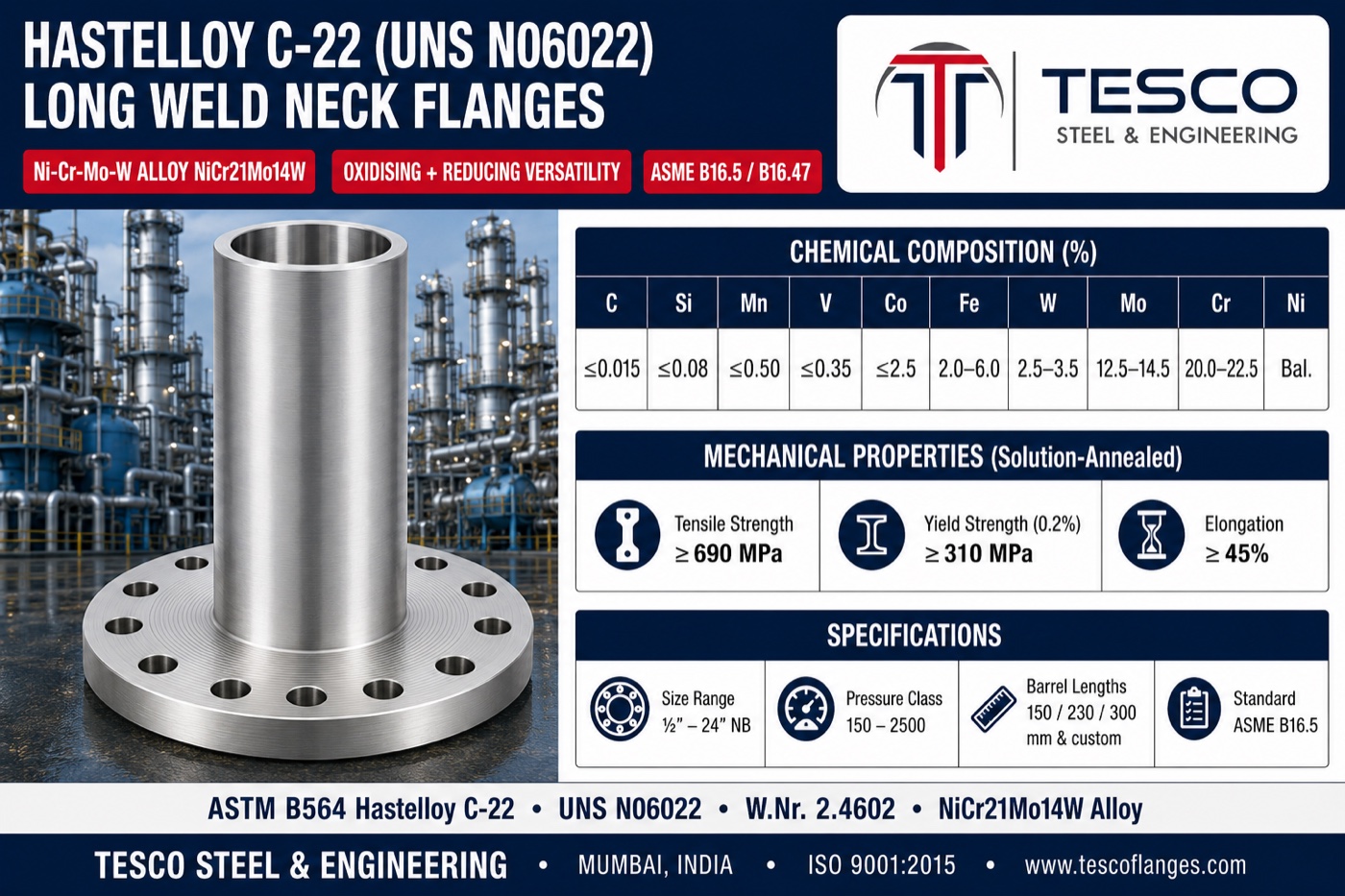
Tesco Steel & Engineering manufactures Hastelloy C-22 long weld neck flanges — the C-family's oxidising-side sibling: ASTM B564, UNS N06022, W.Nr. 2.4602, NiCr21Mo14W — with ASME B16.5 flange ends in Classes 150–2500 and the barrel made to order. Against C-276 the trades fund a second front: chromium up six points to 20–22.5% for nitric, ferric and wet-oxidising chemistry; molybdenum eased to 12.5–14.5% to pay for it; the crushed limits carried forward — carbon at 0.015%, as-welded by design. The franchise is versatility: the alloy for plants whose streams swing — multi-purpose reactors, waste incineration, chlorine-dioxide bleaching — where the honest answer to ‘what chemistry?’ is ‘it varies’. The bench stays honest both ways: C-276 deeper in constant reducing streams, B-3 deepest in pure HCl, and the ladder below quoted gladly when it genuinely serves. The certificate is the bench's most ductile: 690/310 MPa at 45% elongation. One forging, one closing weld with ERNiCrMo-10 — the mixed-service overlay wire, welding its own parent. Facings: RF / FF / RTJ; small bore on the C-22 socketweld. Every lot with EN 10204 3.1/3.2 MTC. ISO 9001:2015, made in Mumbai, India — exported to 50+ countries.
ASTM B564 · UNS N06022 · W.Nr. 2.4602NiCr21Mo14W — The Second Front FundedCr 20–22.5% · Mo 12.5–14.5% · C 0.015%Oxidising + Reducing on One CertificateThe Versatility Franchise — Streams That Swing690 / 310 MPa · 45% — Most Ductile on the BenchB16.5 Flange Ends · Class 150–2500EN 10204 3.1 / 3.2 · ISO 9001:2015
Hastelloy C-22 Long Weld Neck Flanges — Specifications at a Glance
What is a Hastelloy C-22 Long Weld Neck Flange?
The versatile C-alloy, in the nozzle pattern. A Hastelloy C-22 flange (UNS N06022, ASTM B564) whose neck continues as a long, heavy-walled straight barrel — the nozzle itself — bevelled for one closing butt weld at the reactor, scrubber or column shell. Chromium raised six points over C-276 to fund the oxidising front; molybdenum still heavy at 12.5–14.5%; carbon crushed to 0.015% — as-welded by design. The franchise: plants whose streams swing between oxidising and reducing. Welds with ERNiCrMo-10, no PWHT. Supplied solution-annealed — 690/310/45, the bench's most ductile certificate. Flange ends per ASME B16.5, Classes 150–2500; barrel length and bore stated by you. EN 10204 3.1 on every lot.
The split in one line:‘it varies’ reads C-22; ‘always reducing’ reads C-276; ‘pure HCl, guaranteed’ reads B-3 — and everything milder descends the acid ladder honestly.
What the Rebalance Buys
The Second Front
Chromium at 20–22.5% stands nitric, ferric chloride and wet-oxidising chlorine chemistry — the media that probe C-276's deliberately modest film.
The Engine Kept
Molybdenum still at 12.5–14.5% with tungsten beside it — genuine reducing-acid depth retained, above every rung of the ladder below.
Best-in-Family Localised Resistance
Pitting and crevice standing in oxidising chlorides among the C-family's best — chlorine-dioxide bleaching and hot brine oxidisers specify it by name.
The Most Ductile Certificate
45% elongation at 690/310 MPa — a step past even C-276, absorbing the constant fabrication and modification of multi-purpose plants.
Specification Notes — Getting C-22 Long Weld Necks Right
Three honest notes.Name every stream, not just today's: the versatility franchise is bought for the worst day — list all the chemistries the equipment will see, and the C-276 sideways question answers itself. Constant reducing duty reads the sibling: in pure hot hydrochloric C-276 goes deeper, and B-3 deeper still where no oxidiser will ever enter. And do not buy the C-family for a milder swing: stacked severity without the C-premium reads 625, oxidising chloride that never sees a reducing day can read the super duplex twins at iron economics — the cheapest rung that genuinely serves is the one quoted.
How Our Hastelloy C-22 LWN Flanges Are Manufactured
1
Forging — each piece individually forged from certified N06022 heats kept segregated on the nickel shelf, with the barrel integral — no welded build-ups.
2
Solution-annealing — the alloy's one heat treatment: everything dissolved into the matrix, the corrosion performance set; records retained against the heat number.
3
Verification — chemistry per heat with the raised chromium window and crushed limits certified; mechanicals per heat at the 690/310 line.
4
Machining — flange end to ASME B16.5; barrel turned to pattern (standard / HB / equal) and bored to the ordered schedule or drawing; RF serrations, flat face or RTJ groove per B16.20; weld end bevelled 37.5°.
5
Testing & marking — PMI reads the Cr-Mo-W signature on every piece — the chromium line separates C-22 from C-276 on the analyser; marked with grade, size, schedule and heat number.
6
Certification & packing — EN 10204 3.1 MTC (3.2 witnessed on request); WPS guidance naming the ERNiCrMo-10 filler; faces and bevels protected, packed sea-worthy.
Where Hastelloy C-22 LWN Flanges Are Used
Where the chemistry refuses to stay put: multi-purpose chemical and pharmaceutical reactors running different products through the same vessels, waste incineration and off-gas scrubbing burning whatever arrives, chlorine-dioxide bleach plants, hot brine oxidiser circuits, FGD duty with oxidising excursions, pickling and mixed-acid systems that swing with the feed, and the access nozzles, standpipes and level bridles riding on all of them — alongside C-22's parallel career as the overlay wire protecting steel in the same services. Small counts, specific drawings, one forging, one closing weld. Production and supply below:
Long Weld Necks — Machined at Our WorksLong Weld Neck — Heavy Barrel, Bevelled Weld EndDN600 RF Long Weld Neck — Large Diameter, B16.5 Drilling
Hastelloy C-22 LWN Flange Dimensions
Flange-end dimensions are class-governed per ASME B16.5 (ratings per the alloy's tables); barrel length and bore per order. Full class-by-class charts:
How to Specify & Order a Hastelloy C-22 LWN Flange
Seven elements — every stream the equipment will see decides the sibling question:
1
Size & standard — e.g. 4″ NB ASME B16.5.
2
Pressure class & facing — 150#–2500#; RF, FF or RTJ with ring number.
3
Barrel length — overall, face to weld end: 150 / 230 / 300 mm stock or any stated length.
4
Barrel bore & pattern — pipe schedule to match or finished bore in mm; standard, heavy barrel or equal barrel; weld-end prep if non-standard.
5
Grade line & chemistry — ASTM B564 Hastelloy C-22 (UNS N06022) — with every stream named: acids, concentrations, temperatures, oxidisers and their excursions, chlorides — checking the C-276 sideways question and the ladder below honestly.
6
Certification — EN 10204 3.1 (our standard) / 3.2 witnessed.
A Hastelloy C-22 long weld neck flange is a forged nickel-chromium-molybdenum-tungsten alloy flange — UNS N06022, W.Nr. 2.4602, NiCr21Mo14W, supplied to ASTM B564 — whose neck continues as a long, heavy-walled straight barrel that is itself the nozzle, bevelled at its far end for one closing butt weld made out at the reactor, scrubber or column shell. C-22 is the C-family's oxidising-side sibling: chromium raised six points over C-276 to fund standing in nitric, ferric and wet-oxidising chemistry, molybdenum trimmed to pay for it, and the family's crushed impurity limits carried forward for as-welded service — the versatility alloy for plants whose streams swing between oxidising and reducing. Flange ends follow ASME B16.5 in Classes 150 to 2500; the barrel is machined to the ordered length and bore. Supplied solution-annealed at 690/310 MPa with EN 10204 3.1/3.2 certification.
How does a long weld neck differ from a standard weld neck flange?
Geometry and mission. A standard weld neck's hub tapers quickly down to the pipe's outside diameter and wall, ending in a weld bevel a few centimetres from the flange face — it is built to butt-weld to pipe and continue as a piping run. A long weld neck keeps a full-section straight barrel for its entire length: no taper to pipe dimensions, wall far heavier than the matching schedule, length made to order. The mission follows the shape — the LWN is not a fitting on a pipe run but a nozzle in its own right, projecting through insulation, vessel walls or exchanger channels, with the butt weld relocated to the shell side where the fabricator wants it. In one certified forging it replaces the weld neck flange, the pipe nipple and one whole circumferential weld.
How do the trades read against C-276 — funding the second front?
As a deliberate rebalance of the same engine, one decade on. C-276's design put nearly everything into the reducing front: 15-17% molybdenum, chromium held modest. C-22 redistributes: chromium rises six points to 20.0-22.5% — deep enough to stand nitric, ferric chloride and the wet-oxidising chlorine chemistries that probe C-276's modest film — while molybdenum eases to 12.5-14.5% and tungsten trims to 2.5-3.5% to pay for it; manganese halves and the crushed limits carry forward, carbon at 0.015%. The result is not a superior alloy but a differently-aimed one: in pure hot hydrochloric C-276 still goes deeper, while in oxidising-contaminated and swinging chemistry C-22 stands where the older sibling pits. The family's design lesson repeats a third time — the same elements, redistributed by enemy — and the choice between the two siblings is made by one question: which side of the electrochemical street does the plant's worst day live on?
What is the versatility franchise — plants whose streams swing?
The duty that made C-22 many specifiers' default C-alloy. A dedicated process line knows its chemistry and can pick its specialist — but multi-purpose chemical and pharmaceutical plants run different products through the same reactors month by month, waste incinerators burn whatever arrives, and scrubber liquors swing with the feed: for those plants the alloy must stand whatever comes next, oxidising or reducing, and C-22's balanced chemistry is built for exactly that uncertainty. Its localized-corrosion resistance — pitting and crevice in oxidising chloride environments — measures among the best of the whole C-family, which is why chlorine-dioxide bleaching, hot brine oxidisers and flue-gas duty with oxidising excursions specify it by name, and why C-22 became the standard weld-overlay wire for protecting steel in mixed service. Where a stream is known, constant and reducing, the C-276 sibling's deeper engine wins; where the honest answer to 'what chemistry?' is 'it varies' — this page's alloy is the answer.
What do the crushed limits mean on this page?
The C-family discipline, carried forward. The C-276 page tells the full story — the original Hastelloy C's weld-zone sensitisation, and the 1960s answer of crushing the impurities instead of adding a stabiliser — and C-22 inherits the method: carbon capped at 0.015%, silicon at 0.08%, an order tighter than any stainless L-grade, leaving nothing in the metal for a weld cycle to precipitate. The practical consequence is identical to the sibling's: heavy fabrication, repair and the closing welds of this page's nozzles all serve as-welded, with no post-weld anneal and no sensitisation anxiety, in chemistry that finds any weakened boundary within weeks. Between the siblings the limits differ only in decimals — C-276 at 0.01%, C-22 at 0.015% — a distinction of specification history rather than practice: both are melt-shop purity plays, certified per heat, and both exist so that field welding in the worst chemistry needs nothing but a good procedure.
What is the chemical composition of Hastelloy C-22 (UNS N06022)?
Nickel the balance (roughly 56%), chromium 20.0-22.5%, molybdenum 12.5-14.5%, tungsten 2.5-3.5%, iron 2.0-6.0% — a deliberate range — cobalt ≤2.5%, manganese ≤0.50%, vanadium ≤0.35%, silicon ≤0.08% and carbon ≤0.015% — the C-family's crushed impurities, buying as-welded service. Read it against the sibling: chromium up six points, molybdenum down two-and-a-half, tungsten trimmed half a point, manganese halved — every change funds the second front. Nothing is spent on hardening or stabilising; the impurity control does that job. Chemistry is verified per heat, PMI-confirmed on every piece — the chromium-molybdenum-tungsten signature separates C-22 from C-276 on the analyser — and travels on the EN 10204 3.1 MTC.
What are the mechanical properties of Hastelloy C-22 long weld neck flanges?
Solution-annealed to ASTM B564: tensile strength 690 MPa (100 ksi) minimum, yield strength 310 MPa (45 ksi) minimum, elongation 45% minimum — the most ductile certificate on this entire long weld neck bench, a step past even C-276's 40%, with a slightly higher yield from the chromium-richer solid solution. The profile suits the habitat: multi-purpose plants fabricate, modify and repair constantly, and 45% elongation absorbs every cycle of it. The condition word matters as on the sibling's page: solution-annealed is the alloy's one heat treatment, setting the corrosion performance the certificates promise — supplied so, with records, never deliberately aged. The service frame is the wet bench's: aqueous franchises, cryogenic toughness with no transition, and flange ratings per B16.5's tables with the heavy LWN barrel adding stiffness where nozzle loads bear. At a bolted joint the class system governs, as everywhere on the bench.
What is the ASTM B564 specification for Hastelloy C-22 flanges?
The nickel bench's shared forging standard, one severe-service chapter along from the sibling's. ASTM B564 (ASME SB-564) spans the family from pure nickel through Monel, the Inconels, the Incoloys and the Hastelloy grades — one standard, many UNS numbers — and its N06022 chapter covers the forged flanges this page describes, solution-annealed condition and all. Around it sit the product-form siblings: B574 for rod, B575 for plate and sheet, B619 and B622 for welded and seamless pipe, all to the same chemistry. Nothing changes at the flange end: dimensions, drilling and facings follow ASME B16.5, with pressure-temperature ratings from the alloy's tables. The order line reads 'ASTM B564 Hastelloy C-22 (UNS N06022)', with the EN designation NiCr21Mo14W / 2.4602 on the same certificate for European drawings — and the C-family's alloy-market honesty applies here as on the sibling's page: the lead time is quoted as honestly as the price.
How is the C-family split — this page's view of the bench?
By which enemy dominates, exactly as the C-276 page maps it — read here from the oxidising side. C-22 is the versatility answer: the raised chromium stands oxidising and swinging chemistry, the still-heavy molybdenum keeps genuine reducing-acid depth, and the combination covers more of a multi-product plant's worst days than any single-front alloy. C-276 remains the reducing-front original — deeper in pure hot hydrochloric and constant reducing streams. C-2000 adds copper to the C-22 idea for wider sulphuric reach; C-4 simplifies the chemistry for thermal stability in the sensitising band. Beyond the C-family, the chromium-free B-2 and B-3 go deepest of all in pure hydrochloric — and fail fastest if an oxidiser enters, the mirror image of this page's franchise. The practical split: 'it varies' reads C-22; 'always reducing' reads C-276; 'pure HCl, guaranteed' reads B-3 — and everything milder descends the acid ladder honestly.
When does C-22 hand off — the versatile alloy's own economics?
In the same honest directions as every rung on the site. Sideways to C-276 where the stream is constant and reducing — the deeper engine at the same market tier. Down the ladder wherever the swing is milder than the summit needs: 625 carries strength, sour standing and PREN past 50 for stacked severity without the C-family's premium; 825 the sour and mixed-acid middle; and the oxidising-chloride duty that never sees a reducing day can read the 6Mo super-austenitics and super duplex twins at iron-based economics. Down further still for the duties that never needed nickel at all — the acid ladder's lower rungs exist precisely for them. The C-22 enquiry that names its chemistry honestly — every stream the equipment will see, not just today's — gets the same promise as the sibling page's: the cheapest rung that genuinely serves is the one quoted, and for the multi-purpose plant that answer is, more often than most, this page's.
How is the closing weld on a Hastelloy C-22 LWN made?
As-welded, by the family's design. The consumable of record is ERNiCrMo-10 — C-22's own chemistry in wire form, and a famous consumable in its own right: the standard weld-overlay wire for cladding steel in mixed and oxidising-chloride service, doing for uncertain chemistry what ERNiCrMo-3 does for the 625 world. On this page it welds like-to-like, and the crushed carbon means joint and heat-affected zone carry the parent's standing with no post-weld anneal and no sensitisation anxiety. The care points are the C-family's: scrupulous cleanliness — sulphur, paint and grime punished with cracking; modest heat input with a sluggish pool, favouring the good access the LWN's straight barrel provides; interpass control on multi-pass work as good practice. The closing weld inherits the plant's qualified procedure, and WPS guidance travels with every supply, filler class stated.
How are the barrel length and bore of a LWN specified?
Two numbers that belong on every enquiry. Length: measured overall from the flange face to the weld end — 150 mm (6"), 230 mm (9") and 300 mm (12") are the common stock lengths, and any length machines to order; state it explicitly, because 'long' is not a dimension. Bore: the barrel is drilled and bored to order — most commonly to match the inside diameter of the connecting pipe schedule, sometimes cylindrical special bores for level bridles, instrument standpipes or restriction work; state the schedule or the finished bore in millimetres. Add the weld-end preparation (standard 37.5° bevel unless told otherwise) and the nozzle is fully defined.
What sizes and pressure classes do Hastelloy C-22 LWN flanges come in?
Flange ends follow ASME B16.5 from ½" to 24" NB in Classes 150, 300, 400, 600, 900, 1500 and 2500 — with the full class-by-class LWN dimension charts on this site — and larger diameters forge to order against B16.47 or drawing dimensions. The order book mirrors the habitat: multi-purpose reactors, incineration scrubbers and bleach plants concentrate in Classes 150 and 300 — generous connections, modest pressures, the chemistry as the whole load — with pressure-bearing process duty reaching higher classes where piping specifications demand. Piece counts run small and drawings specific, as across the C-family: each forging is individually made and certified. State size, class, barrel length and bore together — the four numbers define the forging — with the chemistry named fully across every stream the equipment will see, and our quotation returns price, unit weight and delivery per class with the alloy-market lead time quoted honestly.
What details are needed to get an accurate Hastelloy C-22 LWN flange quotation?
Seven elements plus commercial terms: (1) size and dimensional standard — e.g. 4" NB ASME B16.5; (2) pressure class — 150 to 2500; (3) facing — RF (the default), FF or RTJ with ring number; (4) barrel length overall, face to weld end — 150/230/300 mm stock or any stated length; (5) barrel bore — pipe schedule to be matched or finished bore in millimetres, with pattern (standard, heavy barrel, equal barrel) and weld-end prep if non-standard; (6) the grade line — ASTM B564 Hastelloy C-22, UNS N06022 — with the chemistry named fully across every stream the equipment will see: acids with concentrations and temperatures, oxidisers and their excursions, chlorides and their level — so the C-276 sideways question and the ladder below are checked honestly, and the cheapest rung that genuinely serves is the one quoted; (7) certification — EN 10204 3.1 (our standard) or 3.2 witnessed. Add quantity and destination; quotations normally within 24 hours, with the alloy-market lead time quoted honestly.
Who manufactures Hastelloy C-22 long weld neck flanges in India?
Tesco Steel & Engineering is an ISO 9001:2015 certified flange manufacturer based in Mumbai, India, producing Hastelloy C-22 long weld neck flanges to ASTM B564 with B16.5 flange ends from ½" to 24" NB (larger to order) in Classes 150-2500, in standard, heavy-barrel and equal-barrel patterns — each forged individually from certified N06022 heats kept segregated on the nickel shelf, solution-annealed with records retained, machined with the barrel bored to the ordered schedule or drawing, bevelled for the closing weld, PMI-checked on the chromium-molybdenum-tungsten signature on every piece, and marked with grade, size, schedule and heat number. Supplied with EN 10204 3.1/3.2 certification and WPS guidance naming the ERNiCrMo-10 filler — alongside the Hastelloy C-22 socketweld, weld neck and blind siblings, the C-276 LWN one bench over, the whole acid ladder beneath, and the complete long weld neck range. Exported to more than 50 countries.