Tesco Steel & Engineering manufactures trimmed elbows — standard butt-weld pipe elbows cut (trimmed) to a non-standard angle or shorter leg length so they fit a specific piping layout. By machining a 90° or 45° elbow down to the exact angle and tangent needed, a trimmed elbow gives a precise, ready-to-weld direction change without fabricating a miter or ordering a special forging. Made from forged butt-weld elbows in SS 304, 316, 310, 410, Duplex 2205/2507, Monel 400/500, Hastelloy C22/C276/B2/B3, Inconel, and carbon steel. 150–9000 lbs / PN6–PN25. ISO 9001:2015 certified. Made in India.
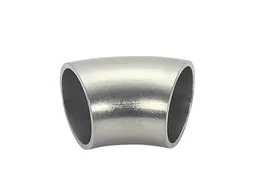
Trimmed Elbow
Trimmed elbows give the smooth flow and full pressure rating of a forged elbow with the flexibility of a custom angle — a better solution than a miter bend where flow and pressure matter. Tesco Steel & Engineering trims elbows to drawing in carbon, stainless, duplex, and nickel-alloy grades.
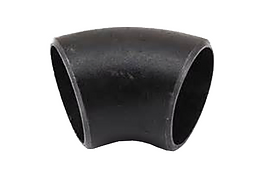
Carbon Steel Trimmed Elbow
| Criterion | Trimmed Elbow | Miter Bend |
|---|---|---|
| Base | Forged butt-weld elbow, cut to angle | Straight pipe cut & welded |
| Flow path | Smooth forged radius | Segmented (more turbulent) |
| Pressure | Full elbow rating | Low to moderate |
| Best size | Small to medium bore | Large bore (economical) |
| Best for | Custom angle with good flow & pressure | Large low-pressure custom angles |
Use a trimmed elbow where smooth flow and full pressure rating are needed at a custom angle; use a miter bend for large-diameter, low-pressure custom angles.
| Need | How a Trimmed Elbow Solves It |
|---|---|
| Non-standard angle | A 90°/45° elbow trimmed to the exact in-between angle (e.g. 30°, 60°, 22.5°) |
| Tight space / short tangent | The elbow leg is shortened to fit a confined layout |
| Avoiding a miter | Keeps a smooth forged radius and full pressure rating, unlike a welded miter |
| Avoiding a special forging | Faster and cheaper than commissioning a non-standard forged elbow |
| Exact field fit | Made to the isometric so it drops straight into the run |
| Material | Properties | Typical Use |
|---|---|---|
| Carbon Steel (A234 WPB) | Strong, economical | Water, steam & non-corrosive lines |
| SS 304 / 316 / 316L | Good corrosion resistance | Process, chemical & hygienic lines |
| SS 310 / 410 | High-temperature / hard grades | Hot-gas & high-temp lines |
| Duplex 2205 / Super Duplex 2507 | High strength & chloride resistance | Seawater & offshore lines |
| Monel 400 / 500 | Excellent in HF & marine media | HF, brine & seawater |
| Hastelloy C22 / C276 / B2 / B3 | Superior acid resistance | Aggressive chemical lines |
| Inconel | High-temperature strength | High-temperature gas lines |
| Parameter | Details |
|---|---|
| Product | Trimmed elbow — standard butt-weld elbow cut to a custom angle/leg |
| Base Fitting | Forged butt-weld elbow (90° or 45°, LR/SR) |
| Trimmed Angle | Any angle below the base elbow (e.g. 22.5°, 30°, 60°) or shortened leg |
| Size | To suit the line pipe (small to medium bore typical) |
| Pressure Class | 150, 300, 600, 900, 1500, 2500, 3000, 6000, 9000 lbs; PN6–PN25 and higher |
| Ends | Bevelled for butt-weld; faced or flanged on request |
| Material | A234 carbon steel, SS 304/316/310/410, Duplex 2205/2507, Monel, Hastelloy, Inconel |
| Standards | Base elbows to ASME B16.9 / B16.28; ASME B31.3 / B31.1 design |
| Certifications | ISO 9001:2015 | EN 10204 3.1 MTC on request |
Standard elbows trimmed to any in-between angle or shorter leg so the fitting matches your layout precisely.
Keeps the smooth forged radius of the original elbow — better flow and lower loss than a segmented miter bend.
Retains the wall thickness and pressure rating of the parent elbow, suitable for higher-pressure service.
Trimming a stock elbow is quicker and more economical than commissioning a non-standard forged elbow.
Carbon steel, SS 304/316/310/410, Duplex, Monel, Hastelloy, and Inconel to match the line and service.
Cut, bevelled, and certified to your isometric for a drop-in, ready-to-weld fit.
| Industry | Typical Use | Why Trimmed Elbow |
|---|---|---|
| Refinery & Petrochemical | Process-piping odd-angle turns | Smooth flow & full pressure at custom angle |
| Power Generation | Steam & water-line routing | Higher-pressure custom-angle elbows |
| Oil & Gas | Plant & skid piping | Exact fit on congested layouts |
| Chemical Plants | Corrosive-line direction changes | Alloy elbows trimmed to angle |
| Shipbuilding & Marine | Compact pipe routing | Short-leg / custom-angle fits |
| Pharmaceutical / Food | Hygienic SS piping | Smooth SS 316 bends to layout |
| Fabrication & Skids | Module & spool fabrication | Drop-in fittings to drawing |
| Water & Utilities | Plant & utility piping | Economical custom-angle turns |
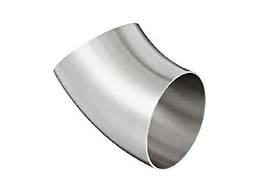
Stainless Steel Trimmed Elbow
Q1. What is a trimmed elbow?
A trimmed elbow is a standard butt-weld pipe elbow that has been cut (trimmed) from its full 90° or 45° angle to a non-standard angle, or shortened in leg length, to fit a specific piping layout. It keeps the smooth forged radius and full wall thickness of the parent elbow, giving a clean, ready-to-weld custom-angle fitting.
Q2. Why not just use a standard 45° or 90° elbow?
Because real piping runs often need an in-between angle (such as 30°, 60°, or 22.5°) or a shorter tangent that no standard elbow provides. Trimming a standard elbow to the exact angle lets the fitting match the layout precisely while keeping the smooth flow and pressure rating of a forged elbow.
Q3. How is a trimmed elbow different from a miter bend?
A trimmed elbow starts from a forged elbow and is cut to angle, so it keeps a smooth radius and full pressure rating — best for small-to-medium bore where flow and pressure matter. A miter bend is cut and welded from straight pipe with a segmented path, best for large-diameter, low-pressure custom angles. Choose by size, pressure, and flow needs.
Q4. What angles can a trimmed elbow be made to?
Any angle below the parent elbow's angle — for example a 90° elbow can be trimmed to 60°, 45°, 30°, 22.5°, or any required deflection, and the leg can be shortened. The finished angle is set to your drawing so the fitting drops straight into the run.
Q5. Does trimming reduce the pressure rating?
No — provided the elbow is trimmed within its geometry so full wall thickness remains at the weld bevel, the trimmed elbow retains the pressure rating of the parent forged elbow. We select the base elbow and trim line so the fitting meets the service pressure and code.
Q6. What materials are trimmed elbows made from?
A234 carbon steel, SS 304/316/310/410, Duplex 2205 and Super Duplex 2507, Monel 400/500, Hastelloy C22/C276/B2/B3, and Inconel — normally the same grade as the line pipe and the base elbow, chosen for the medium, temperature, and corrosion conditions.
Q7. What end preparation is supplied?
The trimmed end is bevelled ready for butt-welding (per ASME B16.25), and can also be supplied faced or flanged on request. NDT and PWHT can be carried out where required, and the fitting certified with EN 10204 3.1 MTC.
Q8. Can trimmed elbows be made to our drawing?
Yes. We trim elbows to your isometric or drawing — pipe size and schedule, required angle or leg, end preparation, material, and testing — for a drop-in, ready-to-weld fit. Send your details and service conditions for a recommendation and quote.