Tesco Steel & Engineering forges ASTM A182 F5 blind flanges — 5Cr-½Mo chrome-moly, the classic grade of hot sulphur-bearing refinery service — to ASME B16.5 Class 150–2500 from ½″ to 24″ NB and to ASME B16.47 up to 60″. Where A105 stops at 425 °C and thins under hot sulphur attack, F5's chromium builds the protective scale and its molybdenum carries strength into the creep range — the closure of crude, vacuum and hot-oil circuits. Siblings F11 and F22 cover the steam-and-hydrogen side; facings follow the mating flange: BLRF, BLFF or BLRTJ. F5a to order. Every lot with EN 10204 3.1/3.2 MTC. ISO 9001:2015, made in Mumbai, India — exported to 50+ countries.
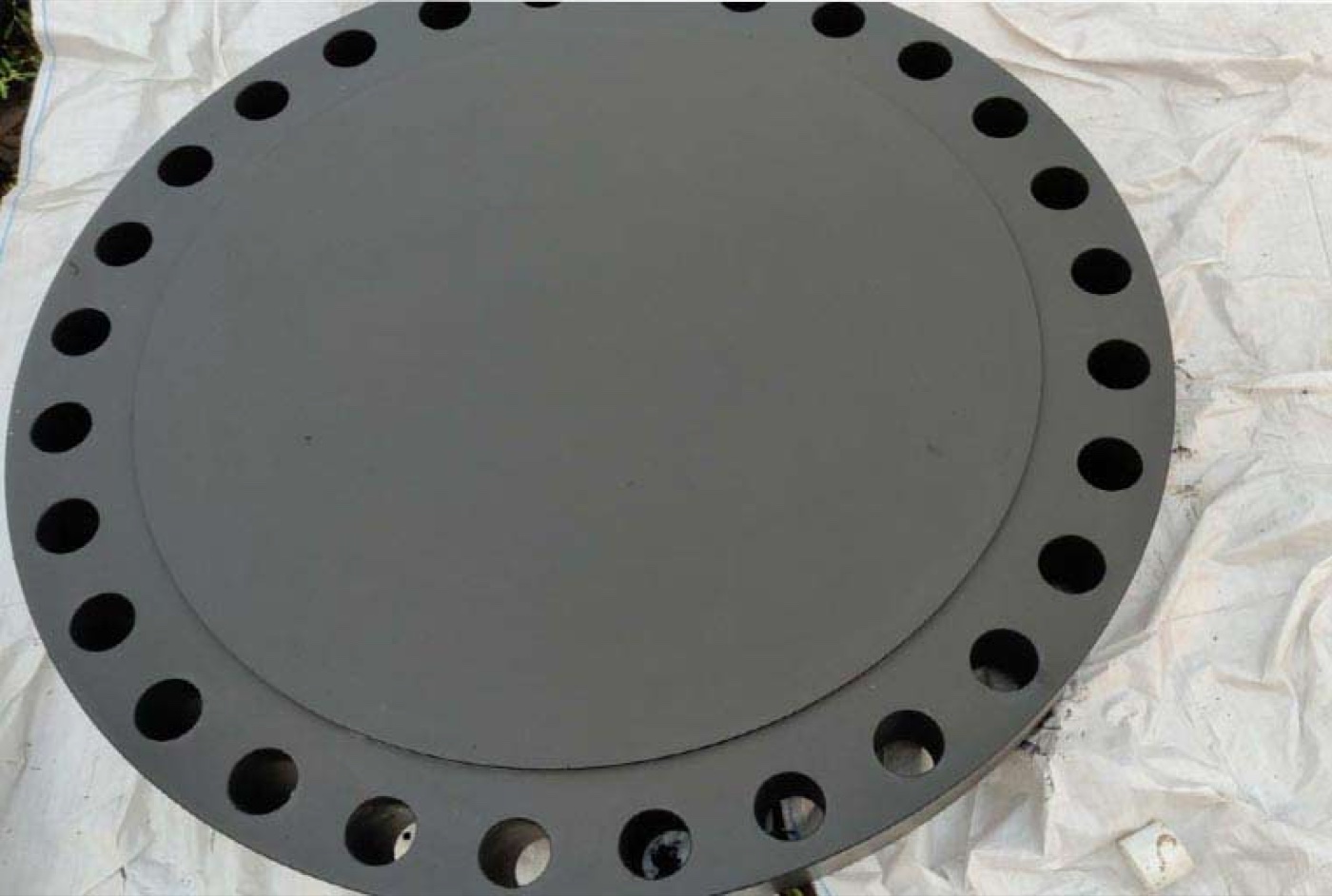
Alloy Steel Blind Flange — Black-Coated Raised Face, at Our Works
What is an ASTM A182 F5 Blind Flange?
The refinery's hot-service closure. A solid forged disc of 5Cr-½Mo alloy steel with no bore, closing pipes, valves and nozzles where the process runs hot and sulphur-laden. The ~5% chromium resists high-temperature sulphidation; the ½% molybdenum holds strength in the creep range — useful allowable stresses to roughly 590–650 °C, far past carbon steel's ceiling. Dimensions per ASME B16.5 / B16.47 in RF, FF and RTJ facings; supplied heat treated with EN 10204 3.1 certification.
Also searched as: F5 blind flange, A182-F5 blind, SA-182 F5 blind (the ASME boiler-code twin), 5Cr blind flange, chrome moly blind flange — all refer to the product on this page. See also the alloy steel hub, siblings F11 blind flanges and F22 blind flanges, and the facing pages BLRF / BLFF / BLRTJ.
F5 Chemical Composition
Element
C
Mn
Si
Cr
Mo
F5 Weight %
≤0.15
0.30–0.60
≤0.50
4.0–6.0
0.44–0.65
Two alloying decisions define the grade: chromium for the chemistry, molybdenum for the mechanics. The steel is dark, magnetic and handles like carbon steel — the difference only shows up hot, which is exactly where it is specified. Supplied heat treated (annealed or normalized and tempered) per A182; the variant F5a raises carbon to 0.25% for higher strength where specified.
The Chromium Story — Hot Sulphur Corrosion
Crude oil carries sulphur, and from roughly 260 °C upward its compounds attack plain steel in an accelerating scaling reaction — sulphidation — that thins hot carbon-steel piping visibly between turnarounds. Decades of refinery data (the McConomy curves) show one clear remedy:
Chromium Slows the Attack
Corrosion rates fall steeply as chromium rises — the 4–6% of F5 builds a far more protective oxide-and-sulphide scale than plain steel manages, and became the historic first answer of the crude-unit world.
Molybdenum Holds the Strength
Above ~450 °C carbon steel creeps — stretches permanently under load. The ½Mo addition slows creep sharply, keeping the blind's bending plate rated where A105 has left the allowable-stress tables entirely.
Same Metal as the Pipe
A closure in a lesser grade becomes the corrosion weak point of the line. Specifying the blind in the line's own chrome-moly keeps the corrosion allowance — and the turnaround inspection scope — uniform.
Rule of thumb: if the enemy is hot sulphur, chromium wins — specify F5. If the enemy is stress at temperature, molybdenum-led F11/F22 win. The three pages tell each story; the line specification decides.
Mechanical Properties
Property
A182 F5
A182 F5a
Tensile Strength
≥ 485 MPa (70 ksi)
≥ 620 MPa (90 ksi)
Yield Strength (0.2%)
≥ 275 MPa (40 ksi)
≥ 450 MPa (65 ksi)
Elongation
≥ 20%
≥ 22%
Hardness
143–217 HB
187–248 HB
Carbon
≤ 0.15%
≤ 0.25%
Room-temperature numbers read close to carbon steel — the grade earns its keep hot, where it retains useful strength to roughly 590–650 °C in the ASME allowable-stress tables. F5 is the default; F5a only when the specification says so.
Annealed or normalized & tempered per A182 — condition stated on certificate
Size
1/2"NB to 24"NB per ASME B16.5; 26"–60" per ASME B16.47; EN 1092-1 equivalents to order
Class
150#, 300#, 400#, 600#, 900#, 1500#, 2500#
Facings
Raised Face (BLRF), Flat Face (BLFF), Ring Type Joint (BLRTJ) with groove per B16.20
Service
Hot sulphur-bearing streams; useful allowable stresses to ~590–650 °C per ASME tables
Modifications
NPT-tapped centre (hydrotest / vent / drain / gauge), lifting provisions — machined & certified at the works
Testing
Tension, chemistry & hardness per heat; UT / MPI / PMI where specified
Certification
EN 10204 3.1 (standard) / 3.2 witnessed
Why F5 Blind Flanges Are Specified
Survives the Hot Sulphur World
Where carbon-steel closures thin measurably between turnarounds, the 5% chromium keeps the F5 blind's corrosion allowance intact — the reason the grade has held its refinery niche for generations.
Rated Where Carbon Steel Isn't
Useful ASME allowable stresses to roughly 590–650 °C — the blind stays code-rated on lines that left A105's table a hundred degrees ago.
Bolted, So the Air-Hardening Doesn't Bite
5Cr steel punishes careless welding — but a blind is bolted, never welded. The metallurgy arrives correct from our furnace and stays that way in service.
The Matching-Metal Principle
Blind in the line's own grade keeps corrosion behaviour, inspection intervals and certificates uniform across the joint — no weak-point closure.
Know the Siblings
Steam & power creep duty: F11. Hydrogen units & heavy walls: F22. General duty: A105. Cold duty: A350 LF2. Facings: BLRF / BLFF / BLRTJ.
Specification Notes — Getting Chrome-Moly Right
Three details buyers miss.F5 or F5a — say which: the two differ in carbon, strength and hardness window; the certificate must match the piping class, not just read "F5". No field modifications: 5Cr steel air-hardens — taps, vents and any machining belong at the works, heat-treated and certified with the flange, never drilled at site. Not a cold-service grade: F5 is ferritic; below about -29 °C it needs impact testing like any ferritic steel — cold closures belong to LF2 or stainless, however hot the line runs in normal operation.
How Our F5 Blind Flanges Are Manufactured
1
Forging — cut billet of the spectro-verified F5 heat is hot-forged into the solid disc blank, keeping full heat traceability from melt to marking.
2
Heat treatment — annealed or normalized and tempered per A182; controlled cooling matters in an air-hardening grade, and furnace charts are retained against the heat number.
3
Machining & facing — faces, OD and drilling to ASME B16.5 / B16.47; RF serrations, flat face or RTJ groove gauged per B16.20; NPT taps machined where ordered.
4
Testing — tension test, chemistry and hardness against the heat; UT, MPI and PMI where specified — PMI is routine on alloy grades so no carbon-steel lookalike slips into an F5 lot.
5
Marking — permanent marking of standard, grade (F5/F5a), size, class and heat number.
6
Certification & packing — EN 10204 3.1 MTC (3.2 witnessed on request); faces protected, palletised or crated sea-worthy.
Where F5 Blind Flanges Are Used
The hot side of the refinery: crude and vacuum unit transfer lines, hot-oil and residue circuits, furnace inlet and outlet manifolds, FCC and coker fractions — and hot-service plants that inherit refinery specifications. Closure duties are the usual ones: isolations, future connections and tapped test blinds, in the same metal as the pipe. Production below:
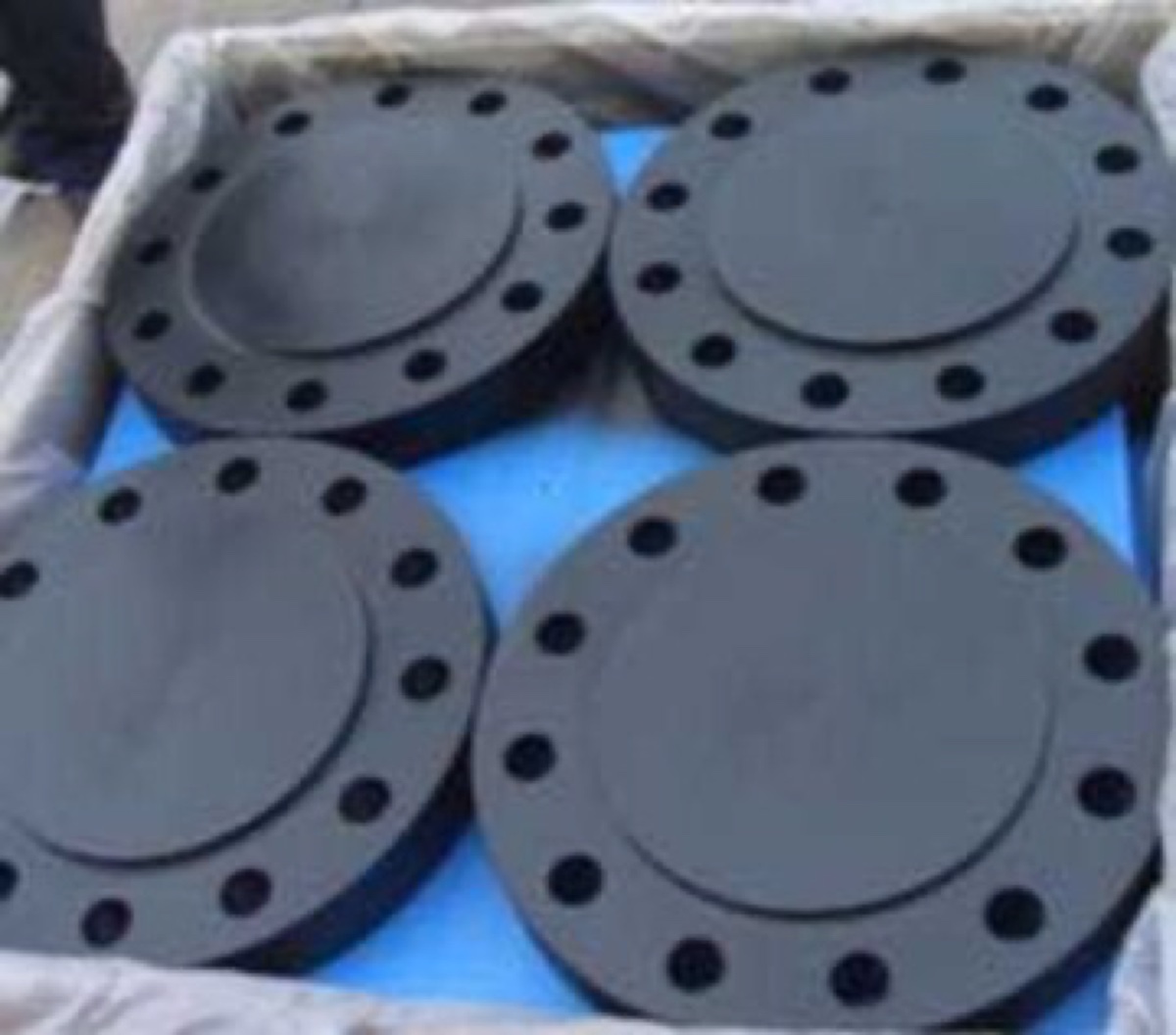
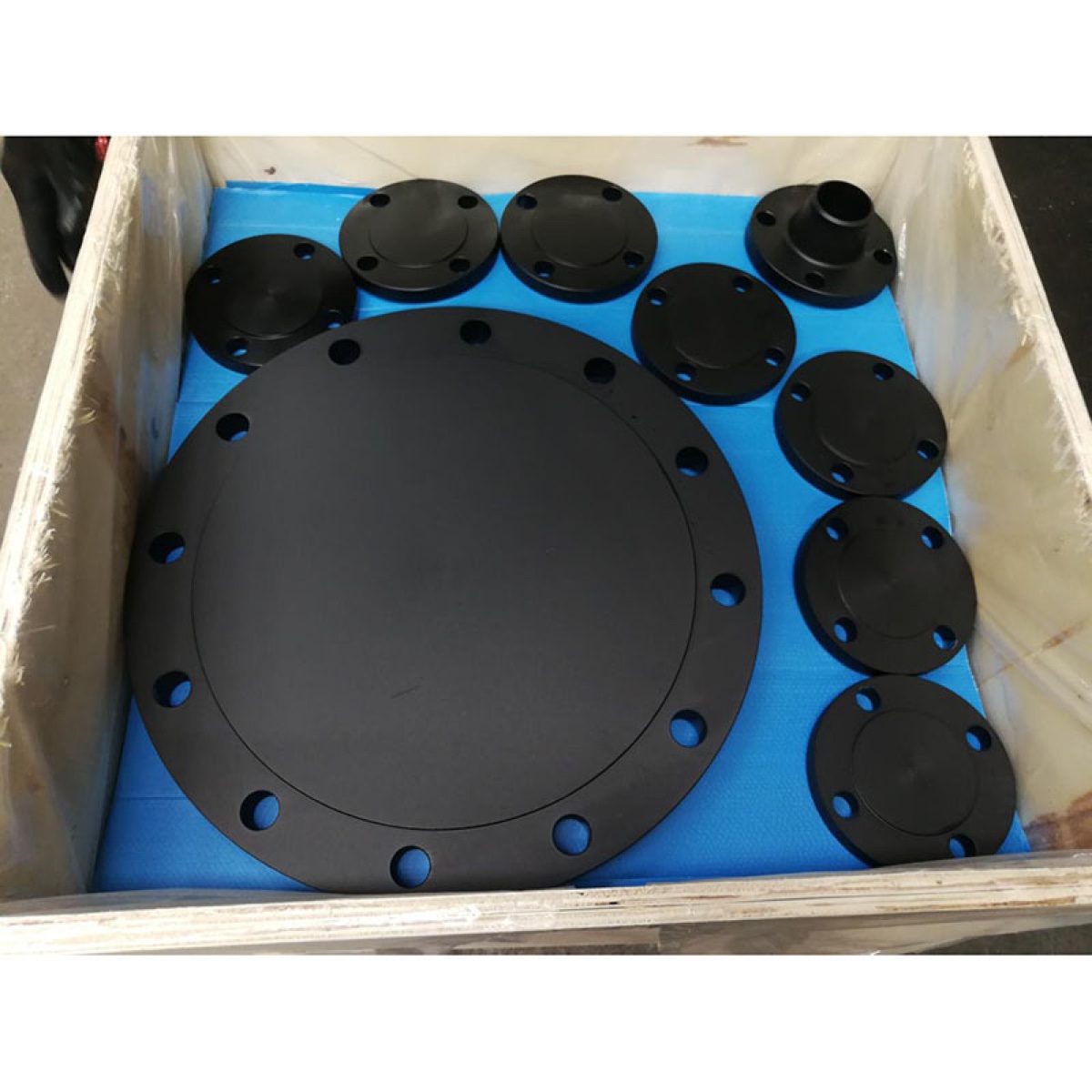
Alloy Steel RF Blind Flanges — Packed in Lined Crate10″ Class 150 RF Blind — Machined Gasket Face
F5 Blind Flange Dimensions
Blind dimensions are class-governed — identical across material grades. Full charts:
An ASTM A182 F5 blind flange is a solid forged disc of 5Cr-½Mo alloy steel, drilled to the standard bolt pattern with no bore, used to close pipes, valves and vessel nozzles in hot refinery service. F5 belongs to the chrome-moly family: about 5% chromium buys resistance to high-temperature sulphur attack, and the molybdenum carries strength into the creep range — duties far beyond what carbon steel blinds tolerate. Dimensions follow ASME B16.5 from ½ inch to 24 inch and ASME B16.47 beyond, in raised face, flat face and ring joint facings.
What kind of steel is A182 F5?
A forged 5Cr-½Mo low-alloy steel — nominally 4.0-6.0% chromium and 0.44-0.65% molybdenum with carbon capped at 0.15%. ASTM A182 covers forged alloy and stainless flange materials for high-temperature service, and F5 is its classic refinery grade: dark, magnetic and carbon-steel-like to handle, but alloyed for a hot, sulphur-laden world. It is supplied heat treated — annealed or normalized and tempered — and the higher-carbon, higher-strength variant F5a is available where the specification calls for it.
What does the 5% chromium do?
It slows high-temperature sulphidation — the scaling attack that sulphur compounds in crude and its hot fractions inflict on plain steel, roughly from 260°C upward and accelerating with temperature. Chromium builds a more protective oxide and sulphide scale, and refinery experience collected over decades (the McConomy curves) shows corrosion rates falling steeply as chromium rises; 5Cr became the historic first answer for hot sulphur-bearing streams. That is why F5 blinds live in crude, vacuum and hot-oil circuits where an A105 blind would thin visibly between turnarounds.
What does the molybdenum do?
Two jobs. It carries strength into the creep range — above roughly 450°C plain carbon steel begins to stretch permanently under stress, and the ½Mo addition slows that mechanism sharply. And it suppresses the embrittlement mechanisms that afflict plain chromium steels in long hot service. The combination is why chrome-moly, not plain chrome or plain carbon steel, is the standard family for hot pressure parts — the chromium handles the chemistry, the molybdenum handles the mechanics.
F5, F11 or F22 — which chrome-moly blind?
By what the service is doing to the steel. F11 (1¼Cr-½Mo) and F22 (2¼Cr-1Mo) carry more molybdenum relative to chromium and rule the steam-power and hydrogen-unit world, where creep strength and hydrogen-attack resistance govern. F5, with the most chromium of the three, rules where hot sulphur corrosion governs — refinery process circuits. Our F11 blind flange and F22 blind flange pages cover their side; if the line is a hot sulphur-bearing hydrocarbon stream, F5 is the traditional specification.
What is the difference between F5 and F5a?
Carbon and strength. F5 caps carbon at 0.15% and delivers tensile 485 MPa / yield 275 MPa minimum — the standard, weld-friendlier grade. F5a allows carbon to 0.25% and is supplied stronger: tensile 620 MPa and yield 450 MPa minimum, with a correspondingly higher hardness window. Unless the piping specification explicitly says F5a, F5 is the default — and for a bolted blind the strength difference rarely matters, since the class tables set the thickness. State the exact grade on the enquiry; the certificate will match it.
What are the mechanical properties of F5 blind flanges?
Tensile strength 485 MPa (70 ksi) minimum, yield strength 275 MPa (40 ksi) minimum, elongation 20% minimum, hardness 143-217 HB — delivered in the heat-treated condition A182 mandates. The numbers read close to carbon steel at room temperature; the difference appears hot, where F5 retains useful strength and creep resistance long after A105 has left its allowable-stress table. Every heat is tension-tested and chemistry-verified, with results on the EN 10204 3.1 certificate.
What temperature range does an F5 blind flange cover?
Its home ground is hot service: F5 holds useful allowable stresses to around 590-650°C in the ASME tables, with the practical limit set by the code, the corrosion allowance and the specification. It is not a low-temperature grade — below about -29°C ferritic steels need impact testing, and cold duty belongs to LTCS or stainless. In practice F5 blinds are specified for lines running hot enough that carbon steel's 425°C ceiling and sulphidation both loom.
What facings are F5 blind flanges made with?
All three: raised face (BLRF), flat face (BLFF) and ring type joint (BLRTJ) — each facing has its own page on this site. The RTJ share is significant in F5: hot refinery circuits at Class 600 and above often run ring joints, with the ring chosen softer than the flange groove. The forging is common to all facings; the mating flange governs the choice, and for RTJ the ring number follows from size and class.
What sizes and classes are F5 blind flanges available in?
From ½" to 24" NB per ASME B16.5 in Classes 150 through 2500, and to 60" per ASME B16.47 where large hot headers need closing. Chrome-moly blinds are generally forged against the order rather than stocked — refinery projects specify them by line class, and each lot carries its own heat-treatment record and certification. EN 1092-1 PN-series blinds in equivalent chrome-moly grades are produced to order as well.
Does the air-hardening nature of 5Cr steel affect blind flanges?
Far less than it affects anything welded — and that is part of the blind's appeal. 5Cr steel air-hardens: weld it without preheat and post-weld heat treatment and the joint turns brittle-hard. A blind flange, though, is bolted, never welded, so the fabrication headache largely disappears at the closure: the flange arrives correctly heat treated from the works and stays that way. The discipline that remains is ours — controlled forging and tempering — and the certificate records it.
Can F5 blind flanges be tapped for testing or instruments?
Yes — the NPT-tapped centre modification applies to F5 as to any blind: fill, vent, drain, gauge and injection connections for hydrotest and operational duty. The tap is machined at the works and certified with the flange — field-drilling an air-hardening chrome-moly blind is exactly the kind of improvisation to avoid. State the NPT size on the enquiry and the tap arrives ready to plug.
Where are F5 blind flanges used?
The hot side of the refinery: crude and vacuum distillation transfer lines, hot-oil and residue circuits, furnace inlet and outlet manifolds, FCC and coker fractions — wherever sulphur-bearing hydrocarbons run hot enough to eat carbon steel. Outside refineries they appear in hot-service duties that inherit refinery specifications. On those lines the F5 blind serves the usual closure duties — isolations, future connections, tapped test blinds — in the same metal as the pipe, which is the point.
Which standards cover F5 blind flanges?
The material standard is ASTM A182 grade F5 (or F5a), with ASME SA-182 as its boiler-code twin; dimensions follow ASME B16.5 for ½"-24" and ASME B16.47 for 26"-60". Pressure-temperature ratings come from the B16.5 tables for the 5Cr material group, which extend far beyond the carbon-steel groups. A complete specification reads: 'Blind Flange, RF, 6", ASME B16.5 Class 300, ASTM A182 F5' — and our EN 10204 certificates state dimension standard, grade, heat treatment and test results together.
Who manufactures ASTM A182 F5 blind flanges in India?
Tesco Steel & Engineering is an ISO 9001:2015 certified flange manufacturer based in Mumbai, India, forging ASTM A182 F5 and F5a blind flanges from ½" to 24" NB per ASME B16.5 in Classes 150-2500 and to 60" per ASME B16.47 — heat treated, tested and certified to EN 10204 3.1/3.2 on every lot — in raised face, flat face and ring joint facings, with NPT-tapped test blinds to order, alongside F11 and F22 chrome-moly, carbon steel, LTCS, stainless and nickel-alloy blinds. Exported to more than 50 countries.