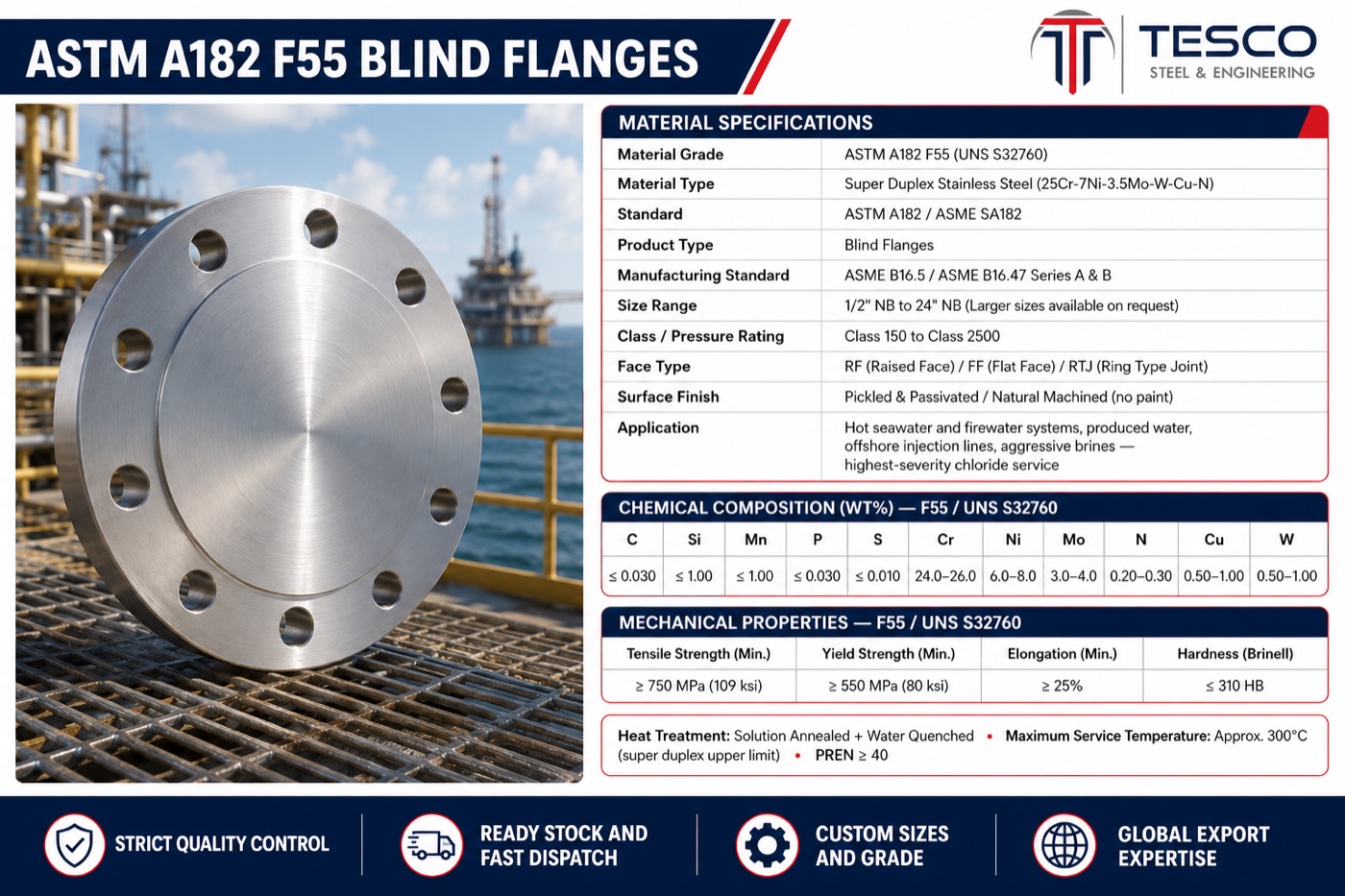
Tesco Steel & Engineering forges ASTM A182 F55 blind flanges — UNS S32760, the tungsten-copper super duplex of Zeron 100 heritage — to ASME B16.5 Class 150–2500 from ½″ to 24″ NB and to ASME B16.47 up to 60″. Sister grade to F53 in the PREN ≥40 seawater tier, F55 adds 0.5–1% tungsten (credited directly in its PREN formula) and 0.5–1% copper (resistance in reducing acids) — the route North Sea and NORSOK-lineage specifications standardised on for hot seawater, firewater and produced-water duty. Yield ≥550 MPa, solution annealed and water quenched under documented control, with ASTM A923 and NACE MR0175 to order. Standard duplex lives on F51. Facings: BLRF, BLFF or BLRTJ. Every lot with EN 10204 3.1/3.2 MTC. ISO 9001:2015, made in Mumbai, India — exported to 50+ countries.
ASTM A182 F55 · UNS S32760 · EN 1.4501Super Duplex 25Cr-7Ni-3.5Mo-W-Cu-NPREN ≥40 · W-Credited FormulaYield ≥550 MPa · Elongation ≥25%ASME B16.5 ½″–24″ · Class 150–2500RF · FF · RTJ FacingsEN 10204 3.1 / 3.2 · ISO 9001:2015
ASTM A182 F55 Blind Flange — Specifications at a Glance
What is an ASTM A182 F55 Blind Flange?
The North Sea closure. A solid forged disc of super duplex UNS S32760 with no bore, closing pipes, valves and nozzles in the severest chloride service: hot seawater, firewater, produced water, aggressive brines. Its signature is the tungsten and copper alloying on the 25Cr-7Ni base — clearing PREN ≥40 (W-credited formula) with yield ≥550 MPa, tensile ≥750 MPa and 25% elongation. Solution annealed + water quenched, hardness ≤310 HB, band roughly -50 °C to +300 °C. Dimensions per ASME B16.5 / B16.47 in RF, FF and RTJ facings; EN 10204 3.1 certified.
Also searched as: S32760 blind flange, Zeron 100 blind flange, super duplex blind flange, SA-182 F55 blind (the ASME boiler-code twin), 1.4501 / X2CrNiMoCuWN25-7-4 blind (the EN equivalent) — all refer to the product on this page. See also the duplex steel hub, siblings F53 / F51 / F60 blind flanges, and the facing pages BLRF / BLFF / BLRTJ.
The Tungsten-Copper Signature
Both great super duplexes reach the same PREN ≥40 tier; S32760 takes the road less common in alloy design — two deliberate additions on top of the 25Cr-7Ni-3.5Mo-N base:
Tungsten — Molybdenum's Slower Partner
Contributes to pitting and crevice resistance — the S32760 PREN formula credits it directly: %Cr + 3.3×(%Mo + 0.5×%W) + 16×%N — while diffusing more slowly, easing the intermetallic kinetics that haunt rich duplex chemistries.
Copper — Reach Into Reducing Acids
The 0.5–1% copper buys measurable resistance in sulphuric and other reducing environments — broadening the grade past pure chloride duty, into acid-bearing produced-water chemistry.
Heritage That Became a Standard
Developed as Zeron 100 and proven in North Sea seawater and firewater systems — NORSOK-lineage specifications still name S32760 by habit, which is why "which super duplex" is usually answered by where the project's paperwork grew up.
The practical rule: seawater performance is comparable, the tier is one — but the UNS numbers are not interchangeable on a certificate. Order the designation your line class names; we forge both.
F55 Chemical Composition (UNS S32760)
Element
C
Si
Mn
P
S
Cr
Ni
Mo
N
Cu
W
Weight %
≤0.030
≤1.00
≤1.00
≤0.030
≤0.010
24.0–26.0
6.0–8.0
3.0–4.0
0.20–0.30
0.50–1.00
0.50–1.00
Eleven controlled elements — the tungsten and copper columns are required, not residuals, and the tight S ≤0.010% reflects the grade's premium-melt origins. PREN = %Cr + 3.3×(%Mo + 0.5×%W) + 16×%N ≥ 40.
Mechanical Properties & The Temperature Band
Property
ASTM A182 F55 Requirement
Tensile Strength
≥ 750 MPa (109 ksi)
Yield Strength (0.2%)
≥ 550 MPa (80 ksi)
Elongation
≥ 25% — the highest guaranteed ductility in the super duplex tier
Hardness
≤ 310 HB (NACE sour service: ≤32 HRC)
Condition
Solution annealed + water quenched — mandatory, documented
Service Band
~ -50 °C to +300 °C — offshore specifications often cap nearer 250 °C
The quench is the qualification. Super duplex begins precipitating sigma phase within minutes in the 600–1000 °C window — the tungsten slows the kinetics somewhat, but the rule is unchanged: solution anneal above ~1050 °C, immediate water quench, documented furnace record, ASTM A923 verification where specified. No field heating, flame-cutting or casual welding, ever.
ASTM A182 F55 Blind Flanges are available in the following specifications:
Material Grade
ASTM A182 F55 (UNS S32760); ASME SA-182; EN 1.4501 to order
Heat Treatment
Solution annealed + water quenched — mandatory, furnace-documented; ASTM A923 testing to order
Size
1/2"NB to 24"NB per ASME B16.5; 26"–60" per ASME B16.47; EN 1092-1 to order
Class
150#, 300#, 400#, 600#, 900#, 1500#, 2500#
Facings
Raised Face (BLRF), Flat Face (BLFF), Ring Type Joint (BLRTJ) with groove per B16.20
Corrosion Duty
PREN ≥40 (W-credited) — hot seawater, crevice, chloride SCC; sour per NACE MR0175 (≤32 HRC)
Surface Finish
Pickled & passivated or natural machined — no paint; segregated stainless handling throughout
Modifications
NPT-tapped centre (hydrotest / vent / drain / gauge), lifting provisions — machined & certified at the works
Testing
Tension, chemistry incl. W, Cu & N, hardness per heat; PMI routine; A923 / corrosion tests where specified
Certification
EN 10204 3.1 (standard) / 3.2 witnessed
Why F55 Blind Flanges Are Specified
The NORSOK-Lineage Choice
Where the project's paperwork grew up on North Sea practice, the super duplex named is S32760 — and the closure inherits the designation with the line.
Seawater-Qualified With Margin
PREN ≥40 on the tungsten-credited formula — hot seawater, crevice conditions and chlorinated firewater covered, the same tier as F53.
Ductility With Its Strength
Yield 550 MPa with 25% guaranteed elongation — the most forgiving mechanical profile in the super duplex tier, welcome on hardware that gets bolted hard offshore.
Acid Reach From the Copper
The copper addition extends resistance into reducing acids — useful margin where produced water brings more than chlorides.
Three details buyers miss.F55 ≠ F53 on paper: the tier is one but the UNS numbers, chemistry windows and certification lineages differ — order the designation the line class names, and expect the W and Cu values on the certificate. The quench is the qualification: insist on the furnace-documented anneal-and-quench, and A923 results on critical lines. Sour caps hardness at 32 HRC: NACE MR0175 sits tighter than A182's 310 HB — state the NACE requirement up front so testing and certification align.
How Our F55 Blind Flanges Are Manufactured
1
Forging — cut billet of the spectro-verified S32760 heat — tungsten, copper and nitrogen in the analysis — is hot-forged into the solid disc blank with full heat traceability and segregated stainless handling.
2
Solution anneal + water quench — above ~1050 °C and immediately into water; furnace charts retained against the heat number.
3
Machining & facing — faces, OD and drilling to ASME B16.5 / B16.47; RF serrations, flat face or RTJ groove gauged per B16.20; NPT taps machined where ordered.
4
Testing — tension test, full eleven-element chemistry and hardness against the heat; PMI on every piece; ASTM A923 and corrosion testing where specified.
5
Pickling & passivation — the restored chromium-oxide skin, with marking of standard, grade, size, class and heat number.
6
Certification & packing — EN 10204 3.1 MTC (3.2 witnessed on request); faces protected, palletised or crated sea-worthy — no carbon-steel contact in transit.
Where F55 Blind Flanges Are Used
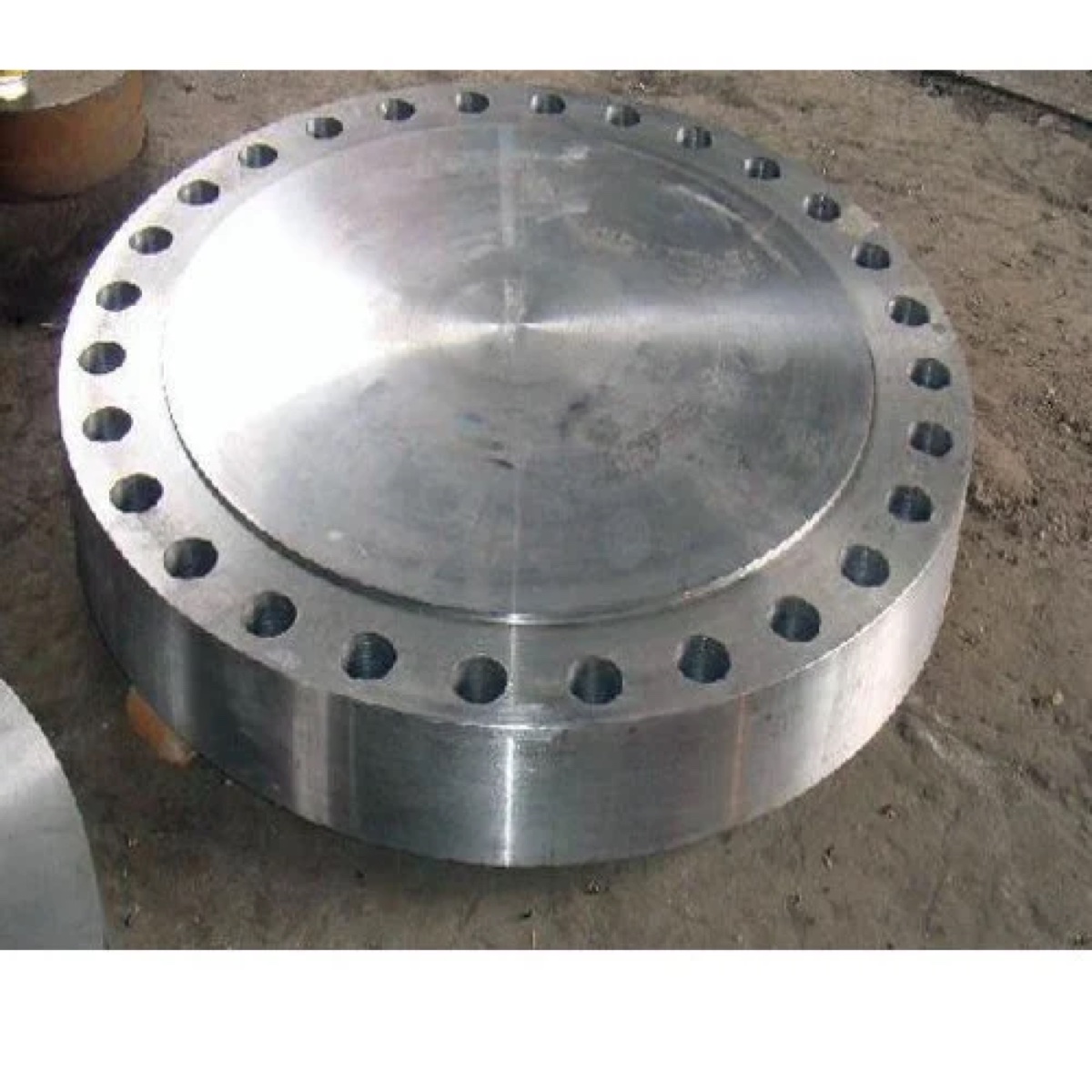
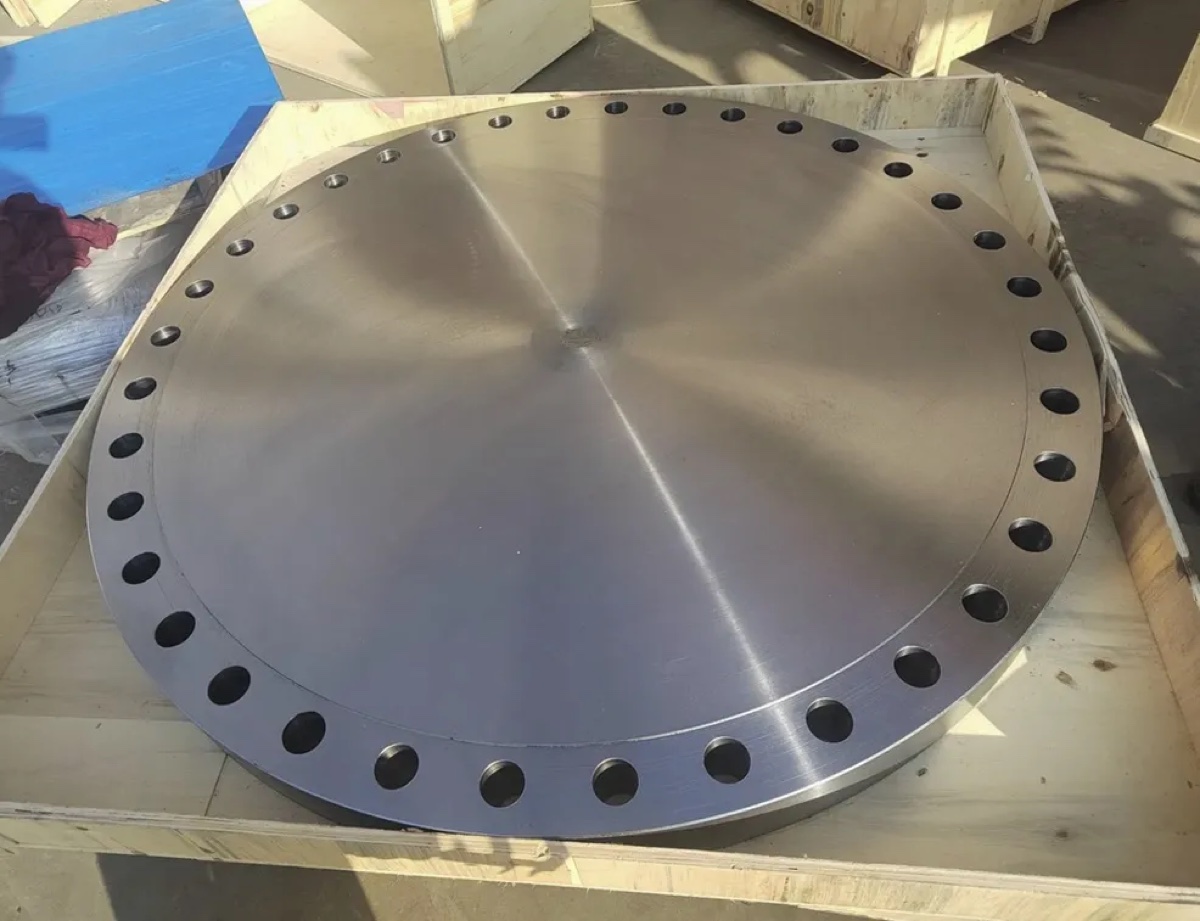
Its home waters are literal: North Sea platforms built the grade's reputation in seawater lift, firewater and deluge rings, and produced-water and injection systems — duties it now serves worldwide, alongside high-recovery desalination, FGD scrubbers and aggressive brines. Production below:
Heavy-Section Forged Blind Flange — At Our WorksLarge Machined Blind Flange — Crated for Export
F55 Blind Flange Dimensions
Blind dimensions are class-governed — identical across material grades. Full charts:
An ASTM A182 F55 blind flange is a solid forged disc of super duplex stainless steel — UNS S32760, the tungsten-copper super duplex of Zeron 100 heritage — drilled to the standard bolt pattern with no bore, used to close pipes, valves and vessel nozzles in the most severe chloride service: hot seawater, produced water and aggressive brines. Like its sister grade F53 it clears the PREN 40 seawater threshold with yield strength of 550 MPa; its signature is the deliberate tungsten and copper alloying. Dimensions follow ASME B16.5 from ½ inch to 24 inch and ASME B16.47 beyond, in raised face, flat face and ring joint facings.
What is UNS S32760?
The second of the two great super duplexes — developed in the UK as Zeron 100 and carried into ASTM A182 as grade F55. The base recipe reads like 2507 (25% chromium, 7% nickel, 3.5% molybdenum, high nitrogen) with two deliberate additions: 0.5-1.0% tungsten and 0.5-1.0% copper. It earned its reputation in North Sea seawater and firewater systems, and NORSOK-lineage specifications still name S32760 by habit. EN calls it 1.4501; the certificate calls it F55.
What do the tungsten and copper do?
Tungsten behaves as a slower-diffusing partner to molybdenum: it contributes to pitting and crevice resistance — S32760's PREN formula credits it directly (%Cr + 3.3×(%Mo + 0.5×%W) + 16×%N) — while being slower to feed intermetallic precipitation. Copper adds resistance in reducing acids, notably sulphuric, broadening the grade beyond pure chloride duty. Together they are the fingerprint that separates F55 from F53 on a certificate — and the reason some operators standardised on the S32760 route.
What is the difference between F55 and F53?
Sister grades in the same PREN ≥40 tier. F53 (S32750, alloy 2507) is the plain-chemistry super duplex; F55 (S32760) adds tungsten and copper, trims the molybdenum and nitrogen windows slightly, and specifies 750 MPa tensile with 25% elongation against F53's 800 MPa and 15%. Seawater performance is comparable and specifications treat them as parallel options — but the UNS numbers are not interchangeable on a certificate. North Sea paperwork habitually names S32760; much of the rest of the world names S32750. Order what the line class says; our F53 blind flange page covers the sister.
Why does PREN 40 matter?
PREN ranks chloride pitting resistance, and 40 is the line the industry drew for seawater qualification. For tungsten-bearing S32760 the formula credits the tungsten — %Cr + 3.3×(%Mo + 0.5×%W) + 16×%N — and F55 clears 40 with margin. Offshore and marine specifications define the super duplex tier by that number and qualify materials for warm seawater, crevice conditions and chlorinated firewater against it; the blind that closes such a line must clear the same bar as the pipe.
When should F55 be used instead of F51?
When the chloride duty outruns standard 2205: warm seawater, chlorinated firewater and deluge systems, high-chloride produced water, aggressive brines. F51 covers the broad middle economically; the super duplex tier buys roughly six points of PREN and 100 MPa of yield for the severe end. Whether the step lands on F55 or F53 is usually decided by the project's specification lineage — NORSOK-heritage paperwork tends to say S32760. Our F51 blind flange page covers the standard tier.
What are the mechanical properties of F55 blind flanges?
Tensile strength 750 MPa (109 ksi) minimum, yield strength 550 MPa (80 ksi) minimum, elongation 25% minimum, hardness 310 HB maximum — in the mandatory solution-annealed and water-quenched condition. Note the profile against F53: a slightly lower tensile floor, appreciably higher guaranteed ductility. For sour duty NACE MR0175 caps super duplex at 32 HRC. Every heat is tension-tested and chemistry-verified — tungsten, copper and nitrogen included — with results on the EN 10204 3.1 certificate.
What temperature range does an F55 blind flange cover?
The duplex band, applied conservatively: roughly -50°C to +300°C, with many offshore specifications capping super duplex nearer 250°C for long-term service. The 475°C embrittlement of the ferrite sets the metallurgical ceiling, and the rich chemistry makes intermediate-temperature excursions unforgivable. Inside the band, the tier's combination of strength and chloride resistance is unmatched in the stainless family.
Why is heat treatment so critical on F55?
Exactly as critical as for any super duplex — the rich chromium and molybdenum accelerate sigma-phase precipitation, and intermetallics can begin forming within minutes in the 600-1000°C window. The tungsten slows those kinetics somewhat — one of its quiet virtues — but the rule is unchanged: solution anneal above roughly 1050°C, immediate water quench, documented furnace record, and ASTM A923 verification where specified. No field heating, flame-cutting or casual welding, ever.
What facings are F55 blind flanges made with?
All three: raised face (BLRF) — the offshore default — flat face (BLFF) for mating GRP and lined systems, common on seawater and firewater headers, and ring type joint (BLRTJ) for high-pressure injection and wellstream duty, the ring chosen softer than the groove. Each facing has its own page on this site. The forging is common to all three; the mating flange governs the choice, and for RTJ the ring number follows from size and class.
Is F55 suitable for sour service?
Yes, within NACE MR0175 / ISO 15156 limits — super duplex is widely used in sour produced-water and injection service, with hardness capped at 32 HRC and environmental limits on H2S partial pressure set by the standard. State the NACE requirement on the enquiry so testing and certification align; sour, chloride-laden and high-pressure typically arrive together offshore, and that intersection is exactly what the grade was built for.
Can F55 blind flanges be tapped for testing or instruments?
Yes — fill, vent, drain, gauge and injection taps are machined into the centre of the blind at the works and certified with the flange. Super duplex machines harder and work-hardens faster than any grade below it, so field-drilling is firmly off the table; the works tap arrives ready to plug with the heat treatment undisturbed. State the NPT size on the enquiry.
Where are F55 blind flanges used?
Its home waters are literal: North Sea platforms built the grade's reputation in seawater lift, firewater and deluge rings, and produced-water and injection systems — duties it now serves worldwide, alongside high-recovery desalination, FGD scrubbers and aggressive brine systems. F55 blinds close those lines as isolations, future connections and tapped test blinds — in the line's own super duplex, keeping PREN, strength and certificates uniform across the joint.
Which standards cover F55 blind flanges?
The material standard is ASTM A182 grade F55 (UNS S32760), with ASME SA-182 as its boiler-code twin and EN 1.4501 / X2CrNiMoCuWN25-7-4 as the European equivalent; dimensions follow ASME B16.5 for ½"-24" and ASME B16.47 for 26"-60". ASTM A923 covers intermetallic-phase testing where specified, and NACE MR0175 / ISO 15156 governs sour service. A complete specification reads: 'Blind Flange, RF, 6", ASME B16.5 Class 300, ASTM A182 F55' — and our EN 10204 certificates state dimension standard, grade, heat treatment and test results together.
Who manufactures ASTM A182 F55 blind flanges in India?
Tesco Steel & Engineering is an ISO 9001:2015 certified flange manufacturer based in Mumbai, India, forging ASTM A182 F55 / UNS S32760 super duplex blind flanges from ½" to 24" NB per ASME B16.5 in Classes 150-2500 and to 60" per ASME B16.47 — solution annealed and water quenched under documented furnace control, PMI-verified, with ASTM A923 testing and NACE MR0175 compliance to order, certified to EN 10204 3.1/3.2 on every lot — in raised face, flat face and ring joint facings, alongside F53 super duplex, F51/F60 duplex, stainless, carbon and nickel-alloy blinds. Exported to more than 50 countries.