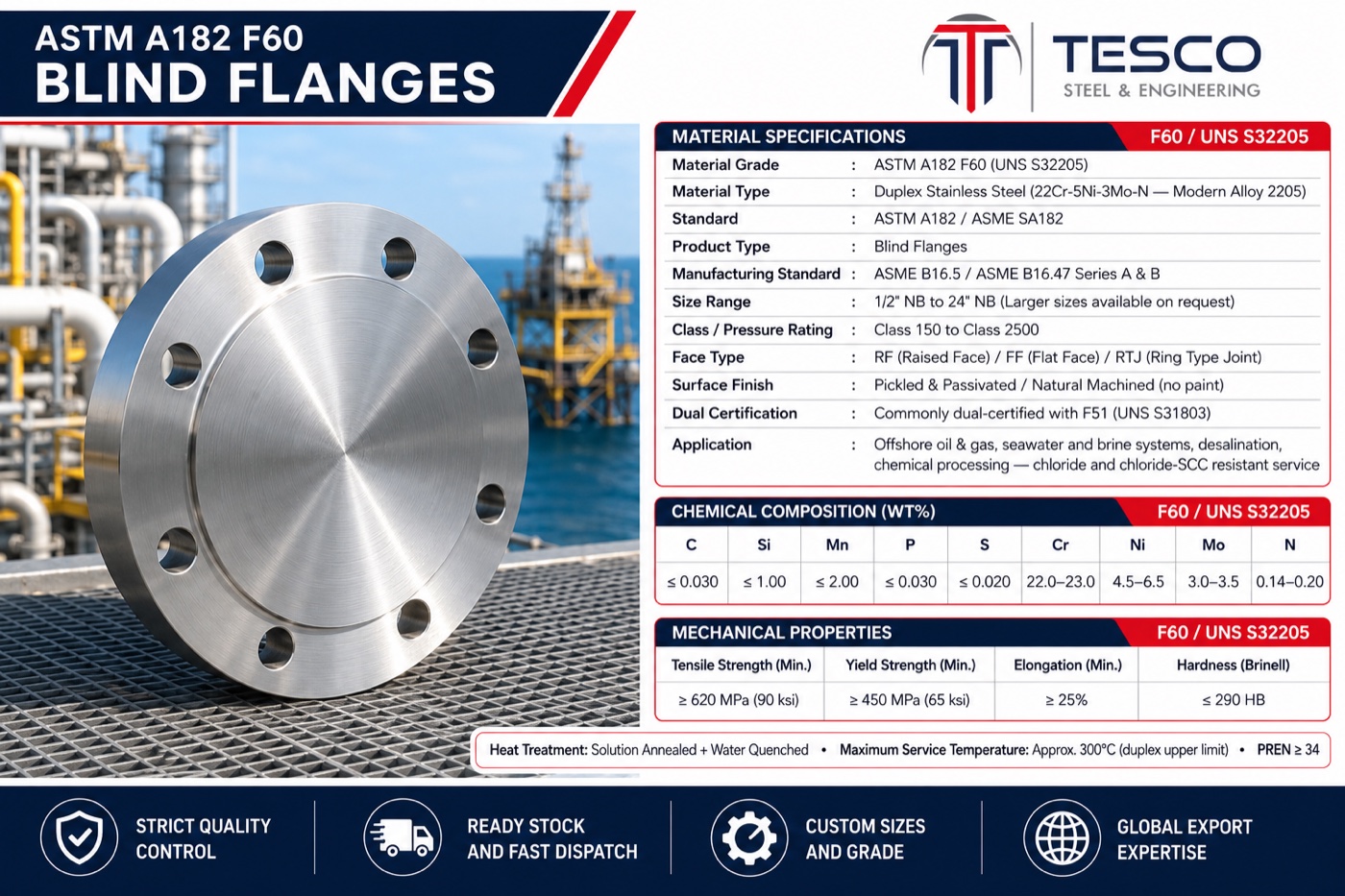
Tesco Steel & Engineering forges ASTM A182 F60 blind flanges — UNS S32205, the modern edition of duplex 2205 — to ASME B16.5 Class 150–2500 from ½″ to 24″ NB and to ASME B16.47 up to 60″. Same alloy family as F51, one decisive refinement: chromium, molybdenum and nitrogen held to the top of the 2205 window — corrosion performance guaranteed by the specification, not the mill's habits. Because S32205 sits wholly inside S31803, most of our duplex production is F51/F60 dual-certified, serving legacy and modern line classes from one stock. Twice the yield of 316L, chloride-SCC resistant, solution annealed and water quenched; hotter, saltier duty steps to F53/F55. Facings: BLRF, BLFF or BLRTJ. Every lot with EN 10204 3.1/3.2 MTC. ISO 9001:2015, made in Mumbai, India — exported to 50+ countries.
ASTM A182 F60 · UNS S32205 · EN 1.4462Modern 2205 · Tightened Cr-Mo-N WindowF51/F60 Dual-CertificationYield ≥450 MPa · Chloride-SCC ResistantASME B16.5 ½″–24″ · Class 150–2500RF · FF · RTJ FacingsEN 10204 3.1 / 3.2 · ISO 9001:2015
ASTM A182 F60 Blind Flange — Specifications at a Glance
What is an ASTM A182 F60 Blind Flange?
Modern 2205, guaranteed. A solid forged disc of duplex stainless UNS S32205 with no bore, closing pipes, valves and nozzles in chloride-bearing service. Metallurgically the 2205 family of F51, with the Cr, Mo and N minimums raised so the corrosion floor is written into the certificate: PREN ≥34 guaranteed, typically ~35. Mechanicals unchanged — yield ≥450 MPa, twice 316L — and most production is F51/F60 dual-certified. Band roughly -50 °C to +300 °C; dimensions per ASME B16.5 / B16.47 in RF, FF and RTJ facings; EN 10204 3.1 certified.
Also searched as: S32205 blind flange, duplex 2205 blind flange, F51/F60 dual certified blind, SA-182 F60 blind (the ASME boiler-code twin), 1.4462 blind (the shared EN number) — all refer to the product on this page. See also the duplex steel hub, siblings F51 / F53 / F55 blind flanges, and the facing pages BLRF / BLFF / BLRTJ.
Why S32205 Exists — Closing the Lean Corner
The original 2205 designation, S31803, drew its chemistry window wide. A melt sitting at the lean corner — molybdenum 2.5%, nitrogen 0.08% — still certified as 2205, but delivered the family's weakest corrosion performance and the least stable weld zones. The industry's answer was not a new alloy but a better-drawn box:
The Top Half, Made Mandatory
S32205 demands Cr ≥22.0, Mo ≥3.0 and N ≥0.14 — the composition good mills were already melting, now guaranteed by the specification instead of habit.
PREN Floor Raised
The tightened minimums lock the pitting index at roughly 35 or better with far less scatter — the lean-corner 2205 that under-delivered in chlorides simply cannot certify as F60.
Nitrogen Where It Counts
The ≥0.14% nitrogen floor matters most at welds, where nitrogen drives austenite reformation in the heat-affected zone — the quiet reason modern line classes migrated to S32205.
Identical — Ni 4.5–6.5%, C ≤0.030%, Mn ≤2.00%, Si ≤1.00%
Mechanicals
Identical — 620 / 450 MPa, ≥25%, ≤290 HB
PREN
≥34 guaranteed, typically ~35–36
≥34 typical, lean corner possible
Relationship
Every F60 melt satisfies F51; the reverse is not guaranteed — hence dual certification
The honest summary: F60 guarantees what a good F51 melt merely tends to deliver. It eliminates the weak tail of the old window rather than raising the ceiling — assurance written into the paperwork.
Dual Certification — One Stock, Both Worlds
Because S32205 sits wholly inside S31803, a melt made to the modern window certifies as both F51 and F60 on one EN 10204 certificate. That single line of paperwork lets one forging serve legacy line classes written around S31803 and modern ones written around S32205 — no substitution argument, no concession request. Most of our duplex production qualifies; state the dual-cert requirement on the enquiry and the certificate reads accordingly. It is the practical reason "F51/F60" appears as one designation across modern offshore purchasing.
F60 Chemical Composition (UNS S32205)
Element
C
Si
Mn
P
S
Cr
Ni
Mo
N
Weight %
≤0.030
≤1.00
≤2.00
≤0.030
≤0.020
22.0–23.0
4.5–6.5
3.0–3.5
0.14–0.20
The bold columns are the tightened ones. PREN = %Cr + 3.3×%Mo + 16×%N — at the leanest permissible F60 melt that is 22.0 + 9.9 + 2.24 ≈ 34.1, and real melts run ~35–36.
Mechanical Properties & The Temperature Band
Property
ASTM A182 F60 Requirement
Tensile Strength
≥ 620 MPa (90 ksi)
Yield Strength (0.2%)
≥ 450 MPa (65 ksi) — twice 316L
Elongation
≥ 25%
Hardness
≤ 290 HB (NACE sour service: ≤28 HRC)
Condition
Solution annealed + water quenched — mandatory
Service Band
~ -50 °C to +300 °C — capped by 475 °C embrittlement of the ferrite
Duplex lives in a band. Hold it around 475 °C and the ferrite embrittles; soak it at 600–1000 °C and sigma phase guts toughness and corrosion resistance in minutes. Codes cap duplex near 300 °C, the solution anneal + water quench is non-negotiable, and no duplex flange should ever be field-heated, flame-cut or welded casually. ASTM A923 testing verifies the structure where specified.
Pickled & passivated or natural machined — no paint; segregated stainless handling throughout
Modifications
NPT-tapped centre (hydrotest / vent / drain / gauge), lifting provisions — machined & certified at the works
Testing
Tension, chemistry incl. nitrogen & hardness per heat; PMI routine; A923 / corrosion tests where specified
Certification
EN 10204 3.1 (standard) / 3.2 witnessed — dual F51/F60 designation on request
Why F60 Blind Flanges Are Specified
The Guaranteed 2205
Corrosion performance written into the specification — the lean-corner melt that under-delivers in chlorides cannot certify as F60, so the floor travels with the certificate.
Modern Line Classes Name It
New offshore, desalination and chemical projects increasingly write S32205 where their predecessors wrote S31803 — the blind follows the line class.
Dual-Cert Serves Both Worlds
One stock, one certificate, legacy and modern paperwork both satisfied — the procurement answer to a two-designation family.
All of 2205's Virtues, Unchanged
Twice 316L's yield, chloride-SCC immunity from the ferrite, economical alloying — everything on the F51 page applies here in full.
Know the Ladder
Original designation: F51. Hotter, saltier: F53 / F55 super duplex. Austenitic alternative: 254 SMO. Facings: BLRF / BLFF / BLRTJ.
Specification Notes — Getting F60 Right
Three details buyers miss.Ask for dual-cert explicitly: most modern melts qualify, but the certificate only lists both designations if the order asks — one line on the enquiry saves a concession request later. Mind the band: duplex is not for hot service — above ~300 °C the ferrite embrittles regardless of designation; hot duty belongs to other families. Sour caps hardness at 28 HRC: NACE MR0175 sits tighter than A182's 290 HB — state the NACE requirement up front so testing and certification align.
How Our F60 Blind Flanges Are Manufactured
1
Forging — cut billet of the spectro-verified S32205 heat — nitrogen included in the analysis — is hot-forged into the solid disc blank with full heat traceability and segregated stainless handling.
2
Solution anneal + water quench — above ~1020 °C and straight into water, racing the forging through the sigma-phase window; furnace charts retained against the heat number.
3
Machining & facing — faces, OD and drilling to ASME B16.5 / B16.47; RF serrations, flat face or RTJ groove gauged per B16.20; NPT taps machined where ordered.
4
Testing — tension test, full chemistry and hardness against the heat; PMI on every piece; ASTM A923 and corrosion testing where specified.
5
Pickling & passivation — the restored chromium-oxide skin, with marking of standard, grade (dual F51/F60 where certified), size, class and heat number.
6
Certification & packing — EN 10204 3.1 MTC (3.2 witnessed on request); faces protected, palletised or crated sea-worthy — no carbon-steel contact in transit.
Where F60 Blind Flanges Are Used
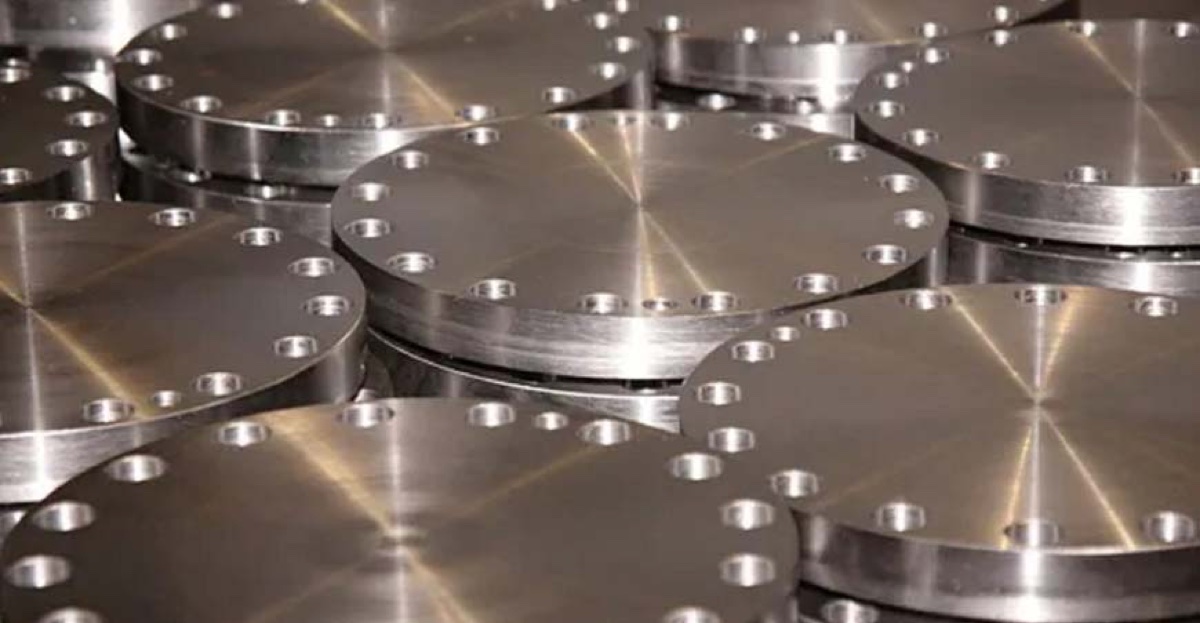
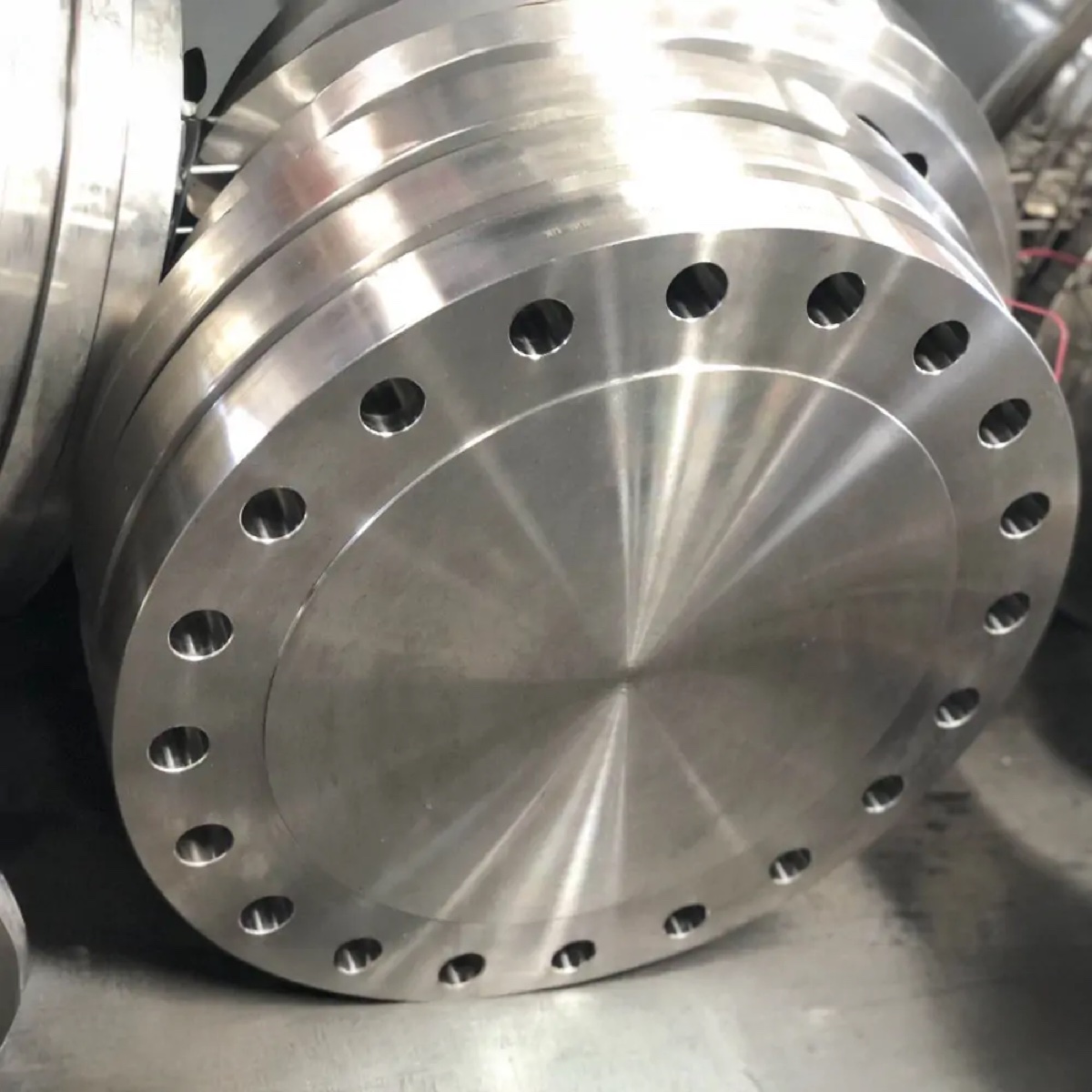
Everywhere 2205 rules: offshore platforms and FPSOs (produced water, seawater lift, firewater), desalination plants, coastal and marine piping, chemical tankers, brine and hypochlorite systems — with modern projects naming S32205 where older ones named S31803. Production below:
Machined Stainless Blind Flanges — At Our WorksLarge Stainless Blind Flange — Machined Face Detail
F60 Blind Flange Dimensions
Blind dimensions are class-governed — identical across material grades. Full charts:
An ASTM A182 F60 blind flange is a solid forged disc of duplex stainless steel — UNS S32205, the modern edition of alloy 2205 — drilled to the standard bolt pattern with no bore, used to close pipes, valves and vessel nozzles in chloride-bearing service: offshore, seawater, brine and aggressive process duty. F60 is metallurgically the same 2205 family as F51, with chromium, molybdenum and nitrogen held to the top of the window for guaranteed corrosion performance. Dimensions follow ASME B16.5 from ½ inch to 24 inch and ASME B16.47 beyond, in raised face, flat face and ring joint facings.
Why does UNS S32205 exist when S31803 already covers 2205?
Because S31803's window has a lean corner. As originally boxed, a melt could sit at 2.5% molybdenum and 0.08% nitrogen and still certify — legally 2205, but with corrosion performance and weld-zone stability at the weak end of the family. S32205 closes that corner: molybdenum at least 3.0%, nitrogen at least 0.14%, chromium at least 22.0%. Same alloy, guaranteed at its better half — which is why modern specifications increasingly name S32205, and why mills melt to it by default.
What is the difference between F60 and F51?
The window, not the alloy. F51 (S31803) accepts Cr 21.0-23.0, Mo 2.5-3.5 and N 0.08-0.20; F60 (S32205) demands Cr 22.0-23.0, Mo 3.0-3.5 and N 0.14-0.20 — the top half of each range. Mechanical requirements are identical: 620 MPa tensile, 450 MPa yield, 25% elongation, 290 HB cap. Every F60 melt automatically satisfies F51; the reverse is not guaranteed. In practice modern production sits inside both windows, which is where dual certification comes from.
What does F51/F60 dual certification mean?
One forging, one heat, one certificate — satisfying both specifications at once. Because S32205 sits wholly inside S31803, a melt made to the modern window certifies as both F51 and F60, and the EN 10204 certificate lists both designations. That lets one stock serve legacy line classes written around S31803 and modern ones written around S32205 without argument. Most of our duplex production is dual-certifiable; state the requirement on the enquiry and the certificate reads accordingly.
Does F60 actually perform better than F51?
Honestly: an F60 certificate guarantees what a good F51 melt merely tends to deliver. The tightened window locks PREN at roughly 35 or better and keeps weld-zone austenite reformation (a nitrogen job) on the safe side — eliminating the weak tail of the old window rather than raising the ceiling. If your existing F51 supply is melted modern — most is — F60 changes the paperwork more than the metal. What it buys is assurance: the corrosion performance floor is written into the specification instead of the mill's habits.
What is the PREN of F60?
The formula is the duplex standard — %Cr + 3.3×%Mo + 16×%N — and the tightened minimums put the floor at roughly 35: 22.0 + 3.3×3.0 + 16×0.14 ≈ 34.1 at the absolute leanest, with real melts typically 35-36. That comfortably clears the ≥34 tier specifications assign to 2205, with less scatter than the S31803 window allows. Where the specification demands PREN ≥40, the answer is a step up the ladder to super duplex F53 or F55.
What are the mechanical properties of F60 blind flanges?
Identical to F51: tensile strength 620 MPa (90 ksi) minimum, yield strength 450 MPa (65 ksi) minimum, elongation 25% minimum, hardness 290 HB maximum — twice the yield of 316L, in the mandatory solution-annealed and water-quenched condition. For sour service NACE MR0175 caps duplex hardness at 28 HRC; state the requirement and the certificate follows. Every heat is tension-tested and chemistry-verified including nitrogen, with results on the EN 10204 3.1 certificate.
What temperature range does an F60 blind flange cover?
The duplex band: roughly -50°C to +300°C. The upper limit is metallurgical — hold duplex around 475°C and the ferrite embrittles, so codes cap continuous service near 300-315°C. The lower limit reflects the ferrite's toughness transition, with -50°C the usual practical floor. Inside that band the grade is hard to beat in chlorides; outside it the specification moves to austenitic stainless (cold) or other families (hot).
Why must F60 be solution annealed and water quenched?
Because between about 600 and 1000°C duplex precipitates sigma phase and related intermetallics — compounds that gut both toughness and corrosion resistance in minutes. Solution annealing above roughly 1020°C dissolves them; the water quench races the forging through the danger zone before they can re-form. A slowly cooled duplex flange can pass a tension test and still fail in service, which is why the heat-treatment record and (where specified) ASTM A923 testing matter. Ours ship annealed, quenched and documented.
When is super duplex needed instead of F60?
When the chloride duty outruns 2205 entirely: hot seawater, chlorinated firewater, high-chloride produced water, aggressive brines — the territory of PREN ≥40 specifications. Super duplex F53 (S32750) and F55 (S32760) raise PREN past 40 and yield to 550 MPa at higher cost and stricter processing. F60 covers the broad economical middle; the specification's PREN floor and design temperature decide the step. Our F53 and F55 blind flange pages cover that tier.
What facings are F60 blind flanges made with?
All three: raised face (BLRF) — the default of offshore process piping — flat face (BLFF) for mating GRP and lined systems, common in seawater service, and ring type joint (BLRTJ) for high-pressure duty, the ring chosen softer than the groove. Each facing has its own page on this site. The forging is common to all three; the mating flange governs the choice, and for RTJ the ring number follows from size and class.
Can F60 blind flanges be tapped for testing or instruments?
Yes — fill, vent, drain, gauge and injection taps are machined into the centre of the blind at the works and certified with the flange. Duplex machines harder than carbon steel and work-hardens, so field-drilling is inadvisable; the works tap arrives ready to plug with the heat treatment undisturbed. State the NPT size on the enquiry.
Where are F60 blind flanges used?
Everywhere 2205 rules: offshore platforms and FPSOs — produced water, seawater lift, firewater rings — desalination plants, coastal and marine piping, chemical tankers, brine and hypochlorite systems, and chloride-bearing process duty. Because modern line classes increasingly write S32205, new projects tend to name F60 where their predecessors named F51 — same joints, updated paperwork. The blinds serve the usual duties: isolations, future connections and tapped test blinds in the line's own duplex.
Which standards cover F60 blind flanges?
The material standard is ASTM A182 grade F60 (UNS S32205), with ASME SA-182 as its boiler-code twin and EN 1.4462 as the European equivalent — S32205 and S31803 share the EN number, mirroring their family relationship. Dimensions follow ASME B16.5 for ½"-24" and ASME B16.47 for 26"-60"; ASTM A923 covers intermetallic testing where specified, NACE MR0175 governs sour service. A complete specification reads: 'Blind Flange, RF, 6", ASME B16.5 Class 300, ASTM A182 F60 (or F51/F60 dual)' — and our certificates state it exactly that way.
Who manufactures ASTM A182 F60 blind flanges in India?
Tesco Steel & Engineering is an ISO 9001:2015 certified flange manufacturer based in Mumbai, India, forging ASTM A182 F60 / UNS S32205 duplex blind flanges from ½" to 24" NB per ASME B16.5 in Classes 150-2500 and to 60" per ASME B16.47 — solution annealed and water quenched, PMI-verified, F51/F60 dual-certified where required, with ASTM A923 testing and NACE MR0175 compliance to order, certified to EN 10204 3.1/3.2 on every lot — in raised face, flat face and ring joint facings, alongside super duplex F53/F55, stainless, carbon and nickel-alloy blinds. Exported to more than 50 countries.