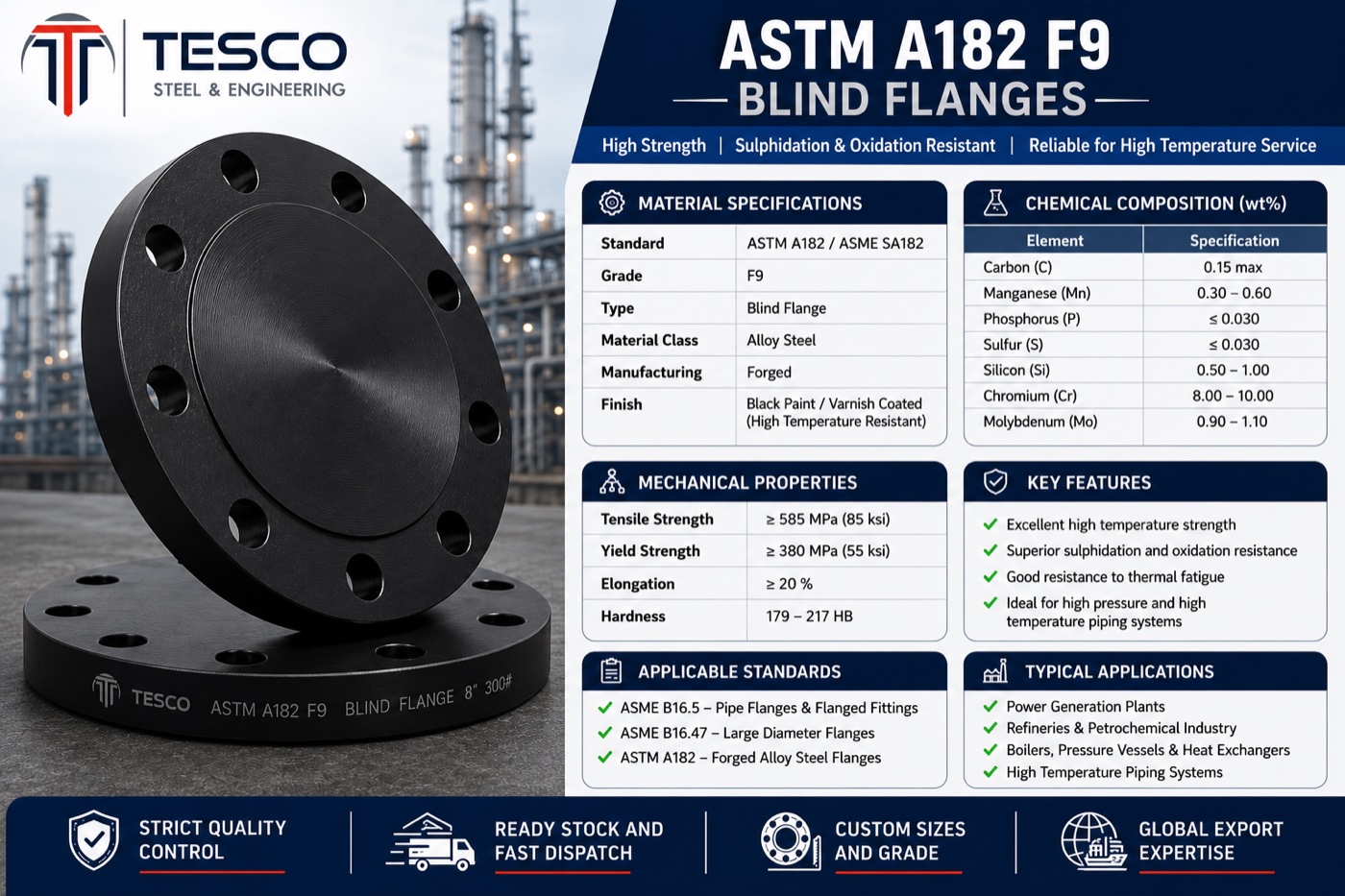
Tesco Steel & Engineering forges ASTM A182 F9 blind flanges — 9Cr-1Mo, the top of the classic chrome-moly ladder — to ASME B16.5 Class 150–2500 from ½″ to 24″ NB and to ASME B16.47 up to 60″. Where even F5's 5% chromium thins too fast — the hottest furnace manifolds, transfer lines and coker circuits — nine percent chromium with high silicon holds the protective scale, one step short of stainless. Not to be confused with F91, the vanadium-modified creep grade of the power world — the comparison is covered below. Facings: BLRF, BLFF or BLRTJ. PMI-verified, every lot with EN 10204 3.1/3.2 MTC. ISO 9001:2015, made in Mumbai, India — exported to 50+ countries.
ASTM A182 F9 Blind Flange — Specifications at a Glance
What is an ASTM A182 F9 Blind Flange?
The top rung of the chrome-moly ladder. A solid forged disc of 9Cr-1Mo alloy steel with no bore, closing pipes, valves and nozzles in the hottest sulphur-bearing refinery circuits. Nominally 8–10% chromium, 1% molybdenum with deliberately high silicon — maximum sulphidation and oxidation resistance short of stainless, with useful allowable stresses to roughly 650 °C. Dimensions per ASME B16.5 / B16.47 in RF, FF and RTJ facings; supplied heat treated, hardness 179–217 HB, with EN 10204 3.1 certification.
Also searched as: F9 blind flange, A182-F9 blind, SA-182 F9 blind (the ASME boiler-code twin), 9 chrome blind flange, 9Cr-1Mo blind — all refer to the product on this page. See also the alloy steel hub, the F9 slip on flanges, siblings F5 / F11 / F22 / F91 blind flanges, and the facing pages BLRF / BLFF / BLRTJ.
F9 Chemical Composition
Element
C
Mn
Si
Cr
Mo
F9 Weight %
≤0.15
0.30–0.60
0.50–1.00
8.0–10.0
0.90–1.10
Note the high silicon window — unusual among the chrome-molys, and deliberate: silicon reinforces the chromium's protective scale against hot sulphur and oxidation. F9 is plain 9Cr-1Mo, with no vanadium or niobium requirement — those micro-alloys belong to F91, a different certificate entirely. Supplied heat treated per A182 with furnace records retained.
Why Nine Percent Chromium?
Sulphidation accelerates relentlessly with temperature — and chromium is the countermeasure that scales with it. The refinery's McConomy curves tell the story in one line: every step up in chromium buys a step down in corrosion rate.
Where 5Cr Runs Out
The hottest transfer lines, furnace outlet manifolds and coker services thin even F5 faster than the corrosion allowance can afford — the specification's next stop is 9Cr.
Silicon Doubles Down
F9's 0.50–1.00% silicon reinforces the same protective scale — the two elements together give the grade its reputation in hot, high-sulphur streams.
One Step Short of Stainless
Past 9Cr the ladder leaves ferritic economics for austenitic stainless. F9 is the last grade that machines, forges and prices like alloy steel while surviving near-stainless conditions.
F9 is not F91. The two share 9% chromium and little else that matters on a certificate: F91 adds vanadium and niobium micro-alloying, a far tighter heat-treatment window and its own hardness limits, all in service of creep strength for power-plant steam. An F9 flange cannot be substituted where F91 is specified — or vice versa. If your line class reads F9, this page's product is what it means; the F91 blind flange page covers the other story.
Mechanical Properties
Property
ASTM A182 F9 Requirement
Tensile Strength
≥ 585 MPa (85 ksi)
Yield Strength (0.2%)
≥ 380 MPa (55 ksi)
Elongation
≥ 20%
Hardness
179–217 HB
Notably stronger than F5's 485/275 MPa — the heavier alloying shows — and as with every chrome-moly, the room-temperature numbers understate the point: F9 earns its keep at temperatures where lower grades have left the allowable-stress tables.
Common — hot circuits at Class 600+ run RTJ, ring softer than groove
ASTM A182 F9 Blind Flange Specifications
ASTM A182 F9 Blind Flanges are available in the following specifications:
Material Grade
ASTM A182 F9; ASME SA-182 dual-certifiable
Heat Treatment
Per A182, hardness controlled 179–217 HB — condition stated on certificate
Size
1/2"NB to 24"NB per ASME B16.5; 26"–60" per ASME B16.47; EN 1092-1 equivalents to order
Class
150#, 300#, 400#, 600#, 900#, 1500#, 2500#
Facings
Raised Face (BLRF), Flat Face (BLFF), Ring Type Joint (BLRTJ) with groove per B16.20
Service
Hottest sulphur-bearing streams; useful allowable stresses to ~650 °C per ASME tables
Modifications
NPT-tapped centre (hydrotest / vent / drain / gauge), lifting provisions — machined & certified at the works
Testing
Tension, chemistry & hardness per heat; PMI routine; UT / MPI where specified
Certification
EN 10204 3.1 (standard) / 3.2 witnessed
Why F9 Blind Flanges Are Specified
Survives Where 5Cr Thins
The 9% chromium and high silicon hold the protective scale in furnace-adjacent, high-sulphur circuits that consume lower grades' corrosion allowance between turnarounds.
Ferritic Economics at Near-Stainless Duty
F9 forges, machines and bolts like alloy steel — the last stop before austenitic stainless pricing and its thermal-expansion complications.
Bolted, So the Air-Hardening Doesn't Bite
9Cr quenches itself hard in still air — a fabrication hazard for welded parts, a non-issue for a bolted blind that arrives correctly heat treated and stays that way.
The Matching-Metal Principle
Blind in the line's own grade keeps corrosion behaviour, inspection intervals and certificates uniform across the joint — no weak-point closure on the hottest line in the unit.
Three details buyers miss.F9 ≠ F91: the certificates are not interchangeable in either direction — check which the line class actually says before ordering. No field modifications: 9Cr air-hardens decisively; taps, vents and machining belong at the works, heat-treated and certified with the flange. PMI protects the lot: visually F9 is indistinguishable from lesser dark alloy steels — positive material identification on receipt (routine at our works, recommended at site) is what keeps a 5Cr or carbon lookalike off the hottest line in the plant.
How Our F9 Blind Flanges Are Manufactured
1
Forging — cut billet of the spectro-verified F9 heat is hot-forged into the solid disc blank, keeping full heat traceability from melt to marking.
2
Heat treatment — per A182 with controlled cooling — critical in a strongly air-hardening grade — and hardness verified into the 179–217 HB window; furnace charts retained.
3
Machining & facing — faces, OD and drilling to ASME B16.5 / B16.47; RF serrations, flat face or RTJ groove gauged per B16.20; NPT taps machined where ordered.
4
Testing — tension test, chemistry and hardness against the heat; PMI routine on every alloy lot; UT and MPI where specified.
5
Marking — permanent marking of standard, grade F9, size, class and heat number.
6
Certification & packing — EN 10204 3.1 MTC (3.2 witnessed on request); faces protected, palletised or crated sea-worthy.
Where F9 Blind Flanges Are Used
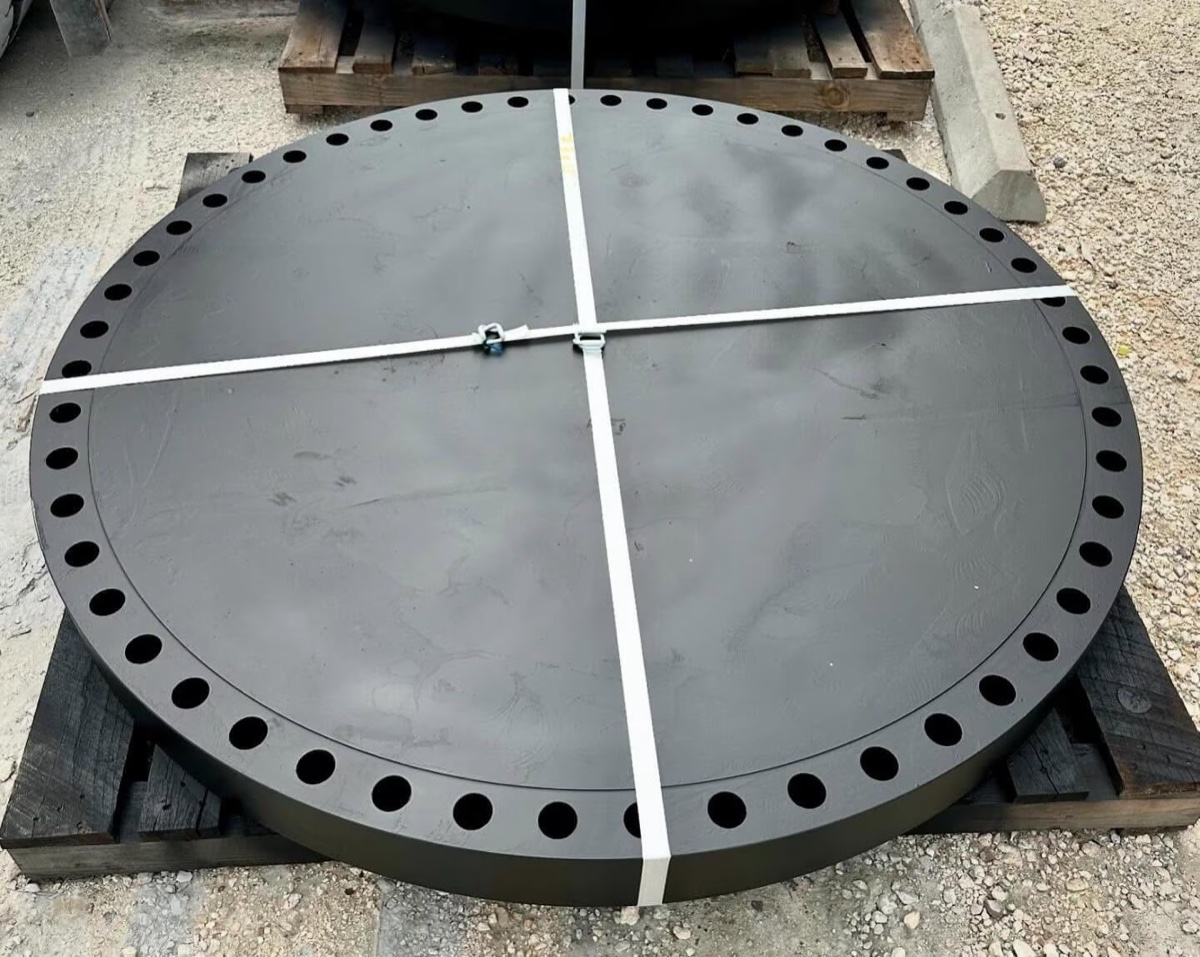
The hottest corners of the refinery: crude and vacuum furnace outlet manifolds and transfer lines, coker heaters and fractions, residue and heavy-oil circuits carrying high sulphur at high temperature — and petrochemical hot services that inherit refinery specifications. Blind-flange production in the yard and packing below:
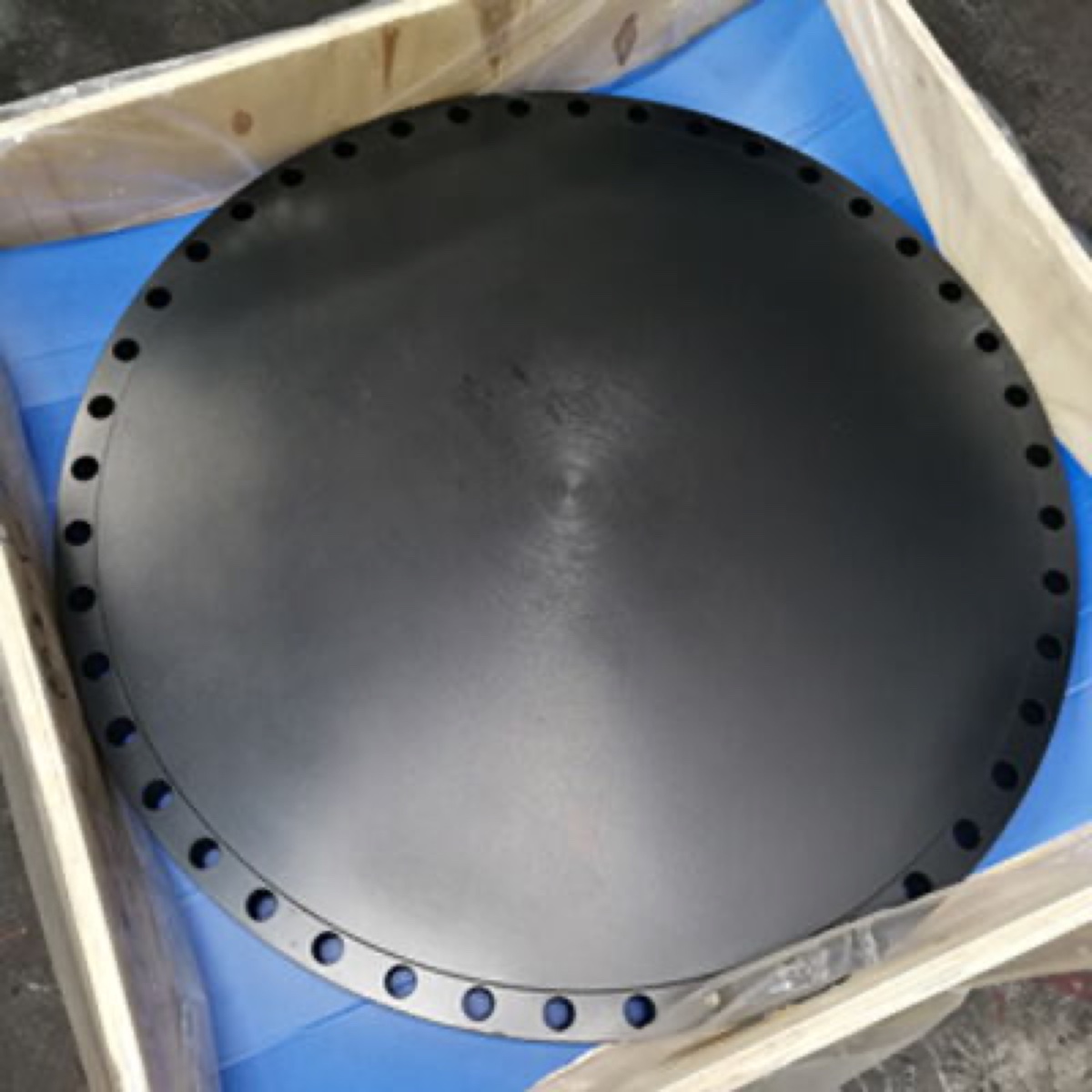
Large-Diameter Blind Flange — Palletised in the Dispatch Yard30″ ASME B16.47 Series B Class 150 Blind — Crated for Export
F9 Blind Flange Dimensions
Blind dimensions are class-governed — identical across material grades. Full charts:
An ASTM A182 F9 blind flange is a solid forged disc of 9Cr-1Mo alloy steel, drilled to the standard bolt pattern with no bore, used to close pipes, valves and vessel nozzles at the hot extreme of the chrome-moly range. With roughly twice the chromium of F5, F9 resists high-temperature sulphidation and oxidation in the most aggressive hot refinery circuits, while its molybdenum holds strength deep into the creep range. Dimensions follow ASME B16.5 from ½ inch to 24 inch and ASME B16.47 beyond, in raised face, flat face and ring joint facings.
What kind of steel is A182 F9?
A forged 9Cr-1Mo low-alloy steel — nominally 8.0-10.0% chromium and 0.90-1.10% molybdenum, carbon capped at 0.15% with silicon deliberately high (0.50-1.00%) for scaling resistance. It sits at the top of the classic chrome-moly ladder, one step short of stainless, and is supplied heat treated per A182 with hardness controlled to 179-217 HB. Dark, magnetic and strongly air-hardening, it demands proper mill heat treatment — which a bolted blind arrives with, permanently.
Why nine percent chromium?
Because sulphidation and oxidation keep accelerating with temperature, and chromium is the countermeasure that scales with them. Refinery experience (the McConomy curves) shows hot sulphur corrosion falling steeply with every step up in chromium; where a 5Cr circuit still thins too fast — the hottest transfer lines, furnace outlet manifolds, coker services — the specification steps up to F9. The added silicon reinforces the same protective scale, which is why F9 reads high on both elements.
When should F9 be specified instead of F5?
When the corrosion rate says so. Both grades cover the same kind of duty — hot sulphur-bearing hydrocarbon streams — and the choice tracks temperature, sulphur content and the corrosion allowance the line can afford. Many refinery specs run 5Cr in the moderate sections and switch to 9Cr where streams are hottest or the inspection history demands it. Our F5 blind flange page covers the lighter grade; F9 is the step you take when the corrosion arithmetic stops working for 5Cr.
What is the difference between F9 and F91?
They share the 9% chromium but serve different masters. F9 is the plain 9Cr-1Mo corrosion grade of the refinery world. F91 is the modified version — micro-alloyed with vanadium and niobium and processed to a tight normalized-and-tempered window — engineered for creep strength in power-plant steam service, with far higher allowable stresses in the creep range. They are not interchangeable certificates: F91's chemistry, hardness window and heat treatment are much more demanding. Our F91 blind flange page covers that grade; if your line class says F9, it means this page's product.
What are the mechanical properties of F9 blind flanges?
Tensile strength 585 MPa (85 ksi) minimum, yield strength 380 MPa (55 ksi) minimum, elongation 20% minimum, hardness 179-217 HB — notably stronger than F5's 485/275, reflecting the heavier alloying. As with all chrome-moly, the room-temperature numbers understate the point: F9 keeps useful strength and creep resistance at temperatures where lower grades have left the allowable-stress tables. Every heat is tension-tested and chemistry-verified, with results on the EN 10204 3.1 certificate.
What temperature range does an F9 blind flange cover?
The hot end of the ferritic range: useful allowable stresses continue to roughly 650°C in the ASME tables, with the practical limit set by the code, corrosion allowance and specification. Like all ferritic steels it is not a cold-service grade — below about -29°C impact testing applies, and cold closures belong to LTCS or stainless. Its home is the permanently hot circuit: furnace manifolds, transfer lines, the hottest sulphur-bearing services a refinery runs.
What facings are F9 blind flanges made with?
All three: raised face (BLRF), flat face (BLFF) and ring type joint (BLRTJ) — each facing has its own page on this site. Hot high-class refinery circuits frequently run ring joints, and the F9 groove takes a ring chosen softer than the flange per B16.20 practice. The forging is common to all facings; the mating flange governs the choice, and for RTJ the ring number follows from size and class.
What sizes and classes are F9 blind flanges available in?
From ½" to 24" NB per ASME B16.5 in Classes 150 through 2500, and to 60" per ASME B16.47 where large hot headers need closing — like the crated 30 inch B16.47 blind pictured on this page (that unit in carbon steel; F9 is forged to the same tables). 9Cr blinds are forged against the order: each lot carries its own heat-treatment record, hardness results and certification, and PMI verification is routine so no lower grade slips into an F9 lot.
Does the air-hardening nature of 9Cr steel affect blind flanges?
9Cr air-hardens even more decisively than 5Cr — weld or flame-cut it without preheat and controlled cooling and it quenches itself brittle-hard in still air. For anything welded that means rigorous preheat and post-weld heat treatment; for a blind flange it means almost nothing, because the closure is bolted, never welded. The flange leaves our works correctly heat treated and stays that way. The corollary: no field modifications — taps and machining belong at the works, certified with the flange.
Can F9 blind flanges be tapped for testing or instruments?
Yes — fill, vent, drain, gauge and injection taps are machined into the centre of the blind at the works, before final inspection, and certified with the flange. Field-drilling an air-hardening 9Cr blind is precisely the improvisation to avoid. State the NPT size on the enquiry and the tapped blind arrives ready to plug, with the tap recorded on the certificate.
Where are F9 blind flanges used?
The hottest corners of the refinery: crude and vacuum furnace outlet manifolds and transfer lines, coker heaters and fractions, residue and heavy-oil circuits with high sulphur at high temperature — plus hot-service duties in petrochemical plants that inherit refinery specifications. F9 closures serve the usual blind duties there: isolations, future connections and tapped test blinds, in the same metal as the pipe so the corrosion allowance stays uniform across the joint.
Which standards cover F9 blind flanges?
The material standard is ASTM A182 grade F9, with ASME SA-182 as its boiler-code twin; dimensions follow ASME B16.5 for ½"-24" and ASME B16.47 for 26"-60". Pressure-temperature ratings come from the B16.5 tables for the 9Cr material group. A complete specification reads: 'Blind Flange, RF, 6", ASME B16.5 Class 300, ASTM A182 F9' — and our EN 10204 certificates state dimension standard, grade, heat treatment and test results together.
Who manufactures ASTM A182 F9 blind flanges in India?
Tesco Steel & Engineering is an ISO 9001:2015 certified flange manufacturer based in Mumbai, India, forging ASTM A182 F9 blind flanges from ½" to 24" NB per ASME B16.5 in Classes 150-2500 and to 60" per ASME B16.47 — heat treated, hardness-controlled, PMI-verified and certified to EN 10204 3.1/3.2 on every lot — in raised face, flat face and ring joint facings, with NPT-tapped test blinds to order, alongside F5, F11, F22 and F91 chrome-moly, carbon steel, LTCS, stainless and nickel-alloy blinds. Exported to more than 50 countries.